


Next: Correction for finite samples.
Up: ENFS and SNFS data
Previous: ENFS and SNFS data
Contents
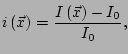
As in every heterodyne technique, we measure the overall intensity
 , generated by the interference of
an object field
, generated by the interference of
an object field
 with
a more intense reference beam with
amplitude
with
a more intense reference beam with
amplitude  . In our
case, the object field is generated by the scattered beams, and
the reference beam is the transmitted one. We measure the
heterodyne signal
. In our
case, the object field is generated by the scattered beams, and
the reference beam is the transmitted one. We measure the
heterodyne signal
 :
:
 |
(6.1) |
where  is the mean intensity. At first order in
 , Eq. (3.22) holds:
![$\displaystyle i\left(\vec{x}\right) = 2 \frac{\Re\left[\delta E\left(\vec{x}\right)\right]} {E_0},$](img439.png) |
(6.2) |
where we have assumed that is real. Equation
(3.72)
states that, under the conditions in which NFS works, the power
spectrum of
is the power spectrum of the
electric field, the quantity we must measure in order to
evaluate the scattered intensities.
We developed an algorithm to subtract the contribution
of the stray light, directly on each image, point by point. This is a
noteworthy feature of the heterodyne techniques, since in dynamic light
scattering and in ONFS the subtraction is possible only on the
scattered intensity or on the correlation function, averages of
square values. The scattered field can be decomposed into
 , the stray light field, and
, the field of the light scattered
by the sample. Both
and
are much less intense than ,
the reference field. At the first order, the resulting intensity
is:
, the stray light field, and
, the field of the light scattered
by the sample. Both
and
are much less intense than ,
the reference field. At the first order, the resulting intensity
is:
![$\displaystyle I\left(\vec{x}\right) = E_0^2 + 2 E_0 \Re \left[E_{SL}\left(\vec{x}\right)\right] + 2 E_0 \Re \left[\delta E\left(\vec{x}\right)\right]$](img440.png) |
(6.3) |
In many cases,
fluctuates in time
and is correlated only on finite delays.
On the contrary, stray light comes mainly from hard surfaces,
and does not change as times go on. This is the case of the samples
we studied. The spatial average of a scattered field is
alwais wanishing; this property, along with the absence of
correlation on different images, says that the average over many
images of
vanishes.
In order to separate the contribution of the stray light,
we average
over many different images.
Since the phase of
is random,
its mean vanishes:
![$\displaystyle \left\{I\left(\vec{x}\right)\right\} = E_0^2 + 2 E_0 \Re \left[E_{SL}\left(\vec{x}\right)\right].$](img441.png) |
(6.4) |
We use the symbol
 for the mean over many samples,
and the symbol
for the mean over many samples,
and the symbol
 for the mean over
  .
The fluctuation
.
The fluctuation
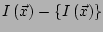 does not depend on
:
does not depend on
:
![$\displaystyle I\left(\vec{x}\right) - \left\{I\left(\vec{x}\right)\right\} = 2 E_0 \Re \left[\delta E\left(\vec{x}\right)\right].$](img444.png) |
(6.5) |
Because of the conservation of the total intensity during the
scattering process,
by averaging
 over the whole plane,
we obtain :
over the whole plane,
we obtain :
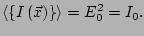 |
(6.6) |
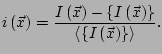
We can now evaluate the heterodyne signal
, subtracting the the stray light
contribution:
 |
(6.7) |
Next: Correction for finite samples.
Up: ENFS and SNFS data
Previous: ENFS and SNFS data
Contents
2003-01-09