Next: ENFS data processing.
Up: ENFS and SNFS data
Previous: Subtraction of the stray
Contents
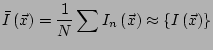
The quantity
 should ideally be evaluated
by averaging infinite images. We obtain a good evaluation of it
by averaging
a great number
should ideally be evaluated
by averaging infinite images. We obtain a good evaluation of it
by averaging
a great number  of images
 ,
typically one hundred:
,
typically one hundred:
 |
(6.8) |
From this evaluation, we obtain
 :
:
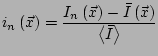 |
(6.9) |
The average value
 ,
evaluated over a given number of images,
is sistematically different from the true mean value, in
the direction that reduces the evaluation of the root mean
square displacement from the mean. This problem is analogous
to the one that leads to the so called Bessel correction for the
evaluation of the variance
,
evaluated over a given number of images,
is sistematically different from the true mean value, in
the direction that reduces the evaluation of the root mean
square displacement from the mean. This problem is analogous
to the one that leads to the so called Bessel correction for the
evaluation of the variance  of a stochastic variable, from the
knowledge of a finite number of stochastic values.
of a stochastic variable, from the
knowledge of a finite number of stochastic values.
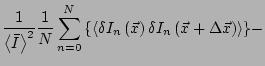
We evaluate the correlation function of
 for each
  , then we average them,
thus obtaining
, then we average them,
thus obtaining
 .
Now we want to evaluate
.
Now we want to evaluate
 ,
that is the mean value over infinite samples, in order to correct
systematic errors:
,
that is the mean value over infinite samples, in order to correct
systematic errors:
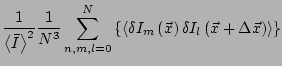
![$\displaystyle \left\{C_i\left(\Delta \vec{x}\right)\right\} = \frac{1}{\left<\b...
...}\sum_{m=0}^N {I_m\left(\vec{x}+\Delta \vec{x}\right)}\right] \right>} \right\}$](img455.png) |
(6.10) |
The symbol
 means the average over
  .
We can write
.
We can write
 instead of
:
instead of
:
![$\displaystyle \left\{C_i\left(\Delta \vec{x}\right)\right\} = \frac{1}{\left<\b...
...m=0}^N {\delta I_m\left(\vec{x}+\Delta \vec{x}\right)}\right] \right>} \right\}$](img457.png) |
(6.11) |
Evaluating the products:
Since
 :
:
 |
(6.15) |
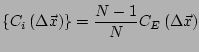
Now we can use Eq. (6.5):
 |
(6.16) |
The correlation function evaluated on samples is proportional
to the correlation function evaluated for
 . The
poportionality constant is the same of the well known Bessel
correction.
. The
poportionality constant is the same of the well known Bessel
correction.
Next: ENFS data processing.
Up: ENFS and SNFS data
Previous: Subtraction of the stray
Contents
2003-01-09