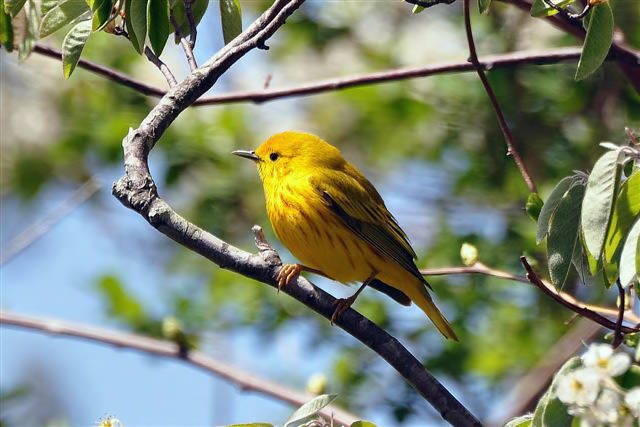
Yellow Warbler
Setophaga petechia
The Yellow Warbler can typically be found waterside in willows and the edges of woodland areas. Nests are often easy to find, so Yellow Warblers may be of special interest to nest afficianados!.
Feeding: The Yellow Warbler eats primarily insects. In fact, two-thirds of its diet tends to consist of caterpillars and moths. Occasionally, it also eats berries.
Parenting: Males defend their nesting sites with song and flight displays. Nests are constructed within these sites by females, within the forks of shrubs and trees, anywhere from two to sixty feet above the ground! Nests are a compact, open cup built from weeds, bark and grass, lined with plant down and fur. Males sometimes assist with trips to gather nest materials and very rarely assist with building as well. Females have no qualms about stealing nest materials from other nests! 4-5 green-white eggs are found in each brood, which are incubated exclusively by the female. Because her time is occupied, the male brings food for her during this 11-12 day period. Unfortunately, Yellow Warbler nests are often parasitized by Cowbirds. Young are fed by both parents for 9-12 days before leaving the nest.
When Can I See It? The Yellow Warbler is visible during the early summer months in our area, between May and June, though it can rarely be spotted as late as July. More information is visible in our Sighting Table.
Information courtesy of The Audobon Society. Photo courtesy of The U.S. Fish and Wildlife Service.