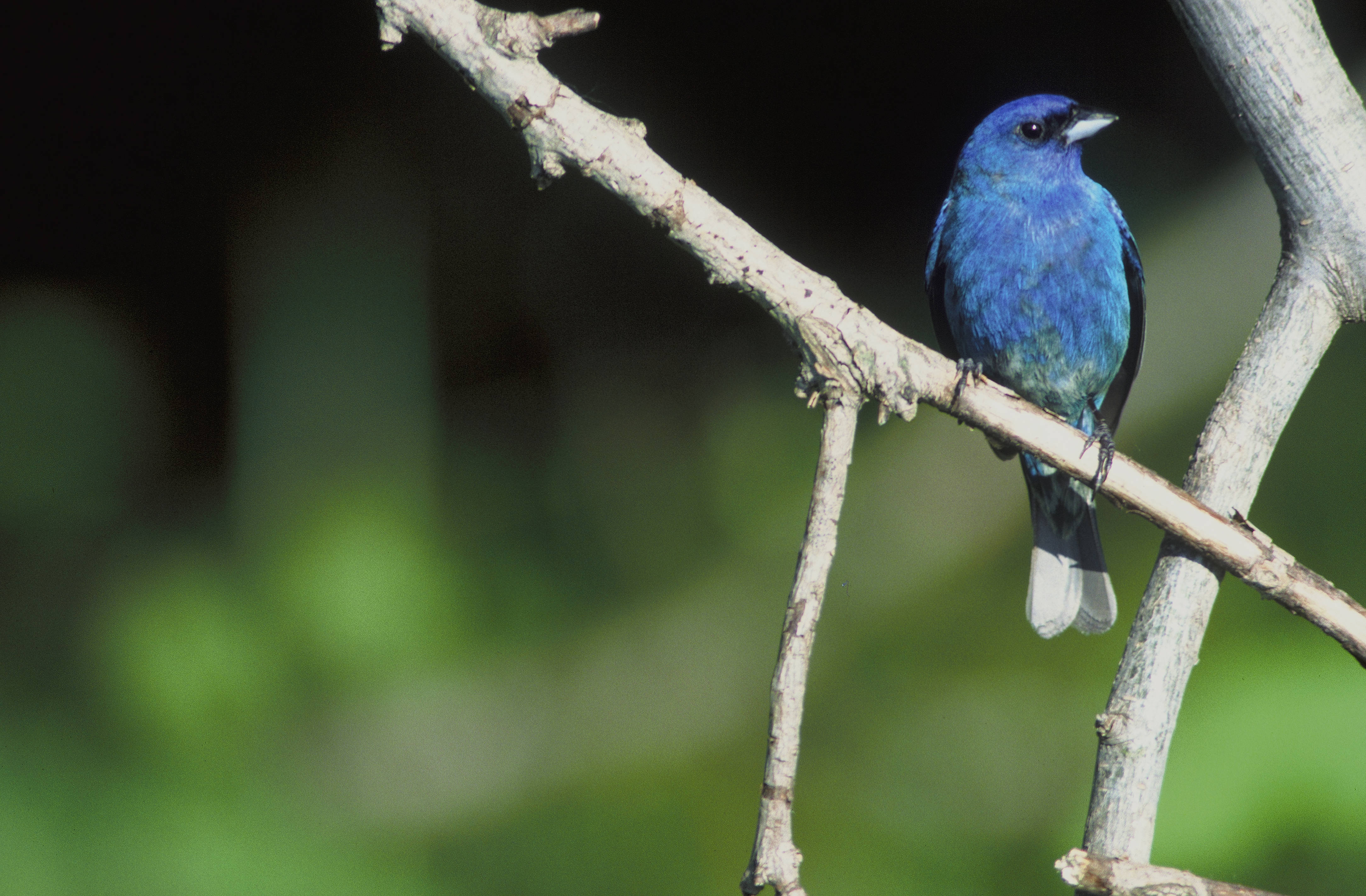
Indigo Bunting
Passerina cyanea
Some may not realize that, though it has beautiful blue plummage rather than the typically expected red (males only), the Indigo Bunting is actually a member of the cardinal family. In fact, it is one of the most abundant songbirds in the country, and can be found singing along almost every roadside! This is because the Indigo Bunting prefers the more open and bushy edges of the forest to the dense thickets within.
Feeding: The Indigo Bunting feeds largely on insects, though seeds and berries may be eaten during mating season and the winter when insects are less abundant.
Parenting: Nest site is generally one to three feet from the ground, up to a maximum of thirty feet. A single male may have multiple female partners within his territory, which he defends by song. Each nest is built by the female as an open cup of grass, leaves and weeds lined with smaller threads of material such as animal fur. Generally 3-4 eggs in a blueish-white hue without spots. Incubated and fed almost exclusively by the female, though occasionally the male takes over just before time to leave the nest. Generally the Indigo Bunting will have 2 broods of young per year.
When Can I See It? The Indigo Bunting is visible during the summer months in our area, between May and September. More information is visible in our Sighting Table.
Information courtesy of The Audobon Society. Photo courtesy of The U.S. Fish and Wildlife Service.