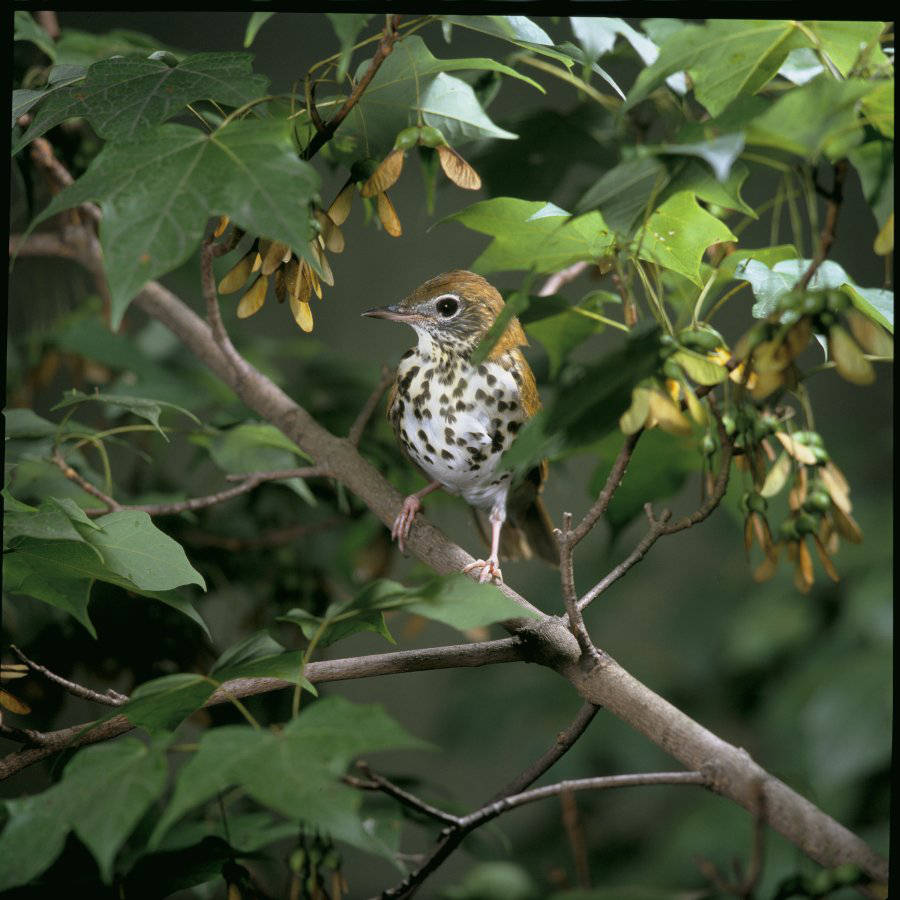
Wood Thrush
Hylocichla mustelina
The Wood Thrush is often easy to find as it tends to nest around people: in the suburbs and frequently in city parks. Its song is frequent on summer mornings, though the Wood Thrush is becoming increasingly endangered. It is a frequent recipient of attention from conservationists, as a result!
Feeding: The Wood Thrush eats primarily insects, especially during breeding season. These include beetles, ants, caterpillars, moths and crickets. Occasionally, the Wood Thrush also eats berries and small fruits. Young are fed both insects and berries as well.
Parenting:Males establish and defend a territory first, where females then build a nest in a vertical fork of a tree. The nest is typically at least ten to fifteen feet from the ground, though can be found as high as fifty feet, and consists of an open cup of grass, weeds and bark mixed with mud. The nest is then lined with softer materials such as roots, white paper or other trash. Broods consist of 3-4 eggs, greenish blue in color with no markings. Both parents participate in feeding the young, who leave the nest in about twelve days. The Wood Thrush has one to two broods of young per year.
When Can I See It? The Wood Thrush is visible during the summer months in our area, between May and August, though it can rarely be spotted as late as October. More information is visible in our Sighting Table.
Information courtesy of The Audobon Society. Photo courtesy of The U.S. Fish and Wildlife Service.