
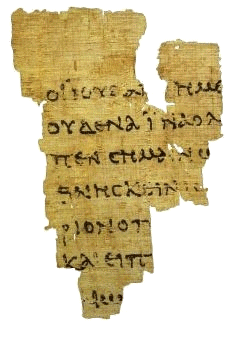
p52 (John Rylands Library) John 18:31-33
Students are responsible for purchasing their own textbooks. The textbooks for the course (less than $50 total at Amazon.com) are:
(NOTE: While the UBS Greek-English dictionary is a handy tool to have in the back of one's Greek New Testament - hence my recommendation of this as the edition to buy and use - it is no substitute for a real lexicon like BDAG.)
The first four lessons of Croy's grammar are here so students will be able to print them out and work on them if they don't yet have their textbooks. They're in Microsoft Word. You will need the free TekniaGreek font to read the Greek. (See II. Class Documents and Handouts (in MS Word and MS Excel) below for the TekniaGreek font.)
To keep my costs and printing time down, many of the handouts will be linked on this page so students can download and/or print copies for themselves. They'll be either Microsoft Word (.doc) or Microsoft Excel (.xls) files, or Webpages (.htm). If you're using a Macintosh, make sure you can read and work with Word and Excel files.
Students who have other editions of the Greek New Testament and do not want to purchase a new one can use those. However, students will not be allowed to use an interlinear (i.e., English printed under the Greek) or diglot (i.e., Greek side-by-side with English) New Testament.
(NOTE: Each Lesson in Croy's textbook has several sentences to translate from the Septuagint (i.e., the Greek translation of the Old Testament that was the source for most of the New Testament quotations from the Old Testament, and abbreviated as "LXX"). Though Croy gives the additional vocabulary as necessary, students can purchase and use The Septuatint with Apocrypha: Greek-English by Lancelot Brenton, ISBN: 0913573442 ($29.67 at Amazon.com), a diglot, to check their translations, as well as for their own reading and study in conjunction with this course.)
The Greek texts of UBS4 and the earlier UBS3 (corrected) and UBS3, as well as the texts of Nestle-Aland 27th Edition (NA27) and NA26, are identical except for punctuation and pagination. The primary difference between the UBS and NA editions is that while the UBS editions list fewer textual variants, those they list are done so in more detail in terms of textual witnesses, and the reading chosen is rated for certainty. Also, since the UBS editions were prepared to help translators, they have some features like section headings and notes of how different translations vary in their punctuation that the NA editions do not have. There is now an edition of NA27 with the same Greek-English dictionary as the UBS "with dictionary" editions, but it costs more. There is also an edition of UBS4 with a Greek-Spanish, rather than Greek-English, dictionary.
There are also non-UBS/NA Greek New Testament editions available, including the Majority Text editions of Hodges and Farstad, and Robinson and Pierpont. These will differ in places from the readings in the UBS/NA text. These differences are likely often minor (e.g., occasional differences in word order), but there are also differences in the words included or omitted in various passages. This course does not really go into textual criticism, so students who want to know the arguments for one Greek text versus another should read the various books and papers on the subject.
The first thing students will (and must) learn is 1. the pronunciation of the letters and sounds, and 2. the article paradigm (i.e., the word "the"). Students are expected to learn these by the third class.
Dr. Caragounis has produced a CD for learning the proper pronunciation of Greek. Per his description:
"The CD is a simple but (I believe) adequate course for learning the Greek pronunciation. It works with Windows 95, 98, ME, 2000, XP or NT 4.0. It requires 50 MB RAM. It consists of twelve lessons. The first seven lessons give the various rules succinctly with examples. All the examples have voice animation (i.e., click on the words to hear the word read/pronounced). Lesson 8 has some 25 sentences from very short to very long. Again, these have voice animation. Lessons 9-12 quote each a number of paragraphs from different books of the NT, normally important texts, which could be memorized. Again, voice animation. The voice is that of a Classical professor at Thessaloniki University. It is a very clear, strong voice, slowly modulated in order to make it possible for the non-Greek student to follow every syllable of the word. At the same time it is read in a natural way, where one can perceive the intonational fluctuation. (Those who think that Neohellenic has lost the pitch are out in the forest picking mushrooms! Their misunderstanding is due to their ridiculous overemphasis of pitch in ancient Greek and their neglect of stress. Stress and pitch are not exclusive of one another.) Anyway, in this voice animation you can hear the harmonious and pleasant fluctuation in pronunciation."Students will be purchasing this CD as part of the course, for hearing and learning proper pronunciation is very important. Dr. Caragounis has granted me permission to make and sell copies for $10 each to my students (versus the normal $15 + $5 shipping price), and I'll collect and send the payment to him. I also have a Macintosh version for students who need that; it runs on a Mac with OS X.3.9 (Panther) system, and should run with Tiger, too.
Here is the sound file for Matthew 6:9-13 (The Lord's Prayer) from the CD so you can hear how it sounds.
Installation Instructions for PC version:
NOTE: Though my work PC (XP Service Pack 2) runs the program fine by running the "RUN_NTG.BAT" file as instructed, it freezes up on my home PC (also XP Service Pack 2). However, running (i.e., double-clicking) the "NTG.jar" file in the "NTG" subfolder runs the program with no problems.
I cannot stress too much how important it is for students to master the alphabet and pronunciation as soon as possible. It is my experience, as well as that of others, that students who do not learn to sight-read and pronounce Greek fairly well pretty early in the course will not master the course material. My best students have always been the best readers, and vice-versa. Students should a) read the class material and homework exercises, as well as the Greek New Testament, out loud at all times or whenever possible, and b) listen to the Caragounis CD until they can "hear" the sounds and intonation in their minds when they read the Greek New Testament.
Memorizing the article paradigm early on helps with noun and pronoun and adjective endings in so many ways that I am surprised that grammars do not have students do this at the beginning of the course when they learn the alphabet and pronunciation.
We'll do one Lesson per week so students can memorize all the new vocabulary each week. The textbook will be supplemented with additional vocabulary so students learn all words that occur 25x or more (and many or all that occur 20x or more), and with reading or other activities to use the class time and increase the learning content of the course. Students will learn more than in a typical 1st-year New Testament Greek course.
Lesson 1 is basically the alphabet and pronunciation (plus accents and syllabification). Ignore the pronunciations in the textbook and use my pronunciation charts instead (see C. FIRST THINGS FIRST above).
Lesson 2 is the Present Active Indicative and Present Active Infinitive forms of the verb, with some exercises to do.
Students who don't yet have the textbook can read and print out the first four Lessons of Croy's grammar here. They're in Microsoft Word. You will need the free TekniaGreek font to read the Greek. (See II. Class Documents and Handouts (in MS Word and MS Excel) below for the TekniaGreek font.)
There is an online set of materials for Croy's textbook from a University of Oklahoma course. This is the first time I have taught using Croy, so I'll be developing the quizzes and handouts as the course progresses, supplementing the textbook as necessary. Some of this online material may be useful for both you and me. Note, though, that the pronunciation used and described is a combination of Erasmian and Ancient (i.e., pre-Koine) Greek, so ignore the pronunciation information and do not use or rely on the audio files.
These require the TekniaGreek font, available for free at http://www.teknia.com/index.php?page=tekniagreek.
"It is absolutely free without any restrictions, both its design and its mapping -- we would encourage you to adopt it in your writing, programming, and websites."
My appreciative "Thanks!" go to Dr. William (Bill) Mounce for his work in creating and distributing this font.
Links and Resources from past classes and other textbooks:
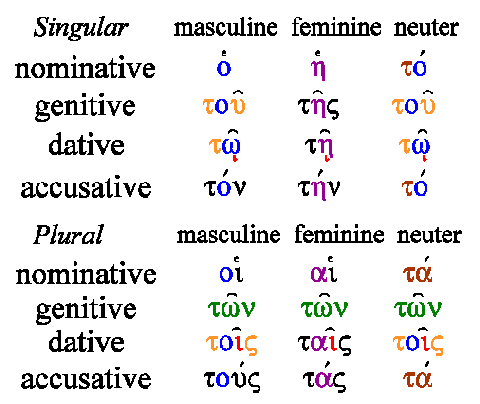
A good way to memorize the article is to write it out repeatedly, pronouncing the words out loud as you're writing them. Learning the article paradigm will help students identify the case, gender and number of adjectives, nouns, pronouns and relative pronouns. It's shown in the most commonly presented order of Nominative, Genitive, Dative, Accusative (NGDA).
| Singular | masculine | feminine | neuter |
|---|---|---|---|
| nominative | oh | ee / ey | toh |
| genitive | too | teece / tace | too |
| dative | toh | tee / tay | toh |
| accusative | tohn | teen / tane | toh |
| Plural | masculine | feminine | neuter |
| nominative | ee / u | eh | tah |
| genitive | tohn | tohn | tohn |
| dative | teece / tuce | tess | teece / tuce |
| accusative | tooce | tahs | tah |
To aid in memorizing the article paradigm, note (per the colors in the paradigm chart):
The symbol font is used for the Greek characters to enable most people viewing this Web page to read it without having to download special fonts. However, the symbol font will not allow the display of accents, breathing marks or iota subscripts.
Matthew 1:16 reads: "And Jacob begot Joseph the husband of Mary, from whom was born Jesus, who is called Christ." There is nothing in this fairly literal English translation to indicate who is the "whom" that Jesus was born from. Was it Joseph, or was it Mary? But the Greek text reads: "Iakwb de egennhsen ton Iwshf ton andra MariaV ex hV egennhqh IhsouV o legomenoV CristoV." hV is a feminine relative pronoun, and clearly shows that the "whom" who begot Jesus was Mary, and not Joseph.
The New American Standard Bible translation of Ephesians 2:10 reads: "For we are His workmanship, created in Christ Jesus for good works, which God prepared beforehand, that we should walk in them." Without using italic or boldface type, it is not apparent what the author's main point or emphasis is. However, the Greek text reads: "autou gar esmen poihma ktisqenteV en Cristw Ihsou epi ergoiV agaqoiV oiV prohtoimasen o qeoV ina en autoiV peripathswmen." "For we are His workmanship, created in Christ Jesus for good works which God prepared beforehand, in order that in them we should walk." The word order shows that Paul is emphasizing, in keeping with what he wrote in 2:7-9, that our being/becoming a new creation is God's doing, not ours (and also likely emphasizing, though less so, what we are to God, i.e., a "work" of his). Paul is also emphasizing that God's intent in (re)creating us in Christ was so that we would live ("walk") in accordance that purpose, rather than after our former manner of life (2:1-3), and he'll develop those details beginning in chapter 4.
The Greek text of Hebrews 1:1 reads: "PolumerwV kai polutropwV palai o qeoV lalhsaV toiV patrasin en toiV profhtaiV...." The alliterative repetition of p is almost impossible to convey in English translation. One could perhaps transate it as: "In many and different parts and portions God in the past spoke to the patriarchs by the prophets."
The Greek text of I Corinthians 15:3-20 reads:
3 paredwka ("I handed
over" - aorist tense = simple statement of past event) gar umin
en prwtoiV o kai parelabon ("I received" -
aorist tense) oti CristoV apeqanen
("he died" - aorist tense) uper twn amartiwn hmwn kata
taV grafaV
4 kai oti etafh ("he was buried" - aorist
tense) kai oti eghgertai
("he is raised/he has been raised" - perfect tense = emphasing a present or
continuing state, often resulting from a past action) th hmera th
trith kata taV grafaV
5 kai oti
wfqh ("he appeared/he was seen" - aorist
tense) Khfa eita toiV dwdeka ...
12 ei de CristoV khrussetai oti ek nekrwn eghgertai
("he is raised/he has been raised" - perfect tense)
pwV legousin en umin tineV oti anastasiV nekrwn ouk estin
13 ei de anastasiV nekrwn ouk estin oude CristoV eghgertai
("he is raised/he has been raised" - perfect tense)
14 ei de CristoV ouk eghgertai
("he is raised/he has been raised" - perfect tense)
kenon ara [kai] to khrugma hmwn kenh kai h pistiV umwn
15 euriskomeqa de kai yeudomartureV tou qeou oti emarturhsamen kata tou qeou oti
hgeiren ("he raised" - aorist tense)
ton Criston on ouk hgeiren
("he raised" - aorist tense) eiper ara nekroi ouk
egeirontai ("they are raised" - present tense =
simple statement, or possibly with a futuristic sense)
16 ei gar nekroi ouk egeirontai
("they are raised" - present tense = simple statement, or possibly with a
futuristic sense) oude CristoV
eghgertai ("he is raised/he has been raised" -
perfect tense)
17 ei de CristoV ouk eghgertai
("he is raised/he has been raised" - perfect tense)
mataia h pistiV umwn eti este en taiV amartiaiV umwn
18 ara kai oi koimhqenteV en Cristw apwlonto
("they perished" - aorist tense)
19 ei en th zwh tauth en Cristw hlpikoteV
esmen ("we have hoped" - periphrastic perfect participle, with the
same sense as a perfect tense verb) monon eleeinoteroi pantwn
anqrwpwn esmen
20 nuni de CristoV eghgertai
("he is raised/he has been raised" - perfect tense)
ek nekrwn aparch twn kekoimhmenwn.
English translations sometimes translate the perfect tense verbs in this passage, especially in 15:4, as they translate the aorist tense verbs, i.e., as English past tense verbs (e.g., "(Christ) rose" or "(Christ) was raised" for eghgertai, the 3rd person singular perfect passive indicative form of egeirw), because to do otherwise (i.e., as perfect tense verbs) would perhaps sound awkward. The NET Bible translates this as: "... that Christ died for our sins according to the scriptures, and that he was buried, and that he was raised4 on the third day according to the scriptures," and they explain their translation with the following footnote: "4tn Grk 'he has been raised/is raised,' using a Greek tense [i.e., the perfect tense - EW] that points to the present effect of the act of raising him. But in English idiom the temporal phrase 'on the third day' requires a different translation of the verb."
When stating that Christ "died" and "was buried" and "appeared," and when simply stating that God "raised" Christ, Paul unremarkably uses the aorist tense. But he consistently uses the perfect tense of the verb when he writes of Christ that he "is raised" or "has been raised." This is probably significant for his argument against those who discount the fact of the resurrection, for Paul is not merely stating that, like his death and burial, Christ "was raised" at some time or as some event in the past, but that he is at present raised/risen. And the presence among them of the living, resurrected Christ (and/or of his spirit) as one who "is raised" (not merely "was raised") should be proof to them both of Christ's resurrection and that the dead "are (or "are to be") raised" (note Paul's use of the present tense for this phrase).
While English translations often do revert to a perfect-tense-form translation of this verb in 15:12ff., e.g., "he has been raised" (but note that the King James Version has the aorist-sounding "he rose from the dead"), the English doesn't fully capture the effect and meaning of the Greek perfect, for I believe (as I stated above) that Paul's use of the perfect is also to emphasize that Christ "is raised/risen," not just that "he has been raised." I.e., he's emphasizing Christ's present state and position and standing vis-a-vis God and the church as a Risen and Living Lord.
Note: Not all verbs in this passage have been color-highlighted and translated, as those that have been color-highlighted are sufficient to illustrate the point being made.
What Paul is setting forth in Romans 10 is more clearly understood when one sees, via the Greek text, how he has constructed or supported his argument. The Greek text of Romans 10 reads:
5 MwushV gar grafei thn dikaiosunhn thn ek [tou] nomou oti o poihsaV
auta anqrwpoV zhsetai en autoiV
6 h de ek pistewV dikaiosunh outwV legei mh eiphV
en th kardia sou tiV anabhsetai eiV ton ouranon tout estin Criston
katagagein
7 h tiV katabhsetai eiV thn abusson tout estin Criston ek nekrwn anagagein
8 alla ti legei egguV sou to rhma estin en tw stomati sou kai
en th kardia sou tout estin to rhma thV
pistewV o khrussomen
9 oti ean omologhshV en tw stomati sou kurion Ihsoun kai
pisteushV en th kardia sou oti o qeoV
auton hgeiren ek nekrwn swqhsh
10 kardia gar pisteuetai eiV dikaiosunhn stomati de omologeitai
eiV swthrian
11 legei gar h grafh paV o pisteuwn ep autw ou kataiscunqhsetai
12 ou gar estin diastolh Ioudaiou te kai EllhnoV o gar autoV kurioV pantwn ploutwn eiV
pantaV touV epikaloumenouV auton
13 paV gar oV an epikaleshtai to onoma kuriou swqhsetai
14 pwV oun epikaleswntai eiV on ouk episteusan pwV de
pisteuswsin ou ouk hkousan pwV de
akouswsin cwriV khrussontoV
15 pwV de khruxwsin ean mh apostalwsin kaqwV gegraptai wV wraioi oi podeV twn
euaggelizomenwn [ta] agaqa
16 all ou panteV uphkousan tw
euaggeliw HsaiaV gar legei kurie tiV
episteusen th akoh hmwn
17 ara h pistiV ex akohV h de
akoh dia rhmatoV Cristou
18 alla legw mh ouk hkousan menounge eiV pasan thn ghn exhlqen
o fqoggoV autwn kai eiV ta perata thV oikoumenhV ta rhmata
autwn
en is a preposition meaning "in, with, by," and hence Paul can use this same Greek word to write what we must translate with different prepositions as "by them," "in your heart," "in your mouth," "with your mouth," etc. The Greek text makes it clear how Paul is able to derive "confess with (en) your mouth" from Moses's statement that the word is "in (en) your mouth."
The Greek words pistewV, pisteushV, pisteuetai, pisteuwn, episteusan, pisteuswsin, episteusen and pistiV all come from pistiV ("faith/belief") or pisteuw ("I believe/I have faith"). Some have made false distinctions between merely "believing" something (or merely having a "belief" about something) and having true "faith," based on the fact that we often use these two different English words (i.e., "faith" and "believe/belief") to translate what in the Greek are the same word (or, rather, come from the same root piq = "bind" and are in the pist- cognate group).
The Greek words hkousan and akouswsin are forms of the Greek word akouw ("I hear"); uphkousan is a form of upakouw, which comes from upo ("under") + akouw ("I hear") and means "obey"; and akoh (and its genitive form akohV) is the Greek word that means "a report" or "what is heard," as well as "the act of hearing." It is clear in the Greek how Paul can derive in 10:17 that "faith comes from akoh (i.e., the act of hearing)" from his quote in 10:16 from Isaiah which reads: "Lord, who has believed our akoh (i.e., that which was heard from us)?" These akouw/akoh (i.e., "hearing") words are also linked by Paul to the pisteuw/pistiV (i.e., "believing") words in this passage through uphkousan ("they obeyed"), for Paul uses "who has believed (episteusen) our report" to prove that "not all obeyed (uphkousan) the gospel." Also, peiqw, a Greek word that also has piq = "bind" as its root, can, like upakouw, mean "I obey." In fact, in Hebrews 3:18, the word apeiqhsasin (participle of apeiqew, "I disobey") is in some manuscripts apisthsasin (participle of apistew, "I disbelieve"), perhaps because of the close semantic relationship between apeiqew and apistew, i.e., between (dis)obeying and (un)believing, or maybe because the words were considered interchangeable in some contexts. Also see Hebrews 4:6 where some manuscripts have apistian ("unbelief") instead of apeiqeian ("disobedience").
The word euaggelizomenwn is the participial form of euaggelizomai ("I preach the gospel"), and the word euaggeliw is the dative form of euaggelion ("the gospel"). Hence the connection Paul makes between the preaching of the gospel and his use in 10:15 of the quote from Isaiah 52:7.
After writing in 10:17 that hearing comes through or by the rhmatoV (genitive singular of rhma, "word") of or about Christ, Paul begins his discourse on the fact that Israel has indeed heard the gospel by quoting in 10:18 from Psalm 19 that "their rhmata ("words," nominative plural of rhma; hence, the rhma about Christ, i.e., the gospel) have gone out to the ends of the world."
Galatians 3:28 in the Greek text reads: "ouk eni IoudaioV oude Ellhn ouk eni douloV oude eleuqeroV ouk eni arsen kai qhlu panteV gar umeiV eiV este en cristw ihsou." While "Jew/Greek" and "slave/freeman" are joined by ouk ... oude ("neither ... nor"), the third pair, "male/female," is joined by ouk ... kai ("not ... and"), a possible or probable allusion to the wording in the LXX (Septuagint, the Greek translation of the Hebrew Scriptures) of Genesis 1:27 where this exact phrase occurs. Paul may be using this as a reminder of the fact that the old creation (in which man was made "male and female") is no more, as there is a new creation in Christ. A comparison with Colossians 3:11 where Paul uses similar language, including the same verb in 3:10 that is used in Galatians 3:27 about putting on Christ or the new man, suggests that the distinction between ouk ... oude and ouk ... kai may be merely stylistic, as in the Colossians passage he uses ouk ... kai to join Ellhn ("Greek") and IoudaioV ("Jew"), and he serially lists and groups together all the other categories, including douloV ("slave") and eleuqeroV ("freeman"), with just commas.