| GREEK NEW TESTAMENT TEXTS
Be sure to check the American Bible Society's Web site (http://www.bibles.com)
to verify the latest editions of these works and the correct ISBN numbers for the editions you want. New editions of these recently
came out with additional papyri citations (but the text remains the same). You may be able to obtain them
online for less at, e.g., Amazon.com or Barnes & Noble, than from ABS.
|
|
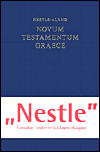
Novum Testamentum Graece (N-A 27). ISBN 3438051087. 27th edition
of the Nestle-Aland Greek text, the standard critical Greek NT text. This has more
variant readings, but less extensive annotations per variant, than UBS(4), which is identical as far
as the text is concerned. This is the higher-priced "Jubilee edition" with some photographs of Nestle, et al.
Novum Testamentum Graece (N-A 27). ISBN 3438051001. 27th edition - 8th corrected edition, updated with papyri 98-116.
|
|
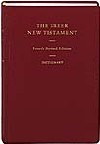
Greek New Testament (UBS4) (with Greek-English Dictionary).
ISBN 3438051133. Designed for translators, this has rankings of significant textual variants and more extensive
notes re: those variants than N-A 27 (but lists far fewer variants overall), and also has a Greek-English dictionary (an edition without
the dictionary is also available). Same Greek text as N-A 27.
|
|
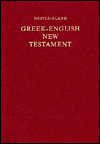
Greek-English New Testament. ISBN 3438054086. Novum Testamentum Graece (N-A 27) Greek text on one side, with
the Revised Standard Version (2nd Edition) English text on the facing page.
|
|
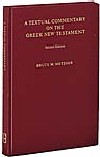
Textual Commentary on the Greek New Testament, Second Edition,
by Bruce M. Metzger. ISBN 3438060108. This book explains the basis
of the decisions the Greek Text editors made in choosing and ranking the
variants in the Fourth Edition of the United Bible Societies Greek
New Testament (UBS4). It's essential for those working with
UBS4 and N-A 26/27 (although it only deals with the
UBS4 variants, not the more extensive, but unranked, variants of
N-A 26/27), and it's also of value to others,
as interlinears and translations rarely or only briefly note or comment on
textual variants. I am listing it here as a companion volume to these Greek texts.
|
| LEXICONS
|
|
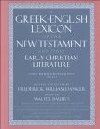
A Greek-English Lexicon of the New Testament and Other Early Christian
Literature, Third Edition (BDAG), Revised and Edited by Frederick
William Danker. ISBN 0226039331. THE authoritative and essential
New Testament Greek lexicon. Expensive, and a bit difficult to use, especially
for the non-Greek student (though much of the Greek is translated). This edition
is burgundy in color. A must-have for every serious student and reader of the
Greek New Testament.
It replaces and supersedes the earlier (1979) green BAGD
(ISBN 0226039323) (which replaced the even earlier gray edition),
which can often be had for $20.00 in used bookstores, and which may be
a good value for the non-Greek student who wants a reliable lexicon but
can't spend $125.00 for the Third Edition (2003 list price; some Internet
retailers sell it for as low as $85.00). A lot of works still cite the
green 1979 BAGD, so a copy of that edition might still be
useful for the next several years. However, the Third Edition improves
upon the Second Edition in many ways, in addition to being more up-to-date.
|
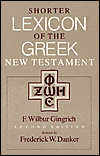
| A Shorter Lexicon of the Greek New Testament, by F.
Wilbur Gingrich, revised by Frederick W. Danker (2nd Edition). ISBN 0226136132.
An abridged and very portable edition of the Second edition of BAGD (see
above). Considered easier to use and more current than Abbott-Smith (see
below), but not as detailed. An inexpensive and compact alternative to
BAGD or BDAG, but not as complete or current. Described as a step up from
the dictionary in the back of UBS4.
|
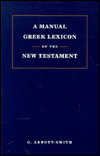
| A Manual Greek Lexicon of the New Testament, by George
Abbott-Smith. ISBN 0567086844. A portable (hence "manual")
lexicon that was published after the papyrus discoveries and reflects
that lexical information. A bit difficult to use (lots of abbreviations,
some in Latin, though there is a key in the front). Indicates or suggests
word etymologies, and also lists the Hebrew word(s) translated by the
Greek word if used in the Septuagint. An inexpensive and compact alternative
to BAGD or BDAG, but not as complete or current.
|
|
Greek-English Lexicon of the New Testament Based on Semantic Domains,
Second Edition, by Johannes P. Louw and Eugene A. Nida. ISBN 0826703437.
This two-volume lexicon (the second volume consists of three indexes to
the first volume: Greek-English, English, and Passage indexes) groups
words by categories of meaning, rather than alphabetically. An important
feature of this lexicon has been adopted by Frederick Danker in the new
BDAG lexicon by his use of extended definitions followed
by suggested translations. Louw-Nida does not have the historical or technical
references or detail of BDAG, but it's very helpful for comparing
words with their lexical sisters or cousins or opposites. Use it in conjunction
with BDAG, which gives more complete and sometimes more correct
definitions of words.
|
|
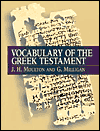
Vocabulary of the Greek Testament by J. H. Moulton and
G. Milligan. ISBN 1565632710. Definitions and explanations of New
Testament words from their use in the papyri (i.e., the pages and fragments
of everyday writings from the Koinê Greek era). This book would be largely
incomprehensible to non-Greek students, as much of the Greek is untranslated
and most of the Greek does not come from the New Testament. The advanced
Greek student will want to consult this (probably with an ancient/Classical
Greek lexicon at hand!).
|
|
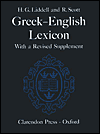
Greek-English Lexicon With a Revised Supplement by H. G. Liddell and R. Scott.
ISBN 0198642261. Combines the text of the ninth edition of Liddell and Scott's Greek-English
Lexicon with an extensively revised and expanded Supplement containing over 20,000 entries,
including coverage of words and forms from papyri and inscriptions discovered up to the present day,
for a range of 1200 B.C. - 600 A.D. Entries in the Supplement also incorporate Linear B forms. This
is primarily a lexicon of Classical Greek, but contains information of value for NT word studies.
|
| GRAMMARS AND GRAMMATICAL AIDS
|
| Beginning and First-Year Grammars
|
|
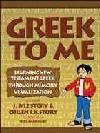
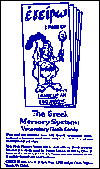
Greek To Me and The Greek Memory System by
J. Lyle Story, Ph.D. A first-year NT Greek grammar using a unique picture-memory
mnemonic system to aid students in learning vocabulary and noun and verb
paradigms. While many first-year Greek courses only acquaint or expose
students to all NT Greek words that occur 50x or more (i.e., about 315
words), Greek To Me teaches students all words that occur
25x or more (i.e., 600+ words) while they're learning (in less time, too)
all the grammatical information taught in other first-year NT Greek courses.
Though geared to the Greek To Me textbook (and CD-ROM), The Greek
Memory System picture Vocabulary Flash Cards can be used with most any first-year Greek course as an
extremely effective aid for vocabulary acquisition and memorization.
To purchase The Greek Memory System picture Vocabulary Flash Cards, CD-ROM, and other
materials like the Greek Exercises book, e-mail the author or visit his Web pages for more information: http://greektome.biz/
Here is a link to a Greek
professor's comments on his continued success using the Greek To Me textbook
and vocabulary cards (but note that he gives an outdated e-mail address for Dr. Story).
|
|
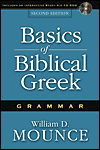
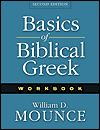
Basics of Biblical Greek. ISBN 0310250870. Basics of Biblical Greek Workbook.
ISBN 0310250862. By William D. Mounce. Second Edition August 2003. Perhaps the most popular and widely-used first-year Greek grammar.
(I learned Greek from the First Edition.) Students first focus on nouns (chapters 1-15) before learning verbs, but this Second Edition has an
alternate track that allows you to learn/teach verbs as well as nouns from the beginning. Mounce is very good at
explaining the morphology of words and word endings, which helps students learn the noun and verb paradigms. Vocabulary is limited to words that occur 50x
in the New Testament, and students must use Zondervan's 12-week workbook A Summer Greek Reader to learn the words that
occur 20x-50x to be ready to use the Graded Reader in second-year Greek. The translation exercises in the workbook are all from New Testament texts. The author's Web site
contains additional Greek language study aids: http://www.teknia.com. This new edition also includes
a CD-ROM that accompanies the chapters.
|
|
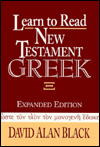
Learn to Read New Testament Greek: Expanded Edition by David Alan Black.
ISBN 0805416129. A basic first-year grammar which also introduces the student
to some basic terms and ideas related to discourse analysis. Black's explanations are good,
and students learning from a different first-year grammar may wish to buy it to help them
understand terms and concepts not adequately explained in their grammar. I used it (the first edition)
as a secondary/supplementary grammar when learning first-year Greek with Mounce's grammar, and found
Black's explanations to be clear, concise, and helpful.
|
|
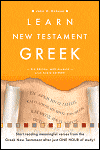
Learn New Testament Greek: Second Edition by John H. Dobson. ISBN 0801030196.
Learn New Testament Greek Cassette Tape. ISBN 0801029945. This book uses an
inductive approach that minimizes vocabulary and paradigm memorization and maximizes reading exercises, and
gets the student into the New Testament text very quickly compared to most other first-year grammars. Dobson also
introduces the student to material (e.g., textual criticism, discourse analysis) rarely touched on in first-year Greek classes.
He continually stresses learning to translate meaning, so that students do not come away from the course
thinking that translation is basically an exercise of substituting English words for Greek words. The cassette tape
reads aloud the content/exercises in the first 14 chapters to help students with pronunciation and reading and
listening. Some caveats: 1. Dobson's book uses no accents (but this is somewhat remedied when students begin reading
from the UBS Greek New Testament after a few weeks and thus see accents in the text); 2. Dobson presents noun
paradigms as nominative, accusative, genitive, dative, whereas most other first-year grammars that use the 5-case
system put the accusative case last; 3. Dobson's approach, while it enables diligent students to "read" the New Testament with
some understanding and recognize forms, may not train them sufficiently with verbal and nominal
paradigms and parsing exercises to prepare them for a standard second-year Greek course. A group of students
I taught at church with this book did not do as well as the book claims they should have, and several retook NT
Greek with me using Greek To Me -- and got much better results (with a lot more work on their part, however!).
|
| Intermediate and Advanced Grammars (most
useful for those who have had one year—or the equivalent—of NT Greek)
|
|
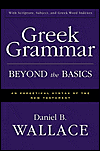
Greek Grammar Beyond the Basics: An Exegetical Syntax of the New
Testament with Scripture, Subject, and Greek Word Indexes by Daniel
B. Wallace. ISBN 0310218950. Designed to be used as a textbook for
second-year Greek studies, it can also be used with profit by those who
have been exposed to basic Greek grammar through Mounce's Greek
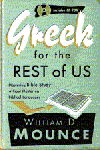
for the Rest of Us or a similar book. (It is highly recommended
that the reader read some such book before tackling Wallace so as to be
acquainted with New Testament Greek grammar and basic and technical grammatical
terms.) It contains a wealth of detailed grammatical discussion and information
on the various syntactical categories of Greek grammar, with many Scriptural
illustrations, and the Greek is all translated. Though there rages a debate
among Greek academics regarding Wallace's "traditional" methodology
versus a "discourse analysis" approach (which Wallace specifically
does not incorporate into this book), I believe there is a middle
ground that can benefit from both approaches, and Wallace's book is probably
the best of its kind. It is certainly the newest and most exhaustive.
Click on this link to read Wallace's chapter on
The Participle.
You will need to go to http://www.bible.org/index.htm
(under Help) for the fonts to read the Greek characters.
|
|
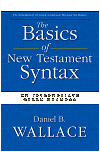
The Basics of New Testament Syntax: An Intermediate Greek Grammar
- The Abridgement of Greek Grammar Beyond The Basics by Daniel
B. Wallace. ISBN 0310232295. Two-thirds the price and two-fifths
the number of pages of Wallace's larger work. The abridgement is achieved
by omitting most of the exegetical discussions, biblical examples and
citations, advanced material, and detailed discussions. It's less intimidating
and maybe more useful than the unabridged book for the student who hasn't
had an actual one-year Greek course.
|
|
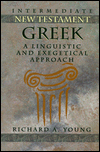
Intermediate New Testament Greek: A Linguistic and Exegetical Approach by Richard A. Young. ISBN 0805410597. A good intermediate grammar that is not as detailed or difficult as Wallace, but still covers many grammatical categories and word usages, taking a discourse analysis approach (kernel, deep structure, surface structure, etc.). As Wallace specifically does not address discourse analysis, the two books complement each other. There are short exercises for each chapter, but no answer key. The final chapters that attempt to explain discourse analysis are unfortunately too brief and unclear, in my opinion.
|
|
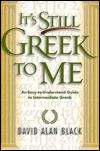
It's Still Greek To Me: An Easy-to-Understand Guide to Intermediate Greek by David Alan Black. ISBN 0801021812. As the title describes, this book is easy to understand and is a great refresher and reinforcer of the information one learned in first-year Greek, plus it introduces the reader to the grammatical categories he would learn in second-year Greek. Each chapter has translation exercises, and there is a complete answer key in the back. Black takes a light-hearted approach (even the chapter and section headings are humorous or pun-ish), but he gives solid information. Even if you use a higher-level intermediate grammar, like Wallace or Young, you would benefit from reading this book.
|
|
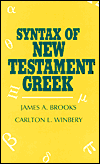
Syntax of New Testament Greek by James A. Brooks and Carlton
L. Winbery. ISBN 0819104736. Not as recent or exhaustive as Wallace,
but much smaller and easier to use. It only briefly explains grammar,
and primarily gives lots of examples of grammatical and syntactical categories.
|
|
New Testament Greek Syntax: An Illustrated Manual by Wesley
J. Perschbacher. ISBN 0802460445. Contains over 3,000 New Testament
verses illustrating various syntactical and grammatical categories. Similar
to Brooks-Winbery, but containing more examples and more detailed categorizations
and descriptions of examples, and including some classifications and examples
(e.g., dative absolute) that are listed in none of the other resources
(except Pershbacher's Refresh Your Greek). This book went
to out-of-print/closeout status in a matter of a few years (it was published
in 1995). Grab a copy if you find it.
|
|
A Concise Exegetical Grammar of New Testament Greek, Fifth
Edition, Revised, by J. Harold Greenlee. ISBN 0802801730. Handy 88-page
paperback. The Syntax section (the bulk of the book) might be a useful
resource, but also might be difficult for those who haven't had a year
of Greek.
|
|
A Grammatical Analysis of the Greek New Testament, 5th Edition, Revised, by Maximilian
Zerwick and Mary Grosvenor. ISBN 8876535888. Perhaps the best portable grammatical aid to accompany
your Greek New Testament. In NT order, gives grammatical information, parsing, etc., and translation
suggestions (except for most common words, i.e., those that occur 60x or more in the NT and listed in the
front of the book). Also has grammatical charts. Keyed to Zerwick's grammar.
|
|
Greek New Testament Insert, Second Edition, Revised, by
Benjamin Chapman and Gary Steven Shogren. ISBN 1887070028. The best
little book for your money ($4.95). The printed edition is designed to
be glued at the back pages of the United Bible Societies Greek
New Testament (it will likely weaken the binding if you do this, though). It can be
ordered at a discount through Grace Books International at http://www.gbibooks.com/final.asp?id=16421.
Its electronic version is part of the Logos system. Contains in succinct summary form lots of basic
information (with examples) about Greek grammar (and a few minor typographical errors).
|
| ANALYTICAL LEXICONS AND CONCORDANCES
|
|
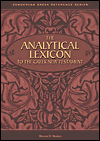
The Analytical Lexicon to the Greek New Testament by William
D. Mounce. ISBN 0310542103. The one I've owned the longest of the three available
recent analytical lexicons - Perschbacher's and the one by Friberg, Friberg and
Miller (see also) being the other two; Mounce has claimed that his has fewer errors
than Perschbacher. Words here are also keyed to Mounce's book on Morphology. An analytical
lexicon gives complete parsing information and the lexical form for
every word in the Greek New Testament text, along with brief definitions and listings of
Scriptures that accord with those definitions.
|
|
Analytical Lexicon of the Greek New Testament by Timothy Friberg,
Barbara Friberg, and Neva F. Miller. ISBN 0801021359. This is the newest of the
three (Mounce and Perschbacher being the other two), and appears to offer some benefits over
Mounce's analytical lexicon. I just recently bought a copy and will be comparing it with Mounce at some point.
|
|
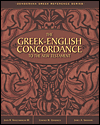
The Greek-English Concordance to the New Testament with the New
International Version by John R. Kohlenberger III, Edward W. Goodrick,
and James A. Swanson. ISBN 0310402204. An exhaustive concordance,
by Greek word, in Greek alphabetical order (with English Scripture
passage quotations), indexed to the New Testament Greek texts of UBS4,
Nestle-Aland 26/27, and the Greek text underlying the NIV.
It replaces the 150-year-old Englishman's Greek Concordance,
which was based on the King James Version and whose Scripture passage
quotations were too short for reasonable comparison and study. I would prefer
it to be based on a formal-equivalence translation like the NASB,
but Zondervan (who publishes it) owns the NIV. An essential tool
for the non-Greek-reading student.
|
|
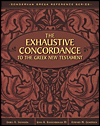
The Exhaustive Concordance to the Greek New Testament by John R.
Kohlenberger III, Edward W. Goodrick, and James A. Swanson. ISBN 0310410304.
An exhaustive concordance, by Greek word, in Greek alphabetical order,
indexed to the New Testament Greek texts of UBS4,
Nestle-Aland 26/27, and the Greek text underlying the NIV.
An essential tool for the Greek-reading student.
|
|
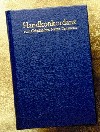
Handkonkordanz Zum Griechischen Neun Testament (A Hand Concordance of the Greek New Testament)
by A. Schmoller. ISBN 3438060078. A pocket-sized (7-1/2" x 5-1/8") NT Greek concordance that is
amazingly complete for its size. Based on the text of N-A 26 (same text as N-A 27 and
UBS4), with Latin Vulgate translations indicated. Introduction in German and English.
|
| THEOLOGICAL DICTIONARIES
|
|
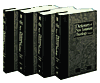
The New International Dictionary of New Testament Theology
(NIDNTT), Colin Brown, Editor. ISBN 0310332389. A four-volume
set that deals with theologically significant words and discusses their usage
in Classical Greek, the Old Testament (Septuagint), and the New Testament.
This is more up-to-date than Kittel's theological dictionary.
|
|
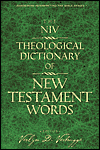
The NIV Theological Dictionary of New Testament Words (NIVTDNTW)
by Verlyn D. Verbrugge. ISBN 0310216508. This an update, abridgement
(in one volume), and expansion (by the inclusion and discussion of additional
words) of NIDNTT. While the additional entries and updated
and corrected information are no doubt valuable, the failure to include
an index that references all the words treated and the pages on which
they are discussed (many words do not have their own entries, but are
discussed under entries for related words) severely handicaps this work,
in my opinion. In contrast, NIDNTT has several complete and
exhaustive indexes.
|
|
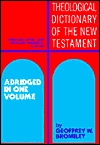
Theological Dictionary of the New Testament (TDNT), Edited
by Gerhard Kittel and Gerhard Friedrich, Translated by Geoffrey W. Bromiley,
Abridged in one volume by Geoffrey W. Bromiley. ISBN 0802824048.
Known as "Little Kittel," this is an abridgement of Kittel's
ten-volume work. Some feel the abridgement is of little value to the "true
scholar," but it's probably worth consulting at times.
|
| OTHER WORKS
|
|
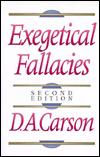
Exegetical Fallacies, Second Edition, by D. A. Carson.
ISBN 0801020867. A very good book that should be read by anyone wanting
to avoid blunders in their exegesis of Scripture. It may be a bit difficult
for those who haven't had a year of Greek.
|
|
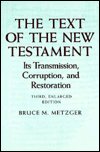
The Text of the New Testament: Its Transmission, Corruption, and
Restoration, Third, Enlarged Edition, by Bruce M. Metzger. ISBN 0195072979.
Considered to be the best overall introduction to the history of the New
Testament text and the formation of the modern critical editions of the
Greek New Testament.
|
|
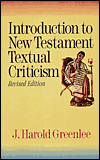
Introduction to New Testament Textual Criticism, Revised
Edition, by J. Harold Greenlee. ISBN 1565630378. Similar to Metzger's
book, but substantially shorter.
|
|
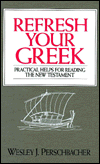
Refresh Your Greek: Practical Helps for Reading the New Testament , by Wesley J. Perschbacher.
ISBN 0802433529. The text of UBS3(corrected)—identical to UBS4 and N-A 27 as far
as the text is concerned—with all unfamiliar words (i.e., words which occur less than 50x) parsed, defined and
grammaticalized in each page's footnotes, thus enabling one to easily read through the text. Also contains 200+ pages of
grammar discussion and vocabulary notes and lists in the back. It's a heavy hardback book, and it's currently out of print,
but if you can find a copy, you'd be wise to buy it.
|