Respiration
When an organism converts food into chemical energy, the process forms many of the high energy molecules called adenosinetriphosphate. Carbon dioxide is also formed as a byproduct. As shown in the chemical properties page, carbon dioxide reacts with water to produce an acid H+ and a bicarbonate HCO3-.

Respiration is the entire process from metabolizing the sugar to eliminating the acid buildup. Carbon dioxide is more than just a waste product. The body uses the bicarbonate HCO3- made from carbon dioxide to capture acid H+ throughout the body. Bicarbonate acts like a buffer because it prevents the body from getting too acidic. In the lungs, oxygen is taken in and carbon dioxide is expelled. By expelling carbon dioxide, the the amount of acid in the body is regulated.
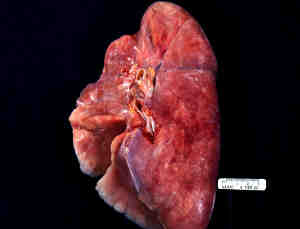
Picture of a healthy human lung
The respiration process can be summarized as:
| Step of respiration | What happens | ||
|
Phosphate (HPO4-3 ) ions are added to a glucose sugar molecule and low energy adenosinediphosphate molecules are eventually converted to high energy adenosinetriphosphate molecules. | ||
|
The carbon atoms in glucose combine with oxygen. The carbon atoms are converted to carbon dioxide and removed from the glucose molecule. | ||
|
The carbon dioxide molecules dissolve in the blood and taken to the lungs. The carbon dioxide molecules are exhaled in the lungs and removed from the body. | ||
|
The adenosinetriphosphate molecules are used throughout the body to power the life-sustaining chemical reactions. In so doing, the adenosinetriphosphate molecules are converted to adenosinediphosphate molecules and phosphate ions. |

This web site provides a simple but more detailed explanation of the process by which carbon dioxide is taken to the lungs and exchanged for oxygen http://www.purchon.com/biology/respire.htm#ventilate
For a more detailed and thorough explanation of respiration, see this college-level web site http://www.edu.ipa.go.jp/chiyo/HuBEd/HTML2/en/3D/lung.html