Photosynthesis
Life on earth would be pretty dull were it not for the process of photosynthesis. There are some forms of life that survive pretty well without this process. For example, those strange organisms that live near thermal vents on the ocean floor have no use for the process and certain one celled organisms that digest iron don't have any use either. For the other creatures on this planet, the photosynthesis process allows for the use of sun light energy. Plants use photosynthesis to make the sugar glucose. They use glucose for chemical energy and as building blocks for making plant parts. The basic features of photosynthesis are listed below:
-
Sunlight or artificial light. It doesn't matter to the plant
-
Carbon dioxide
-
Water
-
The light absorbing pigment called chlorophyll
Carbon dioxide combines with water and light to make glucose (a type of sugar) and oxygen in a specialized cell called the chloroplast. The picture below is a diagram of a typical chloroplast.
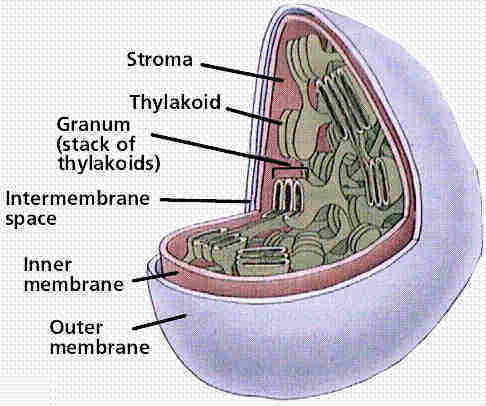
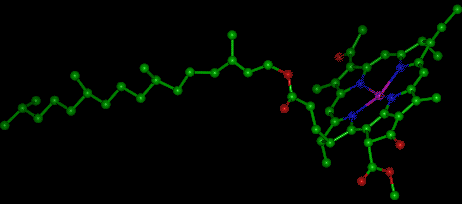
A model representation of the chlorophyll molecule is shown below. Chlorophyll absorbs the energy from light and uses the energy to pull the hydrogen atoms off of water to form oxygen. The hydrogen atoms are combined with carbon dioxide to form sugar.

For a brief and easy to understand explanation of photosynthesis, see
http://askeric.org/cgi-bin/printlessons.cgi/Virtual/Lessons/Science/Botany/BOT0046.html
This web site is produced by the PBS series Newton's Apple and is on a middle school level. It has a number of activities and a small glossary of terms.
For a more thorough explanation along with a number of colorful pictures, see
http://www.emc.maricopa.edu/faculty/farabee/BIOBK/BioBookPS.html
This site is on the level of high school to college.
Classroom Activities
Science teachers often demonstrate photosynthesis by shining light on a submerged plant and showing the students the oxygen bubbles that gather on the leaves. In the activity described in the link below, students will learn how to measure the amount of oxygen given off by photosynthesis. Students will also observe the effect of increasing amounts of carbon dioxide on photosynthetic activity.