Saturday, 10 March 2001
Well here we are in Bangaldesh and suddenly, after all the hassles and setbacks of the last few weeks, the whole thing begins to make sense again. We had both got pretty worn down by all the problems with planning the trip, but stepping into the airport at Dhaka, hearing the voices and smelling the smell of Bangladesh (just dust, nothing too terrible) we suddenly remembered what an adventure it's going to be.
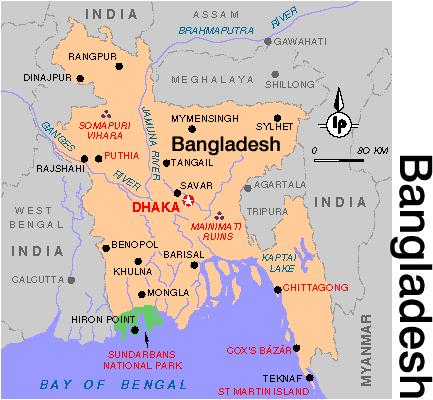
We arrived at 11pm and were very relieved to see the driver from CRP (the Centre for the Rehabilitation of the Paralysed, where we're staying) waiting for us amongst the ubiquitous hordes of spectators. A bone shaking drive through the city and into the countryside took us to Savar, the town north of Dhaka where CRP is located (see the map above). The driver was very friendly and talkative, and curious about our trip. "So, you have the heavy duty motorcycle. Japanese? How many cc?" He was surprised by how far we planned to go. "What if you have problem?" "We have some tools" Dave said optimistically, "And we hear Bangladeshis are very good mechanics." "Oh yes, very good. Very nice. Thank you."
We arrived and our friends, Maggie and Steve Muldoon, were there to welcome us with open arms and open beer bottles, both very welcome. It turned out that instead of unrolling our campamats on the floor Maggie and Steve had arranged for us to stay in the staff block, with a whole flat to ourselves. It's bigger than our unit in Sydney, not what we were expecting at all!
I don't think we mentioned this on the site before but just before we left Sydney Bede, our shipper, had called to say there was a problem. Or two. One was that the airlines had doubled their rates, adding over AU$1200 to our shipping costs. Bugger. The other was that, due to the Eid festival there was a huge backlog of cargo waiting to go into Bangladesh and it might be A WEEK OR TWO before our bikes would leave Sydney. In fact he had no idea when they would leave as the airlines were refusing to confirm them on any flight. Dreadful news really, as we were already pretty far behind schedule, but by the time we got to Dhaka we were resigned to spending a good bit of time here.
Sunday, 11 March 2001
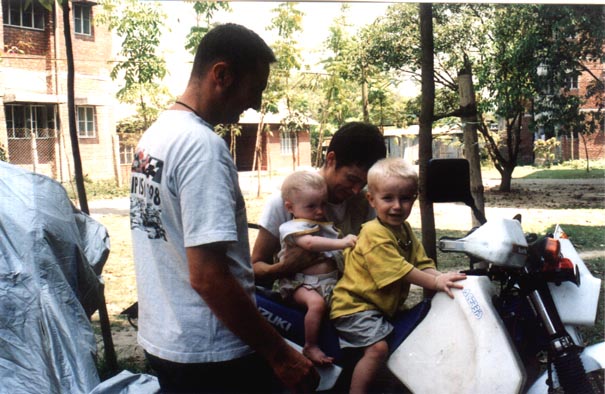
A day of recovering and writing "Things to Do" lists (long ones) took up much of the Sunday. That evening we told Stephen and Maggie about the various problems we were having and the good news of the projected two day customs clearance in Bangladesh and they laughed into their whiskies. Suddenly it did seem a bit unlikely but what the hell, we were here and it really felt like we had got started, bikes or no bikes. That day we also met the additions to the Muldoon family, Tom (two years) and Dan (eight months), two little blond-haired boys adored by all at CRP. We were glad to hear that Tom had kept the strong Irish accent of his mammy and daddy, even when speaking Bangla, in which he is fluent. He taught us a few words so now we speak Bangla in an Irish accent too, which is a bit surreal.
We got in touch with Inge at Trade Clippers, our shipping agents here in Dhaka (a Danish woman working in a Bangladeshi shipping company - an unexpected godsend as she speaks impeccable Scandinavian English unlike the local charming, but frequently impenetrable, variety), and discussed the tragic bike situation. Bede had decided to send the bikes to Singapore on the off-chance that Singapore airlines would just stick them on the next flight without checking they were confirmed. Or something. It seemed like a pretty vague plan but we had nothing to lose. She seemed quite optimistic. We were not.
Monday, 12 March 2001
Our admin started in earnest and we headed off to the Indian High Commission to apply for the first of various permits we need to leave Bangladesh with our own 'heavy duty' bikes. Four hours later, after filling in our forms in quintuplicate (a word created by and for Indian Government bureaucracy) and parting with a fair bit of cash (no receipt asked for or given) we left with our permit - one down two to go. Four hours felt like a reasonable length of time so we're obviously back into the South Asian way of thinking.
After our day wrestling with Indian bureaucracy we went to visit Inge at her office. Momentous news! The bikes were in Dhaka, at the airport. With some pressure from Trade Clippers at the Bangladesh end, and pressure from Bede at the Sydney end, Bede's fiendish plan had worked. Unbelievable. Of course there was still Bangladeshi customs to deal with but the bikes were in the country - a huge achievement.
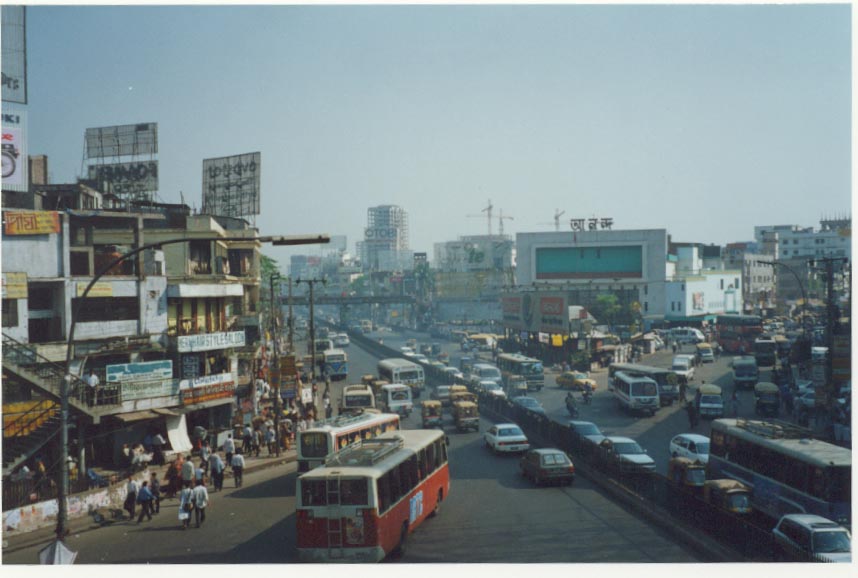
Hurtling around Dhaka in various modes of transport has reminded us of just how mental the driving is here. Trucks, buses, cars, baby taxis (three wheeled little vans like tuk-tuks in Thailand) and the ever present rickshaws, all fight for space in the congested city streets. There are few rules: one is, bigger vehicles do not have to stop for smaller ones, regardless of who, strictly speaking, has right of way. This means that a large truck or bus will simply charge out into a main road and anyone unlucky enough to be driving along it at the time will just have to stop.
The other main rule seems to be that drivers are expected to look out for what's ahead of them, but are not required to pay much attention to what's behind them. This makes overtaking a bit of a challenge, and explains the constant blaring of horns. It's not road rage or rudeness, just a system of letting other drivers know that you're there, as they're not going to check for themselves.
And in Dhaka itself, any vehicle that thinks it will have a better chance of making some headway on the other side of the road might just give it a try, so occasionally you will come face to face with a rickshaw coming the wrong way up your side of the road. During one particularly hair raising baby taxi journey we decided that, if at all possible, we would get the bikes delivered up to Savar. Riding from the airport through Dhaka as our first outing on the bikes seemed over-ambitious to say the least.
Tuesday, 13 March 2001
On Tuesday we spent the day at CRP. We met various people and discussed the plans to raise some money for the organisation. We had been a little reticent about that back in Australia, but now we're here it all makes a lot more sense. It really is an amazing place and is doing such a lot of good for people who need help so badly, it's the least we can do to let them use our trip to fundraise. We're just working on a page all about it so click here for more CRP info if you're interested. No pressure though.
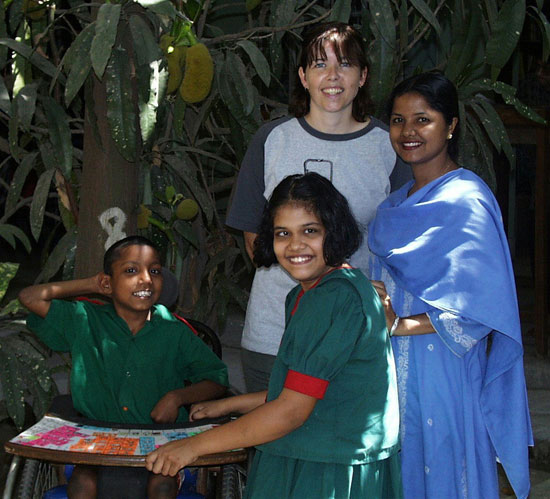
One of the people we met was Valerie Taylor who set up the centre in 1979. She's still here, living and working at the centre, and is a real inspiration. I thought she might be one of these obsessional nutters but actually she's just incredibly pleasant. She obviously corners sponsors and smiles them into submission - it must be hard to refuse someone who's just beaming at you. She's doing something right anyway, as CRP is an amazing acheivement. Valerie was interested to catch up on news of my sister Alyson, who she knew when Alyson lived in Dhaka. She also told me that my late brother-in-law, Ben Kamal, who was a urologist out here used to do surgery for CRP patients free of charge - another good reason to get involved ourselves.
Thursday, 15 March 2001
We were finally summoned to the airport on Thursday morning to sign for the bikes. We arrived at the cargo section to a scene from Dante's Inferno. Trailing queues of people (all men) wound out of little offices, everyone holding documents and shouting for attention. It was hot and dirty and packed with people. We marched from one area to another with our man from Trade Clippers, apparently looking for a particular member of staff who was dealing with our bikes. After about half an hour of this, including a pleasant session having tea with some sort of senior customs official, we were finally taken to the gate of the bond. Herded into another tiny office, we signed a huge ledger, were given some Newsweeks and Time Magazines to read by another kindly official, and after another hour our crates appeared. A little battered but recognisably ours.
Two forklifts lifted them outside and onto the back of a truck that had been organised to take the bikes to Savar. We piled in the front and our Trade Clippers bloke climbed in the back along with about seven or eight men hired to lift the crates off at the other end. We were very nervous as we barrelled out of the airport in the truck (a typical Bangladeshi vehicle - old and battered but brightly painted and decorated with gold rosettes and colourful pictures) but we needn't have worried. The driver was being very careful, driving fairly slowly and overtaking with great care. It wasn't until we were quite far into the journey that we realised why this was - the horn on the truck wasn't working. Instead of a horn, a young lad sitting on the roof would shout out every time the driver started overtaking another vehicle (what is Bangla for 'beep beep' I wonder...). Even they seemed to realise that this wasn't entirely adequate, so they took the journey nice and slowly, relatively.
Back at CRP the job of unloading the bikes began. Again, we were worried because the crates were heavy - a big trail bike in each as well as all our tools and spares and metal luggage. It didn't seem possible that eight scrawny guys (and two fine figures of men, Dave and Stephen) would be able to get both crates onto the ground in one piece but inch by inch with lots of shouting and gesticulating, they did it.
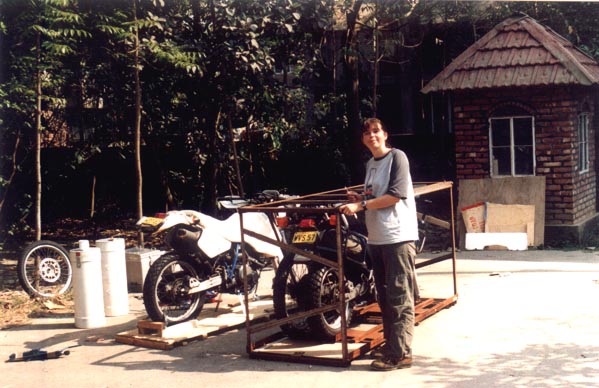
So, only five days after arriving in Bangladesh, and after enduring only three days of customs clearance, we had the bikes in our possession. The crates were pulled apart and with some help from occasional passersby, the bikes reassembled. Turn the key, and my old heap started first time. Turn the key, and Dave's deluxe 660 blew its fuse. The same problem we had just before leaving Sydney. So it's obviously true, your old nag copes better with stress than your thoroughbred. (I'd better not be too smug just yet as the Suzuki is undoubtedly the bike that will cause the most problems on the trip.) CRP has several vehicles and uses an excellent mechanic so he's going to have a look at the XTZ today. We're very confident it'll get fixed without too much bother.
Friday, 16 March 2001
On Friday evening, a weekend of mad socialising began with the annual Concern St Patrick's Day party. Concern is an Irish charity, so St Patrick's Day is a big thing for their workers out here. We went along with various CRP staff and had a great time, dancing to a selection of 80s disco hits, Boney M being a particular favourite as they just toured here apparently (?).
The next night the St Patrick's Day celebrations continued, this time at the British High Commission where Maggie was playing the whistle in a recently formed folk group. They played a selection of Irish folk songs to which we all sang along lustily. Once the band had left the stage, Dave managed to fit in a couple of tunes on his moothy with a couple of band members singing along - his playing must have gone down quite well because talking later, one of the singers urged Dave to apply for a job that he knew about in Sri Lanka - a 4 year post (or was it that his playing was that bad?).
That old Bangladeshi favourite, Irish stew, was served. The British High Commission is, I suppose obviously, a very British institution, with HP sauce on all the tables and the Daily Mail hanging on the newspaper rack. It's in real contrast with the street outside, where the rickshaw wallahs wait to take you home. It was good fun to go, but we also felt a little uncomfortable picking our way through the four wheel drives at the door. The gap between rich and poor here is too vast to describe.
Sunday, 18 March 2001
Sunday is the first day of the working week here, so this morning we set off to the Passport and Immigration Office to get our road permits which will allow us to take the bikes out of the country by land. We already have a long relationship with this particular office, as when we stayed in Dhaka before we had to regularly extend our visas. Housed in a rambling old building, you had to fight your way through crowds of people and plead with a truly unpleasant man to give you a visa extension. A lot of money changed hands. On one famous occasion he insisted that I had to attach my photo to the application form but refused to let me use the stapler sitting on his desk. Not a paper clip in the place, I was finally forced to sew my photo onto the form with a needle and thread lent to me by a kindly old Indian. He had travelled the world and had been saved on many occasions, he told me, by his trusty sewing kit.
Today, it turned out that the Passport Office had moved since our previous stay here to a new high-rise block on the other side of the city. We went up in the lift; explained to the man at the desk what we were doing; he gave us the correct form; we queued and handed it in; he told us to come back and collect it tomorrow afternoon, no charge. He even offered to staple our photos on to the form for us but there was no need as I had a comprehensive stationery collection in my bag, including a stapler, paper clips and glue. And a needle and thread of course.
We also found out that we don't need another permit as we had thought, so once we get this one tomorrow we are ready to go. We'll probably spend another day getting the bikes packed up and having a practice on the quiet roads around Savar, and head off on Wednesday. Our first stop is going to be the CRP subcentre at Gobindapur. It is in the north-east of Bangladesh, near Sylhet in the tea growing region. From there we'll head north and cross the border into India near Shillong. At least that's the plan...
Wednesday, 21 March 2001
We've had a little setback and have spent a large proportion of the last 48 hours either sitting on the toilet or planning the quickest route to it. Nothing too serious, but enough to remind us to be extremely careful. The first time we came here, in 1996, we got ill before the plane even touched down thanks to the Biman Airlines inflight catering. We spent the next four days within a crawl of the toilet and didn't get to do too much sightseeing. We didn't eat the meal on the return flight.
We were having a final document check yesterday before heading north to the border when we belatedly noticed that our Carnets de Passages (the documents which allow the temporary importation of the bikes into different countries) hadn't been filled in completely by the customs. After a lot of cursing and a short discussion about whether to ignore the omission and try to bribe the border guard, we conceded that we'd have to brave the customs warehouse at the airport again. We needn't have worried. An agent from Trade Clippers came along with me and with the minimum of fuss, the now customary "do you take tea?" and a group photo with Customs Officer Mr SA Chowdhury of 7/5 Sattar Mollah Road, Mirpur (to send him the photo), I was out within the hour. Phew.
Between visits to the toilet, Mo has been extremely busy setting up the website and putting on all the information about and photos of CRP. She's extremely patient because Internet connections here are extremely slow, unreliable and subject to disconnection at any time due to power cuts. It's amazing how little can be achieved in 6 hours in front of the computer screen.
Meanwhile I visited the metal workshop and the boss there, Paul, welded the rear carrier of Mo's bike as well as fixing a metal strap between the rear footrest and the rear carrier to try to avert what seems to a recurring problem with our pannier bags pressing on the exhaust pipe and catching fire. Poor Mo has now lost a favourite jumper, a favourite pair of jeans and assorted underwear to this phenomenon.
It's normally Mo's bike that causes us frustration and dollars but it was my supposedly reliable 'only' 4 year old bike that broke down the week before departure, requiring a new rectifier. Then on opening the crate at CRP, it blew its main fuse the first time the key was turned. Having eventually found a short circuit after stripping the bike of tank, fairing etc. several times, I then discovered my speedo wasn't working. On closer inspection, the internal cable that turns inside the outer cable had disappeared - presumably through the bottom of the crate when the front wheel had been removed for transportation. Fortunately I had a spare with me. So that's one less thing I'll have to carry now.
I also took both bikes down to the petrol station yesterday, an adventure of 3km. You really have to expect the worst: rickshaws and baby taxis turning in front of you and coming towards you in the wrong lane. Buses and trucks are king here, indicators are non-existent and I reckon Mo's extra loud two tone horns will come in extremely handy.
We still have to do a proper practice run tomorrow and pack our bags, so it's now looking like Friday for departure. We are planning to get up and away early in the morning before the traffic and the heat builds up. The roads around Dhaka are extremely busy but we're hoping that as we head out to the countryside, things will become a little bit more relaxed. We shall see.
On Wednesday night we went out to a local Savar restaurant, 'Little Italy', with Maggie and Stephen. The owner was a Bangladeshi who had lived in Italy for 15 years. We asked him why he had come back. "Ah, Italy very good. But Bangladesh my homeland." He made a pretty good pizza, so we were glad of his decision.
Back at CRP after our meal we chatted to Anwar, who owned the little shop outside the gate, and whom we had got quite friendly with. He was a real businessman with various shops and business interests in Savar and Dhaka. He had been married only a year and we asked him about his wife. "Is she a good cook?" Pause. "Sometimes. Before, she was at college and she did not learn. So now, she looks in books. Practises." He smiled bravely. We were talking at 10 o'clock at night and I said "You work too hard, Anwar. When do you spend time with your wife? She must be lonely every night." "No, no, not lonely. It is my father who is there." I wasn't over impressed with that. "Dave also has a father, but I didn't marry him to talk to his father every night." (No offence, Tom.)
Anwar was worried about our trip, and our chances of surviving the mad Bangladeshi truck drivers. "These men are not good drivers" he warned us. "They do not follow rule. You are motorcycle - to them, you are mosquito."
Thursday, 22 March 2001
In spite of Anwar's concerns, we didn't have much choice but to risk it so on Thursday morning we set off early on a practice run. What a nightmare. The road through Savar is one of the busiest in Bangladesh and we sped along behind buses and trucks with their horns blaring. We were mosquito all right. We dodged rickshaws, bicycles and heavily laden carts being pulled by hand. It was chaos and after half an hour we were relieved to get back to the sanctuary of CRP. I sat on the bed muttering our mantra "It'll be fine. It'll be fine."
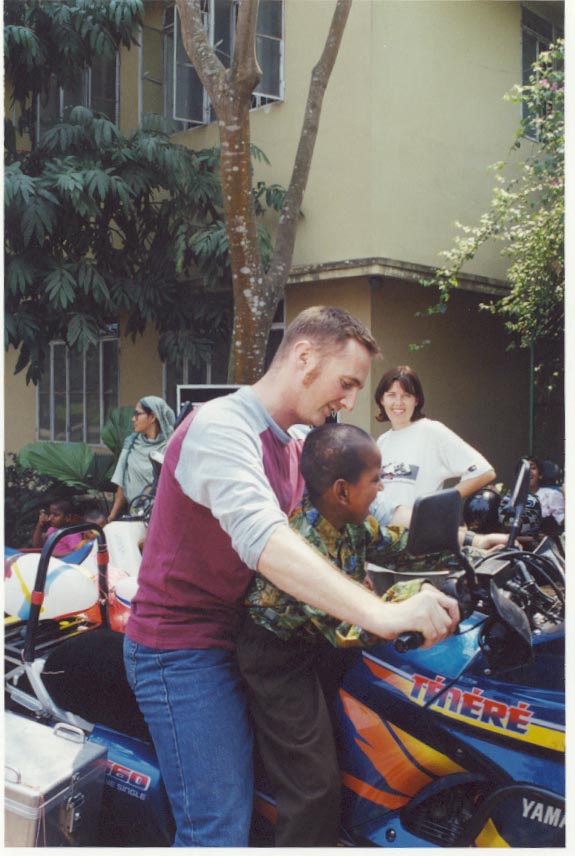
I had to rouse myself from my shocked stupor fairly quickly as this was the day of our official CRP send-off. As agreed we turned up on the bikes at the Special Needs School at 10 a.m. so that the kids there could say goodbye to us. What a fantastic bunch. They all sang songs, recited poems and played a game of competitive five-pin bowling. Maggie and Stephen turned up to watch the show too, and Tom joined in the game. He finally got sick of the pointless system of trying to throw the ball at the bottles and just ran forward and booted them over - a strike. The other kids thought this was very funny and his score was accepted. He ended up coming second, "with help from kick" written on the scoreboard. Next the kids came out and tied balloons onto the bikes. They had each written good luck messages on the balloons and pretty soon the bikes were festooned. A couple of them even got up on the bikes with us. I was doing all I could just to stay upright, but Dave rode around with a little Bangladeshi boy, Tapan, perched in front of him and waving to the crowds like a pro.
We had promised Kabir, the publications manager at CRP, that we would give him an interview about our trip and fundraising efforts, to be published in the CRP newsletter. He asked us all about our plans, and our feelings about the plight of disabled people in Bangladesh. "Can you make to compare the facilities of disabled people in Australia and Bangladesh?" Eh, not really, no, but we did our best to answer his questions. Kabir had also spoken to a journalist, Saiful, at one of the main English language magazines and he was also keen to talk to us. We hooked up by phone and he chatted to Dave all about our trip and how he felt about the plight of disabled people in Bangladesh. By now Dave had his position on this fairly well worked out and talked eloquently about it. Then me. "Can you tell me your feeling for the Bangladeshi people and the disabled people in the world?" Deep breath, and more ill-informed ramblings. As well as features, Saiful wrote a column called '24 hours' a kind of 'Day in the life of...' thing. When could he come and spend 24 hours with us? As we were leaving the next day, it didn't seem feasible. I said, "Maybe you could meet us later, in Iran or Pakistan." He said he would talk to his editor.
By this stage we thought our 15 minutes of fame was well and truly over but no, it was only just beginning. A film crew from Bangladeshi television was at CRP filming a special segment to be shown on National Disabled Day in April. It turned out that they too were very interested in our trip and, needless to say, our feelings about the disabled. So, back on the bikes, surrounded by the special needs kids, balloons blowing around, we were interviewed for Bangla TV. Dave first and he was brilliant, very relaxed, chatting about our trip. Then the bloke turned to me. "Do you have suggestion for the Bangladeshi people regarding the disabled people?" Oh dear God, let this be over, but it's amazing what you can do when you have to and I held forth on this, now my specialist subject, for the required 60 seconds. One last appearance, at the CRP staff meeting, where Dave told them all about what we were up to. I refused to take a turn and just beamed at him proudly from the sidelines like the good First Lady I am.
So our last day at CRP, and our last day before starting the journey, was finally over. What an amazing place, and a great bunch of people. I hope we can help them and raise some money. Remember to keep an eye on the CRP page if you're interested. There are some nice photos on there now, too, so it's worth just looking at anyway.
And thanks are due to everyone in Bangladesh and Australia who got us this far. Mark and Mags for putting up with us and helping organise the fund raising, Crobbo and John for their efforts with the bikes, Bede at Worldwide Forwarding Network in Sydney (highly recommended to other overlanders, although Bede may not thank us for that) for never giving up in the face of huge obstacles, Inge and everyone at Trade Clippers in Dhaka who we simply could not have done it without, and Maggie and Stephen and everyone at CRP, for making us so welcome and keeping us sane until we got into the unpredictable rhythm of life in Bangladesh again.
Friday, 23 March 2001, DAY 1: 0KM - 249KM
D-Day and we amazed ourselves by leaving CRP at 6.45am - an indication of how keen we were to avoid the suicidal traffic we'd glimpsed yesterday. The day dawned clear after a violent thunderstorm which kept us awake much of the night. We headed north up the main highway on dry quiet roads relieved that the only traffic was in the other direction where convoys of buses shipped political supporters to Dhaka to the planned demonstration to force the current goverment, the Awami League, to hold an immediate general election. Banners and arms waved from every window and we were glad that we'd managed to complete our paperwork before the general strikes or 'hartals' began. Hartals are an accepted form of political dissent in Bangladesh organised by the opposition party and compulsory for everyone on pain of mob punishment - usually several people die during the associated violence. In such a desperately poor country, it is a radical means of demonstrating to shut down the economy of the whole country for several days. We were lucky then to be heading north towards the relative peace of the countryside.
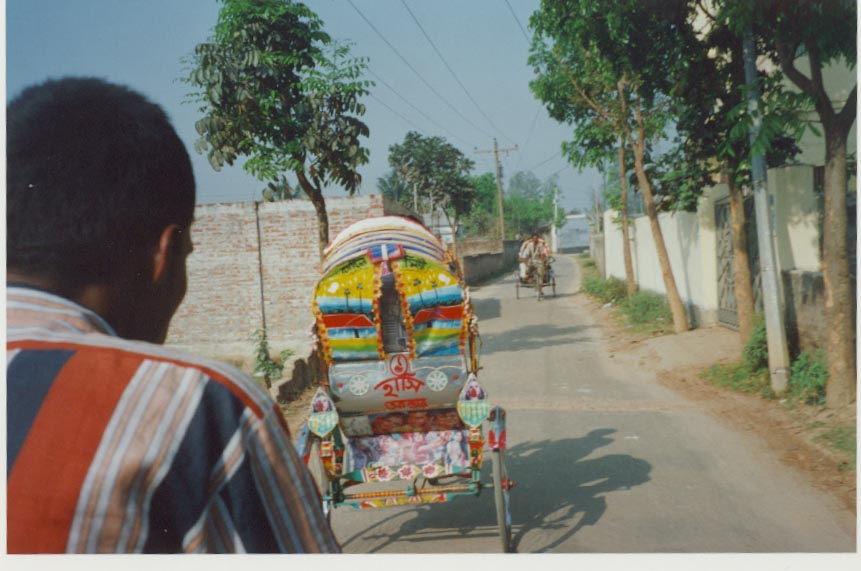
We had been hoping to average 60 or 70km/h but it soon became clear that this was optimistic in the extreme. A combination of narrow and badly maintained roads, along with the ubiquitous and usually unmarked speed humps, kept our speed down and we began to wonder if four months to get back to Britain was a little unrealistic. Leaving the dust and chaos of Dhaka, it was a relief and a pleasure to drive through vast plains of paddy fields relieved by the occasional roadside village. These plains clearly flood on an annual basis and the roads are generally built on elevated causeways, one possible reason for the less than smooth surface which at certain speeds made the bikes wallow and caused an unpleasant seasick feeling.
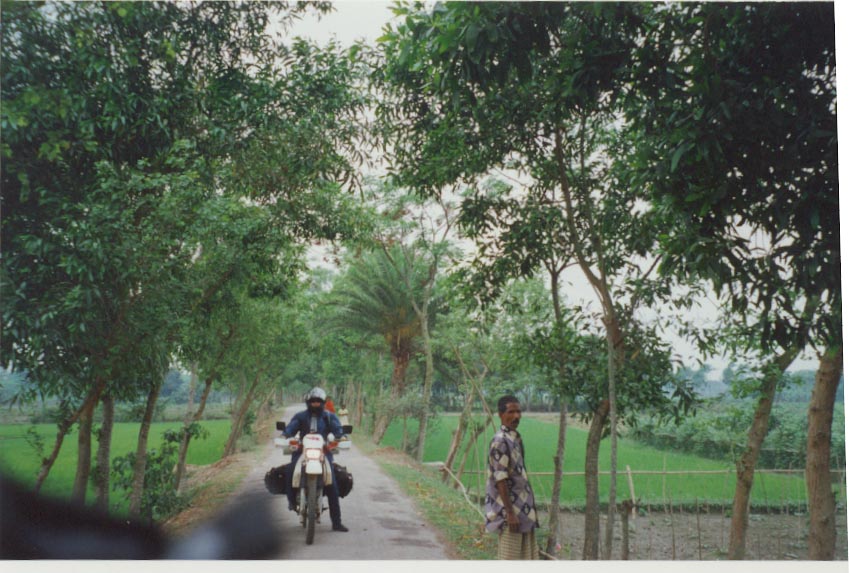
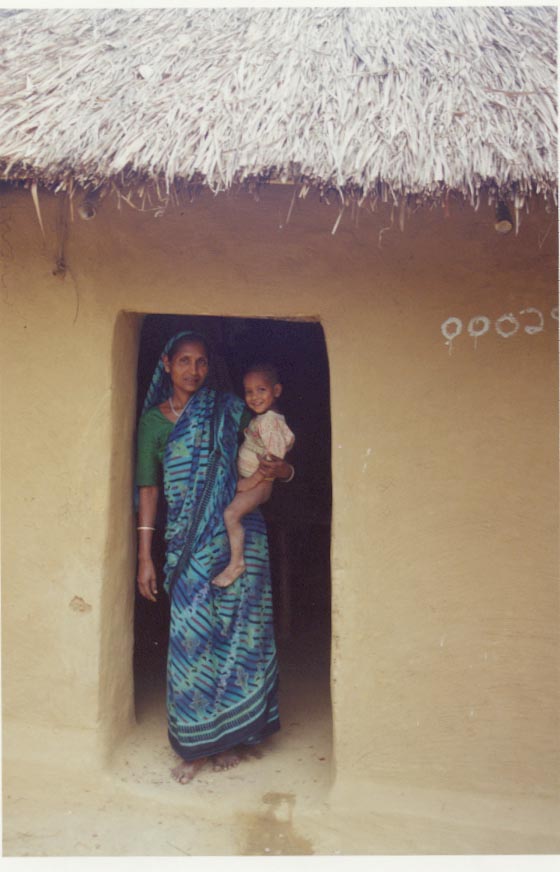
The villages are also elevated high above the plains on little islands where they appear almost self sufficient, a little group of straw and mud buildings and a haystack clustered round a central area of beaten dirt shared by children and animals. They appear as they must have done for many hundreds of years. It's easy to imagine a rural idyll in a landscape of clean mud villages surrounded by a fertile green carpet of rice fields but the reality is plainly very different. Villagers have very little access to any modern facilities that we would take for granted: communications, education or medical services, and they continue to live as they always have on a hand to mouth basis.
Our first river crossing was a short one and only a pleasant break from driving - it didn't prepare us for the chaos of the major crossing at Bhairab. Following the unsolicited directions of a local tout, we were forced to negotiate our way between lines of stationary trucks and buses along a deeply rutted and muddy track down a steep slope to the ferry itself which was reached only by negotiating an extremely tricky step from the slippery mud of the shore onto the slippery steel of the ferry deck. A baptism of fire for poor Mo who I'm proud to say coped admirably. The towns which grow around these ferry crossings are notoriously unattractive and Bhairab is no different, populated it seemed only by men selling cigarettes and paan (the local equivalent of chewing tobacco which I believe consists of some betel nut and some lime, all wrapped up in a leaf - my one taste wouldn't encourage me to try it again) and of course beggars.
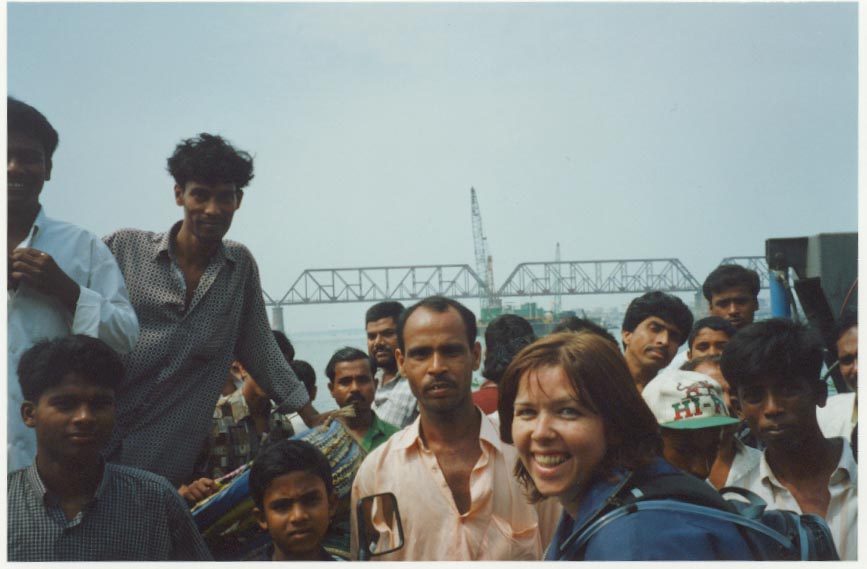
We managed to only pay double what we should have done so were reasonably pleased and escaped intact at the other side. Very nerve wracking to the uninitiated like ourselves to be surrounded on deck by hordes of immobile people without a Western sense of personal space staring blankly at us. We have experienced many crowds but generally there is a means of escape. Being a westerner in Bangladesh does attract a lot of attention and particularly in rural areas, a crowd of thirty or forty people will materialise from seemingly nowhere to observe our every move. I am sure we'll get used to it.
We managed to find a petrol station where the sympathetic owner let us recover in his office away from the gathering crowd. We were amazed to discover we had covered only 100km in four hours. Still 150km to go! As we headed further north towards the tea growing area, the plains gave way to gentle slopes which steepened into rolling hills covered with trees and fields of tea plants which stretched away in every direction. We stopped at a shaded roadside stall which turned out to be a biscuit shop with a vast selection arrayed across the back wall, so we had biscuits and Sprite for lunch, watched by our now familiar shadow of fascinated onlookers.
At 4pm we eventually wound our way through the gates of the CRP centre Gobindapur. What a relief. We were greeted by the manager there, Gourango, who showed us around and let us settle into our guest house. The houses were built as part of a Norwegian Mission from whom CRP bought the property. There are three bungalows with three rooms in each and they all have a kitchen and sitting room as well as a verandah. So I lay around on the verandah in the late afternoon sunshine, recovering, while Mo went straight to bed where she remained until 1pm the next day (well she managed to get up for a couple of meals in between!). Thanks to the staff at Napier and Blakeley who gave me a short wave radio for my leaving present - it was extremely relaxing to listen to the World Service in what felt like a last vestige of the British Empire (most of the tea estates are still operated by British companies). So we made it to the end of Day 1. A very tiring but rewarding experience.
Saturday, 24 March 2001, DAY 2: REST DAY
We took the chance to spend Saturday recovering from our first day on the road and, yes, I did sleep through a lot of it. The manager of the centre, Gouranga, popped in and out chatting to us throughout the day and made us feel very welcome. We also managed a walk around the CRP grounds and the surrounding countryside. There are tea gardens and rubber gardens and fish ponds and the whole place is very peaceful and secluded - just what we needed. Outside the grounds the land is very flat and at this time of year made up of dusty, disused paddy fields. Groups of little boys were using this fairly flat ground to play cricket and football and several of them begged Dave to join them. He played a little keepie-up and we strolled on. Everyone shouted "Adab, adab!", some form of 'hello' that we hadn't heard in Bangladesh before.
Our bungalow's cook, Pierra, had kept us fed with fried fish, daal and curry and ended on a culinary high by giving us fish and chips for dinner. Rice is a perfectly fine food, but these chips were just heavenly. Over dinner we planned our next day's ride - over the border and then up to Shillong in Meghalaya. We were curious to see how our first border crossing would go as you do hear about 8 hour nightmares involving lots of enforced tea drinking and huge amounts of baksheesh.
Sunday, 25 March 2001, DAY 3: 249KM - 440KM
Up at 6.30am and took an hour to pack up and get ready. Another huge storm in the night but again the roads dried quickly in the morning sun so we headed north towards Sylhet and the India border. The road was good and fairly quiet so we made good time and negotiated our final Bangaldeshi ferry crossing like seasoned pros. Straight on and then off the other side, without paying as we later realised. Well, it made up for getting fleeced on Friday.
After the ferry crossing, a lot of the road was under construction, with a mile at a time of one lane closed and the other made up of just mud and stones. There were no traffic controls or traffic lights - you just had to take your chances against the oncoming traffic. As always in Bangladesh, might is right where traffic is concerned so frequently the big trucks forced us to make our way through the road workers and machinery in the closed lane. We passed through Sylhet which looked attractive with a beautiful blue river running through it. So many Sylhetis have moved to the UK that there is an international airport there, even though the town itself is not all that big. Allegedly most Indian restaurants in the UK are run by Sylhetis, so much so that you now can't get a good meal in Sylhet itself as all the good cooks have left!
On and on along this half finished road and finally we got to Tamabil, the Bangladeshi border post. There were a lot of trucks on the way into the village - Bangladesh imports coal from India over this border - so we were worried that the crossing might be very busy but when we got to the barrier we were the only people there. A uniformed immigration policeman noted our arrival, ushered us into a corrugated iron shed and fetched his boss. Half a dozen onlookers crowded into the shed with us to watch the proceedings. The immigration official studied all of our visas in detail, the onlookers waited breathlessly, then our passports were stamped and we were sent across the road to customs. Three or four officials lounged at huge desks, covered in piles of large ledgers tied up with red string. It looked like the set of Bleak House. However, the officials turned out to be very pleasant. We are travelling as Australians, so they chatted to us about the cricket. I asked if they had heard of Donald Bradman, "Of course, WORLD famous" and together we lamented his recent death.
As one of the officials hauled out the appropriate ledger and worked through the paperwork, the other chatted to us about the politics and history of the region. He was incredibly well-read, but then going by the state of the place that morning maybe there's not much else to do with your time as a customs official in north-east Bangladesh. He recommended that we read 'Glimpses of World History', a book of letters from Nehru to his daughter Indira, and we plan to take up his recommendation when we can find the book. We talked about the political situation in Bangladesh, a source of despair to most of the people we've spoken to. He was also pessimistic. The Prime Minister and the leader of the opposition are both women - one the daughter of an assassinated ex-leader, the other the widow of one. He was unimpressed with them, "They have no personal strengths, they have merely a father and a husband. Kahleda was a housewife" he said dismissively and shook his head. We also talked about the religious conflict in the region, and the relationship between Muslims and Hindus. "But in Scotland I think you also have the religious problem, between Protestant and Catholic...". Pretty well-informed bloke.
Again the paperwork was completed easily, the only thing of note being that they didn't ask for our road permit, and we didn't mention it. So two days of going into Dhaka and filling in forms for hours had been for nought. Still, no complaints at all as the whole process had gone very smoothly and had only taken about an hour. We said our goodbyes and rode the 50 metres across a bridge to India.