CRP - The Centre for the Rehabilitation of the Paralysed, Bangladesh
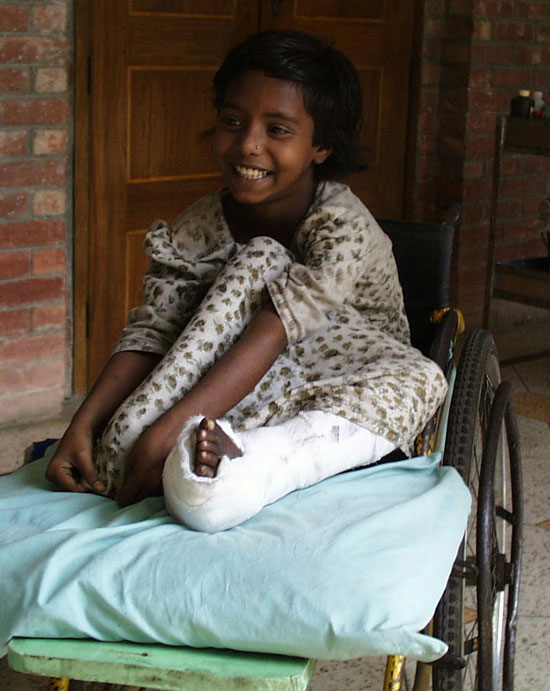
Joyfully, who suffers from club foot, is staying at CRP
for surgery and physiotherapy.
The Centre for the Rehabilitation of the Paralysed (CRP) was founded in 1979 by Valerie Taylor, a British physiotherapist appalled by the lack of care and facilities for spinal injury patients in Bangladesh.
Spinal injury was, and is, a huge problem here. Traditional working practices such as climbing trees to harvest fruit, and workers (men, women and children) carrying heavy loads on their backs and heads, are major causes of accidents resulting in spinal injury. The dangerous traffic conditions - ask anyone who's visited Dhaka - as well as diseases such as TB, now almost unheard of in the West, also cause paralysis in thousands of people every year. The World Health Organisation has estimated that out of a total population of 120 million in Bangladesh, 10% are disabled, approximately 6 million paralysed. As the second poorest country in the world, Bangladesh just can't deal with the numbers of people affected.
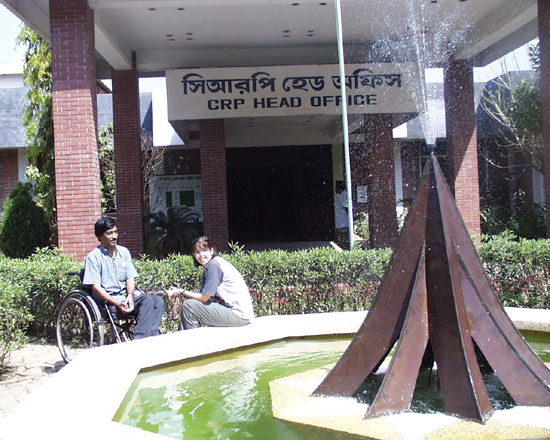
So there is CRP. From very small beginnings and a tiny staff in 1979, the organisation gradually gathered momentum and today has a fantastic centre at Savar, just north of Dhaka, as well as three regional centres and a growing Community Based Rehabilitation programme. The centre provides in-patient care for a hundred patients at a time, out-patient clinics, physiotherapy and occupational therapy departments, a special needs school, a mother and child unit for children with disabilities and many other facilities. They estimate that to date nearly 3,000 paralysed people have received treatment here as in-patients and many more thousands have benefited from the other services. Patients are selected on medical grounds with no regard for their financial situation, so many of the patients here are from the poorest sections of the Bangladeshi community, which is about as poor as people get.
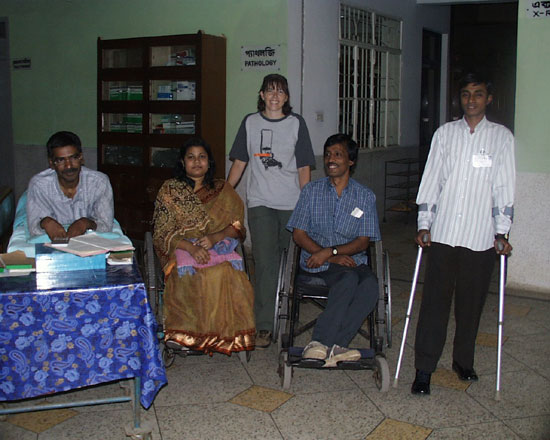
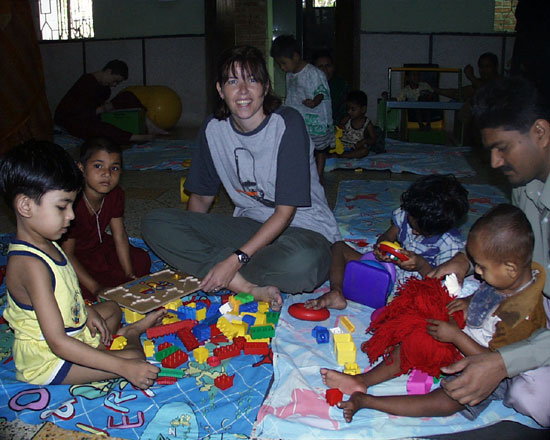
What with all this injury and disease CRP might sound like a depressing place but that couldn't be further from the truth (see picture below!). It's one of the most positive places we've ever been. The little kids scoot about in their wheelchairs, the adult patients work away learning skills that are going to help them live back in their homes and earn a good living, and the staff all seem dedicated and proud to be involved in the work of the centre. And it's quiet - a million miles away from the traffic and noise of Dhaka.
Now here's the rub...
We visited CRP several years ago when we were living in Dhaka and met the nursing educator, Stephen Muldoon. We got to be good friends with him and his wife Maggie (they're Irish so you can imagine the Celtic bonding that went on), and that's really why we're back here now. As soon as Maggie and Stephen heard about our plans, their fundraising antennae started waving and they suggested that we let CRP use the trip as a way to collect money for, and raise awareness about, the centre. It seemed like an OK idea then, and now we're here it seems like a great idea.
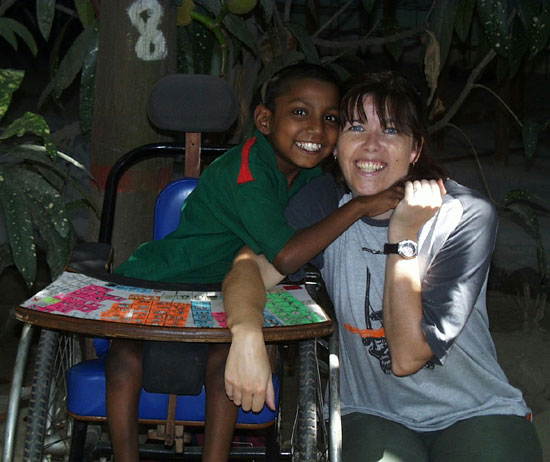
Valerie and the other staff have decided that our trip should raise money for a specific service, a unit for children with cerebral palsy. There is a small unit at the moment but it is badly under resourced and has a long waiting list so the plan is to build a new, bigger mother and child centre. Mothers will be able to come for two weeks at a time and learn about physiotherapy and activities to help them care for their child. They'll also be taught about cerebral palsy, and reassured that it is simply a physical condition and not caused by anything they did wrong themselves, a common belief here apparently. There is a real stigma attached to conditions like cerebral palsy. This is a subject close to Valerie's heart as she has two adopted daughters, both with cerebral palsy, both abandoned as babies because of their condition.
The new centre will cost around GBP45,000, and CRP are hoping to raise almost half of that - GBP20,000 - through our trip. That's around one pound for every kilometre we travel.
CRP are doing most of the real fundraising, contacting ex-volunteers and visitors and trying to get people behind the whole thing. But if any of our friends, or anyone who has just wandered onto this site, would like to help too then all the better. A little money goes a long way here, so even a small donation can make a difference. We don't want to pressure anyone in any way, but if you could see this place you'd want to help. If any parents or teachers are reading this and would like to involve their kids, CRP have written a special information sheet with sponsor forms attached, so to have a look at that click here.
We�ve now sorted out a mechanism for receiving donations in the UK, via an organisation called FCRP (Friends of CRP) which was set up in 1989 for just this sort of thing. So, for anyone who wants to donate, the details are:
Account name: FCRP
Account number: 00405132
Bank sort code: 20-02-06
Branch: Barclays Bank, Chiltern House,
Gerrard's Cross, Bucks, SL9 8PD
or send cheques made out to FCRP to:
Anthony Bargioni, FCRP Treasurer,
9 Latchmoor Avenue,
Gerrards Cross
Buckinghamshire
This is a revised address but if you sent anything to Wendy at the original address, don't worry - she'll pass it on to Anthony.
We�re keen to keep track of how the fundraising is going so if you send a cheque to Anthony could you add a note (even on the envelope) that your donation is related to our trip. And if anyone who makes a donation either by cheque or directly into the bank could drop us a quick email, just to let us know, we would be very grateful. I feel a bit cheesy asking this, and it�s not you blowing your own trumpet, we�d just really like to keep our donations in a distinct fund.
Regarding the Australian end of things, that�s taking a little longer. The plan was to link up with an international charity like Oxfam Australia who would send the funds to their office in Bangladesh who would then pass them on to CRP. However, CRP didn't seem to be making much progress with OXFAM in Bangladesh so we looked into setting up an account independently in Australia. Again, we were defeated by those friendly neighbourhood Aussie banks - there seems to be no way that we can organise an account without going through some hideous process of setting up a formal charity with articles of association, a board of directors and a party of the first part. So, we are officially stuck. All we can suggest is that anyone in Australia who wants to make a donation can email us and let us know, and then when we get home they can deposit Aussie dollars into our account in Australia, and we will deposit the equivalent in pounds into the FCRP account in the UK. We don't want to put our account details here now in case anyone puts money in without telling us and we inadvertently keep it. So if any Aussies out there want to make a donation, let us know (now or nearer the time) and when we get home and are able to get to our British account we'll email you with the details and we can both do the depositing.
Clearly this is not an ideal solution and if anyone doesn't feel comfortable with it, that's fine. However, for what it's worth, you have our personal guarantee that your money will be sent to FCRP on the same day you deposit it in Australia. And to be honest, after crossing so many countries in the last few months, this sort of international currency laundering seems pretty straightforward.