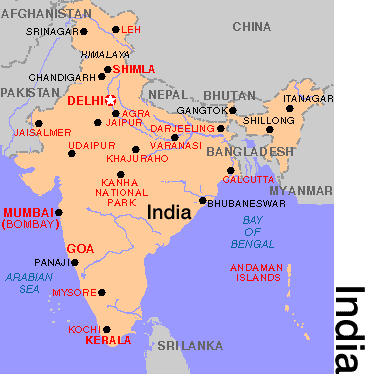
For more on India, check out the Lonely Planet info page.
|
For more on India, check out the Lonely Planet info page. |
Sunday, 25 March 2001, DAY 3: 249KM - 440KM |
We crossed the 50 metres of no mans land from Bangladesh and reached the Indian barrier and the village of Dauki. A group of uniformed soldiers were waiting in a shabby little hut, all carrying impressive rifles, and behaving very formally and courteously. They were all wearing fairly normal, khaki uniforms, but topped by bizarrely small, black plastic hats. Pinned up at one side, like those of Australian Diggers, these perched on top of their heads like little party hats. (For anyone who's seen the film 'Parenthood' they all looked like Steve Martin dressed up as Cowboy Dan.) If it hadn't been for the rifles we would have been hard pressed not to laugh. They also wore tatty little black baseball boots - definitely an under-resourced force.
We waited in the hut while the immigration man was called on a wind up, field telephone and looked around at Dauki. What a horrible place - a collection of filthy little buildings surrounded by rubbish and debris. A group of mangey dogs and grubby children watched us steadily. Presumably, if for some reason a traveller couldn't complete the crossing from India to Bangladesh they might have to spend the night in Dauki, and we were very glad it wouldn't be us. Finally we were sent, on the bikes, along to the immigration and customs building. It had been built quite recently and was cool and pleasant. On entering there was a sign for the toilets with the slogan: Cleanliness is Hygienic. Well, yes. The immigration officer was very friendly and we got all the formalities out of the way quickly. Round the corner to the customs desk, beside which stood a huge luggage x-ray machine, exactly like the ones you see at modern airports. We both looked at it in horror - would we have to detach all the luggage from the two bikes and feed it through this machine? Dave's panniers are metal - would we have to unpack them completely? The customs official didn't seem interested in our luggage and just looked at our passports. Having spent so much time and money on our Indian road permits we were determined to use them so we handed them over and waited. He studied them, then looked at our carnets and said "You do not need these permits. If you have a carnet de passage you do not need any permits." "Yes, well, that's what we thought but at the Indian High Commission they said..." He looked at us as though we were just a little simple. "But you have carnets de passage" he said slowly. "Permits not necessary." Bugger. Four hours and many US dollars spent, all for nothing. The customs man arranged for a dodgy mate of his to change our remaining Bangladeshi taka into Indian rupees and we set off, exultant at having achieved our very first border crossing so successfully, and pretty happy to be leaving the charming Dauki behind. As soon as we passed the last of the shacks, the road started winding up around a hillside, twisting and looping between trees and round tight corners. And suddenly the view opened up and we were riding alongside a stunning gorge with a bright blue river sparkling at the bottom of it. Such a lovely sight after all the filth, we stood and drank it in. |
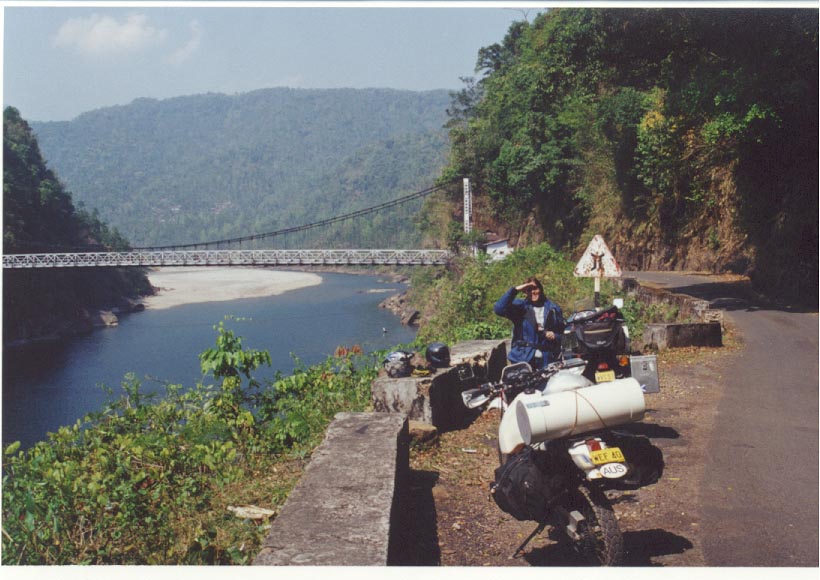 |
Beautiful views can appear when you least expect them |
We were nervous as we carried on up the twisting road with the 100 metre drop on one side as it would only take one lunatic driver to send us over the edge, but it turned out that the driving style had changed when we crossed the border. Truck drivers were pulling over to let us past them, smiling and waving. They blew their horns before rounding a corner, and slowed right down. The change was just incredible. We started waving and grinning back prompting much excitement from everyone on board. The road carried on climbing until it reached a high plateau. The local people seemed friendlier than we had previously seen, coming out of their little houses and waving as we passed by. They had the chiselled features and redder skin which seems to be a feature of all the various hill tribes of India, Bangladesh and Nepal. There were churches dotted along the road and we remembered what Gouranga had told us, that the tribal people had been semi-converted to Christianity by missionaries, largely because they had brought with them desperately needed medical support. The road continued up over another range of hills and then dropped and twisted until we finally reached Shillong. Shillong had been a popular hill station during the Raj era due to its cool climate and it still has a slightly British feel as well as a very strong military presence. It is called the Scotland of the East and whether this is because of the mountains, the cool air, or the fact that it has an annual rainfall of almost 40 feet, who knows. We rode into the centre of town, asked directions from an immaculately turned out traffic policeman and found a reasonable hotel, the Hotel Monsoon. It was a huge place, with labyrinthine corridors, unexpected dead ends and multiple stairways. Our room was in the centre, far from any natural light but with windows opening into two different corridors. This meant it was horrendously noisy, especially as our neighbour had his TV on at full blast and spent all evening flicking between blaring Indian musicals. We were glad to be there though. We dumped our stuff, had our first hot shower since leaving Australia, ate a lovely Indian meal in a nearby restaurant, and then settled into bed to watch Terminator on TV. |
Monday, 26 March 2001, DAY 4: 440KM � 609KM |
We had some admin to do before we could leave Shillong, most importantly we had to get some Indian rupees as we didn�t have enough to pay the hotel bill. It turned out that the banks didn�t open until 10am, so we had some breakfast and went for a wander. Shillong is a very bustling town and we were carried along with the crowds of people shopping and gossiping and heading for work. On every wall was stencilled: Do not spit. Do not rub lime. Post no bills. |
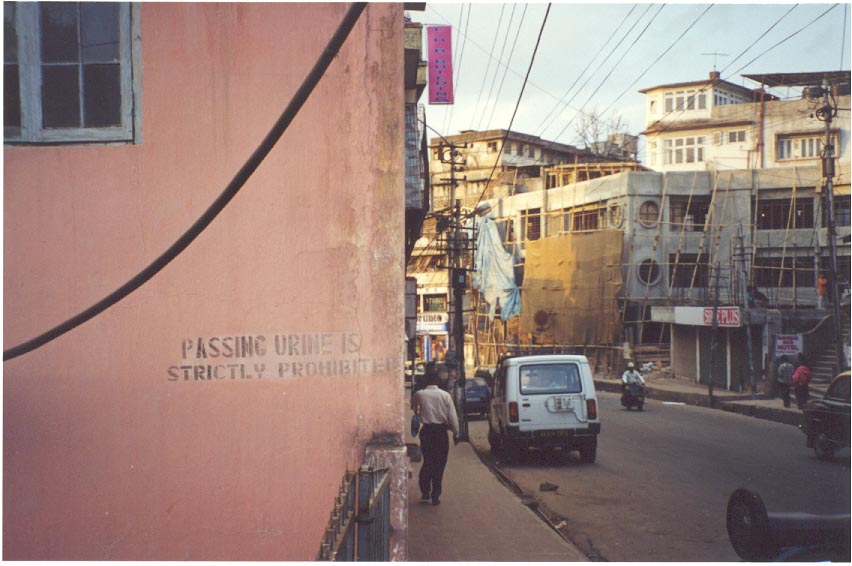 |
Shillong - still a bit British and proper |
Another errand we had to do in the town was to go and take some photos of the jail. A friend of ours spent some time there a while ago when he was arrested for travelling in what was then a restricted area, and had asked if we could take some photos for him. It turned out the jail was right in the centre of town so Dave decided to be very up front about it, marched up to the soldier on the gate and said �Do you mind if we come in and take some photos?� The soldier, unsurprisingly I thought, said �Oh no sir, not possible.� So we walked around the perimeter wall and sneaked some shots of the watch towers and the barbed wire, me sure we would be arrested at any moment. Meghalaya and the other states in north-eastern India are still a little politically sensitive as there is an independence movement. Gouranga had warned us not to ride at night. �It is safe during the daytime, but in the night many miscreants are there.� Now we were lurking round the jail taking photos I thought we might be mistaken for miscreants ourselves so as soon as we had a few shots we headed back to the hotel. The getting of the rupees turned out to be a comedy or errors involving a lot of misinformation and several different banks but we finally got solvent again and left just after noon. There was virtual gridlock in the streets of the town but everyone, including the police and the other drivers, seemed to expect and encourage motorbikes to dodge in and out and go up the outside so we got out into the countryside without too much difficulty. The road twisted and curved, down, down, and the temperature rose. We crossed into Assam, and through the major regional centre of Guwahati. It was stinking hot, full of trucks belching out diesel fumes, and we headed straight out the other side, over the Brahmaputra River and then west along its north bank. The road was busy with buses and trucks and frequently we had to stop completely to let larger vehicles negotiate around each other. At one point the bus I was riding behind stopped to let an oncoming truck squeeze past. I waited behind and then noticed the one working reverse light coming on and the bus slowly starting to move back. I beeped my horn, and some bystanders shouted and banged on the side of the bus, but it kept coming. I started to try to move backwards, the bystanders shouted frantically and hammered on the side but the the driver just couldn�t hear and slowly, slowly the back of the bus pushed my front wheel round and slowly slowly pushed me and the bike over before coming to a stop. By this time my mates doing the shouting were apoplectic on my behalf and shouting in outrage leapt forward to pick me up. A policeman appeared and started shouting at the bus driver. It was all very dramatic and this was the scene that Dave saw when he came back to see what was holding me up � a roaring crowd all bent over the back of a bus, a furious policeman shouting at the driver, and no sign of me. He had a scary moment, I think, before I emerged, dishevelled but unhurt, being dusted down by the crowd. The policeman checked I was OK then waved me on with a rueful smile, as if to say �Well, if you will go hooning around the world on a motorbike��. On and on along busy roads getting hot and tired and as darkness started to threaten we began wondering about where we were going to spend the night. Just as we were both getting concerned a hotel sign loomed unexpectedly at the roadside: Narlbari Motel cum Restaurant. We turned in and had a very welcome cool drink in the restaurant. It turned out that the �motel� was a dingy block of two rooms in a field at the back. We took one of them, a vast room with three single beds and a really nasty bathroom. It turned out that in the other room was a local Assamese politician. We chatted briefly and he told us that he was standing for the Congress I party in the forthcoming election before heading off in his white Ambassador, the car of choice for most Indians. We had dinner in the gloomy dining room, the red light bulbs on the walls giving off too little light for us even to look at our maps. Every half hour or so there would be a power cut and the rusty generator at the back of the building would rumble into life. The food was fine, but the surroundings were grim so we decided to have an early night. It was not to be. When we headed back to our room our politician neighbour had returned and he leapt out to talk to us. He insisted that we join him, and immediately sent his driver away to organise some snacks and drinks. Sri Bhaba Nanda Lal Das was about 55 years old. He had grey hair and a white beard, one front tooth missing and the others red with paan. He also had one of the most impenetrable Indian accents I have ever heard. His style of address was arresting to say the least as he didn�t talk so much as announce (an occupational hazard of a life in politics perhaps) and he shouted out information about himself to us. �MY FATHER. FREEDOM FIGHTER. KNEW GHANDI. KNEW NEHRU.� The whole family seemed to be of the same calibre as his uncle was an MP and he himself was a businessman, employing over 500 people. �IN ASSAM, MEGHALAYA, TRIPURA� YOU SAY MY NAME. ALL WILL KNOW.� The driver arrived back with the food and drink: beer, whisky, a charred fish and some chicken curry. We had just had dinner so we really didn�t want any and Dave said �No thank you, we are vegetarians.� �IS NO PROBLEM. IS CHICKEN,� he roared and thrust it towards us. We agreed to a drink so I had some beer, and Dave had a large glass of �Director�s Choice� whisky. Sri Bhaba had a beer with a generous dash of whisky in it. He seemed to like his drink and got louder and chattier as time went on. After telling us some more about himself, including the fact that he spoke 13 languages, he suddenly barked out �OH DAVID. YOU ARE LUCKY MAN. YOUR WIFE IS GENTLE.� Dave was a little taken aback and stuttered, �Well, yes, she is, yes.� He obviously hadn�t sounded convinced, but Sri Bhaba had hit on a topic he felt strongly about and the rest of the conversation was punctuated with his high opinion of me. General chat then suddenly �VERY VERY LUCKY MAN.� We were all getting a bit hysterical, Sri Bhaba due to the drink, and the two of us due to his bizarre insistence on Dave�s good fortune. �SHE IS GENTLE� he would roar, waving his glass at me, �LUCKY LUCKY MAN.� Dave finally managed to choke out �Yes, she�s lovely.� �OH DAVID, YOU TOO ARE LOVELY� Sri Bhaba beamed at him tearily. This was too much for us so we swapped addresses, thanked him profusely for a wonderful evening and headed to bed. We thought our evening was over but it turned out the fun was only just beginning. In our separate beds, in the dark, we could hear the usual noises. �Did you hear that?� �No, what.� Scratch scratch. �That.� �It�s nothing.� Then a cacophony of scratching and rustling. There was definitely something inside the room. Dave turned on his torch. Nothing. We lay in the dark again, waiting, and the same thing happened. He got the torch on just in time to see a furry tail disappear under the bathroom door. �A rat. It�s a rat. I saw a rat.� Dave hates rats with a deep and enduring passion. He turned the light on to find that our toilet roll had been unrolled and pulled half way across the room towards the bathroom. �What are we going to do?� �Nothing, it�ll be fine.� �No it won�t, there�s a bloody rat in our room.� I was half asleep and I don�t mind rats so I refused to participate. Dave finally said �I�m getting the driver, he�ll know what to do.� Not only the driver, but Sri Bhaba himself, piled into the room. I pretended to be asleep and through slitted eyes watched the three of them creep up and peer in the bathroom door. �NO RAT HERE,� Sri Bhaba hissed in a stage whisper version of his usual roar. �WE WILL FIND HIM, OR YOU CANNOT BE SLEEPING� and he performed an elaborate mime of a rat gnawing through a mosquito net and attaching itself to the sleeping occupant. Dave swallowed. �IF YOU HEAR AGAIN, MY ROOM COME.� He pushed his chest out, �I WILL BE THE SAVIOUR.� At this point he came over to my bed so I closed my eyes and breathed lightly. �AH MO, YOU ARE SLEEPING� he deduced loudly, then pulled out the mosquito net, reached in and squeezed my face tightly. This was not nearly as creepy as it sounds, but after he had left Dave and I agreed that he would not in fact be the saviour and that somehow we would have to contrive to save ourselves. Dave achieved this by stuffing a towel under the bathroom door and a mat under the front door. Wherever the rat was, it was now stuck there and in our hermetically sealed room we finally went to sleep. |
Tuesday, 27 March 2001, DAY 5: 609KM � 934KM |
In the morning we faced the problem of needing to get into a bathroom possibly containing an enraged rat. Dave dressed for battle, then said �Have you seen my other sock?� The sock had gone, and we had a pretty good idea where. He opened the bathroom door and we looked into the gloom. No sign of the rat but sure enough, there poking out of one of the drains was the missing sock. So the rat hadn�t got very far with it. The question was, was the creature now wedged in behind the sock ready to leap out if we moved it? Dave wasn�t willing to take the risk so he went out to pack up the bikes. The driver wandered in to see what was happening. I pointed out the sock and we looked at each other blankly. The shower was dripping slowly and the jug in the water bucket gently rocked against the side. Then not so gently. The driver and I crept over and there, paddling around in a bucket half full of water, was the beast himself � a small, light brown, terrified and exhausted rodent. It must have somehow ended up in the bucket which had then, during the course of the night, drip filled with water until it was out of it�s depth and left swimming for its life. Now I was fairly sure that there wasn�t a rat waiting to jump out from behind it, I tugged the lost sock free of the drain, and took it and the bucket out to Dave. In the clear light of day, the vicious, rabid monster he had been imagining actually looked more like someone�s pet gerbil and we agreed that all was forgiven and we would liberate it into the field. I tipped the bucket over and the poor little sodden creature rolled down the slope. It was clearly absolutely exhausted and could barely drag itself through the grass. We were just about to head back to the bikes, patting ourselves on the back for our big-heartedness when two minahs fluttered down. The rat valiantly struck out for a nearby hedge, but the minahs swooped and one gave him a nasty peck. After all we�d been through together we couldn�t just let him die, so I ran over and shooed the birds away, then escorted our little drowned rat as he struggled to the hedge. After all the excitement we finally set off up the road. The landscape was made up of flat paddy fields and the road was busy with the ubiquitous Tata trucks, mostly travelling in the other direction which was a blessing. Most of the trucks in South Asia are painted in lurid colours, and have messages and handy driving tips on the back � Horn Please, Use Dipper at Night, Good Luck � in jaunty writing. The driving continued to be an improvement on Bangladesh with a clear overtaking system in place. If you do come up behind a truck and �horn� as requested it will pull over slightly and indicate right if it is safe to overtake, then a little hand will appear out of the driver�s window to flick you on. The drivers seem to take this system quite seriously and if they don�t indicate you can be fairly sure something is coming in the other direction. The road was OK but again there was lots of road works and various sections where we ended up rattling through deep gravel and slippery mud. We stopped at a little shop, the owner of which was charming, wobbling his head from side to side in the Indian way. Dave asked if there was a toilet and he showed me into his house behind the shop. It was tiny with a low roof made of some kind of thick fabric. The walls reached up part of the way to the roof, and were made of woven matting tied to bamboo stakes. There was a tiny low bed in one room and a basic kitchen made of concrete with a gas stove. The bathroom was behind a curtain and contained a spotlessly clean ceramic squat toilet, a metal bucket and a huge metal hand pump. It was really fascinating to see a real rural home, and although is was small and low it was certainly liveable. Just after our stop, the road suddenly disappeared and a track dropped down to the left. We followed the pedestrians picking their way down and found ourselves riding across smooth, hard-packed mud. It was a riverbed, obviously containing a vast river in the wet season but now mostly dry. We carried on, bumping over the mud which was solid and corrugated. Finally we came to the river itself and saw where all the pedestrians were heading. To our right a huge new bridge was under construction and the road was completely closed. In front of us was a little, rickety bridge made of bamboo. Thick bamboo poles had been driven into the river bed, more poles had been lashed together to form a framework between them, and flat strips of bamboo had been laid over the top. Obviously a group of locals had spotted a business opportunity, built this bridge and were now charging a few rupees to people to get across. It was a booming enterprise and there was a steady stream of people filing across in both directions. There weren�t any other vehicles in sight, but on the basis that they wouldn�t let us on if there was a chance their bridge would be damaged, Dave eased the bike�s front wheel forward. The poles groaned and the strips of bamboo flicked up and make a cacophonous rattling against each other. He carried on steadily and I slowly followed. We could feel the ladder of cross-poles underneath our wheels but actually the whole thing was pretty stable. At the other side the ticket man tried to charge us an outrageous amount and even the 50 rupees we finally settled on seemed a bit steep but really it was worth it and you have to admire their entrepreneurial spirit. |
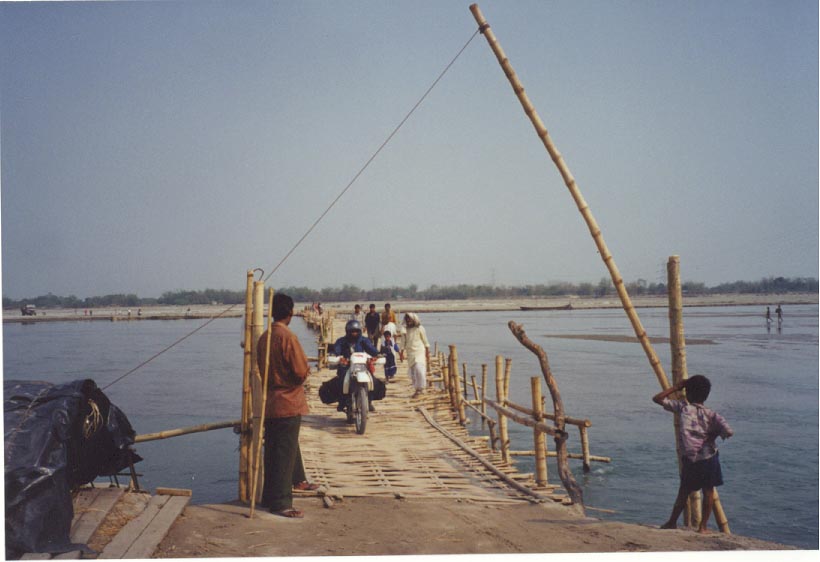 |
The bamboo bridge |
We stopped for the night in a small town, Falakata. We found a hotel with a courtyard so the bikes would be safe, and the manager told us proudly that there had been a Swiss biker staying a few weeks before so maybe we�ll catch him up at some point. The restaurant was just beyond basic, and the boy who worked there and in the hotel had such a disgusting rattling cough that we couldn�t face eating there. We walked around the town until we found the market and bought a few tomatoes, two onions and a clove of garlic. The whole lot cost less than ten rupees and the seller was very frustrated that we wouldn�t buy proper amounts. So for the first time, crouched in our little room, we cooked our own dinner and it was a triumph. We had agreed to eat only vegetarian food in an effort to avoid getting ill, and somehow had got stuck on a diet consisting solely of aloo gobi (potato and cauliflower curry) and naan bread. It was always very nice and we both love Indian food but it was good to have a little variety finally. |
Wednesday, 28 March 2001, DAY 6: 934KM � 1369KM |
We had been planning to head north to Darjeeling and up into Sikkim, but as we�d been to Darjeeling before, and both felt the need to get some real distance under our belts, we decided to head west and into Nepal. By now we had completed nearly 1000kms and were settling into the rhythm of the days. Up at 6am or thereabouts, an hour to pack up and get ready, and then off in the cool morning temperatures and the quiet roads. After a couple of hours we would stop at the roadside for something to eat � some biscuits and bananas, dried fruit and maybe some chocolate. We drink water all the time as we both have a Camelback sort of thing � a bladder with a tube coming out of it and attaching to our collars so we can reach down and have a drink without stopping. These have turned out to be a godsend although it remains to be seen if they survive the journey without bursting. Then on again with the temperature rising, we would keep going for maybe three hours before having another similar snack. After lunch we would start planning where we would try to spend the night, hopefully stopping mid afternoon at the latest. When we stopped we would unpack any removable luggage, have a much needed shower and pick a day�s worth of dead insects and filth out of our eyes and off the front of our jackets. Dinner in the best place we can find � always local dishes, always vegetables � and then bed. We�ve stayed in some pretty basic places but sleep is generally not a problem � we�re knackered by the time we stop. We were also getting used to the physical demands of so much riding each day. Anything that was loose or flawed, on the bikes and on ourselves, had started seizing up or falling off. We had both fused our headlight bulbs, and my right indicator wasn�t working. On one particularly bumpy road my whole front left indicator arm was virtually shaken off and had to be re-attached. My throw-overs were gradually disintegrating, losing a clip from one place or another with worrying regularity, and we were still monitoring them closely in case they went on fire (as has happened twice before). In terms of ourselves, Dave was holding up better than me. My hands, particularly my thumbs, were really painful due to all the clutch control and sudden braking on the dodgy roads. Far worse than that, my rear end was taking a real battering. The DR is really an off-road bike and as such the rider is a) expected to stand on the pegs a lot, and b) not go on long journeys. Because of this the seat uses the same technology as a 1935 bicycle. Hard and narrow, it gets really painful after a couple of hours and I was suffering. A raw, red welt had formed across each buttock, or as Dave charmingly described it �the no man�s land between buttock and thigh�. It was certainly no man�s land at this stage as it was bloody painful. We were both worried that if my welts actually split we might have to stop for a few days to let them heal up. So we left Falakata and pushed on west, me tenderly perched on my rock hard seat. The traffic was quiet until we passed through Siliguri, a major town at the crossroads of Bangladesh, Nepal and India. We kept heading west and kept asking directions for the border until finally we realised we had ridden far too far and must have missed it. Backtracking we were just about to go under yet another of the bamboo barriers that sticks up at an angle from the side of the road when we spotted a sign for customs and realised this was the border. India and Nepal have a fairly open immigration arrangement for locals and we along with everyone else had ridden right past immigration and almost into Nepal. We went into customs and the official there got started on the carnets while we walked back to immigration. Again the men were pleasant, again we discussed the cricket � is it something about border posts that cricket is the main topic of conversation? Back to customs and he was finishing off our carnets neatly and correctly. Then off and over the long bridge to Nepal. |
 |
 |