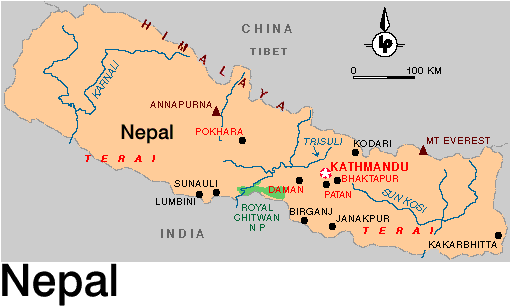
For more on Nepal check out the Lonely Planet info page.
|
For more on Nepal check out the Lonely Planet info page. |
Wednesday, 28 March 2001, DAY 6: 934KM � 1369KM | ||
The border between India and Nepal turned out to be another vast dry riverbed and we rode across a wide bridge to the little town of Kakarbhitta. The usual round of immigration and customs formalities, starting off with a trip to the bank to get some Nepali rupees. Nepal is pretty straightforward in terms of visas so we got that completed and headed to customs. More officials sitting at huge high desks � I was offered a seat and found my feet couldn�t touch the ground � and the usual piles of ledgers. The official was a tall, thin man with an impressive nose and a crusty blob of red powder on his forehead � I had forgotten that men do that too. He got Dave to fill in all the details on the carnet and in the ledger then dived off, presumably to find the boss who had the necessary stamps. After a few minutes he came back and presented the carnets to us, all signed and stamped� in completely the wrong place. They had completed them for exportation rather than importation. Dave explained what was wrong. Everyone sighed and scratched their heads. He said they would need to be done again. More frowning and mumbling. The officials squinted at the page and debated how they could erase the stamps. Finally our man let out an irritated �Bah!� and slapped the carnets back on the desk for us to fill in again. Another clear, slow, words-of-one-syllable explanation from Dave and the official dived off again. We waited tensely but when he came back the carnets were completed correctly. Smiles all round. We thanked him profusely and got the quick sideways duck of the head which seems to mean �Yes�, �Well, I suppose so� and �No problem� along with a variety of other things. We set off west along the Mahendra Highway and it was immediately apparent that we had changed countries yet again. The truck drivers were even more courteous than those in north-eastern India, some of them pulling right over onto the verge to let us past. But the main difference was in the road quality. The Mahendra Highway was genuinely a highway, wide and smooth and straight. The Nepalis also indulged in traffic management fripperies such as speed limit signs, no overtaking areas and a white line in the middle of the road. To be fair, no-one took much notice of these things, but it was still comforting to us to see them. We sped along the highway at 80 or 90kmh, more than double our average speed in Bangladesh, and it felt great to get some miles in. The road travelled through the Terai, the flat hot plain in the south of Nepal, very different from the more familiar mountainous areas in the north. The countryside was beautiful. We passed little stilted villages, sticking up above the green fields of the flood plain, our road a causeway through it. We crossed hundreds of bridges over dry riverbeds, each one with a sign with the name of the bridge and its span in metres. This part of Nepal must be a completely different country in the wet season as it seems to be traced with rivers every few kilometres. We passed through various towns, none of them very attractive (although you have to remind yourself that few towns look their best from the main road). We were looking out for somewhere to stop for the night, but the only place that sounded remotely interesting was Janakpur, famous as the birthplace of Sita. It was too far for us to reach in one day, more than 250km into Nepal, hours more riding. We agreed to just see how far we got and find somewhere in the afternoon. We stopped for a break at the Kosi Barrage, an unexpectedly modern structure built to limit flood damage from the Sapt Kosi river. On and on and on, and still nowhere that we fancied staying. We had promised ourselves that we wouldn�t ride at night but having travelled to far, it seemed a shame to then stay in a horrible place to we decided to keep going and make it to Janakpur. We stopped on a deserted stretch of road to replace the bulb in my headlight, and attracted a substantial crowd of onlookers � where do these people appear from? On and on and darkness started falling. A big feature of the ride so far has been the South Asian obsession with not driving with your headlights on. Everywhere we go people wave and shout, flash their lights and make a flashing sign with their hands, all trying to get us to turn our lights off. In some areas people get quite distressed, and even little children run along shouting to warn us of the terrible crime we�re committing. Of course, we can�t do much about this. Bikes in the west have their headlights permanently on. So as night fell we thought �Well, at least for once we�ll be allowed to have our lights on�, but no, people got even more animated. It got gloomier and gloomier, and still people shouted and gesticulated. Only when complete darkness had fallen did other vehicles put on their lights, at full beam, and we were allowed to ride without the usual chorus. It wasn�t pleasant riding late in the day. Not only was it dark, but with all the cooking fires on in the houses the visibility got very murky. Oncoming vehicles dazzled us with their full beams and people appeared and disappeared in the gloom. Finally after what felt like hours but was really about 45 minutes of this, we arrived in Janakpur at about 7.30pm, more than 12 hours on the road. After such a long day � a trip record of 435km � we treated ourselves to the best hotel in town, the Rama. Places claiming to be the best place in town can be awfully disappointing but the Rama really was pretty nice. We had another hot shower and dinner in the restaurant. The food was good and the d�cor was� interesting � a two-tone, cream and brown, striped and checked look that gave the place a sepia, Bonnie and Clyde, feel. | ||
Thursday, 29 March 2001, DAY 7: REST DAY | ||
We had had such a long day, and the Rama was so comfortable, we decided to stop for a rest day. It was a good decision as Janakpur turned out to be an attractive town with wide streets and little traffic. The town is considered to be the birthplace of Sita and the site of her marriage to Rama (Hinduism is awfully complicated so I won�t go any further with this) so it is full of sacred ponds and temples. The people seemed friendly and several times little children came up and asked to have their photo taken. We wandered and then got a rickshaw out of the town to a women�s development centre where local Mithila women are taught to use their traditional painting skills to make some money and be independent. We met another couple on an Enfield who had come up from Delhi. Theirs had a metal frame on each side with their rucksacks tied onto them, so we decided to try and organise something similar as my throw-overs were looking pretty precarious by now. In the afternoon Dave went to see if he could get my indicator fixed. The mechanic was very worried about the fact that my headlight was faulty and was, horrors!, stuck on all the time, but Dave reassured him and between them they managed to repair the indicator. Later we lay around watching TV, a real luxury now. We had been told that you could visit the Janaki Mandir, the temple dedicated to Sita, between 6 and 8pm. We had fully intended to go, but during our lounging in front of the telly �Runaway Bride� with Julia Roberts and Richard Gere had started. It was a truly agonising decision � crappy romantic comedy, or world famous Hindu pilgrimage site. We dragged ourselves out reluctantly and trudged through the dark streets of the town. Down a little market street, through a gate and there it was, a huge white palace, strung with white flashing fairy lights. It was like some pavilion at Blackpool or Brighton. Outside were little stalls catering to pilgrims� needs � strings of marigolds, bags of bright coloured powders, Hindu paintings and Indian sweets. It was mobbed and everyone was having a great time. Inside the huge doors of the palace was a large courtyard with small temples in the middle, one of which contained a famous statue of Sita. Everyone took their shoes off to go up to it, and men and women kneeled in front of it, touching their foreheads and lying flat on the ground in worship. Around the outside of the courtyard were smoky, pillared cloisters where the sadhus stayed and where other relics were kept. The whole place was incredibly atmospheric, the smell of incense and the quiet shuffling of the pilgrims. A group of musicians were playing in one of the cloisters and beckoned to Dave to join them. The moothie is not an instrument often featured in Hinduism so it was a great opportunity for some cross-cultural moothie missionary work but, unusually, he didn�t have it with him so they had to make do with their drums, cymbals and squeeze box. The gates were closed at 8pm so we had to leave although we could have stayed for hours. It had been the right decision to go although now we�re left not knowing what happened to Julia and Richard. Does she marry the PE teacher? Does he let his hair stay that weird colour? I�m going out on a limb here but do they, maybe, get together themselves? | ||
Friday, 30 March 2001, DAY 8: 1369KM � 1671KM | ||
Up early and packed up the bikes in the hotel courtyard before heading for Kathmandu. Lots of people were coming and going and one Indian family stood beaming as they had their photos taken with us. A Nepali man who had just come from Kathmandu chatted to us and he said it was a good road, �Just a little bumpings.� We set off north and then turned west again along the highway. We were riding through forests and at the side of the road monkeys were picking through the undergrowth. Little black faces with shocks of white hair round them. The road started to climb, up and up and the air cooled. There were scattered villages among narrow stepped fields, each level flat and smooth, some only a few feet wide. Children ran out of the houses to shout �Hello, hello, bye bye!�. Lorries full of workers waved and laughed. Unexpectedly the road surface deteriorated, with pot-holes, deep dust, pools of water and looping u-turns � really rather big bumpings. Hard going but good fun. Up, up and we finally reached the highest point of the road. We sped round a corner and there, suddenly, were the Himalayas, white and ghostly and spanning the whole horizon. I got a lump in my throat, it was just such an incredible sight. | ||
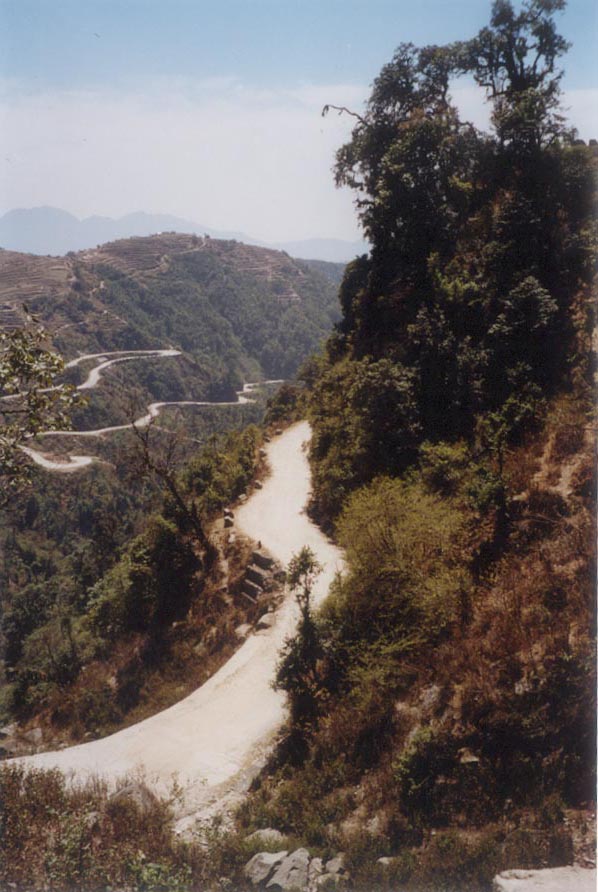 | ||
The long and winding road to Kathmandu | ||
Down down the other side of the ridge, twisting and winding into the Kathmandu valley. Some of the bends looped on for so long it was like we were spiralling down the hillsides. It seemed to be getting dark very early and then we realised storm clouds were gathering. We stopped and put on waterproof trousers just as big spots of rain started splatting down. The road got very busy with trucks, some going painfully slowly, so the last hour into the city was a slow and painful and wet process. | ||
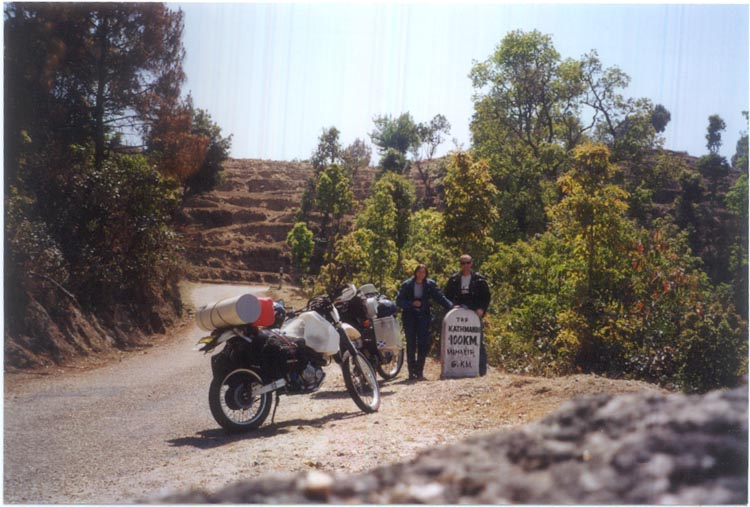 | ||
The sun still shining, we head for Kathmandu | ||
We arrived in Kathmandu in rush hour, or maybe it�s always like that, it was very busy at any rate. Dave has spent some time in Kathmandu before and had a fairly good idea of the layout of the city and we made our way slowly to the traveller district, Thamel. Weaving through wet, muddy streets, thronged with pedestrians and rickshaws, it was exhausting so we finally parked the bikes in a sidestreet and he set off on foot to find a hotel. We ended up in the Hotel Eco, a pleasant hotel a little off the main thoroughfare with a gated area for the bikes. Again they caused a lot of interest and the security guards all came to have a poke around and swore to guard such beautiful machines with their lives. | ||
Saturday, 31 March to Sunday, 1 April 2001, DAYS 9-10: REST DAYS | ||
Kathmandu, and especially Thamel, is a full on tourist destination. It�s heaving with young hippie travellers and also now, we noticed, many older, more affluent ones. Trekking, climbing, white water rafting, wildlife spotting, not to mention just hanging out eating, drinking and shopping, there�s something for everyone. It was a bit of a shock to the system for us after spending the last few weeks off the tourist trail. The streets are noisy and crowded and you are constantly being hassled by people selling Tiger Balm, or little chess sets, or crudely carved, miniature violins. Touts constantly sidle up to you and mutter �You want hashish?� and in the end you have to just switch off and not hear any of it. There are lots of bars and restaurants, many with music blaring � the Nepalis have a fondness for Euro-pop, or maybe they think travellers like it, so we got a much needed chance to catch up on all the latest Venga Boys and Steps hits. But it was nice to have a drink and relax and just wander around agonising over whether to buy a Ghurka knife, a Kashmiri carpet or just a whole load of prayer flags. The whole place is one big market, everyone is shopping and you feel a huge pressure to join them. It also has an amazing selection of western food compared to other South Asian countries and we goggled at the fruit and nut chocolate and Hobnobs and jars of olives. We did manage to get out of Thamel and catch up with some other Bangladesh friends, Maggie and Steve Young. We went round to their beautiful house for dinner and it was just lovely to be in a real home again, and eat home cooked food (not aloo gobi). Steve is head of VSO in Nepal and they�ve been living there since 1997 so they know all about the country. We found out there is a lot of political unrest in Nepal and a powerful Maoist movement which has complete control of some areas of the country. How come we didn�t know about this already? In the paper was an article: Women Maoists stage daring jail break. Not the sort of headline you see just anywhere. We bumped into an Austrian girl who is touring with her partner on two Enfields, the legendary old British bikes now manufactured in India. They are notoriously unreliable, but spares are dirt cheap and every mechanic in India can fix them so they are quite a popular option for people travelling overland. This couple had bought ones with sidecars and her mother was just about to come out from Austria to join them and travel with them in the sidecar. I don�t know if either of our mums fancies the idea but we could certainly talk about it� | ||
Monday, 2 April 2001, DAY 11: 1671KM � 1878KM | ||
We left at 7.15am for a short days ride to Pokhara. Pokhara is another very touristy town but it�s a beautiful place to visit as it�s near the mountains and sits on the side of a lake. A lot of the treks start there so there is steady flow of people arriving and leaving. We left Kathmandu on the same road we had arrived on, and slowly made our way out of the valley. Then the road changed again and curved and swooped alongside different rivers for most of the route. We spent the day looking at stunning views of sparkling blue green water and silvery grey sand. We stopped on one bridge and watched a raft negotiate some rapids, the occupants waving to us as they bounced past. We are still stunned by the range of different vehicles on the road, here and in the previous countries we've passed through. From the battered Tata trucks and buses, down through the less common four wheel drives and private cars, to the smaller baby taxis and weird little boxy metal wagons which seem to be for taking children to school. There are many other motorbikes too, although most very small compared to ours. Very occasionally they are ridden by women, but almost always men. And there is usually a pillion, frequently a woman sitting neatly side-saddle, sari flying behind. When the pillion is a man he seems to take responsibility for signals and waves his hands around to indicate upcoming turns or stops. Pedal power is the most common of all, with bicycle rickshaws being used for ferrying people as well as goods like huge piles of baskets, or sacks of vegetables, or rolls of woven matting. Bicycles themselves also carry just people, but frequently goods, with massive sacks hung over the crossbar as the rider walks the bike along. And any bike will do - we frequently see tiny boys riding a bikes far too big for them, left foot on the left pedal, right leg through under the crossbar to reach the other pedal. And then there's animal power, bullock carts pulled by two white buffalo-type beasts and here in Nepal the occasional horse and cart, which we hadn't seen in India or Bangladesh. And finally foot power - men straining to pull hand carts piled high with goods of one kind or another, or a group of small children, maybe six or seven years old, working together to do the same. You get used to seeing this sort of child labour and don't always remark on it, but then you think of nephews or godsons the same age or older and you get a lump in your throat. We arrived in Pokhara in time for lunch and settled into the Mandana Hotel, something of an overlanders� centre as there were also two German bikers (one on a BMW, of course, and one on a huge DR, the big cousin of my bike) and a Belgian couple travelling by campervan. They had all come from Europe so it was good to catch up and get some advice on the roads and routes we should be taking. We spent a lovely day sitting by the lake, eating and drinking. The main news of the day, however, was that the break in Kathmandu seemed to be just what the doctor ordered for my buttocks. My welts had taken the opportunity to sort of crust over � about as attractive as it sounds but far less painful than before so I was very relieved. | ||
Tuesday, 3 April 2001, DAY 12: 1879KM � 2063KM | ||
We headed south out of Pokhara early, with the mountains just visible through the morning haze, stretching across the skyline like craggy banks of clouds. We were planning to head south back to the main highway and then get as far west as we could, hopefully to Bardia National Park, although it was over 300kms away, which would be a long day�s ride. The road wound up through a green, forested valley. It was beautiful. Women passed us on the road carrying the traditional conical baskets by a strap stretched across their foreheads. We stopped to take a photo of the mountains before they disappeared and when we set off again disaster struck � my bike had died. The lights came on when I turned the key, but when I pressed the starter the whole thing seemed to fuse. Dave started prodding likely problem areas as a small crowd gathered to watch. A man appeared and made helpful suggestions. �Maybe you have the battery problem.� �Yes, maybe.� �Or the fuse. Maybe the fuse is problem.� �Well, yes, possibly.� Ted Glenn finally left and I was just thinking �What a beautiful place to break down,� when Dave worked out the problem � a loose connection in the battery, apparently a problem he had encountered before in Minis. So the Mini obsession that has held the Lawson family in its thrall for so many years has finally paid off. | ||
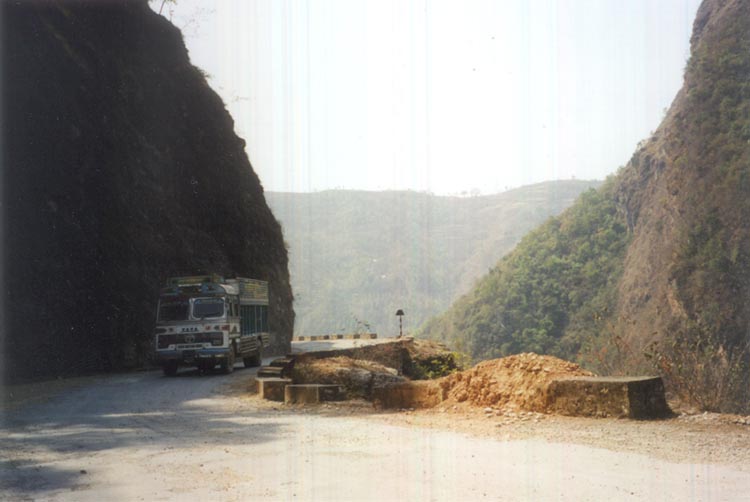 | ||
A typical Tata truck (habit of taking curves on two wheels not shown) | ||
We carried on through this beautiful valley, passing little villages and being dive bombed and raced by tiny swallows. Then without warning the road, which had been the usual high quality, simply disappeared and we were riding along through boulders, pebbles and dust. What road there was was pot-holed and ridged. Every now and then there would be roadworks, so we�d have to ride through a sort of wet clay. At one set of works some part of the process had created a cloud of dust so thick it was like looking through muddy water - we couldn�t see our own headlights. The countryside was still beautiful and we carried on with a steep drop to one side, looking down into a wide valley floor with paddy fields along either side of a river. We stopped and had lunch overlooking the Kali Gandaki river, massaging our battered behinds. | ||
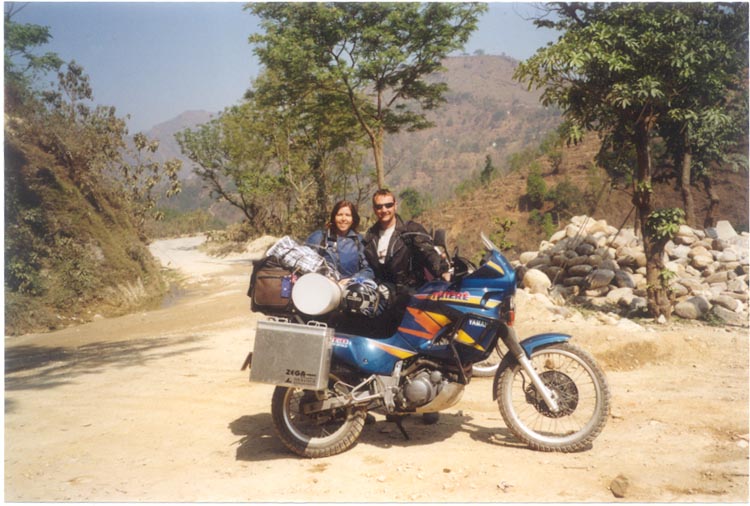 | ||
Putting a brave face on the big bumpings | ||
The road finally did improve around 1pm but it had taken us 6 hours to travel 120kms. We decided to rethink our destination and just see how far we got. The road dropped down onto the Terai again and the temperature rose. Somehow we missed the turning for the highway and by the time we realised had gone quite far south, into the town of Bhairawa. We debated what to do, then spotted an impressive establishment called the Glasgow Hotel. I seemed like fate, so we just called it a day and booked in for the night. The Glasgow Hotel was owned by a Nepali who had lived in Glasgow for several years running a jeweller�s shop. He had obviously picked up some delusions of grandeur from the erstwhile City of Culture as the place had a very upper class feel � a high ceilinged marble lobby and a very ritzy dining room. At the top of the stairs hung a portrait of the Queen circa 1956, perhaps not such a common sight in Glasgow itself, but it did add to the regal ambiance of the place. All of this meant that it was somewhat out of our price range but Dave haggled like a pro and got the price dropped by 60%. The only drawback was that we had to stay on the top floor. A hassle going up all those stairs, we thought, but no big deal really. What we didn�t realise was that we were essentially on the roof and our room had been baking in the sun all day long. The coolest it got during our stay was 32 degrees, and that was in the middle of the night with the fan on full blast. We ended up putting cloths in a bucket of water and then laying them across ourselves to cool down. | ||
Wednesday, 4 April 2001, DAY 13: 2063KM � 2522KM | ||
Bhairawa was near Buddha�s birthplace at Lumbini and several people told us that we should visit it, including the waiter in the restaurant where we had dinner. Dave said, �So are most people Buddhist in this area?� �No, no, sir, the maximum are Hindu.� I piped up proudly with one of my few pieces of Hindu knowledge, �But Buddha features in Hinduism aswell, he�s the ninth incarnation of Rama or� (I began to have doubts) Siva or� someone.� �Vishnu� our man said wearily. Dave smiled winningly and said, �Ah, Hinduism, it�s very complicated.� �Not complicated,� he snapped, �Buy a book. Read.� Well we tried that last time and I�m sorry but it just is bloody complicated. We would have liked to visit the sacred pool where Buddha�s mum gave birth to him (a surprisingly trendy way of doing it) but we had been warned that the road was again a little bumpings in places. We were both really sore after the previous day and the thought of even one bumping was just unacceptable to me so a little reluctantly we headed north, back to the highway. Heading out of town was a sign saying: Bhairawa � thank you for warm visit. Well they got that right. We sped along the highway making good time. There were more monkeys in the forest areas, one with a furious little red face. It also flashed us a bright red behind as it scuttled off so I felt something of a bond. The scenery was stunning again, as we wound our way through the Dundwa Hills � almost vertical, narrow peaks, valleys that plummeted straight down, beautiful autumn forests with great gouges out of them where land slides had happened. It was like something out of a Chinese epic, Crouching Tiger Hidden Dragon territory. And there were hardly any other vehicles so we felt like we could have gone back a thousand years in time. The road levelled off and we stopped for petrol. The lad who was filling the tanks said �You like cold drink?� and led us round the corner to an excellent little shop. It had everything we had been looking for along the road and had had trouble finding � three minute noodles, Baygon, plain crackers. It was the first time we�d seen any petrol station try the motorway services model and sell anything other than petrol and oil and we were very impressed. As we sipped our juices one or other of us kept saying �You really have an excellent shop here.� You could see the bloke thinking �You don�t get out much, do you�� but really, it was impressive. We carried on through forests and towns and then, on another bridge over a dry river, were two huge overland bikes. We stopped for a chat with the two Dutch riders who had come all the way from Holland through Eastern Europe, Turkey, Iran etc. They had camped most of the time just in the countryside, had even camped in the desert in Baluchistan which is not absolutely the safest place to be. No problem, they said, except that there had been a windstorm and their tent had filled up with sand. They made us feel like two old maids, staying in b&b�s and drinking tea out of a tartan thermos flask. Still, each to their own. We finally got to Bardia National Park, which we had naively expected to reach the previous day. We planned to stay there and we�re not sure what happened but somehow, again, we just missed the right turn off and ended up going straight through and out the other side. It�s hard to contemplate turning round and retracing your steps when you�re hot and sore and tired so we decided to keep going and make it to the border. 455kms in the end, another trip record, and we finally reached Mahendranagar, the town just before the Indian border. Again we felt we deserved to stay in the best place in town, so we rode to the Sweet Dreams Hotel. Through a gate and a circular driveway it was all looking quite promising but the hotel itself was flaking and tatty. No-one was around and Dave finally had to go and wake up an employee who took us to a room. It was expensive but he kept saying �Hot water, colour television, flush toilet,� so we gave in and flopped down. It transpired that the hot water wasn�t working, the toilet didn�t flush and the TV was entirely in Hindi but hey, it was still the best place in town. Dave went for a wander into the town, came back and muttered �Fly blown hole� so I decided not to venture out and we just had dinner in the hotel. We were the only people actually staying but a group of well heeled locals turned up to eat which seemed like a good sign. The food was fine and the dining room was decorated with those 80s posters of a shadowy face, half woman, half wolf. Ever so tasteful. We deserved an early night so we headed up to bed. A quick blast of Hindi telly and then we were just settling down to sleep when I could have sworn I saw a figure pass the window. And we were on the first floor. I froze and said through clenched teeth �There�s someone out there.� Dave surprised us both by leaping up, tearing the curtains open and hammering loudly on the window. It turned out there was a very narrow balcony running round the outside of the building. When Dave had jumped up to the window he thought he saw someone disappearing round the corner, so it seemed that we had a peeper. Dave carried on the heroics by going downstairs and complaining to the manager, saying that we had thought this was the best hotel in town and we had not expected such disgraceful happenings. The manager assured him that the security guard would keep a close watch and that we would have a safe night. Not too convincing but in the end we were so tired we fell asleep anyway. | ||
Thursday, 5 April 2001, DAY 14: 2522KM � 2918KM | ||
The border crossing at Mahendranagar goes over a barrage which is closed at certain times of the day and we had been given various reports about what these exact times were. So, to be ready for all eventualities, we set off at 6.30am, another record. The border was bustling with pedestrians and horse carts piled high with people. India and Nepal have a fairly free immigration policy with each other so people were just pouring across in both directions. We, however, had to go through the usual customs and immigration procedure. Immigration was closed when we passed so we carried on to customs and got the carnets. Then we walked back and got our passports stamped. 40 minutes, the quickest so far, and we were ready for our return to India.
|