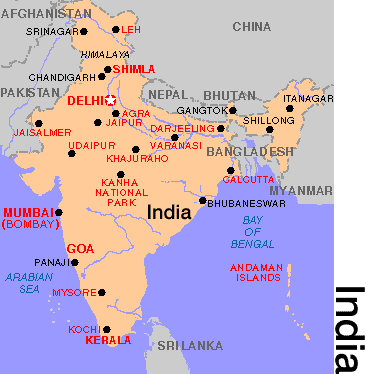
For more info on India, check out the Lonely Planet page.
|
For more info on India, check out the Lonely Planet page. |
Thursday, 5 April 2001, DAY 14: 2522KM � 2918KM | |
The no mans land between Nepal and India was over one kilometre wide and the main 'highway' connecting the two countries consisted of a rutted and dusty track. A line of horses and carts continually ferried precarious loads of Indians and Nepalis with bulging bags of belongings across the open border. The Indian customs officer seemed pleased to see us and admitted that he'd spotted us at the laughingly named 'Hotel Sweet Dreams' the previous evening where he'd been drinking with friends. He apologetically admitted that he'd had "a bout of beer... because one has to let one's hair down from time to time". When our Australian passports were revealed we had the now customary chat about the cricket while he painstakingly wrote down all the details of our carnets in his dog-eared ledger. At the immigration hut, there was a small queue of foreigners waiting to enter Nepal: two young Canadians who had arrived by overnight bus from Delhi and looked like it (they'd been sold a ticket for a 'Super Deluxe' bus which turned out to be a standard local bus with hard seats and chickens in the aisle which dropped them 10km from the border), and a French Canadian man in his 50s who was touring India on an immaculate looking Enfield 500. In fact he was looking pretty immaculate himself, with perfectly creased moleskin trousers and a pressed khaki shirt with a cravat jauntily poking from under his chin. He didn't look as though he'd been on an Indian road for 5 minutes never mind the twelve months he told us he'd been touring. When queried he admitted that he'd had to nip back to Montreal where his tenants had done a runner and his travelling allowance was threatened and had only returned the previous day, but he did add in defence of his appearance that he washed his clothes every day. And then we were back in India. We roared off from immigration with a flourish and a toot on the horn only to be halted about 30 feet later by a locked gate over the barrage. An ignominious start, especially as the locals on their little 100cc Hero Hondas squeezed past us and through the pedestrian gate which despite our best attempts proved too narrow for our 'heavy duty' motorcycles. We eventually caught the attention of the gatekeeper and, after encountering the same problem and the same solution at the other end of the barrage, were finally on our way. We had learned from our previous Indian experience that it is all too easy to lose one's way, a combination of the lack of road signs and the poor quality of the roads which give no indication at a fork which direction the highway might be in and which as often as not lead into the marketplace. I have to admit that having a really small scale map which covers the whole continent isn't really very helpful either. With this in mind I started asking directions the moment we crossed the border. The trick it seems is to ask three people which direction to take at any fork in the road, there is then by necessity a majority of opinion. Of course if it is a crossroads, you just have to ask as many people as you can. We have become quite adept at spotting people who are most likely to speak English and will head straight for the local pharmacist store or a motorycle-riding Sikh rather than the local tobacconist or rickshaw wallah. Having found several English speaking savvy locals, there is still the problem of my accent. I've never been known for my talents at mimicry (I wonder why Mo with her minah-like skills never asks directions?)and as I discovered on the Indian border there is a very specific way to say "Delhi". "Delhi" I say, "Delhi?" says the motorcycling Sikh, "Delhi" I say slightly differently, "Delhi?" says the pharmacist, "Di'li" say I in my finest 'Goodness Gracious Me' accent, "AH, DELHI!" they say in realisation. Well, yes that's what I said isn't it? And so it goes on at every junction. I hope there's a good map shop in Delhi, sorry "Di'li". Confident then that we were making good time in the right direction, we were dismayed 85km later when we stopped in a nameless town for a drink to be told by a Sikh on a motorcycle that Delhi was in fact back the way we had come. Doh! We searched for and found a book shop where we were sure we'd find a map. After much gesticulating and saying "map" in as many ways as I could think of, the shopkeeper somehow understood and produced a large and unwieldy laminated map of India - where on the bike he intended me to hang it I'm not sure. By this time a respectable crowd that many Scottish First Division clubs would have been pleased with had grown around us. Normally the hordes of onlookers are pretty placid and content to stare silently. This time however they appeared more like football fans after a draw - they still wanted some action. They started off by jostling each other and quickly moved on to jostling the bikes and then finally jostling Mo, apparently in an attempt to reach me to find out what I was doing with a big piece of stiff plastic which was never going to fit onto my bike. Just in time, a policeman arrived who not only started shouting abuse at them all, but who could speak enough English to re-direct us onto the highway 15km or 51km away - both of which he agreed were correct when we repeated the distances to him. So 51km later we got back on the highway and finally turned northward to Delhi. The remaining 270km or so to Delhi were on a well made highway which didn't deviate, and wonder of wonders was signposted in English. It was immediately apparent that we were on Indian roads as trucks began to bear down on us two abreast expecting us either to stop or to ride onto the verge, or both. Fortunately we'd become used to this and I generally managed to give some sort of rude sign to the driver as I glimpsed the whites of his eyes just before diving off the road within touching distance of the tassles suspended cutely below his front bumper. A bit unfair really as this is just the way that people drive and might is apparently right. It makes me feel better though. Mo's and my driving style are quite different. She is still very polite and will still give way to aggressive cars and bikes coming from behind us in traffic, while I have embraced the Indian driving philosophy and tend to try to stay or get ahead when I can. Most vehicles here are trucks and buses and most of the private cars are little underpowered and always overloaded Maruti Suzuki cars or vans. It frustrates me to have a tiny car packed full of people toot its horn insistently, then barge its way past me in the centre of a busy town only to run out of steam at about 40km/h and get in our way. I think I'll have to chill out a bit more! We had stopped for a few minutes at one of the many level crossings and just as the train came through and the massive queue which had squashed up against the gates from all sides prepared to squeeze from six vehicles wide to two in 10 feet, an Indian man came up and said "I would like to talk to you". I immediately responded with the usual "we're from Australia, started our trip in Bangladesh and are going to the UK". This wasn't enough for him though, he'd spotted the AUS plate on the bike and he had been to Australia himself, and he had to talk to us. I apologised, explained we were in a massive hurry and had to go. He looked hurt as we drove off at the head of the queue but what can you do? 500 metres down the road, a little car flashed past at high speed scattering cyclists and pedestrians before it and executed a neat hand brake turn in the dust at the roadside, and before we could pass it the driver was in the road in front of us with his hand held up in front of him. "I would like to talk to you". OK then, I said not wanting to argue with a psychopath. So what a lovely chat we had. Where were you in Australia I asked? "Sydney". Did you enjoy it? "Oh yes, very much enjoyed" mmmm...well, goodbye then. We waited patiently while the remains of the queue from the level crossing filed past us. So we came to Delhi at last, the final 30km on a lovely safe divided highway - even a Tata truck couldn't cross the central reserve so we felt quite safe. Our friend Clarissa lives in Sunder Nagar, one of Delhi's many exclusive housing enclaves and we found it on our Lonely Planet map with no trouble. So we crossed the Yamuna river, stressed round the ringroad at rush hour for a few kilometres and then we were there. What a relief. We met Clarissa in Bangladesh in 1997 where she was working for Water Aid, a British organisation providing clean water to mainly slum communities in Dhaka. We had the pleasure of sampling her hopitality for a week or so then so were looking forward to a little pampering now. Clarissa and her son Matthew moved to Delhi 18 months ago where she works for the World Bank on the Water and Sanitation Programme in South Asia, so she has various projects in India, Nepal, Pakistan and Bangladesh. The World Bank is very generous with its housing allowance which we were very glad about when we found Clarissa's apartment on 'millionaires' row', two doors up from the Maharajah of somewhere or another's house. We had our own room already waiting for us next to the roof terrace and it was wonderful to be able to soak away the accumulated grime from ourselves and our gear. The bikes even got their own garage. What a day. | |
Friday, 6 April 2001 to Wednesday 11 April, DAYS 16 - 21: REST DAYS | |
After the relative cool of Kathmandu and Pokhara, Delhi was like a cauldron simmering at a constant 40 degrees. According to local opinion, the summer heat has descended early this year and each year the top temperature gets higher and higher. There is a predicted top of over 52 degrees this summer so maybe we should consider ourselves fortunate we arrived in Delhi in April and not June. We are both quite conscientious about wearing all our protective gear: jeans, leather boots, back protectors, jackets with body armour, gloves and helmets. We are therefore not looking forward to the deserts of southern Pakistan and Iran. Actually I wouldn't be too surprised if we start shedding layers as we head south. As far is clothing is concerned, Mo will have to come up with some compromise in Iran that is modest but realistic, otherwise she'll just swelter. We had been looking forward to reaching Delhi as it was the first real opportunity for maintenance and modifications to the bikes. Mo's panniers have been a source of concern since they are only suspended from a wide strap over the seat. This system is unsatisfactory not only because it allows the panniers to bounce up and down dangerously close to the swinging arm, the back wheel and the exhaust, but because the strap flattens the padding of the seat and leaves poor Mo with a rock hard platform for her much abused buttocks. We were therefore hopeful we'd be able to find a resourceful mechanic/welder in Delhi to create some sort of solid carrying frame. Alphonse, Clarissa's driver, assured us we would find someone. "Indian mechanics are very good. They use their imagination actually." Many of the little bikes in India have a small fibreglass pannier box held in a metal frame bolted onto the right hand side of the frame. After much discussion our only option seemed to be to buy two of these right hand frames and bend and cut them to suit. Mo's DR350, being a trail bike, isn't really designed to accept a luggage system so it took a fair amount of cajoling for the shop 'mechanic' to bend, hammer and bolt the first one into place. It then took a further afternoon at the welders shop to finish the job. I also took the opportunity to add a few supports here and there and basically to have them custom made. The welder even painted them afterwards (with a dollop of paint from the paint shop next door and an old rag). The great advantage of getting any labour intensive task done here is the cost - an hour of a mechanic's time in Sydney cost AUS$65 or US$33, whereas in Delhi to buy both racks and get them welded, which took about 4 hours, cost US$27. Bargain. And the best thing is that he did a really good job and the frames seem really solid. Both bikes were due for an oil change so after a bit of a search, I found a Shell station that had an engine oil that sounded vaguely familiar. I also needed to get some oil for our 'Scottoilers', the automatic chain oilers that were kindly donated by my ever generous parents. However, they use a 'special' type of oil sold in Glasgow but not in Delhi. My brother James kindly called the company and was told that of course you don't need to use 'Scottoil', chainsaw oil would do fine. That might be helpful elsewhere but there isn't much call for chainsaws in metropolitan Delhi, a congested city of 10m people. I did ask at a garden centre but my charade of a chainsaw was met with blank stares so I concluded they just pay a man with a big pair of shears. So I took the bike round to the garage and after a very non technical discussion in sign language which involved lots of people rubbing the remains of my Scottoil between thumb and forefinger and making various grunting sounds, I eventually settled on 2 stroke oil. I'm glad to report it seems to be working. I then spent several extremely hot afternoons in the garage changing oil and oil filters, and cleaning and oiling the air filters. Mo's headlight had blown again so that had to be changed, plus I went round both bikes checking and tightening various nuts and bolts and oiling whatever I could. The next maintenance stop will be Rawalpindi in 3000km after returning from the Karakoram Highway so I hope I did it right! We didn't get too much chance for sightseeing what with fixing the bikes and updating the website, not to mention the searing heat, but I did take a wander to the closest of the tourist attractions, just a few minutes from the apartment. Purana Quila is an old fort built in the 16th century by the Afghan ruler Sher Shah. All that is left is the impressive but crumbling perimeter wall and a mosque inside, which was unfortunately locked. I would have enjoyed it more had I had not been followed by several people and the stares of hundreds of others, mainly the many courting couples lounging on the grass. I also felt it was a little unfair as a foreigner to have to pay 50 times the local entrance fee. Maybe ten times, but 50 seemed excessive. All of India's monuments now have a substantial entrance fee - the Taj Mahal is US$20. Apparently many of the backpackers who made up a substantial portion of India's tourism trade have just stopped going to Agra as a result, and a whole section of the tourism market has collapsed. We got a look at several of the markets frequented by the inhabitants of the more exclusive parts of New Delhi. There is clearly a large and affluent middle class judging by the well-stocked shops filled with western and Japanese goods. They even have imported magazines, including the great British institution Hello! Magazine. The edition available when we were there had the cover story "Carol Vorderman: A new love. A new life." Hard to imagine the average Delhi inhabitant caring much about the lovely Carol, but apparently they do. The more upmarket restaurants and clothes shops charge western prices and many Indians dress in western clothes and talk in English. This apparently is not a middle class affectation but rather a result of the numerous regional dialects and various languages spoken throughout India which make English the common language. Now that cable or satellite TV is becoming universal, there is an enormous cultural crossover and many apparent cultural contradictions. Older Indians appear to be quite traditional, dressing and behaving modestly. The younger people however have embraced MTV culture and seem far more liberal in their attitudes or at least in their dress. It really is a place of contrasts. The old world meets the new here and the two seem to co-exist. Our glimpse of Delhi social life, for a foreigner working here at least, showed us a round of dinner parties and visits to restaurants and nightclubs, like anywhere in the west. There are also the various clubs, American, Canadian, etc which presumably exist wherever there are diplomats. Mixing in the world of foreign aid workers and specifically World Bank Employees means that you meet a very cosmopolitan and interesting mixture of people from all over the world who have all worked in exotic places and been involved in important projects - at least to outside eyes. Clarissa for some reason knows a number of people who have been kidnapped. One Australian bloke Peter, whose wife we met in Bangladesh, had been on the Indian Airlines flight hijacked and diverted to Afghanistan where it sat on the runway for something like 8 days in December '99/January 2000. Pretty disturbing experience from which he appears to completely recovered. He had been on his way to Delhi to meet his wife Anthea and to spend Christmas with Clarissa and Matthew, so poor Anthea and Clarissa spent a sleepless week waiting for news and picking at cold turkey. Another English lady we met here had been working in Africa when she was held by the Tigre Peoples Liberation Front (I think) for six weeks. That experience sounded a lot less stressful as they seemd to spend most of their time playing rounders. The last time we were in Delhi in '97, we were pretty appalled by the pollution which was apparently among the worst in the world. Strangely enough, one of the first things we noticed this time was that it didn't seem as bad. It turned out that on April 1 this year, a law came into effect which forced all public buses and taxis to use CNG. Apart from the small detail that less than half of the public buses had been converted in time, and that Delhi commuters were consequently stranded on 1 April, it seems to have been an instant environmental success. Even the little baby taxis, the three wheelers which are powered by two-stroke Bajaj scooter motors and which are notorious for pumping out clouds of blue smoke behind them, have changed to gas and are strangely visible from behind now. They are also attached to the traditional painted slogans, the most common being 'Keep your distance' but the one we wanted to jump right into sported 'Love Coach'. Alphonse had no time for the baby taxis. "They are rats in the road actually". The other form of transport we've noticed here is the large three wheeled taxis which look straight out of Mad Max - home-made and very unsafe, with parts borrowed from various other vehicles. They have some sort of clunky diesel engine suspended over the front wheel and have a long, long bonnet hanging between the cab and the front truck wheel which always looks in danger of imminent collapse. We steer clear of them, not that that is too difficult since they only appear capable of 20km/h and are usually packed with about 20 people. So we have to say a big, big thank you to Clarissa and Matthew for putting up with us for so long and for looking after us so well. Thanks also to Kanchi for the beautiful food and to Alfonse for ferrying us around and for letting me experience at first hand how scary it is to ride a 1990s motorcycle with 1950s brake technology (beware anyone considering buying or riding an Enfield 500). | |
Thursday, 12 April 2001, DAY 21: 2918KM � 3223KM | |
Clarissa and Matthew got up to see us off so it was more tearful goodbyes before we set off through Delhi, heading north for Shimla, another hill station. I had been very worried about making it through the city as the driving can be wild, but it seemed that we had missed most of the traffic and we made it onto the ring road and round to the highway without incident. It was a fairly good road and we made good time, keeping to around 90kmh most of the time. Unlike in Bangladesh and Nepal, we are definitely not the fastest things on the road any more - jeeps, four wheel drives, little Maruti cars and the occasional BMW all hurtle past us. When we reached Chandigarh, a city purpose built as the capital of Himachal Pradesh (a kind of Cumbernauld of the East) we could see the hills in the distance and soon the road started to climb and the temperature drop. Hundreds of monkeys sat along the side of the road, with lots of babies cavorting about cutely. Again we spent our time nipping past the trucks labouring slowly up the hills. The local transport authority seemd to take the risks of driving on the winding roads very seriously and there were lots of warning signs: Rash driving: an invitation to death. Accident in hills means death. The general attachment to slogans was also still evident on the buses and trucks, with one bus sporting the legend: Take poison do what to belive no girls. And who amongst us can honestly say we haven't thought the same? I was exhausted as we hadn't had much sleep the night before, packing up to leave, so we stopped a couple of hours short of Shimla in a little town, Kusauli. We ended up in a fairly grubby place, the Hotel R. Maidens. We asked, but no-one seemed to know or care what the R stood for. We got settled and then discovered there was no running water. I went to sleep to avoid having to think about the implications of this. When I woke up we went for a walk out of the town. Kusauli was a minor hill station in the time of the Raj and this was reflected in some truly palatial bungalows with names like 'Fairview' and 'Sunnyside'. The hills were covered with tall pine trees and it was easy to see why the British used this area to escape the heat of the Delhi summers, just as we were doing today, and as the Indian middle classes now do each year. We stopped for a drink in the best hotel in town, the Alisia. The bar was upper class shabby, with arm chairs scattered around and a piano in one corner. The manager, a tall military type, came up and welcomed us. He spoke beautiful English and obviously ran a tight ship, barking out instructions to his staff to get us popadoms and chips which we hadn't actually ordered, but he assured us were the best in town. Some of the hotel's guests were in the bar too. One of them told him she was only wait-listed on her flight to Delhi. "Give me your ticket, and I will see what I can do. My friend is the ex-Chief Under-Secretary to the Transport Commissioner. I will call him in the morning." He was obviously a very big fish in a pretty tiny pond. At 8 o'clock the electricity went off, apparently a very regular thing, so we finished our drinks by the light of a gas lantern on top of the piano. We walked back to our hotel in the pitch dark, and stopped to look out over the twinkling lights of the hill villages. Suddenly a whole swathe of lights disappeared - it was their turn for no power - and sure enough just after we got back our lights came back on. Back in the room we noticed a sign above the bathroom door: Water is precious. Please bear with us. Running water timings, 7am - 9am. Disappointing as we planned to leave at 7am. It was a cold night so for the first time we got our down sleeping bags out and snuggled up for a cosy night. | |
Friday, 13 April 2001, DAY 22: 3223KM � 3299KM | |
We woke at 6am and heard rain pouring down outside so we re-thought our plans for the day and went back to sleep until 9am, when the rain seemed to have cleared. We set off back along the winding road to the highway and the main hill station, Shimla. The warning signs along the road side had obviously hit home and the other vehicles on the road were taking it very easy. Even the little Maruti cars, packed with four generations of the same family and with 50 plastic bags stuffed along the back parcel shelf, which usually hurtled around with a complete disregard for road safety. Even they were pulling over to let us past - no rash driving at all. When we got to the highway we stopped for petrol and the man was surprised to see us as the road back to Delhi had been blocked by a big accident. A shame, but at least it meant that our road was pretty quiet. We carried on through beautiful scenery. At the side of the road were the usual little cafes and shops, almost every one with a sign advertising jams and chutneys for sale. There was even a jam factory shop. It was as if the Women's Rural had taken over control of the government. Or perhaps this is another remnant of the Raj, all the British memsahibs up from Delhi filling their time by putting up a good stock of preserves. They clearly left the local population with an urge to do the same. The rain came on and we scrambled into our waterproof trousers, jumping back onto the bikes quickly in the cold. A little too quickly in my case as it turned out I hadn't pulled my trousers up quite far enough. When I got onto the bike my feet simply couldn't reach the ground and over I went. Fool. It was only about 70kms to Shimla so we got there around lunchtime. It's an amazing town, perched along a high ridge with terraces of buildings tumbling down on either side. We got a bit lost and couldn't find the centre of town. It was still raining and we ended up shivering in a side street. A little Sikh man jumped out of a taxi in front of us so we asked directions to The Mall, the main street. His instructions were very confusing and we finally worked out that The Mall was pedestrian so we couldn't go there anyway. Dave asked if he could recommend a good hotel and, lo and behold, did he not run the very hotel we were standing next to, the Sukh Sagar? It seemed rude not to at least look so we went in and looked at a room - a circular bed, colour telly, view of the hills and 24 hour hot water. We'll take it. In the afternoon we walked up into the town. Up is the only way you can walk into Shimla due to its precipitous position - the first exercise we'd had for a good while. The Mall is a long road which runs along just below the very top of the ridge on the opposite side from our hotel. In British days Indians were banned from entering it but times have certainly changed for the better and the whole place was thronged with Indian tourists. The thing to do is promenade along the length of The Mall and back, so that's what we did for most of the day, catching up on emails, looking in shops and stopping for coffee in the famous Indian Coffee House. The Coffee House is a large room with leather bench seats around the walls, exotically turbanned waiters, and groups of Indian men debating politics. Very atmospheric, with a portrait of Ghandi on the wall along with a sign stating: Out Side Eatables Prohibited. Apart from good coffee they also serve masala dosa, my all time favourite Indian food, so we spent some quality time in there over the course of the day. | |
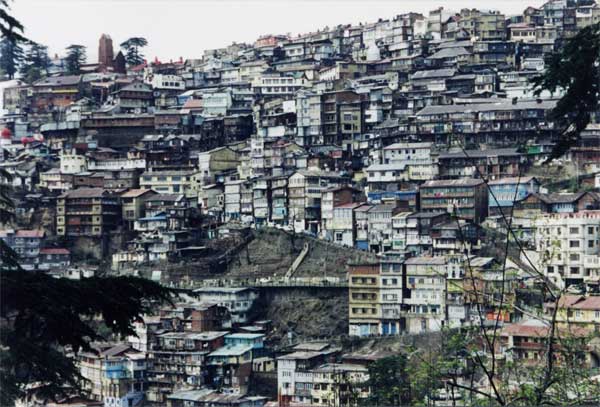 | |
Terraced buildings of Shimla | |
It really is cold up here so the locals dress accordingly. For women this means a knitted cardigan over their saris, which always looks a little odd. The men wear woven straight waistcoats and jackets with brass buttons and little stand up collars something like what Nehru used to wear. They also wear little woven wool hats, a short pillbox style in soft grey or beige. A flap folds up at the front, often dark green velvet with red binding, sometimes mixed colours. They look really smart. The military up here looks very smart too, in green cable knit sweaters. The soldiers posted in the centre of town also sport bizarre khaki turbans, with a rigid fan shape sticking straight out of the top and another out the back. Dave wants to take a photo but I can't help feeling they must know they look a bit poncy and might arrest us for being disrespectful. He says everyone loves getting their photo taken, and he's probably right. We also spent some time browsing in bookshops. We were surprised by how good the bookshops in Delhi were, and these were OK too although all with very similar stock: P.G. Wodehouse, Louis L'Amour, William Faulkner, Mills and Boon. There were also lots of self-help books including some dusty copies of classics like 'How to make friends and influence people'. Another major section in every shop was sex guides, literally dozens of them. We spotted one called 'Improve your sex efficiency'. So if efficiency is what you're looking for in your sex life, this is just the book for you. We spent the whole day in town as we knew we wouldn't manage the vertical hike to The Mall more than once in a day. We got back to the hotel after 9 o'clock and turned on the TV. Now this is a strange thing, but I swear it is the truth. What was on but 'Runaway Bride', about half way through, probably 15 minutes on from where we left it in Janakpur a fortnight ago. We settled in for a blissful night of crappy romantic comedy. So own up - which one of you wrote to Star Movies' India scheduler and said, "I've got these friends, right...". | |
Saturday, 14 April 2001, DAY 23: REST DAY | |
Unbelievable, but I'm writing this on April 14th, so we are officially up to date! We woke up at 6am as usual all set to head up to Dharamsala, the home of the exiled Dalai Lama, about 9 hours north of here. We had left our curtains open so we could enjoy our spectacular view at dawn but all we could see was white fog, accompanied by the sound of rain lashing down. We snuggled down again and decided to wait and see how things were looking in a few hours. At 9 a couple of ridges were visible through the clouds but as we watched they disappeared again. The rain was off and on and as the journey to Dharamsala was a full days ride on hilly roads we decided to just leave it for a day and hang out in Shimla in the hope that the weather would improve tomorrow. We had breakfast in the hotel - opting for 'porched' rather than 'scrimbled' eggs - and then headed back up to town to do exactly this, get up to date with the website. As we reached the top of the ridge we looked out over an incredible view of hills stretching into the far distance. Not a bloody trace of fog. Bugger, we should have gone for it. Still, it was too late to do anything about it, so we settled in for another day in Shimla. We've been stuck in worse places, that's for sure. (And who knows what will be on Star Movies tonight?) We strolled around the town, exploring a bit further afield in the lower bazaars, away from the tourist area. We picked our way through piles of vegetable rubbish, past some fairly confronting butchers shops and fish markets. We ended up in a Tibetan market. The women wore kimono-type dresses, belted and crossing diagonally at the front with woven apron panels hanging down below their knees. We plan to set off to Dharamsala tomorrow no matter what the weather as you just never know what it's going to be like around the next corner. | |
Sunday, 15 April 2001, DAY 23: 3299KM � 3597KM | |
It was a mammoth Internet session that night and as I was finishing off Dave got talking to the other customers. Most of them were groups of teenage boys surfing the web to look at... what teenage boys look at. A bit distracting when you're sitting trying to write an engaging and wholesome account of your holidays. But one lad managed to tear himself away and talk to Dave. The usual "What is your country?" and then, prompted by the Madonna album blaring in the background, Dave said, "So do you like Western music?" "Oh yes, I like very much. I like Jennifer. And Britney Spears. Are you liking Britney?" "Well, not really." "And Ricky Martin. I very much like Ricky Martin. Are you Ricky Martin fan?" "Not exactly, no." The conversation faltered with this lack of mutual fandom, then he piped up "Do you like the chatting?" "Oh, yes", said Dave gamely, sensing an area of common ground, "I very much like chatting." "I also like the chatting. It is the occupation of the teenies." "Um?" "The teenies... the teenagers. It is not commonly the occupation of the..." he gestured vaguely towards us. "Old people?" Dave offered. "No, no. The married people." After what he and his mates had been looking at on the Web he clearly had unrealistic expectations of the daily routine of the married people. The next morning the view was grey but it was dry so we got packed up and set off. Again, when we crossed into the other valley it was clear so our hotel was obviously in a cloud shadow. Or maybe our windows were just really dirty. We set off back down the road we had arrived on before turning north for Dharamsala. The road weaved down through the hills - more doom-laden road signs: Dashing is Danger. And the rather nifty: The minutes you save may be your last, the life you save may be your own - and gradually sank down into a long valley. We had a long ride ahead of us so we didn't stop much, although we did manage to chat to two groups of bikers, six altogether on a total of five Enfields. This is more than we had seen in a week previously, so we're obviously in a popular place for bike touring. One group was heading to Belgium and had to be back by the end of June. They were very relaxed about it, so it made us feel better about our own schedule. We had gone to one of the best restaurants in Shimla for lunch one day and had a very expensive, very ordinary meal, so we had made the decision to eat at little local places instead. This new policy came into effect at lunchtime when we stopped outside Mandi, a market town sitting high above a beautiful blue river. We stopped at a little stall and the man proudly showed us his menu. We ordered and ate a truly delicious, steaming hot omelette and knew we had made the right decision. Until we started vomiting a mile up the road. No, no, only kidding, we were fine. | |
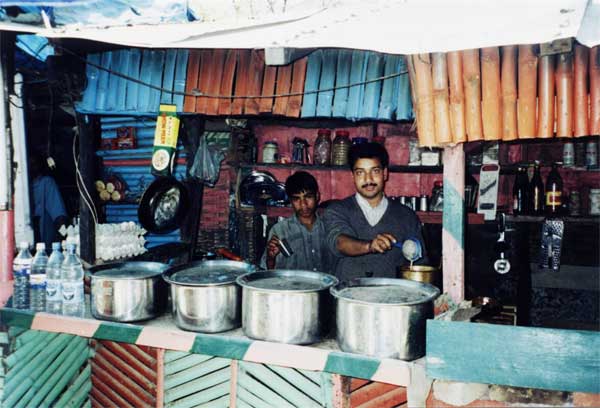 | |
Best omelette north of Delhi | |
The road started climbing again and there was a sign: Slapper 20kms. Slapper got closer and I was sure Dave would want to stop and get a photo of me beside the sign: Welcome to Slapper, but he rode on regardless. We passed through another lovely wide valley (these places have names but I don't have the map with me - I'll add them later) of green and yellow paddy fields and little villages. We passed more travellers on Enfields, one bloke stripped to waist. It seemed like an odd decision - doesn't he realise Dashing is Danger, particularly when you have lots of bare skin showing. We rode through showers of rain and then, round a bend in the road, there were the mountains again, rocky and snow covered in the distance. The road wound upwards and suddenly we were stopped by several parked trucks, the drivers lounging to one side. We picked our way past them to find another set of roadworks had dug up one side of the road, the other side was blocked with a truck. They waved us through and we had to negotiate really tricky ground - over rubble, through deep ridged mud. All with an audience of thirty or so workmen which makes that sort of thing so much easier I find. On again and round another bend a vast green plain opened up in front of us, hills on one side, mountains on the other. Unexpected scenery, I can't quite imagine the geo-history of the area - Dave reckons a prehistoric ocean floor, which could be about right. We had come a long way and were sore and tired when we finally reached Dharamsala. After about 250kms everything begins to hurt - hands ache, backs ache, ears are squashed and sore, my dodgy hip begins playing up and I have to ride with my leg stretched out straight. Very much looking forward to a hot shower, we were just weaving through the town when - disaster - I ran out of petrol. This happened in the middle of the busiest junction, on a very steep hill, with the ground wet with rain and mud. I just stood hanging onto the bike until Dave made his way back to me, we got the bike turned round and I rolled down the hill out of the way. Reserve on, we had to go back down the road 10kms to the nearest petrol station. Neither of us in the mood at all, and the bloke overfilled my tank so it leaked all over me as I rode along afterwards. We gritted our teeth - there will be days like this. Another of the people Dave had been enjoying the chatting with in Shimla was the owner of a hotel in Dharamsala and we had agreed that we would stay there. It was actually in McLeodganj, a village a few kilometres up the road from the main town, where the Dalai Lama's residence and temple are, and where most travellers stay. Another horrible wet and slippery arrival, we found the Green Hotel and got installed. McLeodganj is another real traveller zone, and the streets were busy with dreadlocked backpackers as well as Buddhist monks, Tibetan market stall owners and a few locals. We soon realised we looked very out of place as most of the other travellers had adopted a pseudo-Tibetan look and were swathed in various shawls and scarves with three-quarter length trousers and thick stripey socks sticking out of their hiking boots. They looked really good actually, very funky, and we looked like someone's mum and dad in our fleeces and autumn tones. We had a much needed hot shower, went out for dinner and had a much needed cold beer. I should say, just to keep you up to date with the travails of my behind (and thanks, everyone, for your emails of support and concern), that the new foam in my seat has turned out to be an absolute triumph. Soft and forgiving, I'm in buttock heaven. | |
Monday, 16 April 2001, DAY 25: REST DAY | |
We spent the day wandering up and down the little lanes of the village. It is still wet and muddy so the roads are very slippery. Dave is all over the place, slithering and windmilling around, much to the amusement of the locals. Clearly his old surf shoes are out of tread, so any ideas of trekking will have to be put on hold unless he gets some new shoes. | |
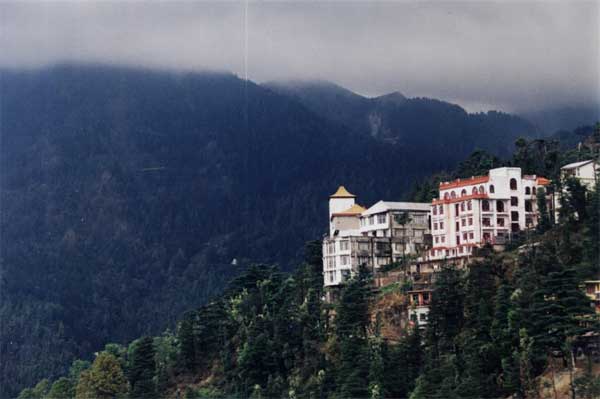 | |
McLeodganj in the clouds | |
Obviously the Dalai Lama is the big pull here and his picture, books and words of wisdom are for sale everywhere. Continuing something of a theme for this trip, Richard Gere is also a well-known McLeodganj alumnus, and our guidebook gives details of the cafes and restaurants he patronises when he is in town. We plan to visit them all, of course. There are lots of beggars in the village, many with fingers and feet missing, so it looks like leprosy is still a real problem. There are also lots of Buddhist monks, some of them Western, all with shaved heads, red robes and black umbrellas. We bought a black umbrella ourselves as the rain was still threatening, and as this is the key monk-ly accessory we think we may have achieved the first stage of enlightenment. Many of the travellers are obviously hoping to do the same, and some have really embraced breadline-chic - tatty red robes, bare feet, matted hair. Hopefully they'll be heading back home soon to take up their place at uni before they do themselves some damage. We walked up to the home of His Holiness, who is out of town at the moment, and a sign ouside the temple said: Circumambulate this way (isn't that an old Marx Brothers gag?) so we did. It was very peaceful, and the inside of the temple was beautiful. There is something very engaging about Buddhism, so much of it makes such obvious sense, you can see why it attracts so many converts. | |
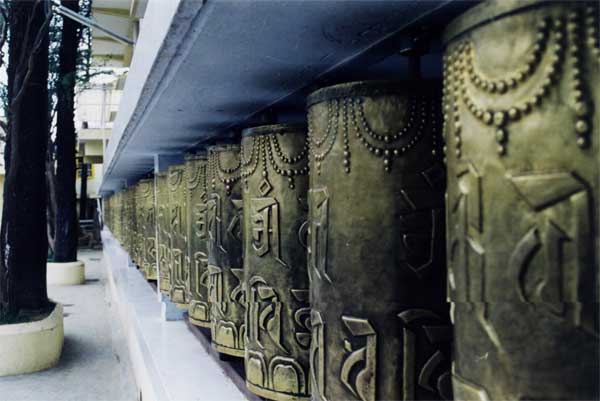 | |
Prayer wheels, possibly touched by Richard Gere himself | |
Tomorrow we leave for Amritsar and the next day, Pakistan, so we'll report in from there. | |
Tuesday, 17 April 2001, DAY 26: 3604KM - 3820KM | |
We set off at 7.30am in drizzling rain, picking our way through the muddy streets. After a mile or so Dave stopped - one of his panniers was banging against the side of the bike. On inspection, it looked as if the box itself had buckled, and was now bending in at the bottom. This was a worry as it meant we were overloading it, and would have to move some stuff. But where to? We set off again, turned onto the road going west and through a series of hairpin bends rapidly dropped into the valley. The usual little villages and towns, and beautiful views across the plain. Little farms with wide terraced fields in patchwork yellow, brown and bright green. The contours slid around old trees and the huge boulders which lay dotted around. The rain was fairly steady so it wasn't a great day's riding and we just slogged on. Around lunchtime we stopped at a petrol station and noticed something drop from Dave's bike. It was a tiny bit of fairing. We checked around and there, on the front, were three big cracks with a hole where the missing piece had fallen. There were also some scratches on the front - at some point in McLeodganj Dave's bike had been knocked over. That was why the pannier had been out of shape and hanging out of alignment. The bike itself was clearly fine as we'd come quite a long way, but the panner frame had been bent and the fairing would have to be replaced. Very bad news. Dave took it all very calmly, but it was a horrible moment. We got to Amritsar in the early afternoon. It seemed like an attractive city, with wide streets and, something of an oddity, traffic lights. We had decided to try to stay at an Amritsar institution, Mrs Bandhari's Guest House. An old Raj residence run by an old Raj-type Indian lady, it was a little out of our budget but sounded like it was worth it. After a good while of riding around in circles we finally found it. A huge house, set in beautiful gardens, it was just what we'd been hoping for. Sadly the prices were not - they had gone up considerably since our guide book had been written and were way out of our league. However, it was possible to camp in the gardens. So, for the first time so far, in the rain, we got out our tent. It is a law of nature, as immutable as gravity, that it rains when I camp. So there it is. Showered and changed, me into the shalwar kameez that Clarissa had given me, we set off for the pride of Amritsar, the Golden Temple. Based on our experience of temple burn-out on previous trips, we had avoided visiting many 'sites' on this journey, but the Golden Temple sounded like it was worth a look. Amritsar is the holy city of the Sikhs, and the temple is their holiest site, where the original copy of their holy book (the name of which escapes me, apologies to any Sikhs reading this) is kept, among other treasures. We hopped in a richshaw and sped through the city, along wide boulevards and through little, canyon-like market streets. Outside the temple, like everyone else, we took off our shoes and handed them in at the huge shoe stall (just like we used to do at the ice rink). I carefully covered my head with my dupata (long scarf thing that comes with the shalwar kameez) as we had been told this was a strict requirement. Men had to cover their hair too, so Dave put on his surfer hat. I thought this might not pass muster, but it turned out the hair covering rule was a nominal one. Some people had little hankerchiefs on the top of their heads and even that was acceptable. | |
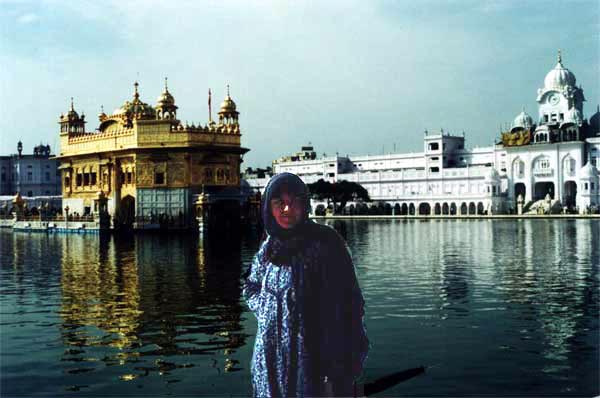 | |
Mo, dressed appropriately to visit a Sikh holy site (beard not visible) | |
Of course best of all were the Sikhs themselves with their amazing turbans. The Sikhs' turbans had been a source of wonder throughout our time in India. Available in all colours, from pale pastels to bright reds and blues, two broad curves of material sweep in from the sides, crossing at the front. Soldiers were dark green ones and traffic policemen wear dark blue with a ritzy red sash across the front. They all look solid as a rock and I'd love to watch someone putting one on, just to see how they make them so secure. Having said that, quite a lot of the ubiquitous motorcycling Sikhs tied a scarf around their face and attached it to their turban. We didn't know if this was as a face mask, or a way to keep their turbans firmly attached, but as no-one else seems to do it, it seems likely it's to safeguard the turbans. The other great feature of the motorcycling Sikh is his beard. Often we would see one flying along, his long white beard being blown into a neat middle parting and sticking straight up on either side like a huge handle-bar moustache. We headed into the temple, stepping through a little pool to have our feet washed (just like we used to do at the swimming pool). The temple was vast, a huge square of white marble buildings. In the middle was a huge square pool, with big carp visible in the water. Some Sikh men were bathing in the sacred water, turbans on, lowering themselves backwards into the water by chains attached to the side. The whole time, chanting was being played through loud speakers at each corner. In the middle of the pool was the Golden Temple itself, well named as it is completely covered in gold - an amazing site. A walkway led out to it so we filed along with everyone else. A turbanned guard grunted at Dave and took his umbrella. He pointed at our camera and barked "Picture no! Picture no!" Fair enough, so we packed it away. At the doors of the temple, everyone stopped to touch and kiss the step. As they stepped through a man gave them a handful of moist brown, well, matter. I'm really not sure what it was, or what the significance of it was, so we just walked on past. Inside we found the source of the chanting - a group of men were playing drums and cymbals, with one singing from a huge book. All around them people were sitting and swaying, eyes closed. It's always a little uncomfortable watching people at worship, so we filed out and back along the walkway. It was amazing though, and worth the visit. We retrieved our sacred Buddhist umbrella and the guard scowled at us, trying to tell if we'd taken any illicit photos or not. I beamed at him and he cracked a smile reluctantly. On the way back to the guest house we stopped at a market to get some fruit and veg for dinner. The usual pantomime of trying to say how much we want and work out how much it costs. Again it was just for one meal, so we wanted one aubergine, a few tomatoes. I asked for two onions and the man rolled his eyes, making a chopping motion with his hand - do you want me to cut one in half for you - cheeky sod. It was a laugh though and as usual we had a horde of followers discussing our every purchase. Back at the guest house some other travellers appeared. A Swiss father and son travelling back to Europe in a camper van (now that's a way to camp in the rain) and a German economist working in Islamabad. He was a good source of information, and told us we would make it to Islamabad in one day no problem as there was a huge, six lane motorway going all the way from Lahore, just over the border, to the capital. It sounded a bit unlikely, but it was what we wanted to hear, so we went to bed feeling optimistic. | |
Wednesday, 18 April 2001, DAY 27: 3820KM - 4211KM | |
It took longer than usual to pack up, what with all the camping gear, so we didn't leave until after 8.30am. We had been given varying reports about the border opening times, and what with this fantastic Pakistani motorway to look forward to, we weren't too worried about time. The German economist changed our Indian rupees into American dollars for us. We kept a few in case of emergencies on the way to the border, 30kms away. The streets of Amritsar were mobbed with rickshaws, taxis and carts. It was very congested so we were picking our way through carefully when a nutter rickshaw wallah came barrelling along the middle of the street, straight into one of my throwovers. If you've been reading at all carefully you won't be surprised to hear that I immediately fell off, as I tend to do with heart-breaking regularity. Of course every other vehicle in the road started beeping their horns and gesticulating at me and as I stood waiting for help to lift the bike I swore that when we get home I am going to buy the lowest, sleekest, most Italian road bike I can find, most importantly one on which I can sit with my feet easily reaching the ground. On both sides at once. I don't think that's too much to ask. We stopped for petrol before crossing the border and we discovered the result of my latest tumble - a small part of the frame we'd had put on in Delhi had snapped. The frame was still fairly stable, but it really needed to be fixed. Dave popped across the road and found a little shop full of turbanned mechanics. They hummed and hawed and welded the part. No charge, they stood proudly for a photo beside the bike. At the border, we found that the difficult relations between India and Pakistan resulted in the most formal border formalities so far. We filled in forms, had our passports examined, filled in more forms and, for the first time, had the bikes examined. The official tapped our storage pipes, and looked inside the panniers. I asked one of the other officials what he was looking for. "Narcotics. Ammunitions. Hashish. Sandalwood." "Sandalwood?" "You have some?" he said, eyes narrowing. "No, no, I just didn't realise it was restricted." He didn't have good enough English to explain why sandalwood was considered an evil of the same calibre as drugs and weapons, but as we didn't have any anyway, we left with a clear concience, heading for Pakistan. |
 |
 |