It was mid afternoon by this point so we started looking out for a decent place to stop for lunch. Not an easy task. The Grand Trunk Road isn't the M6 unfortunately and motorway services are but a distant memory. What we would do for a Cumberland sausage from Killington Lakes now (who would have thought it possible to miss British motorway food?). The equivalent here appears to be a dingy building with a few tables and chairs inside while outside on the dust between the restaurant and the road, there is a kitchen fronted by a line of silver turreens, presumably to entice hungry truckers, and flanked by piles of Pepsi crates. A row of charpoys (timber bedframes hung with rope webbing) normally full of lounging truckers digesting whatever was in the turreens completes the picture. These 'serais' are what have become of the ancient 'caravenserais' where camel trains used to break their journey and while they still fulfil the same function, the romance has definitely gone. I'm sure they do a fine Cumberland sausage equivalent but we weren't quite ready to find out what that was just yet.
When we spotted a sign 'hotel & restaurant' on a plain building with no turreens or belching truckers in sight, we jumped on the brakes. The smiling manager and his staff came out to greet us and ushered us inside and quickly found us an empty table. Worryingly, that wasn't a difficult task and we had the full attention of the entire staff for an hour. Or maybe there were lots of other diners but the lighting was so dim we couldn't spot them. Pakistan doesn't seem to be the vegetarian's paradise that India is and it was only reluctantly that we were allowed to order mixed vegetables. When a vast bowl of steaming curry and freshly baked bread arrived, the manager seemed as pleased as us, and stood smiling over us as we stuffed ourselves. When he spotted me reaching for a fork, he sat down between us and ripping a piece of nan from our steaming pile, proceeded to show us how to eat with one hand only. After he had to order extra napkins for me to wipe my curry stained crotch, he conceded the point and handed me back my fork. He then switched his attention to trying to persuade us to stay the night and told us how far it was to Islamabad and how early it got dark and how dangerous the road became. He also insisted that many foreign diplomats and tourists stayed at his hotel. Much as we enjoyed his food this did seem a little unlikely, the hotel situated as it was 10 feet from the edge of the busiest road in Pakistan. We were only allowed to leave when we promised we would stay there on our return journey. And then he handed us the bill for the most expensive vegetable curry we've had since the Ashoka in Glasgow.
With full stomachs and a smooth road, we reached Islamabad in three hours, making a brilliant arrival just as the sun set, headlights on full beam after both our 'dipped' lights had blown. We quickly found the 'Tourist Campsite' where most overlanders traditionally stay and pitched our tent on the hard packed dirt between the trees. To Mo's credit, she didn't complain, even when the rain started, but then she expected that. We went for a wander to the main shopping bazaar across the road in Aabpara, amazed at how clean, brightly lit and orderly it all seemed after India. Here were 'proper' shops selling branded goods with the brand name spelt correctly. Very odd. We collected email which is always good. Thanks to everyone who has been in touch and has taken an interest in the site, it really is excellent to find a dozen messages waiting and to know that someone is actually reading all this. We then found dinner courtesy of a street vendor standing over a deepfat frier at the roadside and dishing out freshly made chips in little newspaper pokes. Gorgeous.
Islamabad is the place where most of the travellers heading west come to get their Iran visas, and since the Iran embassy is notoriously slow, they usually stay for a week or two. We thought we'd been really clever organising our visas in advance in Australia, especially when the Iranian embassy in Canberra issues 30 day tourist visas while it's generally only possible to get a 7 day transit visa in Islamabad, which then has to be extended once in Iran. Unfortunately we left Australia a month late and our visas have to be used in the 3 months between 6th February and 6th May, which is looking increasingly inlikely considering the distance we still have to go.
So we headed off to the embassy to try to extend our current visa or at least to confirm whether we could still stay for 30 days if we arrived in Iran on 6th May. We found a taxi but he couldn't find the embassy. Islamabad is a new city, begun in 1961, and like its antipodean cousin, Canberra, it was built as a capital city to house the parliament, the government and all the domestic and foreign civil servants that go with that. Like Canberra, it is not immediately apparent where anything is and once you've found it, how you get back to your starting point. It is a city of broad clean boulevards and impressive buildings, not like a South Asian city at all and in sharp contrast to its immediate and much older neighbour Rawalpindi, only 15km away. It was certainly a surprise to find such modern and extravagant buildings in Pakistan.
The taxi drove us up and down empty dual carriageways, while the driver cursed and scratched his head. After stopping several times to ask other taxi drivers for directions, we bumped over a stretch of wasteground, weaved through a construction site and pulled up in front of the Iranian embassy. Closed on Thursday and Friday. This wasn't helping our deadline at all.
At least we had a chance to look around so we went to the 'blue area' where all the bureaucrats shop and where of course you can buy almost anything. As we'd noted before, even in a developing country there is still an elite who can drive a Lexus or a Mercedes, and buy imported goods. It certainly makes life easier for us though, so we stocked up.
We had heard that the Australian embassy club has an 'open' night for non diplomats, and as luck would have it, it's on a Thursday, so once again we hopped in a taxi and after a short safari, located the club at the edge of a forest on the outskirts of town. You can buy a ticket which gets you either 6 beers or 12, so we sensibly opted for the 6 ticket and made polite conversation with the only two others in the bar, two guys working for a mobile phone company. Within an hour though the place was mobbed, the cook was working flat out at the barby and the bar was full of people waving 12 beer tickets.
We had our steak and chips with Peter, an academic from Collector, near Canberra, and John Leighton, an ex-footballer from Hereford, who'd got the job of training the Pakistan national football team. Peter was genuinely outraged and annoyed that we thought Islamabad similar to Canberra and forcefully explained to Mo how Canberra was totally different and not based on a grid system. As Mo replied, Canberra is based on concentric circles, which is just a curvy kind of grid. He then obviously felt a little sheepish and bought us a drink.
The football coach was telling us how he's attained national hero status since Pakistan defeated India at football for the first time ever, and now everyone has high hopes of Pakistan qualifying for the World Cup, although the coach didn't appear to share their optimism.
The next day, more Iran visa hassles to deal with. Just in case we have to apply for another visa, we have to get a 'letter of no objection' from the Australian embassy. Now that we can navigate our way around Islamabad (easy for a native of Cumbernauld), we could direct the taxi driver straight to the door. The Australian embassy is very new and very plush, with polished stone walls and floors - this may be to impress, or intimidate, potential migrants. The lady was very nice and put both our names on one letter so we only had to pay once.
We then had a wander around the carpet shops which are full of Afghan rugs, presumably traded with some of the two million Afghan refugees living in Western Pakistan. We couldn't bring ourselves to actually choose anything or to organise the postage so we left empty handed back to the campground for some bike maintenance and a chat with the other travellers.
The best thing about all this travelling is getting to meet such a variety of interesting people. Before we left, we considered our trip to be quite unusual but of course as always happens, we've met others along the way, some doing the same thing and some whose trips are far more adventurous and generally much longer than our own.
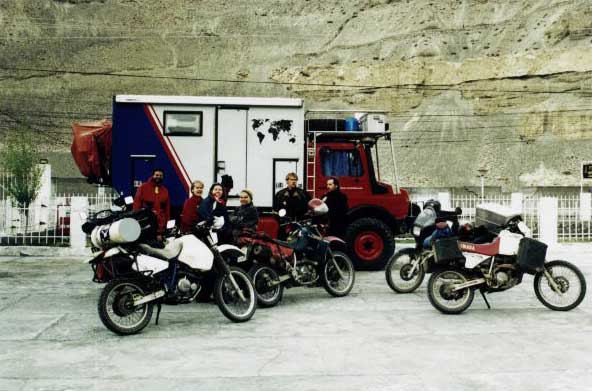
We got talking with a German couple, Klaus and Sonja, who are travelling around the world in a really impressive truck (if anyone is interested, and can speak German, check out their flash site). It's an enormous Mercedes 'Unimog', the engine and chassis is the basis for the vehicles they use on the ski slopes to bash the piste, and it has a specially made cabin on the back (made from the same insulated panels they use to make coolrooms) that is kitted out with all the home comforts including hot water and a shower. They carry a little motorbike too - a DT175 - which has its own electric winch on the back of the truck. The truck's wheels are so big, you can easily sleep under the truck on hot summer nights. They both gave up their jobs, as a policeman and a school building inspector, and now they just travel, making documentaries about the places they visit.
There was also a young Turkish bloke at the campsite who was headed for India. His father had been round the world on a motorbike and had now passed the mantle (and the bike) to his son. He'd just returned from the Karakoram Highway, both he and his bike looking the worse for wear. His chain was almost touching the road, his starter sounded worse than Mo's, and he was wringing his hands and telling tales of terrible rainstorms which had nearly washed him off the road. He also complained indignantly that the local children had thrown rocks at him. He had turned back only a day from the pass, defeated. He was definitely a reluctant traveller, and we all got the impression that he was doing the trip for his father. He did succeed in making us a little nervous of tomorrow's departure, but it was sunny and we're certainly not turning back now.
In the afternoon we got an email from our friend Mags in Australia giving us the phone number of her cousin Tariq and his wife Rushda who live in Islamabad, and urging us to call them. One phone call later and we had a dinner invitation. Pakistani hospitality is legendary and Tariq and Rushda were keen that we should have whatever we wanted. We settled on an Afghan restaurant where we sampled our first kebabs of the trip. Being Scottish, we are used to eating kebabs late at night when the pubs have closed and when our appetites override our taste buds. Interesting then to savour freshly grilled kebab in the daylight hours and to go home with clean trousers, not a hot chilli sauce stain in sight.
We went back to Tariq and Rushda's for tea and it was interesting to get a local perspective on society and politics in Pakistan, and in Afghanistan. With the exception of Islamabad, Pakistan is a very traditional and conservative country, and as Tariq pointed out, it is a developing country where most people live as they have done for centuries. To many western eyes, the requirement for women to cover up and disguise the shape of their body is seen as an infringement of personal rights. From a muslim perspective, the body is sacred and special and should be seen only by other family members. By hiding her body a woman is no longer viewed as a sexual object and therefore gains personal freedom. As a westerner it takes a real shift of perception to understand why things are the way they are here and that many people might be happy with that.
We also heard how along with Iran, Pakistan has borne the brunt of the mass migration from Afghanistan, which has resulted from the Taliban's extreme regime as well as from the continuing drought. Many have become integrated into Pakistan society but most are still housed in refugee camps on the western border. It is interesting to note that the Taliban government, which is universally condemned by the western nations, was born out of the US sponsored Mujahadeen forces who fought and eventually drove the Russians out of Afghanistan in the '80s. In the same vein, Osama Bin Laden, America's Most Wanted terrorist, gained his expertise under the tutelage of the CIA. It takes a lot of effort to find a clear picture of any political situation in this region and it's informative to view events from a different perspective.
It has also been quite informative to learn how Pakistanis regard the current military dictatorship. Pakistan has been unfortunate, to say the least, in its choice of leaders who seem to have viewed the country's treasury as their own personal bank account, and who have all become billionaires while serving as democratically elected leaders. Billions of dollars in aid money have been directly channelled into private bank accounts, damaging the country's economy, its ability to repay overseas debt and therefore Pakistan's international reputation.
It is not surprising then to find that General Musharraf, whose dictatorship appears to have brought some stability to the economy, has been a popular leader and is currently being urged to stand in next year's presidential election. The struggle for democracy in the west has given it such a high value that for most westerners it is the only acceptable political system. However in a country like Pakistan or Bangladesh, where such a high proportion of the plebiscite is uneducated and illiterate, and where corruption is the historical norm, perhaps a benevolent dictatorship is a valid option. It might only be a short term way out of the current morass of personal political ambition and financial greed, but it could pave the way to the longterm development of a stable democracy.
This trip has been a unique opportunity to view the other side of different political and cultural situations. Having been subjected to the largely one-sided western press for so long it will be interesting to reach the Middle East and get some local opinion there too.
Saturday, 21 April 2001, DAY 30: 4211KM - 4493KM |
Having packed our tent and rubbed our aching joints, we headed north for the Karakoram Highway and the Chinese border, 900km away, stopping briefly at the Iranian embassy on the offchance that they would extend our current visas while we were away. I joined the queue of harrassed looking Pakistanis and foreigners standing in the hot sunshine waiting in front of a tiny window in an otherwise blank wall. Eventually it was my turn to crouch down and hear judgement on our visa application from the disembodied voice behind the barred opening in the wall. Any chance of an extension? No. So how long will it take to get a new visa? 10 days, 2 weeks, maybe longer. And with such a firm but vague answer all we could do was head north and hope we could make it back down to the Iranian border in 2 weeks.
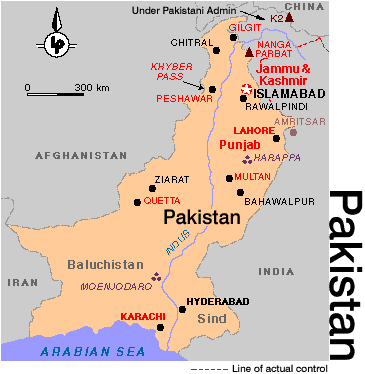
We stocked up on doughnuts and french bread at the bakery in the 'blue area', then headed for the hills. The temperature has risen dramatically over the last few days and the sun was beating down as we climbed into the foothills north of Islamabad. Rather than follow the main highway, we chose the scenic route via Murree which is a hill station several thousand metres higher and several degrees colder than Islamabad. We got our first taste of Pakistan's mountains as the road twistied dramatically upwards to 2500m, passing through tiny villages precariously straddling narrow ridges with houses and narrow fields cascading down either side. And just as quickly as we'd climbed, we began to descend, round and round, following each contour of the hills, eventually reaching the Karakoram Highway (KKH) proper at Abbottabad.
The KKH was built in the '60s and '70s by Pakistan and China as a symbol of friendship and as an effort to increase trade between the two countries. It took 20 years to build and wasn't opened to tourism until 1986. It connects the Silk Road oasis of Kashgar with Rawalpindi and Islamabad, Pakistan's capital, via the 4730m Khunjerab Pass, the semi mythical Hunza valley and the trading post of Gilgit. Construction of the KKH was one of the biggest engineering projects since the Pyramids: a two lane, 1200km road across some of the highest mountains in the world, the Pamir and the Karakoram. Almost 500 Pakistanis and probably even more Chinese died building the road and even now maintenance is a dangerous and endless task since the mountains are constantly shifting, causing rockfalls, mudslides and floods. Needless to say, it's an unpredictable and exciting journey. Well, not too exciting we hope.
We left Abbotabad and rode north on dry roads in warm sunshine through green rolling hills. In the distance we caught occasional glimpses of tall jagged peaks, covered in snow and capped by whispy clouds, as the road climbed imperceptibly following the broad fertile valleys of Hazara. Suddenly at Thakot we reached the mighty Indus river and turned into its steep valley, where the mountains rise to nearly 6000m. We began to follow the river which would lead us for another 400km, almost all the way to Gilgit, the real hub of the KKH.
|
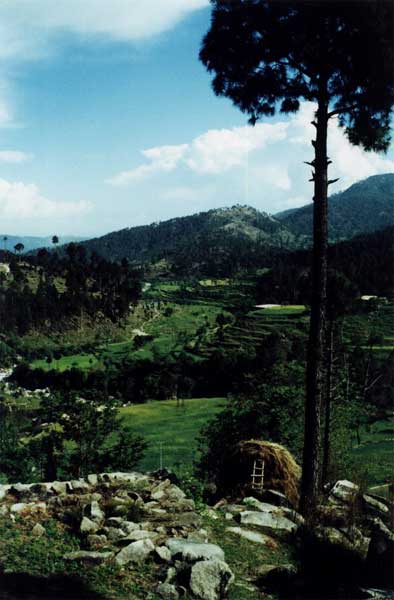 |
A lunchtime view on the road north
| |
We bumped into the German couple, Klaus and Sonja, in their bright red Unimog, parked at the roadside and surrounded by a crowd of gaping villagers. As we pulled up, it seemed as if reinforcements were called from neighbouring villages as the crowd of onlookers grew to mammoth proportions. A couple of photographs seemed to satisfy most of them though and after agreeing to meet up and stay the night together in Besham, we all managed to escape without casualties.
A few kilometres further on, the valley suddenly opened out before us and in the distance a vast expanse of snow covered rock rose high above and we got our first inkling of the huge scale of the mountains.
The Pakistan Tourist campsite in Besham sits on the edge of the Indus and from your room you can watch the chilled glacial water rush past 20m below. If you have a room that is, we couldn't quite see it from our tent, sheltered as it was among the fruit trees in the garden. After six hours of dust and diesel fumes, we'd been looking forward to the hot showers we'd been told about here. Maybe they were only available in the bedrooms though as we ended up with a bucket of hot water in a tiny room in the bus drivers' (male) toilets. At least one of them got a shock when Mo emerged. We spent the evening with the Germans exchanging travel tales and information on the road ahead. A mythology seems to evolve about 'the road ahead', wherever it might be, and thankfully this never seems to match the reality. We are still waiting for the torrential floods and the stone throwers.
Sunday, 22 April 2001, DAY 31: 4493KM - 4837KM |
The road through the Indus Valley is just unbelievable. It is dramatic on a scale we have never witnessed. The valley is so deep and its sides so steep that in some parts the sun hardly makes an appearance and there is almost perpetual shadow. The road itself is sometimes no more than a notch cut into a sheer vertical wall of rock.
|
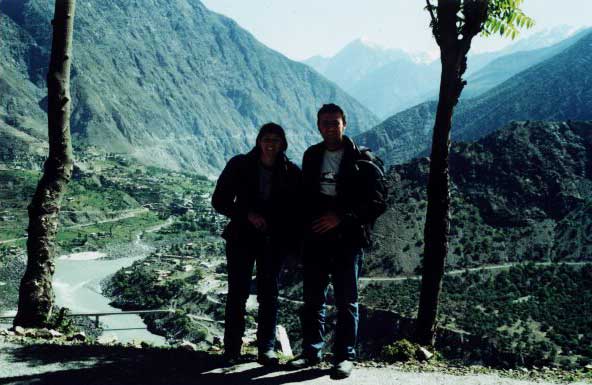 |
The Indus Valley, north of Besham
| |
There are very few structures supporting or protecting the road because it is carved directly out of the rock. Sometimes it traverses unstable areas (which are signposted, although quite what purpose the warnings serve other than to scare you I'm not sure), slopes of scree, vast quantities of loose rock balanced precariously and constantly shifting. The road here has to be cleared constantly and quite often we saw rocks on the road or occasionally small stones tumbling onto it in front of us. A few times we were stopped by the Frontier Works Organisation (FWO), the division of the Pakistan Army who built and still maintain the highway, blasting and clearing the road. Apparently the surrounding cliffs are still really unstable from the original construction when vast explosions rocked the mountains and sent a network of cracks deep into the rock. We stopped every few minutes to take photographs as each corner we turned revealed a more dramatic and heart stopping view than the last.
|
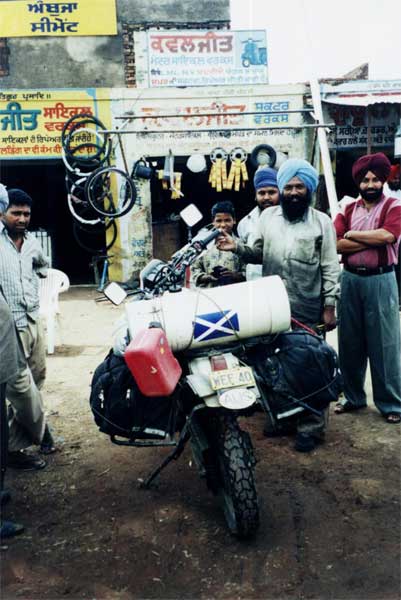 |
Still in the Indus Valley
| |
The FWO are clearly proud of their achievement and every so often there is a sign at the roadside reminding us where we are and who built it. 'KKH, Eighth Wonder of the World'.'FWO, 142nd Road Maintenance Battalion, Guardians of the KKH'. And there's a lot about Indo-Pak friendship and how the FWO unites the world. Well, you can't blame them for being proud.
|
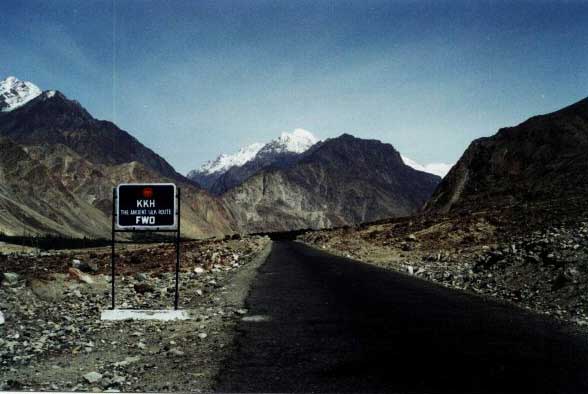 |
One of many FWO signs: KKH, The Ancient Silk Route
| |
The villages we've passed through are themselves rough hewn and they blend in with the bare rock walls above them. It looks like a pretty hard life in the mountains, with very little land to farm. The green hills of the plateau gives way to an increasingly barren landscape with small fields irrigated by the Indus and a few goats grazing on sparse pasture high on the hillsides. There are no women in the streets but old men squat in huddles of conversation at the roadside.
We get a lot of attention and everyone waves, even oncoming truckdrivers. The soldiers who stop us at the checkpoints are more interested in our bikes than whether we're smuggling drugs, or sandalwood. The trucks here drive mercifully slowly and the drivers always move out of our way whether they are in front or behind us. This is just as well really as it would be a one-sided contest should we come head to head on a blind corner. The trucks are very distinctive in Pakistan, with the cab and the body of the truck intricately painted in bright colours. These paintings depict various themes apparently, a popular one being lost love. The cab is generally wooden, which lends itself to detailed carpentry, if not to road safety. The cabs themselves are furnished like a harem, with wall to wall velvet and mirrors, and little silvers chains and ornaments dangling from the ceiling, all illuminated with red lights. Again, it's just as well they drive slowly.
|
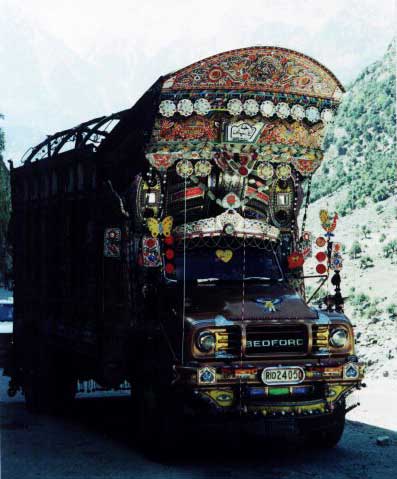 |
An unusually muted Pakistani truck
| |
We met our first stone throwing children today. Some of them just pretend but others have sturdy looking catapults and a pocket full of stones waiting for us to go past. We quickly found the best way to deal with them was to drive straight for them and slow down as if we were going to stop and chase them. They usually hopped over the edge of the road and started running. Neither of us was actually hit, so it was an effective tactic. We later heard that the kids target cyclists too, which could be painful.
|
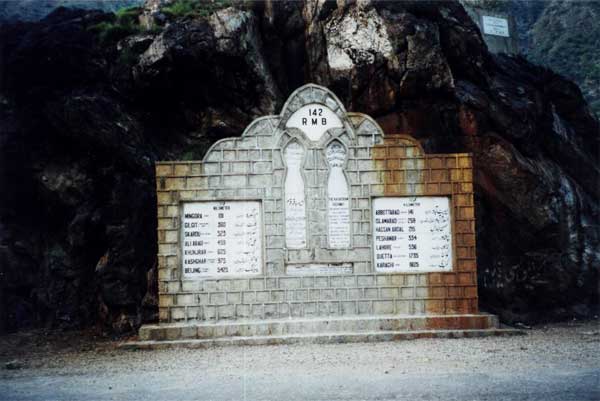 |
Understated KKH milestone
| |
The people up in the hills look very different to those in Islamabad and beyond. The men here have the most amazing Abraham Lincoln beards, long, bushy and moustacheless. The punjabi outfit is still pretty evident but as we get further north, the men all also wear the Hunza hat, a circular soft woven wool flat cap with a thick rolled up ring around it. The women, who become more evident higher up the valley, wear bright waistcoats and embroidered hats.
|
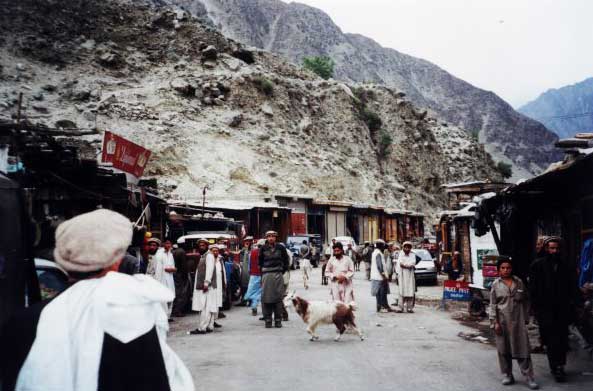 |
A typical Hunza village, ubiquitous goats and hats
| |
As we rode further north and got closer to Gilgit, the valley began to open out and the villages seemed to become more prosperous, or at least more attractive, with fields and orchards lining both sides of the road. The green of the villages is in stark contrast to the surrounding moonscape. The rocks are black and have a melted look, like baked sugar. There was a sign at the edge of the road, "Nanga Parbat, the Killer Mountain", and sure enough rising dramatically out of the cloud above the surrounding peaks, was an imposing snow covered wall of rock which looked as its name suggested.
We reached Gilgit just before dark and stayed at the Horizon Guest House, as recommended by the Lonely Planet (thanks for the book Phil, it's been really useful), who said it was run by a local man and his Kiwi wife. Unfortunately she's gone but Abdul is still there. We got a warm welcome and sat relaxing in his garden drinking tea, not quite believing that we'd made it this far. Abdul told us about the various expeditions he'd been on to K2 and Nanga Parbat, although he'd never actually reached the top. In his experience, international expeditions are full of people whose massive egos often clash and everyone behaves like small children. Often not everyone can go to the top and it can end in a big fight. Trekking sounds like a far more civilised option. He tried to persuade us to go on a trek but with our time limit, we'd have to walk pretty fast.
Gilgit is a real focus for the whole KKH and various international organisations are here. The WWF have an office and the Kashmir situation is monitored from here. There is a real mixture of people from all over Pakistan and the bazaar is notoriously colourful. Unfortunately, power cuts are an everyday occurrence here so we didn't get to see the town at all. Maybe on the way back.
Monday, 23 April 2001, DAY 32: 4837KM - 4995KM |
As soon as we left Gilgit, we had to cross a deep gorge on a suspension bridge. It didn't look too tricky till we realised it wasn't actually connected to dry land at either end and was swaying gently back and forth. Getting the front wheel across the moving gap was a leap of faith and a relief. When we reached the other side we found the road immediately went straight into a narrow tunnel in the cliff. Once in the darkness of the tunnel we noticed just in time through squinting eyes that the road twisted upwards and off to the right before reaching daylight again. Driving really isn't straightforward here! Not only do we have to contend with twisty narrow roads suspended above bottomless chasms, goats, sheep, dogs, cats and people, but also unmarked and unlit tunnels.
|
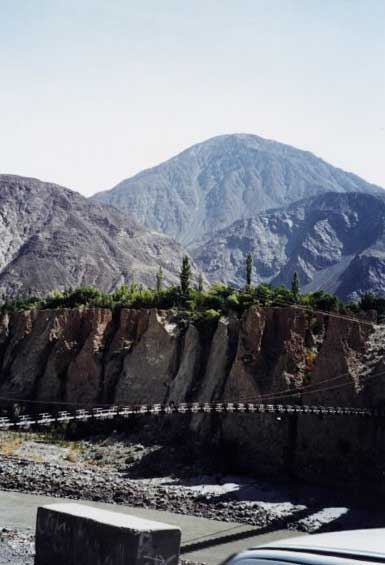 |
Gilgit suspension bridge - even scarier than it looks
| |
We continued north through the same barren landscape punctuated with fertile villages and passed the viewpoint for Rakaposhi, another of the highest mountains in the world. In this landscape all the peaks look equally insurmountable and dramatic. At 3000m, it feels like we still have a long way to go up. This area is the Hunza valley, fabled for the great age of its inhabitants. The owner of our hotel told us of a villager who had died recently aged 160.
|
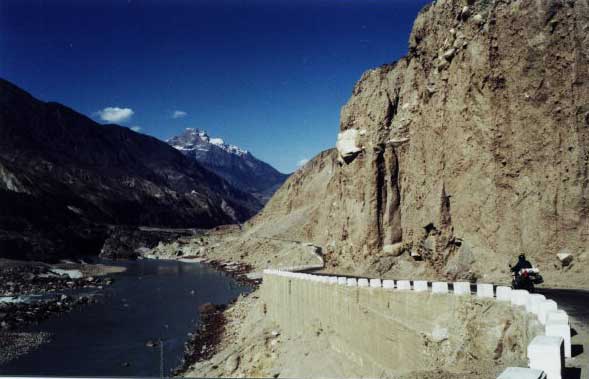 |
A typical stretch of the KKH
| |
We briefly visited the village of Karimabad, which has the steepest cobbled street I've ever driven up. What makes it really tricky is at the steepest point as you round a corner, there is a sign saying "No Vehicles Past this Point". I don't know how I managed to back pedal with both brakes on then do a u-turn without falling off. Mo had been sensible enough to stay half way up and wait for me to see what was at the top.
An old man insisted that we accompany him to his house, a single room in an ancient building where he and his family of nine live. Being cynical, we weren't too surprised when his mother pulled out a bag of knitted hats for our inspection. However, it was interesting to see how little life has changed here for ordinary people whose world must have remained completely unchanged for centuries until the construction of the KKH began. Most visitors come to Karimabad to see the 'Baltit Fort', a royal palace perched high on the mountainside which was recently restored. It has stunning views across the valley and is an imposing place where the local ruler lived for centuries. It was closed for lunch though so we continued north.
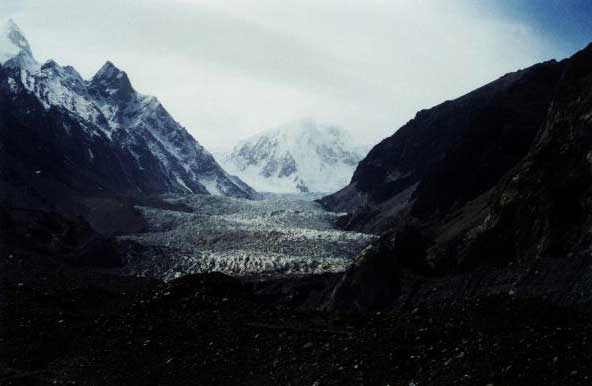
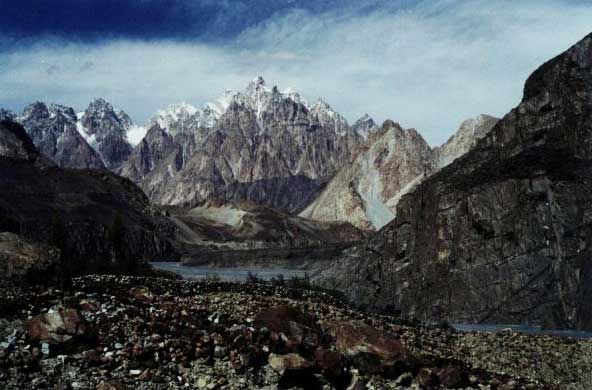
We reached Passu mid-afternoon and found the Batura Inn just below its namesake glacier, a dramatic river of ice apparently stopped in midflow. The guesthouse lay on a plain at the feet of a semicircle of giant grey cliffs, which today disappeared into the high cloud. The inn itself used to house and feed Chinese workers and has two long low buildings housing a dozen small rooms. The walls are thick and rough, built with rocks from the glacial moraine packed with mud. For under $2 a night you can't complain, even if the water in the shower can only be just above freezing.
|
 |
| |
For the first time since Islamabad we met some other foreigners, three bikes all heading north before two of them made their way back to Europe and one to Australia. Olly, a 24 year old German, had already ridden his Transalp to India and Nepal. He had then made an epic 48 hour nonstop journey back to Pakistan to meet up with Carmen, an Aussie girl he'd met and left in India. He arrived to find she wasn't there. She coolly turned up a few days later. They were riding together with all their combined equipment so the poor bike was looking like my brother James's Moto Guzzi - prepared for every eventuality - when we went touring in Europe, except Olly didn't have two spare helmets with him.
|
 |
| |
Ben and Nick, two English friends riding together, turned up in a cloud of dust - they seem to ride everywhere at maximum throttle. Nick had already been through North and South America on his TT600 before he met up with Ben in New Zealand where they toured together. They then shipped to Australia and toured, then moved to Indonesia together.
Ben is 6'6" and his KLR650 looks like a moped under him so he attracts a lot of attention wherever he goes, especially in Asia, and especially since he rides flat out all the time. He's also a bit of a wheelie expert. I was asking him how he'd managed to scrape all along the top of his bike: fairing, tank, etc. Apparently in Cairns in Queensland, a car full of young guys at the traffic lights had egged him on to pull a wheelie. He got the bike onto the back wheel and changed gear up to about 80km/h but having had a late night and not much sleep, he wasn't concentrating, gave it too much throttle and when he went to correct it with his back brake, his foot slipped and over the back he went, he and the bike scraping down the road on their backs. Ouch. He was really embarrassed as he prides himself on his wheelying ability. Apparently his record on his Fireblade in the UK is 140mph with the front wheel off the ground!
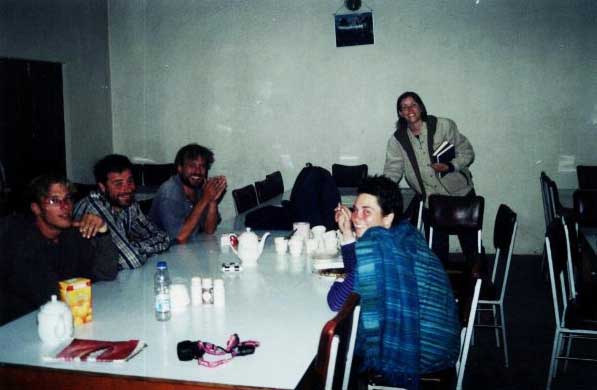
That night it was Carmen's birthday, and not only had the devoted Olly managed to organise a cake, he'd also managed to get some vodka and rum over the border from India, which he generously shared around. So we had a slightly surreal experience huddled in the commmunal dining room high up in the Karakoram, eating cake and drinking vodka and singing happy birthday.
|
 |
Everyone at the Batura Inn
| |
Tuesday, 24 April 2001, DAY 33: 4995KM - 5242KM |
We all decided to go to the Khunjerab Pass together. The weather was looking good with only a few clouds high in the distance and there was a possibility if we waited that we wouldn't be able to make it the remaining 120km and 1500m. So we set off, with Ben and Nick racing each other off into the distance. We'd dumped all our luggage at the Batura Inn and it was brilliant to be able to drop the bikes into corners again and accelerate without the deadweight on the back.
The landscape became bleaker and bleaker and started to cool down. We weren't worried though because we'd gone to a lot of trouble in Sydney to have heated handgrips installed on both bikes (thanks James). We thought we'd save them for when it got really cold so we waited. We passed several checkpoints where the guards were delighted to see us. Apparently we were the first bikes of the season. While the Chinese border wasn't open yet, the Khunjerab Pass itself was passable, the snow having recently receded.
So we reached the last habitation before China, the tiny village of Sost, where we'd been told that we'd find our last petrol. 5km after the village, we spotted the petrol station, complete with hand operated pump. Fortunately it was open. Unfortunately they had no petrol. They were expecting a delivery which hadn't arrived. Disaster - we didn't have enough petrol to get us up to the pass and back to Passu. Then the others came to the rescue, working out that they should have enough petrol between them to get us all up to the border and back to the hotel but no further. Oh well, we'd work it out from there.
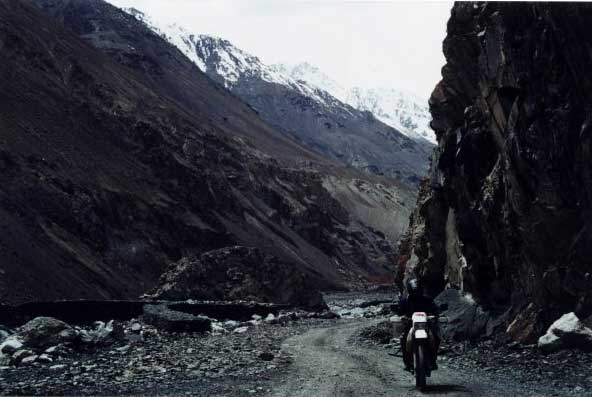
So with that generous offer we headed up the increasingly twisty, sometimes damaged and narrow road as it passed beneath unstable slopes. At one point we drove across a deep landslide of small unsettling stones and were glad we'd chosen off road bikes. We started climbing and the wind got up and the temperature came down. So I turned my handgrips on. Aaaah, wonderful, so hot that when we stopped for a break everyone came along to try them out. Not so good for Mo though, her grips showed no sign of working even after much cursing and tugging of wires. We eventually gave up and she put on an extra pair of gloves. And after all the hassle they gave us too.
|
 |
Mo negotiating another KKH hazard
| |
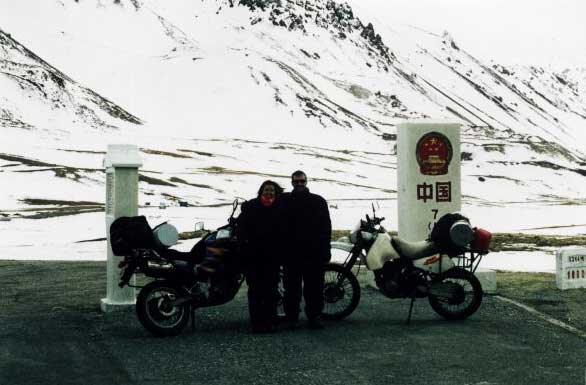
After a series of steep switchbacks inhabited by very hairy yaks, we came out onto a plateau covered with snow and in the distance spotted the border. Two stone posts mark the Pakistan-Chinese border and there is a roadsign indicating how far it is to Beijing (6921km) among other places. There is also a concrete building on the Chinese side with darkened windows and no sign of life. Apart from that there is nothing. We were all for riding into China but the guard at the Pakistan checkpost had warned us not to be tempted since the Chinese were still very upset at the American spyplane incident. So we all sat in the freezing cold while Olly tried to brew up some tea. The thin air wasn't making it easy though so after about 30 minutes of cooking, he abandoned the stove and Nick put the warm water in a plastic bottle and stuck it down the front of his jacket.
|
 |
The Pakistan-Chinese border at the Khunjerab Pass
|
What a great feeling to have made it this far. The Khunjerab Pass is supposedly the highest or second highest motorable road in the world. Mo should be especially proud, having ridden over some of the roughest roads in Asia to get here and only passing her bike test just over 6 months ago. No mean feat.
By now we were pretty keen to get back down, especially as the clouds had moved in, so we took a few more photos and set off as quickly as possible. Now my handgrips decided to give up the ghost. I take back all the nice things I said about Oxford Products, I wonder if they'll give us a refund. As we got further down the hill the snow started. It began as a gentle flurry, but soon it got thicker and started lying on the road. This wasn't part of the plan. Then just as we were getting a bit concerned as it started to obscure our visors, the snow stopped.
By this point our petrol tanks were almost dry and we were ready to start siphoning from the others. Mo's bike was running on fumes as we pulled into the petrol station at Sost, where to our delight the tanker had just been and we all gratefully filled up. Ben reckoned he could turn the pump handle faster than the guy at the garage so we all laughed as he proved himself wrong. Then it was a clear blast all the way back to the Inn, all feeling pretty elated.
|
 |
The whole gang, including Klaus and Sonja who had turned up in the Unimog, at Sost
| |
We all felt like celebrating but apparently we are two weeks too early for the local wine that is brewed for the benefit of the tourists, so we settled down to drink tea and play Scrabble. The local man who has run the Inn for almost 40 years, Baig, is a great cook so we all appreciated the steaming plates of potatoes and rice that he served up as soon as we got back.
|
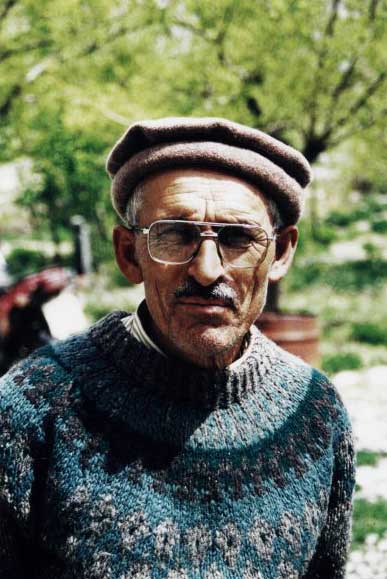 |
Manager, cook and chief bottle washer, Baig (Iris, is it just me or does this remind you of someone?)
|
Wednesday, 25 April 2001, DAY 34: 5242KM - 5396KM |
We were a little disappointed to say goodbye to the others, but we were in a real hurry. They'd been a great laugh and meeting people, especially with a similar outlook, is always a highlight. We left for Gilgit feeling slightly deflated at the prospect of riding 900km on roads we'd already travelled. But we needn't have worried, it may have been the same road, but it was a very different journey. The whole perspective changed as we looked south and it was interesting to watch the scenery change in reverse.
We stayed in Gilgit again where Abdul appeared delighted to see us and we took the opportunity to get some minor repairs done. All the rattling had cracked Mo's rear carrier rack in four places so I went in search of a welder. Abdul's brother knows everyone in the town and took me to a repair yard where it took the welder no time at all to do a great repair job, including repainting the rack, all for $2.
After dinner we thought a walk into town would be a good idea. Unfortunately it got dark and then simultaneously the power went off. It wasn't much fun strolling down the side of a dusty and crowded road with no pavement in the dark, with Mo the only woman on the street, so we did a u-turn. Gilgit will have to wait.
Thursday, 26 April 2001, DAY 35: 5396KM - 5721KM |
An early morning visit to the bank to change some travellers cheques was a very civilised experience. I was invited into the manager's office and brought tea while the paperwork was completed. An interesting contrast to our experience in Australia where there is a universal move towards automation and internet banking and where you have to pay several dollars to carry out any transaction within the branch.
We intended to reach Besham tonight, the same journey we had done on the way up. The sun was shining and we made good progress, Mo now riding a lot faster than she had on the way up, obviously having gained confidence with the passing kilometres. It was 4.30pm when we reached Pasu, a dusty village 90km from our destination. We filled up with petrol then climbed out of the village along what was almost a groove in the cliff. We were riding above some of the most precipitous cliffs of the whole road under overhanging rock when 15km out of Pasu Mo pulled to a stop with a very flat back tyre.
It was our first puncture in 5000km so we could hardly complain, but it couldn't have happened in more dramatic surroundings. We moved the bike onto the narrow verge above the canyon and while balancing it on a big boulder, I pulled the back wheel out. After much huffing and puffing, I got the inner tube out and saw what damage two little nails had done. Rather than repair the tube in the fading light I put in the spare we'd carried all the way from Oz.
By this point, even though we were 15km from the nearest village, a crowd had gathered. Presumably they were goatherds who lived on the hillside and their daily lives didn't usually include meeting a couple of strangely dressed foreigners dismantling one of their exotic vehicles on the edge of a cliff, because they were totally transfixed by our performance. I got the tube in and while Mo balanced the bike precariously on the rock I tried again and again to get the tyre back on the wheel, lubricating the tyre with detergent we'd brought specially for the purpose mixed in water from the Camelbak bladders we carry in our rucksacks. I took great care not to damage the inner tube in the process. I just couldn't get the last bit on and clearly taking pity on me, one of the shepherds came and held the wheel while I wrestled with the tyre.
With a final effort and pouring with sweat, the tyre finally slipped into place, and I was ready to pump it up and put the wheel back on. 300 pumps on my bike pump later and I had to admit what was becoming obvious, that the spare tube was damaged. I assumed that I caught it while putting the tyre on but with reflection, I remembered that I had got the spare tube from the previous owner of the DR and had never actually checked that it was okay. Oh well, my fault either way so I loaded the DR wheel and tyre onto the back of my bike and headed back to the last village leaving a patient Mo and a bemused shepherd standing on opposite sides of the DR now balanced on one of my aluminium boxes.
With an hour or so of daylight left I was lucky that the first shop in the village was a puncture repair place. The thought did cross my mind that those nails were suspiciously close to such an establishment... No matter, it was lucky for me so once I'd explained the problem using both hands, the guy whipped out the inner tube and quickly found the punctures. Within moments the crowd of onlookers around me and the bike had blocked out the light to the repair shop and a cloud of dust had been kicked up that was blocking out the sun.
I was glad I hadn't tried to repair the tube myself as this guy did a far better job. He heated a flat piece of metal and then testing the temperature by bringing the plate close to his cheek, he put a big rubber patch on the tyre then put the plate over it, compressing the whole lot in a vice thereby vulcanising the rubber. While he waited half an hour or so and I fretted about the coming darkness, the crowd, with not one word of English between them, tried to communicate with me. I really wasn't in the mood and when one of the kids thought it would be really funny to tap me on the shoulder then look away so I wouldn't know who had done it, it didn't help matters. The second time he tried it I caught him and belted him back on his shoulder. The crowd seemed to appreciate this even more than his his antics and the boy slunk away. There's definitely a fine line between a crowd of kids being friendly, and trying to get a rise out of a foreigner. I suppose they just want some sort of reaction whatever it might be.
Eventually the tyre was back in place and it was good to see that the professional guy had as much trouble installing it with his 2' levers as I had with my 6" ones. I took the obligatory photo and raced back up the mountain arriving just as dusk was turning to night. I found Mo and the shepherd in the same position as I'd left them, facing each other wordless across the saddle. Mo had taken out the Lonely Planet to try to communicate but had given up very quickly. He had apparently been very supportive if uncommunicative and had made no move to leave. I quickly got the wheel in place and gave the man something for his invaluable help.
Then we were off, driving on one of the most precipitous roads in the world, in pitch darkness with only full beam headlights which we had to switch off when confronted with oncoming trucks for fear they would blind us in retaliation. We had 75km to go and could only be relieved again that trucks drive so slowly here. After 30km we weren't enjoying ourselves much and were wondering just how long this was going to take when we spotted what seemed like a mirage, a beautiful new hotel nestling in a sharp turn in the road. We were both considering how much we'd be willing to pay for a room in such a nice place, 'quite a lot' we agreed, so we were pleasantly surprised to find it was only about $6 a night. The place was empty except for half a dozen UN Soldiers swapping vehicles at the halfway point between Islamabad and Gilgit. Our rooms were spotless and the Chicken Balti was gorgeous. We couldn't believe our luck.
Friday, 27 April 2001, DAY 36: 5721KM - 6023KM |
When we drove the remaining 30km to Besham we realised how lucky we'd been not to have to negotiate this potholed and twisty section of the road last night. We were now in familiar territory and started recognising landmarks from the way up - one particularly memorable one being the slogan daubed in large letters on the side of a house "Proud to be Islamic Fundamentalist". That was where the petrol station attendant had refused to fill Mo's tank up, so maybe it was his house.
As we descended towards the plain, the vegetation began to return and the slopes of the valley became wooded. The air grew warmer and smells returned whose absence we hadn't noticed. The scent from the thick stands of pine trees filled the air and we felt in a different and more hospitable place. Insects returned too and soon our visors were stained with a selection of the local fauna. We had been extremely lucky with the weather and I'm sure the KKH would be a very different proposition in the rain and cold.
The road gradually became busier until by the time we reached Abbotabad, we were constantly overtaking. We chose the scenic route again back to Islamabad and headed up the winding road we'd only recently descended. On one particularly tight corner, there was a patch of diesel which I was fortunate enough to avoid. Unfortunately, Mo took a different line and hit the diesel as she leaned into the corner. Feeling the back wheel slip from beneath her, she fought for control and at this point I witnessed her valiant struggle in the rear view mirror as she weaved from side to side. She managed to hold it until she had almost reached a standstill, and then the deadweight of the bike became too much and it toppled over with her still standing over it.
She was absolutely unfazed, which is more than I could say for the two lads on the little moped she'd overtaken just before the corner. They must have been captivated by the vision of a foreigner on a big bike coming past them only to lose control and swerve dramatically from side to side in front of them before coming to a stop and toppling over. And then when they stopped to help, they saw that on top of all that, Mo was a woman too. They were very concerned for her safety and pointed to the speed limit sign at the side of the road before ambling off at about 20km/h.
At the top of the pass at 2500m we stopped for a lunch of chicken balti and vegetables which was appreciated all the more for the stunning view across steep hillsides of stepped fields like corduroy. And so we returned again to Islamabad, by now sweltering at 40 degrees and an unwelcome indication of what the next few weeks will be like.
Tariq and Rushda had kindly invited us to stay with them as long as we liked so we gratefully headed straight there. We were too tired to do much and as Tariq and Rushda were going out that night, we took the opportunity to take it very easy. We wandered down to the Tourist Cmapsite to see who was still there. We'd met a Belgian couple Sarah and Peter before we'd left who were waiting for their Iran visa, and they were still there, still waiting, so it seemed that our decision to just go for it had been justified. We also met a guy whose fame had preceded him (all the overlanders seem to know each other),'Mad Mike', a German on a 25 year old Moto Guzzi road bike which he'd taken up the KKH last year in the winter and which he'd ridden across the Shandur Pass to Chitral, a jeep track which at the time was covered in deep snow. (James, how's that Guzzi of yours?)
When Tariq and Rusda came back we sorted out all the world's problems and came up with business ideas that would make us all millionaires, and it only took us till 2am. Tariq in particular is a great person to cast a little light on Pakistani politics, religion and society as he understands them from both a western and eastern perspective. His father is a Pakistani who studied in Glasgow and Edinburgh where he met and married Tariq's mother before moving back to Pakistan. Tariq was educated in Scotland from age 15 so is himself very Scottish. We certainly had plenty to talk about, although we couldn't tell him too much about Scotland and how devolution has worked, not having lived there full time for a few years. It will be great to get back for so many reasons.
|
Saturday, 28 & Sunday 29 April 2001, DAYS 37 & 38: REST DAYS |
After a wonderful night's sleep in a comfortable bed with a fan and running water - all these things that have now become unutterable luxuries - Dave and I got up and had breakfast with the family before setting off on a shopping and errand expedition with Tariq. Rushda had unkindly suggested that Tariq wasn't the world's best shopper but it turned out she was very wrong as he patiently drove us round the city working our way down the latest 'To Do' list. We had a great time and managed to tick off: getting my spare tube puncture fixed; buying a nail brush (what between the combination of general filth, working on the bikes, and eating with our hands, it seemed like a good idea); looking into fixing small metal tool boxes onto the front of Dave's bike; getting films developed; and searching, albeit unsuccessfully, for goggles. Although our sunglasses are effective against a direct hit from stones or insects, they don't protect us much from dust and some days our eyes can get pretty sore and red. We had looked at goggles in Australia and hadn't bought them (they just look ridiculous basically and we couldn't bring ourselves to do it), a big mistake. So we all trailed round Islamabad, looking in opticians and bike shops and even in a sports shop at swimming goggles (I know, I know, but we were desperate).
Tariq and Rushda conformed to the Pakistani ideal of hospitality - which is to show your guests a fantastic time and never let them pay for anything - and took us for lunch at the Arizona Grill where we pigged out on the most fantastic Mexican food. We got a little more shopping done (we all agree that Rushda is the world's best shopper) before heading home. Tariq's local Mr Fixit came round and discussed with Dave how to fix extra boxes onto the bike. He went off and came back with two old army radio boxes and between them they fitted them onto the XTZ's crash bars. That'll free up some space, and weight, from the panniers.
Having spoken to the other travellers at the campsite, and the other bikers on the KKH, it was clear that we had made the right decision about our Iran visas. Sarah and Peter were still waiting to hear about their's; Nick and Ben were waiting for their's and were having real trouble getting through on the phone to find out what was happening; Olly told us when he came through Iran before, he had had a transit visa and had had to keep extending it, but some of the extensions he was given were only for a day or two days. All a lot of hassle we don't need. However, the downside was that we really couldn't hang about in Islamabad at all, and we decided to leave in two days, on Monday. Heartbreaking, given the kindness and hospitality of our hosts, but there it was.
On the Sunday we continued getting organised and packed up. Dave took Shamoon, Tariq and Rushda's nine year old son, for a spin on the bike. He tucked his beige punjabi shirt into his trousers, put on my helmet and ended up looking like a midget NASA astronaut. All the neighbourhood kids came out to watch and although Shamoon seemed a little shaken after his ride, hopefully he'll be a local legend and it will all have been worth it.
|
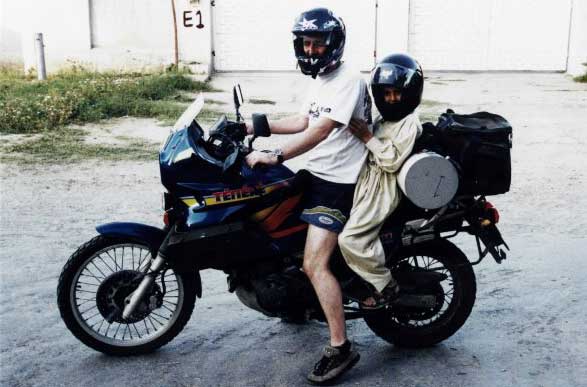 |
Dave showing Shamoon a good time (and scaring the life out of him)
|
That night we went to Tariq's dad's, Mr Qurashi's, for dinner. He is a lovely old man, a teacher and headmaster who had gone to university in Glasgow and married a Scottish woman (our friend Maggie's aunt). He had spent several years teaching in Africa so he had a lot in common with my own father (yes dad, you're a lovely old man too). We had a great dinner, chatting to various relatives. It turned out that Mr Qurashi was heading south himself the next day with his nephew to stay on the family farm at Bhakkar. It was a day's ride away, and pretty much on our route, so it was a lucky coincidence. We arranged to meet him and spend the night there.
|
Monday, 30 April 2001, DAY 39: 6023KM - 6449KM |
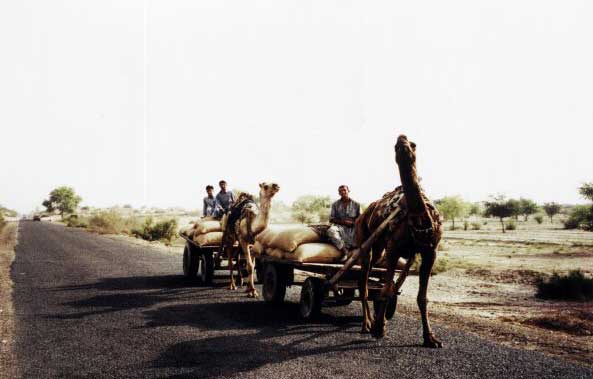
Up in the morning and more farewells with Tariq and Rushda. We owe them a huge thank you - they showed us a fantastic side of Pakistan, kindness and generosity and good fun - and we are very grateful. We negotiated our way out of Islamabad, the temperature just pleasant at 8am. This was a worry as it meant it would be hot later. Asking directions regularly, we finally got off the Grand Trunk Road and suddenly we were a million miles away from modern Islamabad. We saw mud houses, smooth and creamy brown. On the walls, drying in the sun, were stuck round pancakes of dung, each with a hand print in the middle. Outside the houses were perfect little haystacks with peaked mud roofs looking like little houses themselves. We saw camels carrying loads, walking in lines along the road. All different colours and different sizes, some of them were so big they looked like we could have ridden the bikes between their legs and they wouldn't have noticed. Camels don't tiptoe, like cows and goats, but flick their hooves back and then slap them down, like Shaggy in Scooby Doo. They all have goofy expressions and they bob their heads up and down when they walk. Camels are groovy, basically. We passed through one village where a man was working a hand water pump. His camel had its lips clamped over the pipe, gulping steadily, water dribbling down its chin.
|
 |
| |
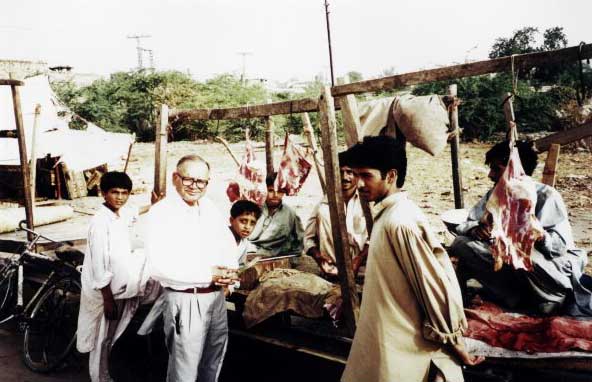
On and on and it was getting hotter and hotter, over 40 for sure. It got so hot I was starting to get that panicky 'get me out of here' feeling so we stopped and poured water over ourselves. The water was burning hot to touch, but it's amazing how quickly it cools down, and cools you down as well. Finally, after 3pm, we arrived in Bhakkar and met Mr Qurashi, who was just starting to worry about us. He needed to buy some food so we had a tour of the town and the market. He bought fruit and veg, chatting and joking with one of the young stall owners. He told us, "My age is a real advantage here. You see, I call him 'son' and he has to treat me with respect." At one point we suggested that we pay for some fruit as a contribution to dinner. He spoke to the stall owner in Urdu. "I asked him,'Can I let my guests pay for these?' and he said, 'Oh no, sir, absolutely not.'" It's the rule in Pakistan, guests don't pay. We stopped for some meat and Mr Qurashi said "You just sit here and don't look." Good advice, as the choice was looking at unfortunate live chickens waiting to be selected and killed, or goat meat hanging up in the sun with flies buzzing around it. Mr Qurashi told us that if we'd come on a Sunday we could have seen the big weekly camel market. Apparently you can pick up a camel for US$300, which is within our souvenir budget so it's certainly something to think about.
|
 |
| |
Shopping complete, we hopped back on the bikes and followed Mr Qurashi to the farm. It was a simple little building a few hundred metres off the road in amongst sand dunes. Riding through soft sand is a tricky business on a bike. Mr Qurashi said, "Just get into second gear and keep going, the same as riding through snow." As I've never done that before either, it wasn't a big help. I made it up in one peice, just. The farm workers came running to greet Mr Qurashi, hugging him and slapping him on the back. When the wife saw me she gave me a huge hug, laughing and laughing. She made a show of feeling my muscles, tricky as I don't have any, but I got the message.
The water for the farm came from a massive tube well and was pumped up by a noisy motor. It gushed out of a huge pipe into a concrete trough and Mr Qurashi said why didn't we have a bath in the cold water. So later, in the darkness, we went out and got jet washed in the coldest, freshest water you can imagine. After the day of sweltering heat we'd had it was an almost spiritual experience, and a little surreal, lying in the cool looking up at the stars.
We had a lovely dinner of very fresh chicken and Mr Qurashi told us about his time in Glasgow, and how kind everyone had been to him there. He said "You know, I didn't go to Scotland to get a wife..." "You just got lucky then", we said, and it seemed that he had. His wife had moved to Pakistan and fitted right in with his family, becoming best friends with his father, a fierce old man who the rest of the family were rather scared of. We talked about the differences and similarities between Islam and Christianity, and how sad it is that there are so many problems between them, when really they're so much alike.
|
Tuesday, 1 May 2001, DAY 40: 6449KM - 6967KM |
Up at 4.45am, another record, but more than worth it if it let us avoid the heat. In fact it turned out to be a cloudy day, good news for us and a relief to Mr Qurashi as he was very worried about our travelling prospects. More goodbyes, and we set off through the sand again. I didn't do so well this time and stalled the bike a couple of times. Dave walked back. "It's easy really. Just remember that the bike wants to stay upright." "Mine doesn't. It wants to fall over." "No it doesn't. Look, think of it as a gyroscope." "I don't want to think of it as a gyroscope. And neither does my bike. It wants to fall over." "It doesn't." "Does." Silence. "Fine." He walked back to the road and I shuddered and lurched on through the sand with my bike doing its damnedest to fall over, I swear.
We blasted on and made good time. Passed a school with a huge sign: Give us your child and we will return you an excellent. I've always fancied an excellent so if we have kids we'll have to come back here. We kept going south, down the east side of the Indus but no sign of the river until we finally turned west and came to a long bridge with roadworks all along one side - our old friends the FWO in charge of the work. We passed through Dera Ghazi Khan, a busy, noisy town, and then suddenly without warning we were in the desert. Nothing on either side, just flat dust. Spotting a busy truck stop we pulled in for a drink. Here we found our first real serai - a big, open, pillared room, a food counter at the front, charpoys in the middle and a seating platform round the sides. The truck drivers were all lounging about like traders have done for centuries. And a million flies buzzed around us.
The drivers mimed to us that there were other foreigners around, on bicycles, and sure enough a minute later three cyclists turned up, one Swiss and two Japanese. I know some people think we're mad doing this trip but doing it by bicycle is another level of insanity altogether. The Swiss bloke told us he planned to be on the road for ten years - nutter. One of the Japanese got some lunch. It arrived black with flies, and he munched through it seeming not to even notice. Some travellers have a shift in perception that allows them to do this sort of thing, while we won't even drink the water.
|
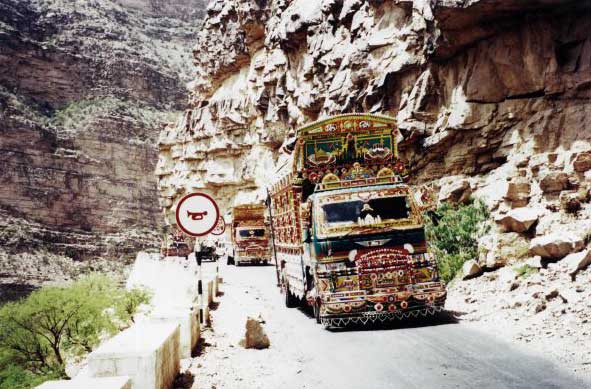 |
More trucks brightening up the road
| |
We decided to eat elsewhere, at Fort Munro, a nearby hill station. We set off, up through a range of rocky hills. Some dodgy riding as the road was narrow and busy with trucks. A minibus full of women passed. They spotted me and started laughing and waving. When we finally reached the Fort Munro turn off the minibus was waiting for us. Everyone jumped out to say hello. The driver said "Are you Irish?" No, but a very good guess. We asked if Fort Munro was a good place. "Of course." Is the road good? "Oh yes, of course." Is it twisty and narrow? "Of course." Oh dear. We decided to risk it and weaved up a little twisting road. The village of Fort Munro turned out to be closed for renovations - the road was being dug up and most of the buildings were semi-derelict. We found a little bazaar and ate probably the worst omelette I've ever had in my life.
Just as we set off again the drought, which has been causing untold misery to the region for months, decided to break, causing untold misery to us. The road back down through the hills became slippy and treacherous. We took it easy and finally made it down to the desert. The rain went off and we got to see our surroundings again. Very beautiful, the desert changes colour every time you look. Sometimes red like in Australia, then yellow, brown, grey and pastel pink. The other traffic was the usual buses and trucks, but we were clearly in the Tribal areas as now there were also pickups with turbaned men in the back leaning on their rifles.
The Tribal parts of Pakistan, down the western border with Afghanistan, have a reputation for lawlessness, and the people there clearly see themselves as something other than Pakistani. Many of them don't even speak Urdu. This whole area was the setting for the Great Game, played out in the late 19th century, where British and Russian army officers, disguised as dodgy Afghani goat traders, lurked around the mountains spying on each other and trying to work out whose empire the whole area was to be part of. There are some hilarious pictures of the British officers in their disguises, huge elaborate turbans and neat little moustaches, still looking awfully British. Riding through the desert landscape it was easy to imagine them, sneaking around taking notes and talking loudly so that the locals would understand them. Most of them came to nasty ends, usually at the hands of mobs of dodgy Afghani goat traders, who don't like to be patronised, especially in their own country.
|
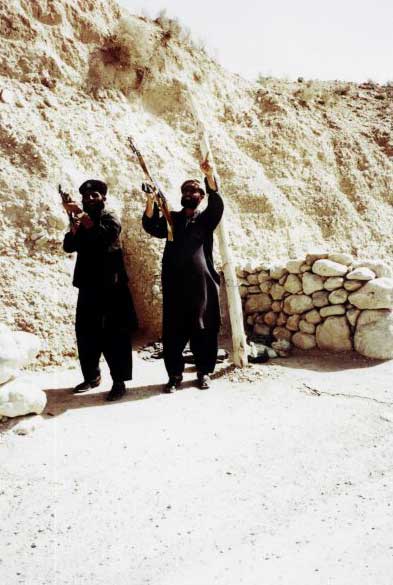 |
Still playing the Great Game in Baluchistan
| |
One of the first things we noticed when we crossed into Pakistan from India was the amazing painted trucks, but all Pakistan drivers seem to take real pride in their vehicles and make all sorts of additions and improvements. Few drivers are satisfied with standard horns, for example, and install instead bizarre whoops and whistles. They also fiddle with the electrics so that occasionally their back lights - indicators, brake lights and reverse lights - will all flash on and off in a weird, coordinated display. It looks nice but since you don't know whether it happens when they brake, or indicate, or reverse it's not a real benefit from a road safety point of view. In the tribal areas, as in most others, all the truck drivers were very friendly and flashed at us as they approached. We waved back, prompting them to give us a toot on their ridiculous whistling horns. Riding past a whole convoy was like walking past a building site.
Late in the afternoon we stopped in a deserted petrol station for a break. Of course nowhere is really deserted here and a little bloke sprinted over from a nearby house. He only sold diesel so instead of petrol he offered us some tea. He quickly boiled water in a kettle balanced on two bricks, a little twig fire in between. We sat on a charpoy and had tea and some sort of sugary substance, a bit like Scottish tablet. Hard to conceive of the number of flies the stuff must have had on it throughout its life, but it doesn't do to dwell on these things so we just dipped it in our tea and sucked on it, as instructed by our new friend.
We finally reached our destination, Lorelai, just before dark. No women in the streets, at all, just turbanned, rifle-toting men. So I vetoed any evening strolls and we just settled into the hotel. It's a strange thing in rural Pakistan that you just do not see women at all. Whenever we are out and about, not on the bikes, I wear my shalwar kameez, so I know that I am suitably dressed, but being the only woman in the streets of a town (and I really mean the only one, even in restuarants or shops) makes you feel very conspicuous and pretty uncomfortable at times. It made me wonder how Abdul's Kiwi wife up in Gilgit had managed. Or maybe she hadn't, and that's why she'd gone back home.
|
Wednesday, 2 May 2001, DAY 41: 6967KM - 7189KM |
Up and off again through the busy town and across the desert. We passed bright green irrigated orchards, apple I think, and huge, mud walled enclosures, smooth and brown. We weren't sure exactly what these were for - privacy, or to keep the desert winds off? One had a flag at each corner and looked like a massive sand castle. The men at the side of the road all waved and smiled. Dave stopped to take a photo and two women, away off in the distance, ducked into a doorway.
With some help from a local driver we found the right road. It was being worked on and for several kilometres we had to pick our way through a pebbly dry river bed, the official detour. The night before, a man had been chatting to us so we asked him about our route the next day. Was the road good? "Oh yes, good road, some little piece bad. Beautiful road." Based on past experience this could mean almost anything but, the dry river bed aside, it turned out to be a fair description. It was a good road, twisting up through more hills, pot-holed and ridged occasionally where there had been a landslide. It was certainly beautiful, he was right about that. Mountains on all sides, pine forests, little villages, flocks of goats. We stopped in a little town, Ziarat, for lunch. On the wall in the hotel was a photo of the main street, deep with white snow. It looked absolutely beautiful.
We wound down out of the hills and back onto the plain. In the distance we could see little groups of tents. Nearer the road were tiny, low thatch houses, perhaps for animals. We passed a petrol station with a camel at the pump. So that explains what they keep in their hump (although I'm not sure where you put the nozzle). Finally we reached Quetta, a big town with busy wide streets, traffic policemen, roundabouts. Still definitely a frontier town, but the most developed place we'd seen since Islamabad. We checked into our hotel, the Bloom Star, and gaped at the cleanest hotel bathroom we'd seen on the whole trip. Caught up on a little TV - no Richard and Julia sadly, but 'Starship Troopers', just the sort of rubbish you feel like watching after a long day on the road.
We braved the womanless streets of Quetta and found a restaurant for dinner. One of the other diners asked us in perfect English "How do you find our spicy Pakistani food?" Dave said it was very popular at home, "Scottish people love Pakistani food." "And Pakistanis love Scotch. A fair exchange", he replied, smiling. We had heard that General Musharraf himself is partial to a nice malt, but no-one else had referred to alcohol at all.
|
Thursday, 3 May 2001, DAY 42: 7189KM - 7535KM |
It was hot at 7.30 in the morning so we set off, planning to get as far as we could but not kill ourselves in the heat. The long 400 and 500km days we'd done since Islamabad meant we were on schedule and actually had a couple of days spare before our Iran visa deadline of the 6th. Quetta was busy and we picked our way between everything from donkey carts to huge trucks. We passed three trucks loaded with clay urns, hay packed around them, the whole load bulging out into a huge net like a massive head of hair in curlers.
Out onto the plain, up over hills and down the other side, and then the desert stretched out ahead of us again, jagged hills along our left and on our right peachy orange sand, totally flat. We could see little columns of dust rising up in the distance and assumed they were vehicles crossing the desert but then one came closer and they were mini tornadoes, pulling dust up from the desert and spinning it round in a funnel shape. One actually passed across the road in front of us and Dave said he felt burning heat coming off it. The road stretched out ahead as far as we could see and the land around was flat, pointed rocky hills poking up ocassionally like the tips of icebergs. Sometimes a hundred metres from the road we would see groups of men, chatting. Their bicycles were propped up with a blanket hung over them and each man was sitting in the shade this gave - a fine idea in the desert heat.
There were no petrol stations but we started to notice jerry cans lined up outside houses at the side of the road. Smuggled petrol from Iran. We pulled into one and asked the price - 50 rupees. 50!? Nearly twice the price at the official stations so we huffed off. Tried another one and the price was 60. We were just about to set off again when the man managed to explain that this was for a gallon, not a litre. Oh, right, that's OK then. We filled up and chatted to the bloke, another Abdul. We took some photos and he asked us to send them to him: Abdul Hallick, Petrol Service, Mull. We tried to tell him we had a Mull too in our country, but it was all too complicated.
On and on and it got hotter and hotter. We were sweltered in our jeans, boots and heavy jackets. Then the grey pebbly desert suddenly changed to rolling dunes of pure yellow sand - like a cartoon version of a desert, Tin Tin in Baluchistan. Round a corner and we came up against two huge trucks that made Klaus and Sonja's Unimog look like a little runaround. Another two German couples, each with a young son, one with a dog, who had just come from Iran. We stopped to chat and they told us their thermometer was reading 45 degrees. One of the women appeared with two pint glasses of Coke with ice. Now normally I don't drink Coke believing it to be the drink of the devil, but really, there are no words to describe how good that icy glass was. I looked at the woman and she said, "I know, you don't have to say anything."
|
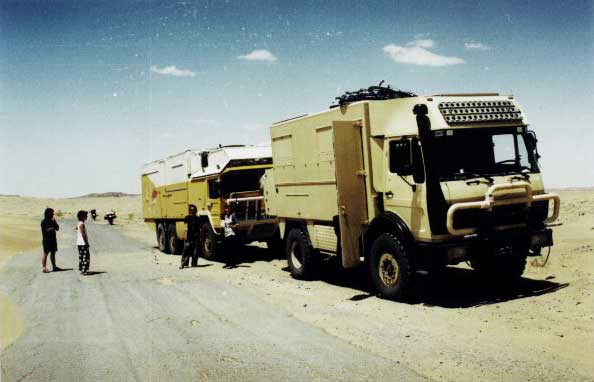 |
The Germans, making good use of the props from Space 1999
| |
We stood and chatted and she told me they had really enjoyed Iran, and that the clothing restrictions were not nearly as strict as they used to be. We have found that the clothing issues for women in Iran are an absolute staple topic of discussion for all women overland travellers. Anyone who is going there is always looking for information; anyone who has already been is happy to describe what they wore, what Iranian women wore, what other travellers wore, and how they were treated. The official line is that Iranian women are required to cover their heads at all times in public, and wear loose fitting dark clothing that disguises their body shape. The traditional garment is the chador (literally 'tent') which is a sheet of black fabric you wrap round yourself and over your head. Although foreign women are not strictly speaking covered by these laws, it is clearly a good idea to conform and women who are not dressed correctly can be turned back at the border. I was planning to wear my blue-grey shalwar kameez, at least to start with, and the Germans said this would be fine.
We got to a little desert town, Dalbandin, in the early afternoon but it was so hot we decided to spend the night. We found a reasonable hotel (reasonable being a relative term - this was the middle of the Baluchistani desert after all). News of our arrival had obviously got around town and twenty minutes later all the young blokes turned up and sat around, fiddling with Pepsi bottles and peering at us. There was a television on with the usual Pakistani programmes - music videos with girls in tight t-shirts and jeans and slightly dubious bits taken from musicals with women coyly running away from men across lush green hillsides. And yet the men all prefered to watch me, swathed in a baggy sweaty t-shirt and motorbike jeans. It seems that you just never know what a western woman might do, no matter how unlikely a woman it is, so they're worth watching. I slunk off to our room, a real disappointment I'm sure.
The room was hot, 34.5 degrees, and as the electricity was off it didn't cool down at all. We went down for dinner and ordered some water. It came, a bottle of BMW, Baluchistan Mineral Water. There were things floating in it so Dave said "Water OK?" The waiter said "Ah, Baluchistan water not good. You want Nestle?" Yes, I think we do, but he still charged us for the other stuff. We kept it to pour on ourselves during the next day's ride.
|
Friday, 4 May 2001, DAY 43: 7535KM - 7848KM |
Woke early after a horrible night. No electricity again so no fan or light. We got up at 5.30am and dressed in the dark. I waited outside while Dave went and got some drinking water and the men of the town stood and stared at me. One man drove past twice in his pickup, slack jawed. They make their own entertainment in Dalbandin obviously. I had decided to wear my Iran riding gear as we would be crossing the border later, and had chosen my usual jeans and boots, but with my shalwar dress over the top. A good look. We set off in a beautiful cool temperature but by 7.30 it was hot again. We stopped at another jerry can stall for petrol. The man poured it through a big funnel with a cloth stretched over it. We passed through little mud house towns with palm trees around them, like little cartoon oases.
|
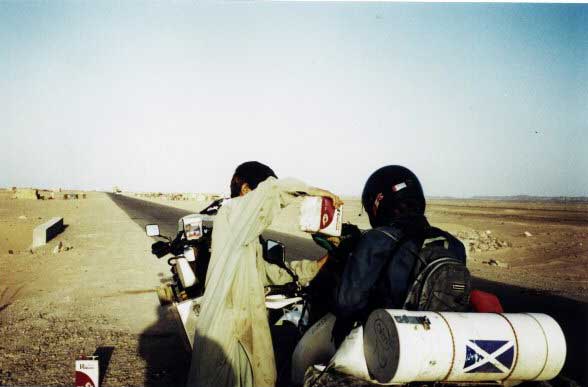 |
Motorway services, Baluchistan style
| |
We stopped for breakfast in a grim little settlement, sitting on the floor with a bunch of turbanned men who chatted to each other and laughed at us. We persuaded the cook to make an omelette, deep fried again, very horrible. We ate bread that they brought wrapped up in a huge rug, and drank sickly warm orange juice. The bottle said: 'Refreshing. Nourishing. The taste of joy.' No, none of the above. Carried on and were stopped by occasional checkpoints. The soldiers here were dressed in charcoal grey punjabis, worn with a thick belt, and berets slanted steeply to one side. The overall effect was off a Cossack officer - they looked really smart.
We finally reached Taftan, the Pakistani border town. It had a real frontier feel, wide and dusty with herds of goats wandering around. The officials at customs were pleasant and businesslike. They finished our paperwork quickly and professionally and then presented us with sweet, milky tea. On to immigration and they were also very pleasant and offered us even more tea. "You have babies" the officer dealing with our passports asked. "We have motorcycles", Dave said, prompting much laughter and translations for the non-English speakers. When we were ready to go I started wrapping my dupata over my head so my hair was covered as required by Iran. As Dave got on his heavy jacket one of the officials leaned forward and said seriously "It will snow, you think?" Loud laughter again. Tariq had described Pakistan as a gregarious society and he was certainly right. Everyone is ready to have a laugh. So it was a little reluctantly that we left and headed towards Iran.
|
 |
 |
| | | | | |