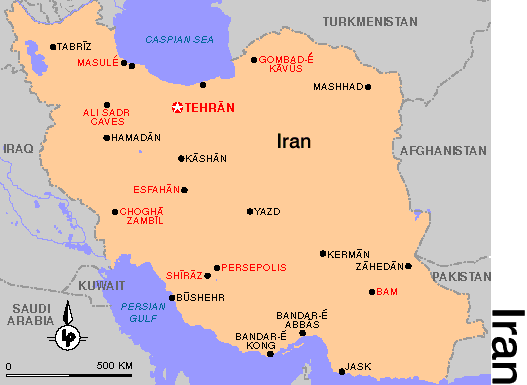
For more on Iran, check out the Lonely Planet info page.
|
For more on Iran, check out the Lonely Planet info page.
|
After sad farewells with the jolly Pakistani customs officials, we wheeled the bikes across a dusty square to the Iranian immigration office. It was packed with people and I carefully checked out what the women were wearing - mostly shalwar kameezes, with wide, dark shawls over their heads and backs. I reckoned I was doing OK in my shalwar/jeans combo, but kept checking that my hair was still in place. There seemed to be a special counter for foreigners so we were sorted out fairly quickly. Through the gate, and after our mad race through Pakistan we were finally officially on Iranian soil. We knew this because painted along the wall was the very reasonable slogan: We don't want anything except the adoption of Islamic law everywhere in the world.
We rode off to find the customs office, got a bit lost, but finally spotted it and went in. We were just getting our documents out when a man ran in and started shouting at me and gesticulating that I had to leave. He had a little flat peaked cap with a scarf hanging down at the back and a white moustache - a Charles de Gaulle type. I shuffled out behind him, wondering what terrible crime I had committed - had a lock of hair come astray? Had I flashed more than the legal limit of wrist when I jumped on the bike? He jumped in a car and waved at us to follow... back to another customs building. It turned out that we had completely missed a whole stage of customs and had ridden straight past his office. First rule of overland travel: never needlessly annoy a customs official, they can seriously disrupt your day. So we jumped off the bikes and hit the ground apologising. Into the office, de Gaulle beamed at us and pointed to a tray with little glasses of tea. He didn't seem at all bothered by our faux pas and filled in our details in his ledger while we drank tea and stood in front of a huge fan, cooler than we had been for days. He asked the same baby question so we wheeled out the same motorcycle joke to much laughter - this one could run and run. Iranian hospitality and friendliness is a legend among travellers in this region and our very first experience of an Iranian seemed to be confirming all the good things we'd heard.
Back to the other customs office and the formalities were completed, another ledger filled in. The official came out and checked the numbers on the bikes but didn't search our luggage. This was a relief as we've heard that short wave radios are not allowed in Iran and can be confiscated. Dave was given a rather nice one as his leaving present from work and we'd be very sorry to lose it. On to the next customs office where the formalities were checked and, are you following this, another ledger was filled in. And then we were through a huge gate and we really were in Iran. Unbelievable somehow that after all the discussion and debate and worry we had made it, on schedule, exactly as planned. What a triumph.
It was still baking hot so it was great to get moving again, but - no! - a mile up the road was another checkpoint. We began to worry that the whole of the country was just going to be one ledger after another. They checked Dave's passport, looked over at me and, obviously spotting that I was on the edge of madness, what with the heat and being swathed in this bloody scarf thing, they took pity on me and just waved me through.
The road was excellent, as most are in Iran apparently, and we sped along. So did everyone else, with lots of flash cars and modern buses passing us at high speeds. They drive on the right here, and it's surprising how quickly you get used to that (I know, famous last words). Everything works the same, just the other way round. I mean, it all seems a bit silly, but you can do it. It was just far too hot to go any further that day so we stopped in the first town, Mirjaveh. Very dusty, very quiet, we drove up and down looking for a hotel. Dave was told by two people that there was no hotel in town but the prospect of carrying on to the next place, 80km away, was just not acceptable so he refused to believe them and by sheer force of will found a hotel in a side street. The gruff little cook who seemed to be in charge showed us a room - it smelled funny, there was no fan, and the curtain didn't shut, but it was an oasis so we moved in and lay around for the rest of the day, relying on the old method of draping ourselves in wet towels to cool down.
We had planned a very early start to take advantage of the (relatively) cooler temperatures, but we needed petrol and when Dave asked where we could get it the gruff little cook told him the petrol station was on the way out of town and didn't open until 7am. Or maybe 7.30. Or it might be 8. We set off anyway and got there at 6.45 to find a queue of cars waiting for it to open at 7. We were ushered to the front by the other drivers and the man in the first car shouted to the petrol bloke. He pointed towards me and seemed to be saying "Get a move on, there's a woman on a motorcycle out here and she's overheating!" Whatever he said, it worked. The gates opened, we were served first, then waved off by the other drivers. These people are excellent. The price of petrol is also not bad and another big talking point among overland travellers - around 5USc a litre.
So we were off again through the desert, flat and grey with a jagged rocky ridge on our right, smoother dustier hills far away on our left. We were heading for Bam, the first major town of note and famous for the manufacture of pots, many of which are exported to Glasgow. (This is a Scottish joke, and a pretty bad one at that, so for those of other nationalities, just ignore it.) Every now and then we were stopped by passport checkpoints. At one, the soldier said "Your country?" "Australia" "Ah, Harry Cule, footballer, Leeds United!" I thought, what on earth are you on about, but Dave confirmed that this bloke was indeed an Aussie footballer in England. When I drove past he shouted "Mark Bosnich" and I smiled vaguely, thinking "Yes, very possibly, I really wouldn't know mate."
The countryside quickly began to take on a Middle Eastern feel - the usual camels strolling along in groups in the distance but also the little square buildings beside the road had domed roofs, some even had palm trees beside them. They were made of mud so were exactly the same colour as their surroundings and they looked just like illustrations from the Good News Bible we had at primary school. We stopped for petrol and some women in a car spotted me and started chattering to each other. I waved and they grinned and waved back enthusiastically. Everyone says the women in Iran are much more outgoing than in other countries and even this exchange seemed to confirm that.
After a hot morning's ride we finally arrived in Bam. Iran has a truly dreadful reputation for driving, with a horrific death toll each year, but based on our experience so far we couldn't understand why. People were driving quite quickly on the highway but nothing too dangerous. As soon as we arrived in Bam it all became clear. There are no traffic rules. At all. No right of way system at junctions. No rules of any kind at roundabouts. Everyone just tries to get where they're going as fast as they can and by the most direct route. You can stop in the middle of a three lane road to drop someone off, or you can reverse back along it if you've missed your turning. You can do U-turns or turn across the flow of traffic without a second thought. It was terrifying. I was still concentrating on the right hand thing when suddenly I was caught between three cars, all trying to go in different directions, all determined they could somehow squeeze past the others. No-one gets annoyed, they're too busy ignoring everyone else on the road. Except us. Cars and bikes would pull up alongside us, say "Ooh, look, foreigners!" and then drive along, inches away from us, smiling and waving. Charming. Life-threatening, but charming.
After half an hour of this, during which I aged about 10 years, we finally found our guest house, Akbar's, another travellers' legend. A legend for good reason. We knocked and the gates opened onto a cobbled courtyard with a huge date palm in the centre. Low beds were scattered under a shady roof. The guest house itself was air conditioned, our room had a fan, hot running water, crisp clean sheets, a true oasis. I snoozed in the luxury of cool air while Dave made some lunch, the treasure, and then we set off to check out downtown Bam. Unfortunately our 'anything goes' policy on food had finally caught up with me and I'd been a little under the weather for a couple of days. On the way into town it descended again and I had to make an emergency return to the guest house, so Dave explored the town himself.
By the time he got back, and I had recovered enough to face the world, some other guests had arrived. Fred and Dienne, a young Canadian couple, and David, an Englishman turned Australian. They had all travelled a lot so war stories were exchanged. David was an inspiration. It is his 70th birthday next month, and he has spent the last few years travelling all over the world, sometimes crewing on sailing boats, sometimes by public transport as on this trip. We agreed to explore the town and the 16th century old city of Bam together the next day.
We all slept in and missed the famous sunrise photo opportunity at the old city but it takes a lot to lure us from a comfortable bed in an air-conditioned room these days. We ate breakfast with the others - the standard Iranian breakfast of huge ovals of flat bread, white cheese (like fetta), honey, a boiled egg and tea. Then off to the old city. In through huge wooden gates, we wandered along little streets through the semi-ruined city. The walled city was first established around 225AD apparently, but the ruins we were seeing dated back only (only!) as far as 1500. There was a mosque and various residences, stables, and barracks all overlooked by a huge citadel and surrounded by a high wall. The whole place was built of flat mud bricks and around a corner we came across an old man making those exact bricks to be used in renovations. He was mixing water into a pile of soil, then packing the mud into a square wooden frame before knocking it out to lie flat and dry in the sun - presumably the same method that had been used when building the city 500 years ago.
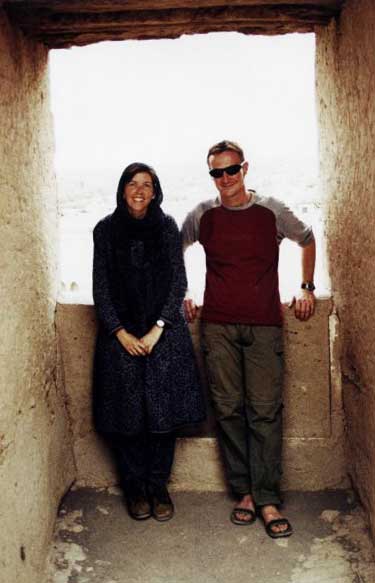
A window in the old city wall, Bam
In the evening we all went into the modern town of Bam for our, or at least my, first real look at Iranian society. Dienne and I were both still dressed for Pakistan in baggy shalwar kameezes - mine a dusty blue and hers a muted green - and with our dupatas draped over our heads. When we arrived in the town almost every other woman (of which there were many) was wrapped in a black chador and we realised we looked like two exotic birds of paradise, or alternatively two members of the oldest profession, which was obviously what some of the older women of the town were thinking as they pointedly looked us up and down. Most people were perfectly friendly though, and we got lots of 'hello' and 'hello-mister-how-are-you-fine-thank-you', a pretty self-contained greeting. Of course the main difference from Pakistan was that there were women in the streets at all, and in spite of their 'any colour as long as it's black' dress code they certainly weren't shy. Whole groups of women would say hello as they passed, and one particular group took a real shine to David (the other one, sadly), giggling and trying out their English on him which included 'I love you' from one girl, prompting a hoot of laughter from David and shrieking giggles from all of her friends.
The town was interesting too. Shops selling dried fruit, nuts and pulses, or tinned food (pears, cherries and apples), many shops selling fabric, much of it variations on black obviously. Black with shiny black flowers, black with slightly see-through black stripes, just plain black. The popularity of football was evident, with several shops and stalls selling posters of David Beckham. (No sign of Posh though - she obviously doesn't pass muster with the mullahs.)
Eventually my garish and tarty outfit got too much for me and Dave and I set off to find something more becoming. A chador looked too tricky (it's just a sheet of black material, so you have to hang onto it with one hand at all times), and we had worked out that for the racier woman (the category into which I fall, apparently), another option was a long black coat and a headscarf. We found a bazaar with a reasonable selection and while I tried some on in a little changing room, Dave talked to the men about football and they all got a lot of mileage out of Iran's defeat of Australia during the World Cup qualifiers a couple of years ago. They had very little English, but you can always spot a joke at your own expense. We bought a lovely, A-line, ankle-length number for me ('I think I'll have it in, now let me see... black') and headed back to the guest house US$7 poorer.
In the morning we all set off for another famous Iranian town, Kerman - us on the bikes, the others in the bus. Only 200kms, so a short day for us and it was cloudy which was, as always, a relief. More desert riding, yellow rolling hills near the road, brown ones behind, then rocky grey and red ridges in the distance. We reached Kerman just before the bus and met up with the others in the Akhaven Hotel, another legend among travellers as the family who run it are famously friendly. They certainly proved to be and, even though they were fully booked, they sat us down and plied us with tea. It was bad news that the Akhaven was full as another part of the legend was that it really is the only good hotel in Kerman. Dave and Fred went off to investigate the other possibilities and again proved the legend to be true. We had to choose between the Milad, a smelly cockroach ridden place nearby, the Naz, a nicer but unfriendly and expensive place across the road, and a not much better place another 20 minutes out of town. In the end, after much debate, we opted for the smelly cockroaches.
Although the hotel situation was grim, Kerman itself was a lovely town. It turned out that Fred was a temple/mosque obsessive and he and Dienne had logged visits to hundreds of them throughout their travels. We don't do a lot of that sort of thing, but Fred infected us with his enthusiasm and we all set off to look at the 14th century mosque in town. It was lovely - huge peaked doorways, high domes, intricate blue tiles - and Fred ran from one corner to the other, taking photos from weird angles and pointing out special features to us. From the mosque we headed into the bazaar which was, if anything, even more impressive. It was housed in a 1.5km long corridor, the roof made up of a long series of brick domes. Half way down was a stunning 13th century underground bath house, now used as a tea house. We sat admiring the beautiful tile and brick work, drinking tea and trying to smoke a hubble-bubble with limited success.
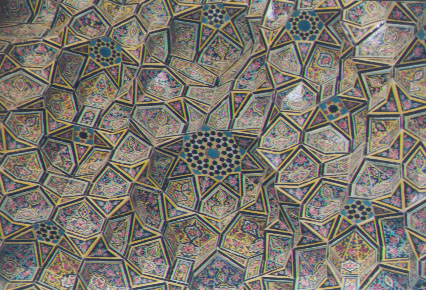
Ceiling detail, nameless mosque, Kerman
No-one could face going back to our horrible hotel so we wandered around and watched a bakery making the flat bread we'd eaten so much of. Balls of dough were spun by one worker until they were flat, and then another chucked them onto a turntable, turning slowly around inside a huge open oven. As the discs of bread appeared again, crisp and bubbled on top, one of the men would quickly flip them over, then when they came round again, flip them out onto a table in the street where the audience of shoppers were waiting. The smell was amazing, so Dave tried to buy a disc for us. The man brushed away his money and gave him one so we all tucked in. Hot, crisp and fresh, it was probably the best bread I've ever eaten.
The suicidal frenzy of driving in the town continued to stun us all. We watched in awe as one driver reversed round a corner onto a busy main road and came within an inch or two of ending up in a drainage ditch. It was a little confronting then, when he pulled up in front of us and offered to be our taxi back to the hotel. We all got a bit hysterical as he careered through the streets, a near miss every few moments. He could obviously smell our fear and rose to the occasion, nearly killing us all several times to more cheers and howls of terrified laughter.
Our hotel was truly dreadful and we were woken in the morning by someone, apparently in the bed with us going by the volume of his performance, clearing phlegm from his throat in the manner of Asian early risers. Fred and Dienne had had a far worse time it turned out - the smell in their toilet had been so bad they couldn't use it and they had been overrun, literally, by huge cockroaches. They had all had enough of Kerman so headed off to the bus station. We decided to wait a day, but opted to upgrade to the unfriendly and expensive Naz across the road.
We spent the day working on the Internet and exploring Kerman. I finished off my new racy outfit with a headscarf - not completely black, but black with a sprinkling of little gold flowers. Modest but wanton. Demure but sexy. The shop only sold head scarves but there was a changing room to avoid any public displays of fringe while trying on. So my Iranian look was now complete - long coat, loosely tied headscarf. A little like Jaquie O. A little like Princess Grace. A lot like Hilda Ogden.
Up at 6.30 and off, riding through a flat desert landscape, then gentle hills dotted with trees. We weren't sure what these were, then passed some stalls selling huge bags of nuts so they must have been some kind of nut tree, maybe walnut going by the size (of the nuts, not the trees, I wouldn't have a clue what size a walnut tree is). We were stopped by a couple of checkpoints, one very officious. They examined every page of our passports, then looked severely at our Iran visas. One of the soldiers motioned for me to take off my helmet - OK, if you think it'll help to see me with a scarf rather than a helmet covering my entire head.
Stopping for lunch we pulled into a town near the highway, Neyriz. They clearly don't get many foreigners in Neyriz and a large crowd quickly formed, our first in Iran. As always happens, a reasonable English speaker emerged from the sea of faces and struck up a conversation. He was Ari, a local PE teacher and a really lovely man, and he (and a small band of others) joined us for lunch in a nearby burger place. We noticed that two blokes at the next table were drinking bottles of a soft drink called 'Arso'. It seemed like fate, so when we ordered I said, smoothly, "Mine's an Arso." "You Arso?" to Dave, but he, having no sense of adventure, said "No, me Pepsi." Crestfallen, "Ah, no sir, no Pepsi." "OK, me Arso." "Ah, Arso! Arso!" the attending chorus shouted triumphantly. Arso turned out to be a sort of lemonade and has now become the drink of choice for the two flat arsos.
We set off again and the road immediately climbed up into rocky hills. Stopping to take a photo, a truck pulled in beside us. After picking at his tyres for a couple of minutes the driver finally plucked up the courage to talk to us. "Your country?" "Scotland." "Ah, Scotland! Scotland very good! Iran bad." "No! Iran good." "No, no, Iran bad. England good!" "Well, yes, England good, but Iran also good." "America! America good!" "Really? You think so?" "Ireland! Ireland very good!" As fascinating as this was, we dragged ourselves away, wondering if he was just trying to be nice, or he really was in love with the West.
On through the hot desert again we decided to have one last break and pulled into a mosque/truck stop. A bunch of truck drivers beckoned us over to join them for tea, sitting on low beds under a trellis of vines. It was really picturesque, in a truck stop kind of way, so we got some cold drinks and sat down. "Your country?" one of them said, conforming to a rigid code of Iranian small talk. "Scotland." "Ah, Scotland, whee-shkee..." he said, and mimed drinking from a bottle. The others all laughed and nodded vigourously. I said "In Iran, whisky not good." "In Iran..." he mimed being shot in the head with a downturned mouth. More laughter. More questions. "Childrens?" "No." "Childrens in Scotland?" "No." We tried the motorcycle joke but they didn't get it. Dave got out the guidebook and read out "I'm sorry I don't speak Farsi" in Farsi. A hilarious joke, loudly repeated by everyone along with howls of laughter and slaps on the back for Dave, the great linguist.
Waved off by the drivers we carried on through the desert. A dazzling white band was visible in the distance, like sun shining on water. The closer we got the whiter it got until we could see it was huge salt pans. All controlled by a dam, some of the pans were still full of water with the salt just starting to chrystalise around the edges, like ice forming on a loch at home. On the other side of the dam was the deeper water - a lurid, stunning pink. The same pink that the desert was sometimes, it was a weird sight.
After some close escapes in the lunatic traffic, we finally found the street where our hotel was located. A man gave us directions to it and as I set off he said, "Be careful." I said, "Iranian drivers, mad." He leaned forward, tapped his forehead and said solemnly "Crazy." We found Fred, Dienne and David's names in the register and met up with them later for dinner. The big pull of Shiraz is the nearby ancient ruined city of Persepolis (named after a local football team, apparently), and they had already arranged a car to go out the next day so we asked, and were allowed, to tag along.
We met at 6.30 the next morning and got in the car with Ali, the driver the others had arranged. He was friendly and chatted throughout the hour journey to Persepolis. When we got to the site he opened the boot and produced a pot of pea and ham soup - a traditional Shiraz breakfast apparently - and heated it up on a gas stove. It was cool at that time in the morning, so we all enjoyed it. Then, into the city which was amazing. Very much a ruin, it was first built in 500BC, and destroyed by Alexander the Great in 330BC, but there were still massive gate columns and stairways and halls for us to stroll through.
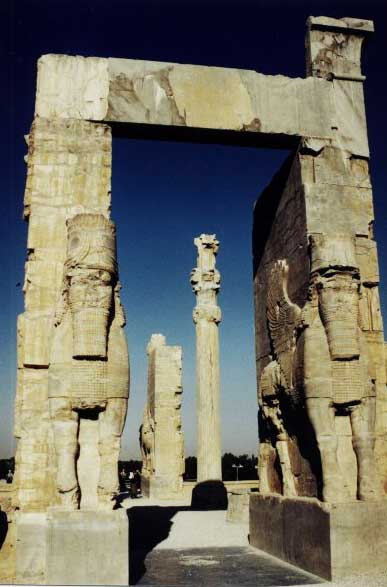
Some stunning ruins at Persepolis
The best things were the bas reliefs which were covering all the ruins - kings and monsters and inscriptions, but my favourites were the hundreds of people, visitors to the king, some carrying plates and goblets, wine sacks and goats, all wearing different hats and shoes, some with beards, some with curly hair. Apparently they really did accurately represent the different tribes and peoples that were part of the kingdom at that time, with their different styles of dress.
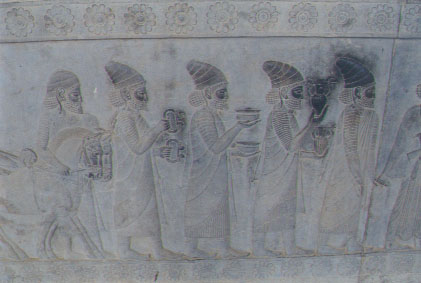
Details on bas-relief, Persepolis
We were almost the first people to arrive in the morning, but gradually more tourists arrived, many of them Iranian. Three girls came up and introduced themselves to me, as Iranians so often do, and we chatted briefly. They were students and had very little English but they still managed to be very friendly and asked if they could have their photo taken with me. As we went into the museum Dave pulled a nail out of his shoe. "Do you think this is from 500BC?" It didn't seem likely but then, in the museum, there was a case of nails exactly the same (OK, they were made of gold, but apart from that they were identical). So we hung onto Dave's nail and will consider donating it to the British Museum, in that great British tradition of ancient artefact pillaging.
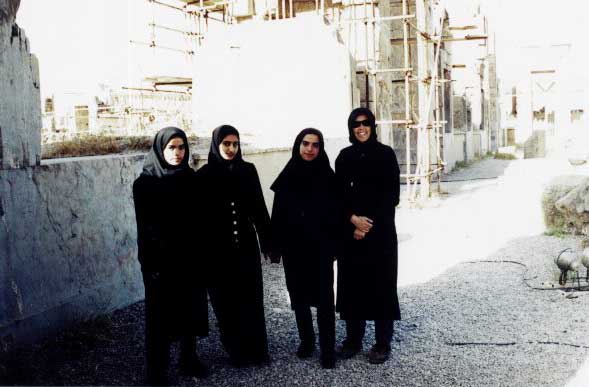
More new friends at Persepolis (I'm the one in black)
Most of our time in Shiraz was spent wandering around, catching up on the website, and working on the bikes. We managed to scan in a lot of photos, so if you're interested go back through a couple of pages, the new ones start at Shimla in northern India. And I really should take this opportunity to say another thank you, to our friend Ross, web expert and all round good guy. He helped us set up the site (i.e. he set up the site and we watched and said "Yup, that looks good.") and is now a ghostly presence on it, nipping in to the file manager to fix our mistakes and sort out the many photos. And also thanks to Ziggy, who is responsible for the groovy red line on our home page which plots our route (and makes it look like we still have an awfully long way to go).
The bikes were badly in need of an oil change but Dave had been putting off doing it as he searched for high quality oil. He finally found a parts shop with a helpful owner who supplied oil to Mercedes-Benz in Iran and decided to go for it. All was fine with the XTZ... all was fine with the DR... until he tried to start it again afterwards and it wouldn't start. It seemed that the starter motor had finally given up. It had always sounded like a bag of bolts but we had been hoping that this was just a design feature of the bike. On the Karakoram, however, the sound of me starting up had taken on a teaspoon in a blender quality that had been worrying both of us for a while. Well at least it happened in a workshop and not in the middle of the desert. He took the bike apart again, poked about a bit, put it back together and eventually it started, but we both know that its days are numbered. Hopefully the number is big enough to get us to Europe where we can shop around for a replacement one. Some other bikers had arrived at out hotel when he got back from this repair session, and one of them suggested banging the starter motor on the side with a hammer each time you need to use it (which is funny, as that's just the sort of thing I might have thought of myself). Apparently, to people who understand starter motors, this solution actually makes sense (it will help some particular part shoot out and connect with some other part) so we may have to resort to that soon.
We left late and headed out past Persepolis, through the desert to our next stop, Yazd. It's a town with an old city like Bam, the only difference being that Yazd old city is still inhabited and is a bustling, living part of the town. We rode over 450km through the usual desert landscape and somehow we both had a miserable day. It was hot, and boring, and really for the first time we just didn't enjoy it at all. We passed through various little dusty towns that we were relieved not to be stopping in. Then we did stop in one but the little crowd of men and boys that formed around us was so creepy we just got back on the bikes and left. Some days you're just not in the mood for it.
We got to Yazd and found the Hotel Aria. There was a note from Fred and the others who had left that morning saying 'This place isn't up to much but it's all there is.' So we checked in. Our room faced out onto a courtyard where various Iranian men sat around chatting and smoking. We didn't have our own bathroom (a first - you see, we don't slum it much), and had to use a communal squat toilet. And somehow, for the first time, the clothing restrictions really started getting to me. If I wanted to nip out for a pee I had to get completely dressed in my coat and headscarf, and then cope with them while trying to negotiate a squat toilet. This is never easy at the best of times, and an ankle length coat wouldn't be my first choice of outfit for such potentially hazardous athletics.
In the evening we wandered into the old city and it made the whole thing worthwhile. Little old streets winding around under archways, mud buildings, another old bazaar, and every now and then a beautiful, blue tiled mosque. The usual 100cc motorbikes still sped about the tiny streets, scattering chador-clad women like crows, but if it hadn't been for them we could have slipped back in time 500 years.
The old city had been so good we had decided to spend another day in Yazd to explore it and buy some souvenirs. It was only when we got up in the morning we discovered that it was a national holiday throughout Iran, and all businesses would be closed. Bugger. We wandered out anyway, and explored the much quieter streets. Emerging out into the square of the main mosque, we discovered why the streets were so quiet - thousands of people thronged the square. Not only the women but the men were all dressed in black - we found out later this was a mourning day for one of the old imams who had been killed. A lorry pulled up at the doors of the mosque and huge copper pots, maybe two metres across, were carefully lifted down by several men. They had cloths wrapped round their hands, as the pots were clearly hot. These were then taken round to the back door of the mosque - we never did see what was inside, or found out what it was for.
Later we took a taxi outside the town to visit another local site of interest, two Zoroastrian Towers of Silence. Zoroastrianism used to be the main religion in Iran but was gradually pushed aside by the spread of Islam. I don't know much about the religion itself, but the thing that you can't help being a bit fascinated by is their way of disposing of their dead - by placing the bodies on high stone towers to be eaten by vultures. Cool! The towers we visited, on two rocky hills on the outskirts of Yazd, were no longer used so we could climb right up to look inside them. They were circular, a flat area inside with a round pit in the middle and a high wall around the outside. We stood trying to imagine the ancient ceremonies that must have gone on as the bodies were carried up the winding stone paths to the towers and it would all have been very atmospheric if not for the squads of teenage boys outside who were using the whole area as an off road motorbike park. Little 100ccs sped up and down the sides of the hills in first gear, speeding over jumps and spitting dust out behind them.
Another day of uneventful riding, although a lot of the countryside was much more built up and industrial. We passed through more dusty little towns, green irrigated areas, and flat grey desert. It was hot when we finally reached the outskirts of Esfahan, the next town on our schedule. We stopped to get our bearings and were immediately beckoned into a shop piled high with watermelons. The owners were just having tea and cheerily pressed a glass on each of us. They had very little English but we all managed the usual chat nonetheless. A steady trade was kept up throughout this and there's obviously good money in melons as the owner kept his takings in a huge black bin bag. This volume of money is not that unusual in Iran, actually, as the exchange rate is 8,000 rials to the US dollar. The biggest note we have seen is 10,000 rials, just over a dollar, so any reasonable amount of money results in a huge wad of notes. We just changed a hundred and fifty dollars so are currently millionaires.
We waved goodbye and carried on into central Esfahan and our hotel, the lovely Sa'adi. After the failings of the Aria we both felt the need of a little pampering so we upgraded a little from our usual hostel type accommodation and it was well worth it to have a sit down loo of our very own. We got washed and set off to explore the city. Esfahan is generally accepted to be the most attractive city in Iran, and we wouldn't disagree. The tree-lined streets and busy shops were almost Parisien and, within the restrictions placed on them, the women even managed to be quite stylish. Lots of coats and headscarves, some of the coats with a deep slit up the back revealing slinky trousers and very smart shoes. The younger Esfahanis have a certain look, a mid-thigh length, fitted jacket, with black drainpipe trousers and Baby Spice clumpy trainers. They look good, but I'm not sure the mullahs would approve. The people of Esfahan don't seem as worried about the mullahs as those in other towns and it does give the city a pleasant, relaxed feel.
Up to date again! We've spent the last couple of days wandering around the city, chatting to the friendly locals, and drinking tea in an assortment of beautiful locations. We caught up with Fred and Dienne just before they set off for Turkey. They were more casualties of the frustrating Iranian visa system and had run out of the patience and funds to get more visa extensions. They're heading the same way as us though, through the Middle East, so we fully expect to bump into them at some point. Before he left, Fred told us we had to visit the central mosque in Esfahan's main square as it was probably the best one we would ever see. We decided that in the absence of his influence it might well also be the last one we would ever see, so we obeyed and he was absolutely right. It was stunning, with high tiled domes, quiet leafy courtyards, and one of the most remarkable echoes I've ever heard, even a whisper is thrown back at you five or six times.
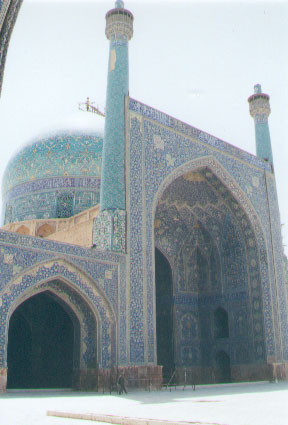
The 54m high main dome of the immense Emam mosque in Esfahan, completed in 1638
David had parted company with the others so we spent yesterday with him, drinking tea and eating gaz, the powdery, nutty nougat which seems to be a speciality here. In the evening we went to the Abbasi Hotel, built in the shell of an old caravanserai. There are beautiful fountains and gardens in the stunning central courtyard and we sat drinking tea and joking with the waiters, elegantly dressed in loose white shirts, red waistcoats, voluminous black silk trousers and little black hats like a round version of a fez (or a bowler hat without the rim). A couple of them could balance a dozen little trays of tea in a pyramid resting up their arms so we cheered them on to greater things until it all inevitably ended in tears and broken glass. It was just idyllic, an unforgettable evening and the last time we will see David for a while at least, so we all made the most of it. I ran the gauntlet of the morality police and kissed him goodbye in the street outside. He is off to Azerbaijan and then Georgia before heading west to meet his family and new grandson in the UK. Not bad for a grandad.
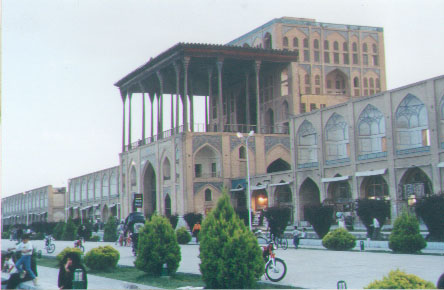
Ali Ghapu Palace in Meidun-e Emam Khomeini, the main square in Esfahan, all 80,000m2 of it
The people of Esfahan are unbelievably friendly and we have chatted to some lovely people over the last couple of days. Sometimes of course, you're not really up to it. Yesterday a young bloke approached us with the usual "Hello mister, what is your country?" Us, a little wearily, "Scotland." "Ah, Scotland. England. Can you write for me a beautiful sentence?" "Well, no, not really." He pulled out a notebook and showed us a page containing the undeniably beautiful sentence: The more I learn the less I know. "Yes, you can write for me a beautiful sentence like this?" "No, we really can't," we edged away. "Or like... 'No pain, no gain'," he said desperately. "Scottish people do not use beautiful sentences like this" I snapped (although it occurred to me later that 'Glasgow smiles better' might have been the sort of thing he was looking for). We heard of other people being asked to correct English essays. So people are friendly, but they can also have an agenda.
Iranian food so far has been good, but of a variety similar to women's fashion. You can have anything as long as it's a kebab. They're always good, served with salad, bread, fresh herbs and raw onion, but we are both fast approaching the day when we won't want another kebab for quite some time. Yesterday Dave tried to explore other areas of Iranian cuisine and ordered 'Stone Dizi - mutton speciality. Lamb meat cooked in the stone place.'. The waiter brought the usual herbs, onion, tea and metal-lidded sugar pot. We sat and waited for the meal. And waited. A painting on the wall included the wise words: "Thou hast broken my wine jar, oh Lord. Thou hast shut the door of my joy, oh Lord. I drink wine and it is as if thou wert intoxicated. Oh fill my mouth with earth, oh Lord." Oh fill my mouth with pretty much anything, oh Lord, we were thinking. Finally the waiter appeared and looked at us. Concluding that we were a little simple, he lifted the lid off the sugar pot and there it was, Dave's stone dizi, a sort of lamb and potato stew. In the manner of Fanny Craddock giving a cookery demonstration, he showed us what you do with your dizi. He slowly poured the juice out into a bowl, then tore some pieces of bread and dropped them in, raising his eyebrows at Dave to see if he had grasped the concept. He had. Then, he picked up a little round untensil and started beating the lamb and potato left in the pot. When it was mashed to his satisfaction, he spooned it out onto a plate and looked pointedly at Dave again to see if he had got it. Dave nodded: I eat it, right? The waiter then cracked a huge smile and strolled off to tell his mates about the stupid foreigners. The dizi turned out to be delicious, soup with a bubble and squeak chaser. Lovely.
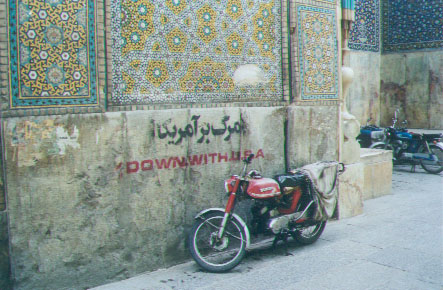
Very rare anti-western graffiti on the outside wall of a mosque in central Esfahan
So, we are off tomorrow, heading north and crossing into Turkey in a couple of days. Then we'll take about four days to get to Syria. We've heard that the Internet is illegal in Syria so we might be out of touch for a little while and will catch up again in Beirut, where nothing is illegal and we might even be able to have a drink again. (Thou hast broken my wine jar right enough, oh Lord.) Thanks for all the emails and interest - it means a lot to us that you are all tuning in.
After a late night phonecall to my brother James (amazing how people can be persuaded to call us on the pretext that it is too expensive for us to call them), we still managed to drag ourselves out of bed at 6am. We were quite pleased with ourselves when we arrived in the underground carpark of a neighbouring hotel at 7am to collect the bikes where they had been safely parked for the last three days.
It had seemed a clear cut arrangement when we left them, 10,000 rials (just over US$1) per day per bike, so we were a bit surprised when the carpark attendant showed us on his calculator that we owed him 160,000 rials. An animated discussion ensued with me repeating my interpretation of the original deal in English, him doing the same in Persian, and both of us fighting for possession of the calculator, our only common language. We had the bikes ready for a sharp exit and I was contemplating some diversionary tactic to allow us to slip away unnoticed, like setting off a car alarm, when another customer arrived. Fortunately he was a policeman, and unusually, I was glad to see him. Suddenly the attendant's tone became placatory and he graciously accepted my 60,000 rials. He put the money straight into his top pocket anyway so who knows how much would have eventually made it to the till.
So half an hour later than planned we headed north once again. We hoped to reach the Caspian coast in two days which is over 700km so we wanted to cover some ground before the sun got a chance to turn the desert into the griddle it becomes by mid-morning.
The novelty of the well-built and well-maintained Iranian roads had worn off within a day of crossing the border and we very quickly tired of driving hour after hour on an unbending and unending road through the desert. The road takes on a hypnotic quality as the heat haze of the horizon remains tantalisingly distant. Occasionally a range of hills rises from the rocky plain and then it's a pleasure to lean the bike into the curves and change gears for a while and to feel the changing landscape pass beneath the wheels. But then we're back on the plain again, the same thoughts turning over and over, the endless calculations of how many kilometres have passed and how many still remain, and then doing the same calculations again, this time in miles.
Then suddenly at the side of the road a herd of camels appears, nonchalantly ambling across the lifeless dunes, apparently unconcerned by the lack of food or water. A dirt road appears, at right angles to the highway, narrowing into the distant haze, and where the track meets the highway there is a man, standing immobile, waiting for who knows what. In what appears to be a wilderness to us, there is life, and we glimpse it when we least expect to.
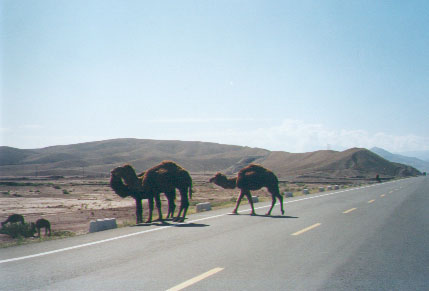
Camels completely ignoring us, northern Iran
Lunchtime in Saveh. This was where we intended to stay the night but first impressions aren't encouraging. We stopped at a transport cafe on the dusty edge of town where the truck drivers were immediately engrossed by the bikes parked outside, and then Mo took off her helmet and their attention turned towards her. Their muted comments rose into a loud hum of bewildered surprise and admiration. A waiter came over for a closer look and took our order as an afterthought. Yes, a kebab would be lovely, thank you.
It was still only 1pm and the thought of an afternoon looking for entertainment in a town built around a truck transfer depot wasn't grabbing us so we decided to press on.
As we had approached Saveh, a long smudge on the horizon gradually resolved itself into a low range of mountains, capped with snow, hard to comprehend as we struggled to cool the sweat beneath our open jackets. And now as we left the town the wind that had been growing steadily all morning decided to gather its strength for a final assault before we reached the shelter of the mountains. Sometimes it blew steadily until we were leaning at an impossible angle, and then it would change in an instant, whipping in the opposite direction and challenging us to drag the bikes upright and over onto the other side to meet it. At other times the eery calm of a tailwind would be shattered and a vicious punch of solid wind would knock us violently across the road, and then drop again just as suddenly.
By late afternoon we had already ridden almost 700km and as we gained height and latitude and the desert changed into the damp and forested landscape of northern Iran, we felt in a different country altogether. And then at 5pm only 50km from our destination, I felt that dreaded but as yet unfamiliar wallowing feeling from the back of the bike and realised I had a puncture.
Having unloaded the bike the first problem was how to get the back wheel off. Not easy without a centre stand. With the help of a local lad from the farm we'd fortuitously stopped outside, we experimented with balancing the 170kg bike on bricks and blocks of wood but after it teetered and threatened to crush us both several times, we eventually managed to balance it on its side on a big log. Having learned from my previous mistake with Mo's puncture, I wasn't going to try to fix the tyre myself and was just about to strap the wheel onto Mo's bike to begin a search for a repair shop when two men stopped and offered me a lift. One kilometre down the road we found a workshop where the mechanic had to be persuaded to accept any payment, and within half an hour the tyre was fixed, the wheel was back on and we were on our way.
Now it was a race to reach our destination before dark. Masouleh is a resort in the hills close to the Caspian coast and is frequented by holidaymakers from Tehran. We'd been told that this part of the country is quite different to the rest, but we weren't prepared for the paddy fields and wooded slopes more reminiscent of South East Asia than the Middle East. We passed through Rasht, the nondescript regional centre, then headed into the hills along a narrow twisty road that became narrower and twistier as darkness fell. Then it started to rain.
We spotted some lights through the trees and a few minutes later and with some relief we pulled up outside a brightly lit hotel. As it was Friday, the Muslim holiday, we were a bit concerned that this resort town would be full. We needn't have worried though as we appeared to be the only guests. Within a few minutes we were showered, changed and back in the restaurant, cutlery in hand. So what's on the menu tonight then? Oh, yes, a kebab would be lovely, thank you.
Our map had shown a road from Masouleh heading west across the hills towards Tabriz and the Turkish border which we'd assumed we could follow. On closer inspection the road turned out to be a muddy forestry track climbing almost vertically out of the village and into the woods. Not having enough petrol or confidence to risk it, we opted to take what we assumed would be the scenic route along the Caspian coast before turning to the west.
So we retraced our steps from the previous evening and had the opportunity to appreciate the lush landscape in the sunshine. The rice fields were full of lines of women up to their knees in mud and dressed not in the black tents we were used to but in colourful dresses and headscarves. We stopped for a photograph and a teacher appeared from the school opposite. He'd already taught the boys that morning and was having a break before teaching the girls. It didn't take him long to move from the usual 'what is your country' onto politics and we were interested to hear his bad opinion of the government. He insisted that most people were unhappy with the government in general and Iran's isolation from the western world in particular. He was concerned we had a good opinion of Iran and was anxious to reassure us that they want to be friends with the west. When we said we didn't have time to stop for breakfast and continue the discussion, he urged us to wait for a moment and dashed into the school, returning with a present of a packet of nuts for each of us.
We followed the coast road north but didn't even glimpse the sea for 150km until we stopped for lunch at Astara, right on the border with Azerbaijan. We headed hopefully towards the beach, but as we rode through the dusty carpark and past the little tea stalls with lines of hubble bubble pipes outside, any thoughts of having our first swim since Singapore were quickly dispelled. Manly Beach it wasn't. It wasn't even Largs. There was a narrow strip of grey sand lapped by the grey looking water and punctuated by several groups of picnickers, pasty looking men with their wives still wrapped in black. We noticed with some surprise, and I have to say admiration, a man standing in the water, presumably someone who had come from Tehran (or Glasgow) on a beach holiday and was determined that he wouldn't go home without going for a swim. We decided not to join him.
After another tasty kebab lunch with the eyes of the other patrons fixed firmly on Mo, we headed west at last into the hills and towards Turkey. We had a motorcycle escort all the way out of the town, just as we'd had on the way in, a couple of locals riding alongside us then screaming off ahead in a cloud of blue smoke before slowing to walking pace to let us catch up, then repeating the amusing game.
As we were now on the main road connecting Turkey with Azerbaijan, much of the traffic consisted of Turkish trucks. We were later told by a border official that there isn't any trade between Turkey and Iran but there is an agreement to allow Turkish traffic to transit Iran on its way to Azerbaijan and all the 'stans' or ex-Soviet states. There was still the familiar sight of Iranian lorries with one big lump of marble on the back, presumably destined to be someone's kitchen benchtop, labouring up even the slightest slope at walking pace, but otherwise there was an almost unbroken line of what seemed to us enormous and very modern Turkish articulated trucks.
We were hoping we'd soon be seeing the last of some of the quirky road behaviour we had become so fond of and which had continued all the way from India to Iran. Indicating right to go left was one we'd mastered but we were never quite ready for the line of boulders reaching from the edge almost to the middle of the road to warn us that a truck had broken down 20 feet ahead. How helpful, especially when the truck had been repaired and driven off, and all that was left was a pool of oil and a line of big rocks.
The road passed through scenery reminiscent of northern England and the borders, bare and rounded green hills, and it seemed all the more familiar under a grey leaden sky. The road was wonderful, twisty and smooth and we had great fun overtaking the lorries as they struggled round the near hairpin corners.
We stopped for tea a short distance outside Tabriz and were immediately approached by a middle aged man with excellent English. He had studied business at an Indian university and had returned to Iran to get a job. He couldn't find any suitable work though and was very disillusioned by the lack of opportunities in a country almost closed off to the outside world. He confirmed what the teacher had told us that morning, that most people were opposed to the hardline government and felt their only hope lay with the current president being re-elected.
We eventually reached Tabriz and immediately got lost. It has a big ring road which we looked for and completely missed, finding ourselves being dragged irresistably along by the heavy traffic into the city centre. It took a very stressful hour of detours, u-turns and shouting for directions from other drivers before we eventually found the Iran Hotel. Unfortunately the rooms were overrated and the shared toilet had that odd self-flushing system that we haven't been able to fathom. It appears that the only thing that gets rid of what is already in the hole in the squat toilet is what the next person leaves behind. Maybe someone comes along every few hours with a big bucket of water, but I don't think so.
The hotel did have a restaurant though that was recommended in the guide book so we headed downstairs with high hopes for our last meal in Iran. However the familiar smell of grilled meat roused our suspicions and the young waiter confirmed them when he arrived without a menu. So Mo had the chicken kebab and I had the lamb kebab.
Our last day in Iran was strangely cold and the run to the border uneventful. We left it as late as we could to fill up with cheap Iranian petrol and even filled the spare five litre container for the first time. The cost of a litre goes from 6c to $1 so we even considered buying a couple of jerry cans which is obviously a common ploy as there are plastic ones available in all the local shops.
The border itself was really the first 'proper' one, and what we'd been expecting at all the previous borders. Lines of trucks and cars queued for several kilometres and touts waved wads of banknotes in our faces trying to get us to change our cash. Fortunately no-one complained when we rode to the front of the line and walked straight into customs. Amazingly, we were directed to a very friendly official who dealt with our carnets quickly and efficiently and then we were onto immigration. It was only 12 o'clock and we had visions of a non-kebab lunch in Turkey.
But it wasn't to be. There was a power cut and the computer system had gone down, meaning that they couldn't check our criminal records. There was another Australian guy and a Japanese who had already been there for an hour so we all sat for two more hours becoming increasingly frustrated, discussing the worst case scenario which involved our sleeping bags and a couple of packets of instant noodles. And then our saviour arrived in the form of Mr Hussein, the tourism officer. A very distinguished looking man with an impressive moustache and an impressive command of English, he managed to persuade the immigration officials to call another border post and get them to check our details. Fortunately we hadn't unwittingly acquired a criminal record in the two weeks since our arrival in the country so they let us through with a smile and a wave, except for the poor Japanese bloke who was told he would have to wait. Mo was later told that Japanese can sometimes be mistaken in Iran for Afghanis, an unfortunate likeness, considering the Afghanis reputation as drug smugglers and the procedure employed to search for illegal drugs.
And then it was onto Turkish immigration. It was like stepping back 50 years. The building was decaying and the atmosphere chaotic. Scenes from Midnight Express immediately came to mind as we stood in the dim and dusty room waiting for our officials to finish their lunch while others swaggered between offices paying no attention to the growing throng of truck drivers clutching their passports and yellow carnet documents.
Having stood for an hour in an increasingly restless crowd, we were finally allowed into the main office. We then discovered that our visa had to be purchased in a bank somewhere else outside in the compound. We eventually found this. We were then told that we could import our bikes without carnets (which agreed with the Lonely Planet) so we thankfully got loaded up and drove the one kilometre to the final checkpoint before entering Turkey. We drove over a rutted and dusty area of wasteland lined with trucks and patrolled by a selection of vicious dogs who all began furiously barking at the sound of our bikes. They raced after us but fortunately we arrived at the post inches before the horde of salivating beasts and they obeyed the command of the soldier not to rip our limbs off.
The soldier then asked us where our customs documentation was and why hadn't we completed a PDGTKS3495 form? So we had to go all the way back to the office compound and start again. The dogs clearly didn't take the soldier's order to mean never rip off their limbs, so as soon as we started moving they were after us again. I've never seen Mo move so fast and she was halfway across the carpark heading straight for the boundary fence followed by a cloud of dust and barking dogs before I hit second gear. They were no match for her throttle action though and luckily they gave up the chase before she had to do her Steve McQueen impression and jump the barbed wire. They turned their attention to me but rather than risk a bloody end tangled in the wire, I stood my ground and screamed at them. Fortunately this seemed to work and they turned away sulkily, their fun spoiled for the moment.
And so we returned to customs, spending a further two hours trying to find out which office to sit outside, waiting for two different officials to finish some late afternoon snack and having our carnets processed, which are apparently necessary for travel in Turkey. At 6pm (7.30pm Iran time), we rode into Turkey.
 |
 |