
|
Hello eveybody! |
|
| Brno Kutná Hora Prague Orlík Accommodation in Prague |Info pages |
The
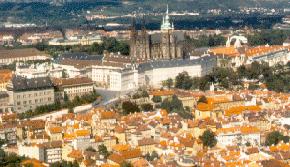
History of Prague Castle On the basis
of archeological research and the oldest written sources it is thought
that Prague Castle was founded around the year 880 by Prince Borivoj
of the house of Premyslides. The early medieval castle site was
fortified with a moat and a rampart of clay and stones. The first
walled building was the church of Our Lady. Other churches, dedicated
to St. George and St. Vitus, were founded in the first half of the
10th century. From the 10th century Prague Castle was not only the
seat of the head of state, the princes and later kings, but also
of the highest representative of church, the Prague bishop. The
first convent in Bohemia was also founded in the grounds of Prague
Castle, a convent next to the church of St. George for the order
of Benedictine nuns. The basilica of St. Vitus, built on the site
of the original rotunda, was the main castle church since the 11th
century, where the relics of the patron saints of the land were
kept: SS. Vitus, Wenceslas and Adalbert. And from the 10th century
the convent of the Prague church was an important educational and
cultural institution. The period of the rule of King and later Emperor
Charles IV. (the middle of the 14th century) was a time of prosperity
for Prague Castle, for then it first became an imperial residence,
the seat of the ruler of the Holy Roman Empire. The royal palace
was magnificently rebuilt and the fortifications strengthened. Building
began on the Gothic church of St. Vitus on the model of French cathedrals.
Building continued on the Castle during the reign of Charles's son,
Wenceslas IV. The Hussite wars and the following decades, when the
Castle was not inhabited, caused the dilapidation of its buildings
and fortifications. The next favourable time came after 1483, when
a king of the new dynasty of Jagellons again made the Castle his
seat. New fortifications were built and, together with them, defence
towers on the northern side (the Powder Tower, the New White Tower
and Daliborka). The architect of the fortifications, Benedikt Ried,
also rebuilt and enlarged the royal palace: the splendid Vladislav
Hall was the biggest secular vaulted hall in the Europe of that
day. Its big windows are considered to be one of the first examples
of the renaissance style in Bohemia. The kings of a further dynasty,
the Habsburgs, started rebuilding the Castle into a renaissance
seat. In accordance with the taste of the time the Royal Garden
was founded first, and in the course of the 16th century buildings
serving for entertainment were put up in it: a summer palace, a
ball games hall, a shooting range and a lion's court. Afterwards
the cathedral and the royal palace were adapted. New dwelling houses
began to be built to the west of the Old Royal Palace, along the
southern ramparts. The adaptation of the Castle came to its height
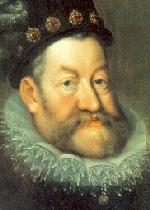
in the second half of the 16th century, during the rule of Rudolph
II. The emperor settled permanently in Prague Castle and began to
turn it into a grand and dignified centre of the empire. And he
founded the northern wing of the palace, with today's Spanish Hall, Emperor Ferdinand V., after abdicating in 1848, chose Prague Castle as his home. On this occasion the chapel of the Holy Rood in the IInd courtyard was rebuilt. The Spanish Hall and the Rudolph Gallery were done up in preparation for the coronation of Francis Joseph I. which, however, did not take place.. There was a big movement to complete the building of the cathedral, but this was not inspired by the ruler but by the patriotic Union for Completing the Cathedral of St. Vitus. It was in fact completed in 1929. After the foundation of the independent Czechoslovak Republic in 1918 Prague Castle again became the seat of the head of state. The Slovene architect Josip Plecnik was entrusted with the necessary alterations in 1920. Today too reconstruction and alterations to the grounds of Prague Castle are going on, and this is not only a matter of essential building maintenance. The basic aim is to open the grounds of the Castle to all comers. Since 1989 many previously closed areas have been thrown open to the public, for instance the Royal Garden with its Ball Game Hall, the southern gardens, the Imperial Stable, the Theresian Wing of the Old Royal Palace. Today Prague Castle, besides the seat of the head of state, is also an important cultural and historical monument. The crown jewels are kept in Prague Castle, as are the relics of Bohemian kings, precious Christian reliquiae, art treasures and historical documents. Events important for the whole country have taken place within its walls. So Prague Castle the embodiment of the historical tradition of the Czech state, linking the present with the past. |
 to house his precious artistic and scientific collections. Baroque
Music at Prague Castle (Programme quarterly Prague Castle) The Prague
defenestration in 1618 started a long period of wars, during which
Prague Castle was damaged and robbed. It was used by the country's
ruler only exceptionally and temporily. Musical Classicism and Romanticism
(Programme quarterly Prague Castle) In the second half of the 18th
century the last great rebuilding of the Castle was carried out,
making it a prestigious castle-type seat. But at that time the capital
or the empire was Vienna, and Prague was just a provincial town.
The Castle gradually became dilapidated and its art treasures were
impoverished by the sale of the remains of the Emperor Rudolph's
collections.
to house his precious artistic and scientific collections. Baroque
Music at Prague Castle (Programme quarterly Prague Castle) The Prague
defenestration in 1618 started a long period of wars, during which
Prague Castle was damaged and robbed. It was used by the country's
ruler only exceptionally and temporily. Musical Classicism and Romanticism
(Programme quarterly Prague Castle) In the second half of the 18th
century the last great rebuilding of the Castle was carried out,
making it a prestigious castle-type seat. But at that time the capital
or the empire was Vienna, and Prague was just a provincial town.
The Castle gradually became dilapidated and its art treasures were
impoverished by the sale of the remains of the Emperor Rudolph's
collections.