Brno
Kutná Hora
Prague
Orlík
Accommodation
in Prague
|Info pages |
Informations
about Brno
Man has lived in the Brno basin since prehistoric times, and there
was a settlement on the site of today's city at the time of the
Great Moravian Empire. In around 1000 a settlement was established
on a ford across the River Svratka, now known as Staré Brno (Old
Brno), and it was this that gave the city its name. From the 11th
century, Břetislav's castle stood here, and was the seat of the
non-ruling Premyslid Prince. Around the castle several Czech market
villages grew up, both in Old Brno and around Horní trh (today Zelný
trh/Vegetable Market). Foreign colonists started to arrive from
the 13th century: Germans, Flemish and Walloons, who settled around
the Lower Square (today's Náměstí Svobody).
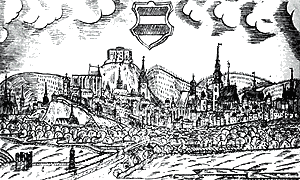 A
Jewish quarter was also formed in the area that today forms the
lower end of Masarykova Street. Legal support for the development
of the city came with the large and small privileges that were conferred
upon the city in 1243 by Václav I, King of Bohemia. The city was
then surrounded by fortifications which had five gates (Měnín, Židovská
(Jews' Gate), Starobrněnská (Old Brno Gate), Veselá (Merry Gate),
and Běhounská). There were two parish churches - St. Peter's and
St. James', and several monasteries: Benedictine in Komárov, Premonstrate
in Zábrdovice, monasteries for mendicant orders such as the Dominicans,
Minorites, Heburgs, Johannites in Old Brno, and a convent for Cistercian
nuns also in Old Brno, which was founded by Queen Eliška Rejčka.
The Špilberk castle was rebuilt in a Gothic style in the 13th century.
In the 14th century the city became the seat of the Moravian Margraves,
and underwent a period of great expansion; at this time there about
1000 buildings and 11 000 inhabitants. Thanks to the right that
the city possessed of holding annual markets, international trade
grew. This meant that in-depth knowledge of legal regulations had
to be gained, and so in 1355 Jan, the town hall scribe, compiled
a book of regulations for the city aldermen, which became the legal
norm for several other cities .... A
Jewish quarter was also formed in the area that today forms the
lower end of Masarykova Street. Legal support for the development
of the city came with the large and small privileges that were conferred
upon the city in 1243 by Václav I, King of Bohemia. The city was
then surrounded by fortifications which had five gates (Měnín, Židovská
(Jews' Gate), Starobrněnská (Old Brno Gate), Veselá (Merry Gate),
and Běhounská). There were two parish churches - St. Peter's and
St. James', and several monasteries: Benedictine in Komárov, Premonstrate
in Zábrdovice, monasteries for mendicant orders such as the Dominicans,
Minorites, Heburgs, Johannites in Old Brno, and a convent for Cistercian
nuns also in Old Brno, which was founded by Queen Eliška Rejčka.
The Špilberk castle was rebuilt in a Gothic style in the 13th century.
In the 14th century the city became the seat of the Moravian Margraves,
and underwent a period of great expansion; at this time there about
1000 buildings and 11 000 inhabitants. Thanks to the right that
the city possessed of holding annual markets, international trade
grew. This meant that in-depth knowledge of legal regulations had
to be gained, and so in 1355 Jan, the town hall scribe, compiled
a book of regulations for the city aldermen, which became the legal
norm for several other cities ....
more informations
about Brno
|
