| Brass Instruments |
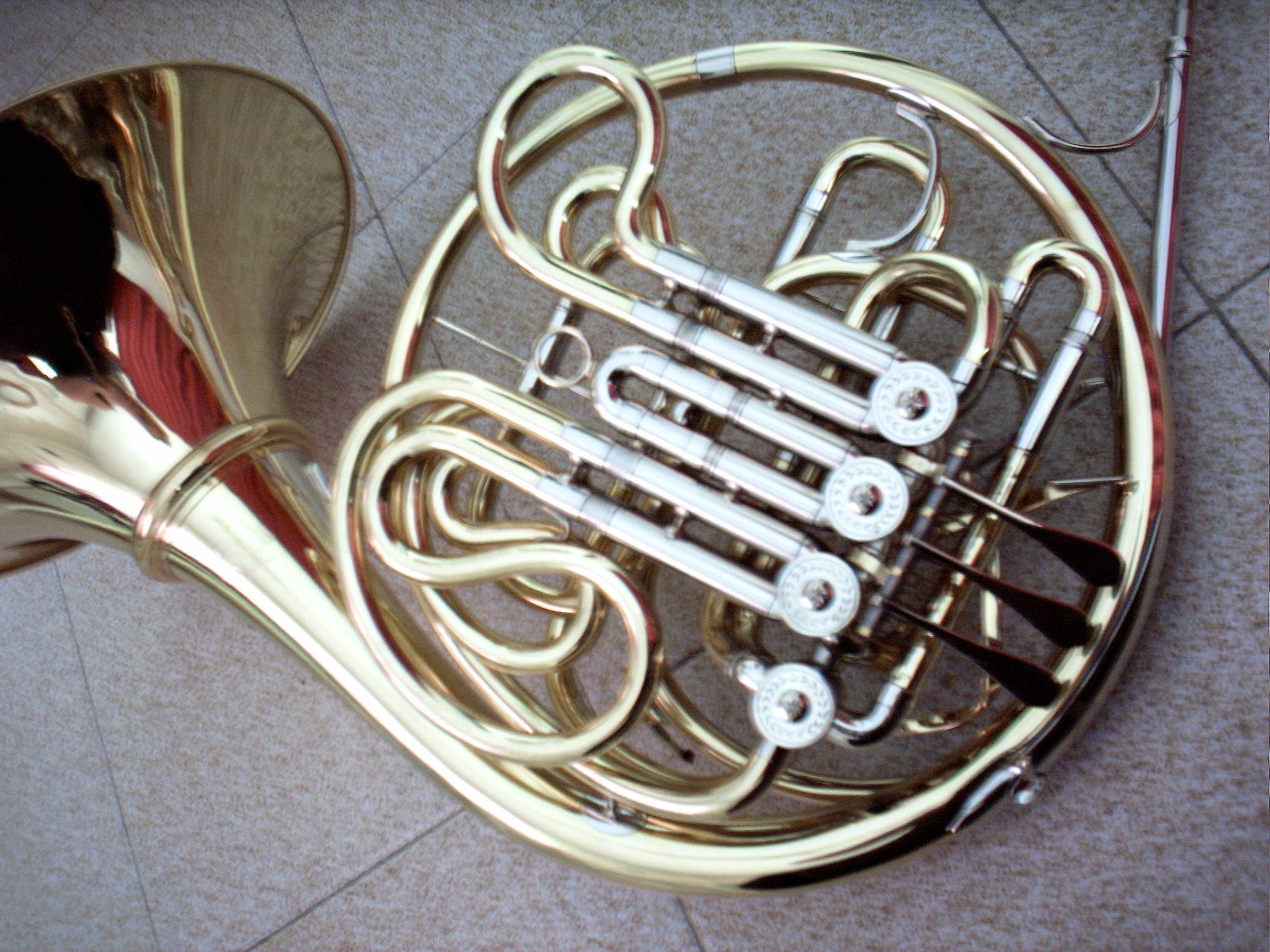
| Playing a Brass Instrument: Emboucher: Various ways may be used to help the beginning student produce their fist note. The following is one method that has proved successful: Close the lips and then gradually pull back the corners of the mouth until the lip surfaces are even. (Do not stretch the lips tightly). Take a breath, and, gently blowing, produce a "buzzing" sound.The lips must vibrate in the very centre while producing the "buzz". When you are able to "buzz" steadily you are ready to place the mouthpiece to the lips. It is considered good practice to place the mouthpiece half on the upper lip and half on the lower lip in the centre of the mouth. An abnormal mouth formation or tooth structure may necessitate modifications of the above, but in general, it is good to strive to form the embouchure as closely as possible as described above. The tip of the tongue is placed behind the upper teeth, and when ready to produce a tone, jerk the tongue downwards by using the syllable "TU". The tongue must be moved very quickly. Breath should be taken through the corners of the mouth. Do not puff out your cheeks. Practise in front of a mirror. Correct Position (Posture): When practising, it is better to play in a standing position as this will help you to breath properly. Your teacher will instruct you as to the proper method of holding the instrument. Technical: The most important technical points for wind instrument players are as follows: 1) Developing and strengthening the lip muscles (process) Playing of long sustained notes. 2) Developing clarity and precision in attack (process) Proper use of the tongue. 3) Developing a fine quality of tone (process) A combination of No 1 and careful listening. 4) Develpoing fluency in fingering. (process) Playing of scales and arpeggios in various keys. 5) Developing a mastery of the entire range of the instrument (process) A combination of all of the above. (Taken from the 'Forword to Students' in the 'A Tune a Day' series of books for brass by C. Paul Herfurth.) French Horn in F: Tonal and Dynamic Qualities: Low Register: In this register the tone quality lacks focus, is tuba-like, unsolid and quite dark. This subdued tone is more apt to provide a supportive presence than a confident tone. Projection is poor and intonation problems are more likely to be encountered in this register. Middle Register: Here, the horn in F is the most characteristic sounding. The tone quality can vary from warm, dark, and haunting to velvety, noble and heroic. At louder dynamics and/or when ascending the register, the tone becomes brighter and projection increases. The best control over the instrument is offered in this register. High Register: Ascending the high register, the tone becomes progressively more brilliant and exciting. The higher the player ascends, the more difficult it is to play at softer dynamic levels. General Characteristics: i) The horn in F is invaluable for its wide range, very flexible timbre and dynamic variance. It is an excellent choice for solo passages since it is capable of conveying a wide range of emotion, from tenderness to heroicism. ii) The characteristically diffused tone of the horn enables the instrument to become a vital link between the woodwinds and the brass in an orchestral setting. The ability to blend in an ensemble, whether woodwinds or brass, is excellent. Technical Considerations: i) Like the trumpets and trombones, the horn utilizes the harmonic series to produce pitch. Since the horn player primarily plays in the range of the instrument's higher partials, the horn is sometimes unpredictable in regard to accuracy and security. ii)Typically the horn lacks the agility found in other brass instruments. Smooth melodic passages are most successful. Quick jumps and leaps of over an octave can be awkward. iii) Because the instrument has a tendency to speak slowly, articulations, attacks and repeated notes have a tendency to be less crisp and precise. Double, triple and flutter tonguing are possible but can be problematic in the extremes of the instrument's range. iv) Overall, trills tend to react sluggishly. Valve trills of a minor 2nd are possible throughout the range. The smoother and more characteristic lip trills are possible in whole step intervals from the middle of the range upwards. v) The notes of the extreme high range can be more difficult to produce and tend to be more insecure. vi) The horn is prone to intonation problems in the lower register. vii) Prolonged muting can be tiring to the embouchure. Notating Horns: i) Due to their extremely wide range and traditional scoring practice, horn players are accustomed toplaying either high or low ranges of the instrument. The use of four horns is standard in an orchestra with the odd numbered combination (I & III) playing the higher part and the even numbered combination (II & IV) playing the lower part. ii) Horn I will play the majority of the high solo passages with the remaining solo passages assigned to horn III. Solos for horns II and IV are more equally assigned with horn II playing the higher, more agile parts, and horn IV usually playing the parts falling within the lower part of the range. iii) In orchestral scoring, horns are traditionally scored without a key signature. In a concert band, horns are scored using key signatures. iv) It is standard practice for the horn to be notated in treble clef but they are sometimes required to and can read and play in bass clef. Special Effects: i) 'Brassy', or 'cuivre', denotes a "brassy" timbre produced by causing the metal to vibrate in a particular manner. The dynamic must be very loud or muted to create this forced effect. ii) 'Bells up' instructs the performer to lift the bell of the horn up and parallel to the ground. The projection and tone become incisive and direct. iii) 'Lontano' is an effect of separation or distance produced by employing a partial or completely stopped tone, and/or by playing extremely soft. iv)Like the trumpet and trombone, an arpeggiated glissando over the entire harmonic series in a single position is possible. Muting: The horn is usually played in a manner which requires the performer to place the right hand partially into the bell of the instrument. i) The hand stopped horn: The performer places the right hand as far in to the bell as possible, almost completely blocking the flow of air. At soft dynamics, a distant, delicate and buzzy effect is produced. At loud dynamics the sound is more nasal and metallic. Pitch alteration occurs and is adjusted by the performer. ii) Half hand stopped horn: This more suble effect is achieved by placing the right hand into the bell only far enough to reduce the volume and/or to veil or cover the tone. Pitch alteration also occurs and is adjusted accordingly. iii) Sizzle or Ball mute: This is a small metallic mute that creates the same effect as full hand stopping. It is useful in lengthy stopped passages and can be useful to control the intonation in such passages. iv) Straight mute: This commonly used mute produces a caged sonority which can give the impression of the horn being played from a distance. It can be used to make the horn play softer but the tone quality is changed. The mute is cone-shaped and made of either metal, wood or cardboard. The metal mute produces a brighter and more biting sound. v) The hand slide or bend: This effect produces a smooth glissando. The effect is produced as a result of the hand, from a normal position in the bell, closing to a half or full stopped position which 'slides' or 'bends' the note down a semitone. Double Horn in F and Bb: The double horn is a combination of two horns in one. The F side is approximately 12feet or 4 metres in length. The Bb side is approximately 8feet or 3 metres in length. The thumb valve allows the performer to switch from one horn to the other with ease for every note if required. The tone quality of the Bb side is almost identical to the F side although it tends to sound brighter and less round due to the shorter tubing. The double horn is always written as if for the horn in F. Certain very low pedal notes are made available by the Bb side. A greater sense of accuracy and control in the high register of the Bb side is due to less resistence caused by shorter tubing. Triple Horn in F, Bb and F Alto: This hybrid horn is equipped with a third, F alto, capability. Pitched a perfect 5th higher than written, the F alto division allows increased accuracy in the high register due to shorter tubing again. Access to the F alto side is through a second thumb valve. The F alto horn is rarely used. Triple Horn in F, Bb and A: This other hybrid horn is used for transposition mainly during hand stopping. The A horn is also accessed by a second thumb valve. These horns are also rarely used. Wagner Tuba in Bb and in F: General Characteristics: i) The Wagner tuba is not actually a tuba but a horn. The tone quality is similar to the alto horn or euphonium, but is broader and more horn-like. ii) Rarely used, its primary use is to recreate the music of Wagner, Bruckner and Strauss. Tenor Trombone: About the instrument: The trombone uses the overtone series of the basic pipe to produce pitch. The slide: i) Movement of a slide extends the length of the basic pipe, creating more pitches than those produced from the overtone series. ii) There are seven slide positions, each capable of producing a complete harmonic series. iii) Movement between the seven slide positions provides alternative positions for a given pitch. iv) the distance between positions determines the technical difficulty not the distance between pitches. - The upper potion of the range is more agile due to the increased number of alternate positions. Solo passages are best executed in the upper range. - Because the lower portion of the rangerequires larger slide movement and fewer alternate positions, it is more technically difficult. v) Pitch can be corrected easily with slight movements of the slide. vi) Only the pedal notes in the first four positions are recommended. The pedal tone in the first position is the easiest and most widely used. The lower the position the more unstable the pedals tend to be. The F Attachment: Some tenor trombones have an F attachment (with a trigger) operated by the left thumb. i) This valve lowers the fundamental pitch of the instrument down a perfect fourth. ii) When utilized, a complete set of new harmonics are possible in the various slide positions. iii) Because the F attachment eliminates certain awkward changes of position, technical problems are simplified. Tonal Qualities: i) The low register is full, yet dark and somewhat 'tubby'. The quality of the low E is slightly poor and should be avoided in exposed passages. This range is not quite as strong as the upper range. ii) The middle to upper registers are very sonorous, rich and full, becoming progressively more brilliant in the upper register. iii) At softer dynamic levels, the tone quality becomes horn-like and full. iv) At louder dynamic levels, the timbre becomes bright, massive and strong. Technical Considerations: i) Double, triple and flutter tonguings are all easily possible. Rapidly repeated notes and quick, short musical figures are not problematic. ii) Lip trills are produced by the lips on adjacent harmonics a whole or semi-tone apart. iii) Trigger trills (valve trills) between some notes a whole or semi-tone apart are possible by rapidly depressing and releasing the F attachment while the slide remains stationary. iv) Tongued legato is utilized to avoid glissandos when changing slide positions. The air is stopped inperceptively between notes. A true legato is achieved only between two adjacent harmonics in the same series. If a slide positionchange is required to slur two notes, skillful coordination of the tongue and the slide change will be required. Special Effects: i) Like the horn, an arpeggiated glissando over the harmonic series in a single position is possible. ii) Glissandos require a movement from one slide position to another using the same harmonic number of the overtone series. Glissandos are only possible up to the interval of a tritone. Muting: The following mutes and muting techniques may be used: i) Cup mute ii) Harmon mute (no stem) iii) Straight mute iv) Solotone v) Hand over bell vi) Plunger vii) Hat (for descriptions see trumpets) Scoring: i) The trombone is primarily considered the tenor voice in ensemble writing ii) The usual scoring for jazz bands is three trombones and one bass trombone iii) Since the dynamic range from very soft to very loud is consistent throughout its range, balance with most instruments does not present a problem. Valve Trombone: General Characteristics: i) This instrument is essentially a tenor trombone in which the slide mechanism has been replaced by three piston valves. ii) Inclusion of the three valves allows the instrument to be more technically agile than the tenor trombone. iii) Legato tonguing and glissandos characteristic of the tenor trombone are absent. iv) Inherent intonation problems are associated with the valve trombone, as with all valve instruments. v) The valve trombone may be written in either bass or tenor clef. Alto Trombone: General Characteristics: i) The alto trombone possesses its own distinctive tone quality which is lighter and more delicate than the tenor trombone. ii) It offers a unique lyric quality that is useful in solo passages. iii) Technical characteristics (the use of a slide and legato tonguing) are identical to the tenor trombone, only pitched a perfect fourth higher. iv) The alto trombone is useful in playing hightrombone parts, extending flexibility to the trombone family. v) Although it lacks some of the power and nobility of the tenor trombone, it can be quite assuming in the proper register. vi) As with other trombones it blends well with other instruments. vii) Because the instrument is smaller, with closer slide positions, the player's arm is not required to reach as far as on the tenor trombone, allowing for greater agility and flexibility. Bass Trombone: About the Instrument: i) The bass trombone has the same tubing length as the tenor trombone (with an F attachment), giving it the same range and technical capabilities as the tenor trombone. ii) Bass trombones are equipped with an F valve/attachment and usually another in E. The use of the E attahcment enables the bass trombonist to play a low B-natural. iii) The valve mechanism also helps to increase technical facility by providing additional alternate positions for pitches in the low register. iv) With a larger bore and wider bell, the bass trombone is constructed to better handle the lower pitches. v) Pedal tones on the bass trombone are more securely produced than on the tenor trombone. Tonal Qualities: i) The low register has a warmer quality and is stronger and more secure than the tenor trombone. Like the tenor trombone, this register is full, yet dark. ii) The middle and upper registers are very sonorous, rich and full, becoming progressively brighter in the upper register. Technical Considerations: i) Although most bass trombonists are capable of playing higher it is counterproductive to write them a high part. ii) Because the lower range requires more breath, consideration should be given when scoring. iii) The bass trombone is effective in solo passages. iv) Double, triple and flutter tonguings are all easily possible. Rapidly repeated notes and quick, short musical figures are not problematic. v) All special effects and techniques possible on the tenor trombone are also possible on the bass trombone including lip and trigger trills. Contrabass Trombone: General Characteristics: i) Although the more rounded-sounding tuba often performs contrabass trombone parts, the tone quality of the two instruments is substancially different. ii) Pitched an octave lower than the tenor trombone, the cylindrical bore allows a majestic quality, unique in sound. iii) More so than the bass trombone, the contrabass trombone responds slowly and requires even greater endurance. iv) In its lower, most effective range, the limitations of slide movement add to the need for careful scoring. European-Style Bass Trombone: i) Without a trigger attachment, the european-style bass trombone also posseses a longer slide. An extension is attached to facilitate movement. ii) This rarely-used instrument is pitched in G or F. Slide Trumpet: i) For the most part, a slide trumpet is a soprano trombone possessing a longer slide. An extension is attached to the slide to facilitate movement. ii) This rarely-used instrument is pitched an octave higher than the tenor trombone. Trumpets in Bb and in C: About the Instrument: The trumpet uses the overtone series to produce pitch through the changing of three valves. General Characteristics: The trumpets in Bb and C are essentially identical with a few exceptions: i) The trumpet in C is generally brighter and more brilliant than the trumpet in Bb. ii) Each trumpet differs in its solutions to fingering problems as well as a differing response to certain pitches. iii) A definate benefit of using the trumpet in C is that is it a non-transposing instrument. iv) The instrument in Bb is the standard instrument and is more commonly used. Tonal Qualities: i) The low register is darker than the middle register, yet remains full. These notes tend to project poorly and are prone to intonation problems. ii) The middle register is the most widely used register. Here the tone quality is much brighter and the instrument has better projection than in the lower register. Dynamic control and intonation are excellent. iii) The high register is brilliant and penetrating but is more difficult to produce softly. Notes in this register are best approached from below. An extended upper register is available to very strong players, with difficulties in control. Dynamic Response: i) All trumpets command a strong presence in any range. Projection increases relative to the amount of effort required ascending from the middle through the high ranges. ii) The usable dynamic range extends from extremely powerful and brilliant to quite soft and delicate. Yet, in most circumstances, the trumpet will have an exposed and dominant presence not easily hidden in any range. iii) Awareness of register-produced power and intensity is necessary when balance is required with instruments outside the brass family. Technical Considerations: i) Pedal tones are possible, although not commonly used on all trumpets. ii) Trumpets are the most agile instruments of the brass family, yet they lack the proficiency of the woodwinds and strings. iii) Attacks can vary widely from quite pronounced to subtle and very legato. iv) Rapidly repeated notes, double, triple and flutter tonguings are all well-suited to the instrument and are characteristic traits of the trumpet. v) Three types of vibrato are possible: diaphragmatic, jaw and mechanical. They are usually left to the discretion of the performer and may depend on the style of music. vi) Lip trills are produced by the lips on adjacent harmonics. vii) Most trills of major and minor 2nds are possible. Special Effects: i) Like the horn and trombone, an arpeggiated glissando over the entire harmonic series in a single position is possible. ii) Bells up directs the performer to lift the bell of the trumpet up and towards the audience. The projection and tone become incisive and direct. Scoring: i) The instrument is primarily scored as the soprano part of the brass section. ii) The trumpet is capable of tremendous power and crescendos making it a favourite for fanfares. iii) Becaue of its excellent projection, the instrument is widely used for solo passages. Trumpets in D and in Eb: i) With few exceptions, all characteristics are identical to the trumpets in Bb and in C. ii) There is greater technical ease and intensity in higher, ornamental passages than that produced by the trumpets in Bb and in C. This makes them a frequent choice for playing high trumpet parts in 18th Century Baroque literature. iii) These trumpets are primarily used in a solo capacity and not as ensemble members. iv) These trumpets are more brilliant and lack the warmth of the trumpets in Bb and in C. The tone is clear, light and clean-sounding. Bass Trumpets in Bb and in Eb: General Characteristics: i) Seldom used, the bass trumpets extend the lower range of the trumpet family. ii) They are respectively pitched a perfect 5th and octave lower than the trumpet in Bb, yet they would not tend to be used for this lower range. The trombone and euphonium respond more successfully in this range and often substitute for these trumpets. iii) Their tone is darker, rounder and fuller than the Bb trumpet and they are less agile. Cornets in Bb and in Eb: About the Instrument: The cornet falls somewhere between a trumpet and a flugelhorn in construction and tone. The cornet is identical to the trumpet in how it uses the overtone series to produce pitch. Characteristics: i) The cornet in Bb is the most commonly used of the two cornets. ii) The overall tone of the cornet is mellower and more rounded than that of the trumpet. iii) It is as technically agile as the trumpet and is well suited for lyrical passages. iv) A mainstay of military, concert bands and dixieland jazz, the cornet in Bb is not as commonly used in the orchestra. v) The cornet in Eb is a rare instrument that is primarily used by brass bands and Salvation Army bands. v) There is a cornet in C but it is rare. Flugelhorn in Bb: Tone Qualities: Because the flugelhorn (or soprano sax-horn) is a conical bore instrument, the tone quality is inherently darker, warmer, mellower and more intimate than that of the trumpet. In fact, it is closer in timbre to the horn than the trumpet. Technical Considerations: i) In technical ability and in the tone qualities of the registers, all characteristics of the flugelhorn are similar to the trumpet in Bb. ii) Becaue it lacks the power and range of the trumpet it is used as an alternative and not a substitute. It is not very successful in the upper range. iii) Above a moderate dynamic the instrument loses its charm and effectiveness and is prone to intonation problems. iv) Mutes are generally avoided. Scoring: i) The flugelhorn is frequently used in a jazz and/or pop context and is seldom used in orchestras or concert bands. ii) It is best suited as a solo instrument. Piccolo Trumpets in A and in Bb: Characteristics: i) The piccolo trumpet is the smallest trumpet and has a lighter and more delicate sound than the other trumpets. ii) Like the trumpets in D or in Eb, it is useful when playing in the high registers of Baroque music. They can technically facilitate extremely high passages although they are technically more difficult to control and require more endurance than the larger instruments. iii) Both instruments possess a bright and flute-like sound at soft to moderate dynamics. At loud dynamics, the sound becomes shill and piercing. Mutes and Articulations: Mutes: The following mutes can be used: i) Straight mute: This most commonly used mute produces a sharp, biting sound. It is cone shaped and is either made of metal or cardboard. ii) Cup mute: Produces a nasal, almost colourless sound which enables it to blend well with woodwinds. Brilliance is replaced with a muffled, distantly distorted sound. iii) Mica mute: Similar to a cup mute but made with a rubber edge which covers the sound more successfully. Like the cup mute, it is nasal and colourless but with more of a muffled sound. iv) Harmon mute (with stem): Encased in cork, the sound is forced through the mute. An adjustable or removable stem varies the impact of the mute. It produces a cold, distant, brittle sound much like the ponticello of the strings. With the stem pulled out, the mute produces a filtered, hollow sound. v)Whispa mute: The sound is forced out of a sound-absorbent material with small holes. The softest of all mutes, it is almost inaudible except in extremely quiet passages. vi) Bucket/Velvetone mute: Filled with cotton material, it produces a mellow, veiled sound with little edge. Allow time to insert/remove the mute. vii) Solotone/Cleartone mute: This rarely used mute produces a distant, nasal sound that can be both resonant and loud. viii) Practise mute: This mute is exactly as it says - a mute for pracising. It is encased in cork to make the space between the bell and the mute almost airtight. The result is an almost non-existent sound with no projection. It is barely audible and is therefore ideal for practising in a situation when it is inappropriate to make noise. ix) Silent Brass mute: This mute is a variation on the practise mute. When used without the electrics it acts in exactly the same way as any practise mute but when the electrics are used and the earphones utilized it is possible for the performer to play into the mute and hear themself in different settings acording to their choice eg. concert hall, practise room, church etc. It is good for when open practise is not possible but too much mute practise can disorientate the performer when playing open as the resistence on the embouchure is different for open and muted playing. Mute-like Effects: i) Hand over bell: Produces a generally subtle muting. ii) Hand in bell: Mutes the sound while lowering the pitch. The pitch alteration may be compensated for by lipping the pitch upward. iii) Plunger: A plumber's plunger without the handle produces a muffled tone. A "dirty", jazzy sound is produced when the mute is removed in combination with on/off flutter tonguing. iv) Felt hat: Produces a more subdued tone. Reduces the intensity of the instrument without the distortion of tone. v) Into the stand: Like the felt hat, produces a more subdued volume, without creating performance difficulties. The tone is softer with only a slight loss of brilliance. vi) Handkerchief or cloth: Reduces the strength of the upper partials, causing a reduction in the intensity of the tone. More subtle than using a hat. Articulations: The following articulations and devices provide a variety of effects: i) Shake: Similar to a lip trill but faster and with less control (without the use of the valves) ii) Wide lip trill: A slower lip trill on a larger interval. iii) Flip: The note is sounded, raised and lowered to the next note. iv) Bend: The note is sounded, lowered and raised to the original pitch. v) Smear: The note is approached from below, reaching the correct pitch prior to sounding the next note. vi) Doit: The note is sounded followed by an upward glissando ranging from one to five steps. (Usually a 1/2 valve for brass) vii) Du: A tone muffled by a plunger, hat or hand over the bell. viii) Wa: A tone unmuffled by the release of a plunger, hat or hand over the bell. ix) Rip: (Gliss up) Slide into the note from below. No individual notes are heard. x) Fall off: (Gliss down) The reverse of the Rip. xi) Lift: The note is approached chromatically or diatonically from below. xii) Spill: The reverse of the Lift. xiii) Plop: Before the note is sounded it is approached by a rapid descending scale. xiv) Indefinite sound or Ghost note: An undefined or indeterminate pitch. xv) Turn: The first note rises up a step then back down before decending to the next note. (Also known as an appogiatura) Tubas in BBb, in CC, in Eb and in F: Tonal and Dynamic Qualities: i) The low register is dark, has less fluidity and requires the most breath control. Although there is less agility, the instruments possesses good pitch focus. ii) The middle register is most successful for the tuba, producing a timbre that is velvety, smooth and mellow. There is maximum control of the instrument without the strain inherent in the high register. In comparison to the trombone playing in this register, a tuba would possess a rounder, less cutting and spreading tone. iii) With excellent penetration, the tuba possesses a horn-like, round tone quality at a soft-to-medium dynamic range in the the high register. At louder dynamics it is powerful, robust and exciting. General Characteristics: i) Most orchestral tubas have four or more valves whereas student models (including sousaphones) are usually made with three. The lack of the fourth valve reduces the range and creates intonation problems in the lower register. ii) The instrument's ability to blend with other instruments in excellent iii) Since the middle register of the instrument is the most effective, its primary function is that of a bass instrument. Its use in this range can strengthen low brass and woodwinds. iv) The tuba is much more flexible and agile than is commonly thought. In the hands of a good performer, it is capable of executing 16th-note runs, wide skips and trills (if employed in the upper register only). Double and triple tonguing are possible as well as rarely used flutter tonguing. Technical Considerations: i) Because of its heavier quality, care should be taken to ensure that the tuba does not overpower other brass instruments. ii)The fundamental is obtainable on the instrument but it best used for brief, sustained tones. iii) Muting is rarely used. When called upon, however, the straight mute is the one generally used. Scoring Considerations: i) As the bass voice in a mixed ensemble, the characteristically diffused soundgives the ensemble an overall smoothness, unlike the more biting quality that can result when using a bass trombone or baritone saxophone. ii) An important consideration when writing for tuba is the large amount of breath required. In the low register, especially at a loud dynamic, a note can only be sustained for a short period of time. Parts for the tuba should include sufficient rests to allow ample opportunities for the player to breath. iii) The instrument is only occasionally used in a solo context. Baritone and Euphonium in Bb: General Characteristics: i) The baritone and euphonium are so similar in appearance and in range that they are often used interchangeably. At times they may be labelled tenor tuba and can substitute for high tuba parts. ii) The tone quality of these instruments is smooth and mellow, with the euphonium possessing a slightly broader and darker sound (due to it's large bore). iii) Used regularly in bands, they are capable of great expression and are employed primarily as solo voices. They are rarely called for in orchestral music. iv) In comparison to the tuba, they are more agile, technically versatile and require less air. v) Since the fingering patterns of the baritone are the same as the trumpet or cornet, the baritone is sometimes written in treble clef. The standard practice however, is to notate the baritone in bass clef. vi) The harmonic series is identical to that of the trumpet in Bb, but an octave lower. vii) The combined use of the baritone or euphonium and tuba is commonly heard in bands, brass sextets and brass choirs, and may double the tuba at the octave or play an independent tenor voice. (From the 'Essential Dictionary of Orchestration' by Dave Black and Tom Gerou) |
 |