 |
 |
| to red brindles which vary from an orangy red to a rich mahogany red |
 |
| Breeding Brindle Cardigans presents no health problems that can be blamed on the colour genes.
The genes that cause and modify the brindle colour do not appear to cause any problems. The only way to get too much white is if you are unlucky enough to have two animals carrying the gene for lots of white. It is very unlikely that we would get the extreme white with its inherent hearing problems that occurs in breeds like the Dalmation. Brindling is the presence of 'stripes' of black (or dark brown) hairs in areas that are otherwise red/yellow. The colour of the black stripes may be modified by the normal genes that affect black eg the dilution gene that turns black to blue in Great Danes. The �otherwise red/yellow� may be affected by the genes that affect the red/yellow coat colour eg the chinchilla gene that pales red to cream. The brindle gene has been identified in dogs. It is dominant over no brindle and it is dominant over the A series reds In Cardigans; This makes brindle dominant over most of our reds So to be red, a pup must have no brindle genes (unless it's red comes from the E series); one brindle gene equals brindle colour. Therefore, with most of our reds, two reds cannot produce brindle. Because in the E series reds, which are rather rare in Cardigans, the black/brown colour which is necessary for the brindle pattern to be seen, has not been allowed to form, they can carry brindle; two of these reds could produce brindle. It seems to me that a red coloured animal needs to be thrown into a brindle breeding programme periodically or the brindle colour becomes darker and darker, thus possibly losing the lovely highlights. or it maybe that lately we have been choosing the very dark sires & dams. Brindles can be bred to any of the colours, including brindle with no ill effects healthwise. If this is done repeatedly, you will produce brindle dogs that can only produce brindle or brindle points - is a pain if you decide you want reds or tricolours.. However, the introduction of merle into the brindle brings with it the problems of possible blue eyes in brindle and hidden merles (dogs that appear brindle, but are actually merle) This is not a health hazard but it does rule them out of the show ring. I believe that the merle gene can cause some strange effects on the brindle colour, which doesn�t make the colour incorrect, but it may not be very attractive. |
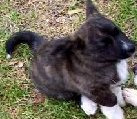
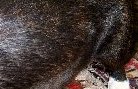
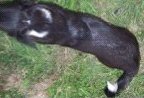
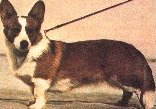
| I don�t know whether or not this is truly brindle. She is mostly black right to the skin, with a
mixture of agouti (banded) and almost white, dark tipped hairs down her back.
She has no points. |
| They all have black noses, lips and the eye rims and dark eyes; the eye colour will vary a little depending on how dark the face is; eye colour should blend with the head colour of the dog. |
| As our standard is worded, all these colours are correct. |
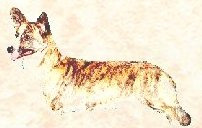
| The stripes may be very obvious or they maybe rather blurred, so that the coat doesn�t seem to be striped, just highlighted.. |
| All these colours have the usual varying amounts of white. |
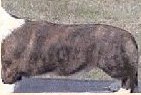
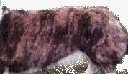
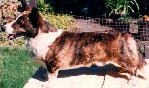
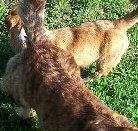
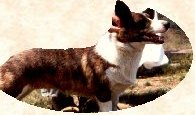
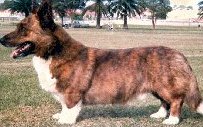
| to a colour so dark it is almost black. |
 |
 |
 |
 |
 |
 |
 |
 |
 |
 |
 |
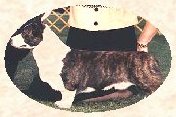
| The brindle colour in Cardigan Corgis comes in all shades from a very pale washed out colour (I have seen one paler than this) |
| through many shades of �normal� brindle, |
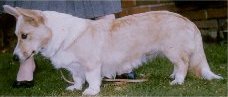
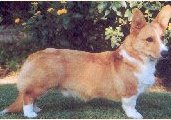
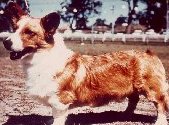
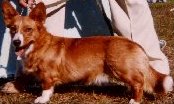
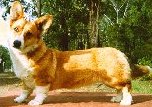
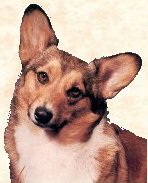
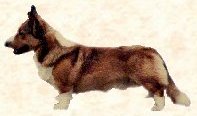
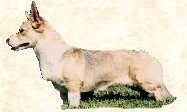
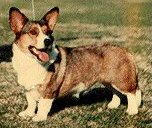
| As with the other colours in the Cardigan Corgi, a wide variation in the shades of red and sable occurs. The reds vary from a very pale washed out colour to a deep,
rich red and all shades in between.
Often there is sable shading on the tail and sometimes a little across the shoulders. |
 |
| Breeding Reds & Sables
Both red and sable puppies can be born a very dark colour. It is sometimes difficult to decide the final colour, although the face markings usually give the game away. Both dark colours tend to be very rich red/sables as adults. You should be able to tell - sable or red - by 8 weeks; sables normally have their lovely �spectacles�, although genetically almost all our "red" Cardis are sable. Red or sables can be bred to any colour, but should not be bred to merle. There are no health problems with breeding red and merle, but it is very possible to get red with blue eyes and hidden merles (dogs that appear red, but are actually merle). This blue eye will rule out showing the pup and could cause unexpected surprises with eye colour in future generations. Two genes series are relevant to these colours: - The A series can restrict dark pigment, allowing red/yellow colour to become visible - The hair tips can remain black - The extent of the black tip varies considerably from the reds with a few hairs on the tail to lighter sables ( just the ear tips are black and �spectacles�) to darker sables - where much of the body is dark - All our sable and almost all our red Cardis are sable/red because of this series of genes. and the E series which allows formation of dark pigment evenly over whole coat or restricts this dark pigment. - The reds from this series are dominant over other colours - the black/brown colour is prevented from forming, so no matter what other genes the dog carries that need the dark colours to show their effect (black, brindle or merle ), these Cardis will be red The interaction between (and different combinations of) these genes and other genes determines the final colour of our red/sable Cardigans - how much sabling, if any, appears in our red coats We often refer to a dog as �carrying or not carrying red�. This expression is only correct if one is referring to the E series red, which very few Cardis carry. All our Cardigans carry the genes that can produce red or sable. What we really mean is that a dog does or does not carry the gene that stops it from producing red/sable ie the double brindle gene; such a dog is sometimes referred to as �brindle block� ie all it�s offspring will be brindle or brindle pointed. Some people get quite a surprise when their apparently all brindle lines turn up a red or sable. This just means that at least some of their brindles including both parents of the red /sable are not �brindle block�, thus allowing the possibility of red or sable. |
| Once again, as our standard is worded, all these colours are correct. |
| Remember this �butterfly nose� is allowed in babies, but the adult nose should be solid black. |
| In both colours (as with all other Cardi colours) white may vary from a little to a lot. |
| Sables can vary from just black ears tips, their �spectacles� and a few black tipped hairs on their back to a dog that looks almost black.
The �red� base colour can vary from very pale to a rich dark red. |
| They all have black noses, lips and the eye rims and dark eyes (the eye colour will vary a little depending on how dark the face is; eye colour should blend with the head colour of the dog. |
 |
 |
 |
 |
 |
 |
 |
 |
 |
 |
 |
 |
 |
 |
 |
 |
 |
 |
|
|
 |