 |
 |
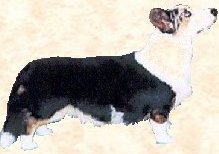
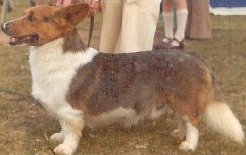
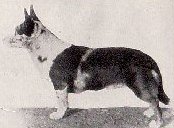
| The Merle Cardigan Corgi comes in many �colours�.
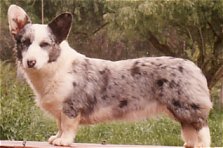
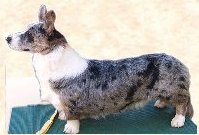
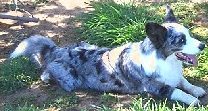
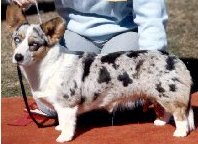
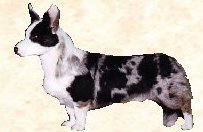
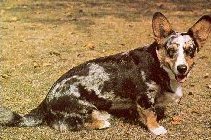
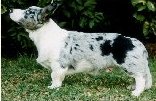
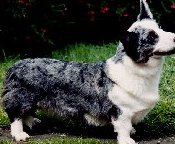
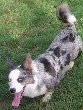
Remember the standard states �any colour so long as white does not predominate; nose must be black�. Therefore, to be accepted in the show ring, our merles must be blue. The blue merle varies from a pale blue with almost no black marks to a black dog with just a few blue marks. The blue can vary from a clear pale blue to a very muddy colour to a gunmetal grey. The white markings can vary from very little to large white collars, white on the ears and slashes of white on the hips and over the head. The points may be brindle or red. They may be large or so small that they are unnoticable. Remember the merle pattern affects black, so what applies to black, applies to merle - the dog cannot be merle and white; it must have points, even if you have trouble finding them. |
 |
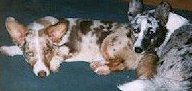
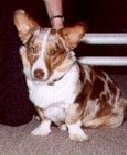
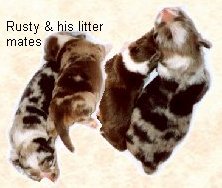
| A blue merle and a chocolate merle from the same litter.
The chocolate merle is Rusty, a top obedience/agility dog in USA. |
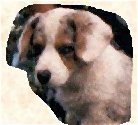
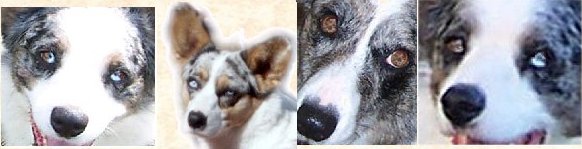
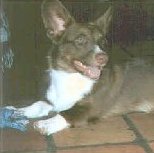
| The eyes will be brown (maybe lighter than in a blue merle) or blue or a mixture of both colours.
They may still have tan points. I don�t know about brindle points - what happens to brindle in a chocolate dog???? - probably brown and lighter brown stripes! |
| The pigmentation will be brown (liver); ie the nose, eye rims and lips will be brown. |
| If the basic colour of the Cardigan is brown (chocolate) then the merle will be a brown (chocolate) merle with a brown nose.
These dogs may not be shown because our standard states that �the nose must be black�. As a pet or a competition (agility, obedience etc) dog, there is nothing wrong with them; they are as healthy and normal as any other colour. (look at Australian Shepherds) |
| The Merles that are Not Blue & the 'Blacks' that are Not Black |
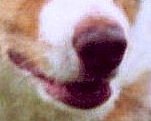
| In the adult the nose should be a solid black. In puppies it will often be butterfly (have pink on it). It can take much longer for the colour of the nose to change from pink to black in merles than it does in other coloured dogs. |
| The eyes may be brown, blue or a combination of both colours. |
| The shading on the body of this dog is blue; his nose is black; therefore he is a blue merle.
His tan points are �large�.
His coat colour is just as correct as any dog above. As an adult the nose should be completely coloured, not butterfly as in the photo. |
| As our standard is worded,
all these colours are correct. |
 |
 |
 |
 |
 |
 |
 |
 |
 |
 |
 |
 |
 |
 |
 |
 |
| Breeding The Merle
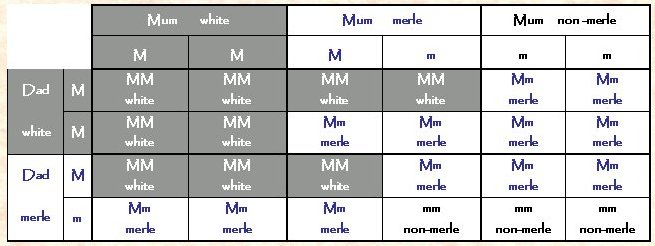
The 1st point to remember is that genetics is a science of probabilities not definites. ie, if a merle dog (Mm) is mated to a black bitch (mm), there is a 50% chance of getting a merle pup. You may get all merles; you may get no merles; you may get some merles and some blacks - over a very large number puppies from such a mating half will be merle, half will be black. Obviously a non merle (mm) to a non merle (mm) can produce only non merle. |
| I am indebted to Marieann Gladstone of Aragorn Kennels for allowing me to use these photos of Rusty ( ADCH Canfield Aragorn Coppertone CDX, MX, MXJ, EAC, EGC, EJC) and his chocolate brother (he is actually tricolour - chocolate with red points) |
| If you turn up such a colour, don�t panic, there is nothing wrong with them except they don�t meet our standard; they make
beautiful pets.
Just be aware that both the lines that produced the colour must carry brown (black is dominant). |
| It is possible to produce chocolate (brown) merle and chocolate (brown)
Cardigans. The brown gene exists in our breed. It is generally suppressed by breeders because of the limitations of our standard. |
| The 3rd point to remember is that merle to merle breeding can be dangerous.
In a merle to merle mating there is a I in 4 chance of getting a white dog (may have a few patches of blue-grey hair); ie in a large group of such puppies 25% will be white ( MM in the table above). To complicate this situation, these white pups may suffer from eye (blind or no eye), ear (deaf) and other problems. It is possible for these white dogs to be perfectly healthy, but not often. I don�t know whether this is correct or not, but I feel that many of these white pups don�t make it to birth; perhaps they are absorbed by the bitch because they are so badly affected. I have occasionally put blue to blue with no ill effects (no white pups); that could just be the luck of probabilities or it could be that the affected pup didn�t make it to birth. Breeders of other breeds that carry the merle gene state that almost all of the white pups have slight to very severe defects. To avoid this situation only breed a merle to a black thereby eliminating any possibility of a homozygous (MM) merle and its inherent health problems. The 4th point to remember is that the merle need not necessarily be blue ( and the black need not necessarily be black) In Cardis we show and hopefully breed only blue merles, simply because our standard says that �the nose must be black�. All dogs are basically black (with black pigmentation) or brown/chocolate (with brown/liver pigmentation). All other colours are modifications of this basic black or brown. Therefore the merle gene will produce blue merle in a basically black dog and chocolate/brown merle in a basically brown dog. |
| The 2nd point to remember is that merle is not a colour, it is a pattern.
The merle gene acts only on the black or brown (chocolate) pigment in the dog's coat, not on the red or brindle of a tricolour (points will still be red or brindle). A dog with one merle gene will have the black (or brown) part of its coat diluted, with patches of dark pigment remaining. |
 |
 |
 |
 |
 |
 |
 |
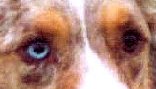
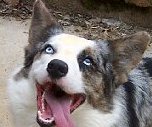
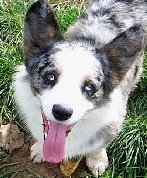
| Merle acts on the dark pigment in the iris of the eye just as it does on the coat, so merle dogs often have part or all of the eye blue. (This does not affect their vision). |
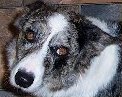
| or their eyes may be brown |
 |
 |
 |
 |
 |
 |
 |
|
 |
 |