 |
 |
| The aim of this article is to help new owners, potential new owners and judges
of the show/breeding Cardigan Welsh Corgi
It is the result of my observations, after many years of watching puppies grow up, of watching Cardis in the ring, reading other opinions and discussing the breed with other breeders. We disagree on some points, but then who doesn�t? I travelled many miles to see babies and those same babies as adults. These days I am not in the position to travel as much, but I still try to follow babies through to adult hood where possible. To me, this is the best way to learn to pick the best puppy from one�s own litters. After all that is the point of breeding - to pick for yourself the best possible. I was lucky, in that I was introduced to good Cardi type and conformation by Mrs West of Westavon Kennels and I was able to see dogs like Leycaswa Pavo and some of Val�s stunning Valjax dogs. Most of these photos have been chosen because, to me, they typify the Cardigan Welsh Corgi as defined by our standard. Most you won�t see today, some are from way back when; some of us may remember others (these photos are from my archives, some their original source is unknown, some are from handbooks, magazine/newspaper/old books articles etc). Other photos are those I have taken in more recent times. They have been selected to illustrate correctness and, to some extent, the way in which the eye can be deceived. I have only occassionally attempted to illustrate faults. Some sections, eg movement, are ongoing. As I obtain suitable photos these will be completed. Our beautiful Cardigan is unique in the world of dogs. I don�t know of any other breed with such a combination of conformation and colours as that we find in the Cardigan Corgi. |
| The Standard of The Cardigan Welsh Corgi
General Appearance - Sturdy, tough, mobile, capable of endurance. Long in proportion to height, terminating in fox-like brush, set in line with body. Characteristics - Alert, active and intelligent. Temperament - Alert, intelligent, steady, not shy or aggressive. Head & Skull - Head foxy in shape and appearance, skull wide and flat between ears tapering towards eyes above which it is slightly domed. Moderate stop. Length of foreface in proportion to head 3 to 5, muzzle tapering moderately towards nose which projects slightly and is in no sense blunt. Underjaw clean cut. Strong but without prominence. Nose black. Eyes - Medium size, clear, giving kindly, alert but watchful expression. Rather widely set with corners clearly defined. Preferably dark, or to blend with coat, rims dark. One or both eyes pale blue, blue or blue flecked, permissible only in blue merles. Ears - Erect, proportionately rather large to size of dog. Tips slightly rounded, moderately wide at base and set about 9 cms (3� ins) apart. Carried so that tips are slightly wide of straight line drawn from tip of nose through centre of eyes, and set well back so that they can be laid flat along neck. Mouth - Teeth strong, with scissor bite, i.e. upper teeth closely overlapping the lower teeth and set square to the jaws. Neck- Muscular, well developed, in proportion to dog's build, fitting into well sloping shoulders. Forequarters - Shoulders well laid, angulated at approximately 90 degrees to upper arm; muscular, elbows close to sides. Strong bone carried down to feet. Legs short but body well clear of the ground, forearms slightly bowed to mould round the chest. Feet turned slightly outwards. Body- Chest moderately broad with prominent breast bone. Body fairly long and strong, with deep brisket, well sprung ribs, clearly defined waist. Topline level. Hindquarters - Strong, well angulated and aligned with muscular thighs and second thighs, strong bone carried down to feet, legs short; when standing, hocks vertical, viewed from side and rear. Feet- Round, tight, rather large and well padded. All dew claws to be removed. Tail - Like a fox's brush set in line with the body and moderately long (to touch or nearly touch ground). Carried low when standing but may be lifted a little above body when moving, not curled over back. Gait- Free and active, elbows fitting close to sides, neither loose nor tied. Forelegs reaching well forward without too much lift, in unison with thrusting action of hindlegs. Coat - Short or medium of hard texture. Weatherproof, with good undercoat. Preferably straight. Colour- Any colour, with or without white markings, but white should not predominate. Size - Ideal Height: 30 cms (12 ins) at shoulders. Weight in proportion to size with overall balance the prime consideration. Faults - Any departure from the foregoing points should be considered a fault and the seriousness with which the fault should be regarded should be in exact proportion to its degree. Note - Male animals should have two apparently normal testicles fully descended into the scrotum. |
 |
 |
 |
 |
 |
|
 |
 |
| Last update:- Movement 27/5/2006 |
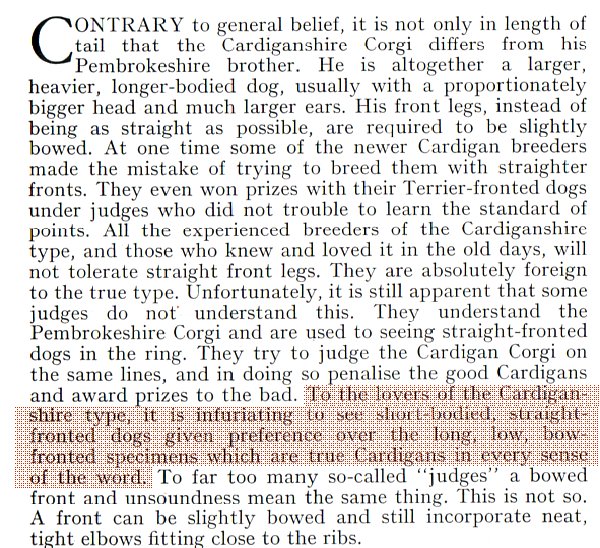
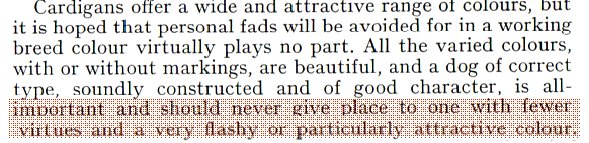
| I am beginning this article with a couple of quotes from Thelma Gray, a foremost authority of her day on both breeds of Corgi, as I believe they are still as relevant today as when they were written about 50 years ago. |
 |
 |
 |
| If anyone would like a copy of this article, please just ask and I will post your a hard copy. |
 |
 |