 |
 |
| all with white markings, usually on the chest, feet, tip of the tail, head and neck.
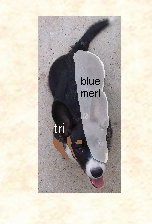
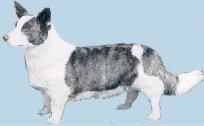
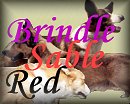
I have seen a Cardi (years ago) and quite recently an Australian Shepherd, that was tricolour on one side and blue merle on the other. I have no idea what the geneticists would make of that. I don�t have a photo of the dog, so have drawn the effect as best as I can remember. I don�t remember what colour the tail was and I think the dog had more white on it than this, but I hope you get the idea. As the standard applies to this dog, his colour is correct. Many people, however ,will condemn this dog simply because they find it unattractive. I have had many a good natured argument on this subject. The white may only be a tiny spot on the chest, a few hairs on the tail tip, a tip of a toe or it may be a large white collar, a mostly white face, long white stockings or any other variation of size and placement up to an almost completely white dog. The amount of white and its distribution is quite independent of the colour of the dog, although the merle gene is said to enhance white. Brindle and merle, strictly speaking, are patterns of colour and both need a black/brown base to express the pattern. Sable is a red dog with varying amount of black or black tipped hairs in his coat. Many of our red dogs have some sabling especially on their tails. For me, to be registered as sable, the pup must have his 'spectacles'. I know many refer to any red dog with black hair in his coat as sable. |
 |
 |
 |
 |
 |
 |
| The white on a Cardi can vary from almost no white to an almost white dog, both in merles and in other colours.
The white may be pure white; sometimes the white is a little creamy; sometimes it is �persil� white or it may have coloured spots in it (freckles) Remember the standard says �white must not predominate�; this does not mean that Cardis may not have white slashes on the body or ears or large white collars - it means that white must not cover more than half the dog. |
 |
| Also our standard says that �the nose must be black�.
This infers (and probably should be spelled out in the standard; it does state that �rims should be dark�) that eye rims and lips should also be black , thus ruling out the half white face, even though the rest of the body is well coloured; the eye rim of the �white eye� will be pink. If this eye has colour surrounding it and thus a black rim, all is OK. |
| The eyes are dark; the eye colour will vary a little depending on how dark the face is; eye colour should blend with the head colour of the dog. The merle may have brown, blue or partly blue eyes. |
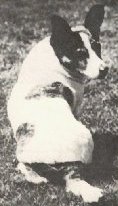
| These are not correct
Both are brindle, not merle, but by today's standard carry too much white |
| As our standard is worded, all these colours are correct. |
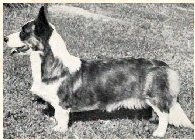
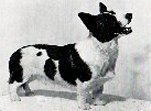
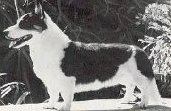
| This dog gained his English title back when the standard said �any colour but pure white� . He appears nicely proportioned, well angled front and back, nicely rounded croup, level topline , good hocks and head, maybe a little lacking in crook, but by today�s standard he would be thrown out with the dishwater!!!! |
| For the Breeder
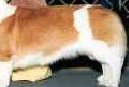
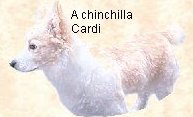
The white colour and its distribution is said to be controlled by the Spotting series of genes, with a little interference from other genes. I believe that it is going to prove to be much more complicated than this. Then there is the presence of colour (? the ticking series of genes) in those areas that have been made white by the effect of the white spotting genes, giving the Cardi its �freckles� and spots of varying sizes on collars, toes etc. Then there is the Albino Series which affects the intensity of colour - lightens the red/yellow colours. - turns red to cream - pigmentation (nose colour) is black. - puppies are born nearly white or light beige. - apparently can happen in Cardis giving the so called chinchilla - gives the blue eyed albino. has an entirely white coat. has a very small amount of residual pigment in the eyes, giving pale blue eyes. - gives the true albino (white coat, pink skin and pink eyes). it is not supposed to occur in dogs. |
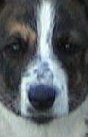
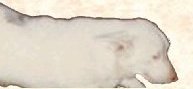
| Is this entirely the effect of the double merle gene ?
The puppy has blue patches on a white coat appears to have some colour on the nose and around the eyes appears to be healthy (is playing with a baby in the original photo). Maybe a lucky double merle or normal merle and piebald or normal merle and extreme piebald or has the albino gene something to do with it |
| This has nothing to do with the merle gene.
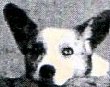
She is white with brindle marks. Her offspring are mostly red/ sable or brindle with �normal amounts of white on them. Maybe she is �piebald� instead of the more common �irish spotted�. If the white on most Cardis is caused by the �irish spotting� gene, what is the difference between this |
| and this? |
| Interesting, isn't it? |
 |
 |
 |
 |
 |
 |
 |
 |
 |
|
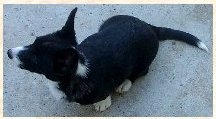
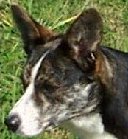
| �Black� Cardigans are genetically tricolour, somewhere you will find a few coloured hairs if you look long enough; they may not appear until the dog is an adult.
Both the dominant black & the recessive black genes do not exist in the Cardigan Welsh Corgi. Therefore a purely black or black and white Cardi is not genetically possible. I believe that in the adult, somewhere you will find a few coloured hairs if you look long enough; maybe, I am wrong and colour can�t be found in some dogs, but every �black Cardigan� I have bred had colour by registration time (about 2 months old) this colour may only be 3 coloured hairs in a very private place but they are not black and white as in a Border Collie, they are tricolour; very occasionally one proves to be brindle. The tricolour Cardigan may have brindle points or red points. |
 |
| Now consider the black portion of the coat.
The black hairs may be completely black all the way to their roots and the skin black. This is the ideal dog to use in blue merle breeding. I am told they are most likely to give clear blue and avoid the �muddy� and very dark �steel grey� merles. The skin under the black portions of the coat is usually blue, varying from a fairly dark blue to a very, very pale blue; the pigmentation of nose etc is black. The majority of the black hairs may be pale with black tips. These tips may be most of the length of the individual hair or just a little on the very end. The bitch on the previous page, who can�t make up her mind on the colour of her points, has this black coat. She looks a lovely solid black till you inspect her coat carefully. Her skin is a very pale blue, gradually changing to pink under the white portions of her coat. These dogs may, and I mean may, give you �muddy� coloured merles. To use with other colours, I don�t think the �colour� of the black matters much. As the tri gene is at the bottom of the dominance scale, both sire and dam must be carrying it to produce tricolour. Brindle points are dominant over red points. It possible for two brindle point tricolours to produce a red point tricolour, but not for two red points to produce a brindle point. |
| Breeding the �Blacks�
These beautiful �Black� Cardis are very useful to own from a breeding point of view. They can be mated to all colours. The Agouti series controls the replacement of black with red/yellow in the growing hair. It affects not just whether or not this shift occurs, but where on each hair and where on the dog's body it happens. The genes from this series relevant to the �black� Cardis control whether or not the dog has points - colour other than black on the eye brows, cheeks, legs |
| They all have black noses, lips and the eye rims and dark eyes; the eye colour will vary a little
depending on how dark the face is; eye colour should blend with the head colour of the dog. |
|
They may have a lot of white in the coat or very little.
|
| or she may not be able to make up her mind.
This bitch has pale brindle on her cheeks and legs. On the back of her head and a little on the back of ears, the colour is red and reddish brindle. |
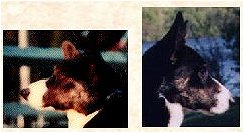
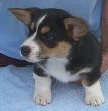
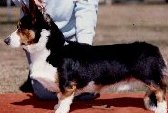
| These points may be quite large or almost impossible to find. |
 |
 |
 |
 |
 |
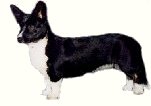 |
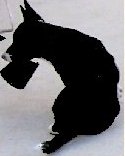
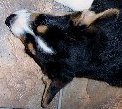
| This dog appears to have a tiny bit of colour on its hind leg and inside its ear. |
 |
 |
 |
 |
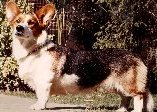
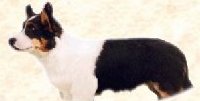
| Occasionally the points are so large that we have the �saddle� tri that is seen often in Pembrokes. |
| The black on the points may be replaced with red/yellow (the black is restricted ); - gives red points.
|
| If the brindle gene is present, then brindle appears in the portions of the coat in which black is restricted; - gives brindle points. |
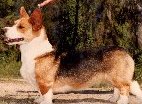
| Sometimes the black is restricted to the back and side, thus the 'saddle'. It is rarely seen in Cardis |
 |
 |
| As our standard is worded, this may be too much white all theother colours are correct. |
 |
|
|
These pages on colour explain, as best I can, colour of the Cardigan Welsh Corgi; breeding with
colour in mind, very basic genetics of, pitfalls, what is possible, what is acceptable in the show ring and why. I have used the conventional explanation of colour.
This is rapidly changing, as the geneticists have mapped the dog genome and are discovering which gene does what, including those gene/s responsible for coat colour. Much of the conventional explanation of colour is proving to be true; much of it is not. If you are interested in more genetic detail in a form that is understandable, please contact me. I have attempted to present the genetics of colour in an understandable form. I find it very interesting and of great help in explaining colours that have occurred in litters. Our lovely breed comes in many colours, the basic colours being: black red/sable brindle merle |
 |
 |
 |
 |
 |
 |
|
|
 |
 |