 |
 |
| What YOU do affects the world. |
| Bring On the Heat Live a little cozier through the winter by ensuring the efficiency of how you heat your home. Be sure that your furnace and heaters are in good working order and that your home is well insulated, windows, doors, floors, roofs, walls, and all. Holding onto heat is as good as holding money in your pocket and it surely helps to save the natural environment. If maintenance is due on your home (e.g., insulation, caulking around windows and doors), summer is a perfect time to care for it. Do it before the cold comes back! |
| Basic Sustainables Page 4 |
| Pollution In Perspective (Hazardous Waste) Watershed- When the rains come runoff water carries with it much of the contaminants released on land bringing it down the rivers and out to the ocean. Chemicals and trash are the trail left behind the whole way from land to sea. Don't pollute what you drink. If you toss it out your window or pour it down the drain it will come back to you. Hazardous waste of all kinds, toxic dumping, auto emissions, production of electricity, and all sorts of litter all contaminate the earth's soils and waters. This includes the water you use to drink and bathe. Everything becomes contaminated. Plants drink the water and grow in the soil, thus soaking up contaminants. Animals wild and domestic are subjected to the contaminants, as are people who eat plants and animals. Pesticides are contaminants, which contaminate an eco-system (on farms and in the wild) killing nearly everything including essential microorganisms and nutrients in the soil. Even the desired crop will have serious trouble in the long run. The watershed will carry these contaminants far beyond their origination. (Back to Litter of All Sorts Page) |
| Humanity for Habitat (Let it Grow!) Urban, suburban, or rural. What lives in your backyard? Create a wildlife habitat, at least a small corner of your yard and lawn, or a large section, or maybe the whole thing! Whatever you decide, the wilds will be happy! Plant native trees, shrubs and grasses, and set out feeders and houses for the animals. Bird and bat houses, and old logs are good starters for animal shelters. This will yield quick results. 'You could also let natural succession take over....' 'Natural succession?' 'Yep, in other words you won't have to do anything, really.' 'Sounds good to me! Let's hear it!' If you were to section off a portion of your property, wild grasses, shrubs, and trees would grow (in this chronological order) over the course of a few years. Results will vary, depending on local climate and neighboring ecological systems. Wildlife is sure to come and make home, while you enjoy their company living side by side. Your new "mini-wildlife sanctuary" will be a happy habitat, providing food and water for the plants and animals, as well as many places for them to hide and live. This eco-system will also support your lawn and garden. It will help to retain water and will downsize your yard, thus reducing the need for pesticides (if you use them). It will save time and money spent maintaining your lawn and yard. Animals like the opossum and bats should be encouraged to reside in your yard. Opossums will eat bugs that destroy your garden, and a single bat will eat up to 10,000 insects in one night! (Back to Reuse Page) |
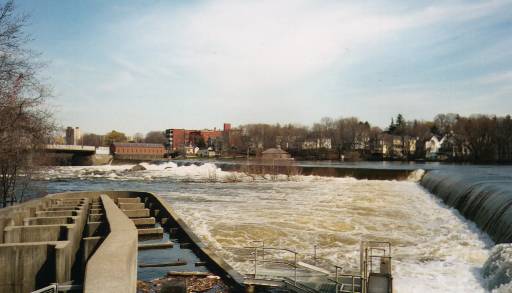 |
| Let us go back to the photo you see above (also found on Basic Sustainables Page 2) In the bottom left-hand corner of the photo is a tan concrete structure known as a fish ladder. It is a structure created by humans, designed to allow fish to migrate upstream to spawn. Fish are one of the very few things to migrate up rivers (in the water) and with all the dams across rivers in this world it is a wonder that fish will ever be able to carry out their natural process. When spawning, fish return to where they were born to do so, and if they cannot make it home, there is a good chance they will not spawn. This will not only reduce the livelihood of fish species, but it will alter the upstream river eco-systems, which depend upon these fish as a source of food. Ocean eco-systems, where the fish come from, are affected, too. At a dam like the one in the photo here, you can see that during heavy spring runoff it would be extremely difficult for a fish to swim through. The fish ladder is designed to channel a lower volume of water where the fish can easily swim upstream beyond the dam. Fish find their river from the ocean using their sense of smell and continue swimming into the current to keep their bearings. |
| Fish Ladders |