MAPPA
Cultural Voice
Zone Consigliate
Personaggi
Musica Significativa
Filosofia
Università
Storia
Arte
Cinema
La Vita e la Carriera
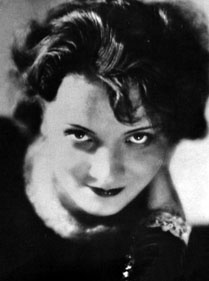
When Marlene Dietrich died in May 1992, the world lost the greatest
icon in the history of motion picture. Miss Dietrich had already become a
legend many years before she died. Miss Dietrich always wanted to make us
believe that The Blue Angel, 1929/30, was her first film. But
before she acted "Lola Lola" in one of the most famous films
ever made, she appeared in 17 silent movies between 1922 and 1929.
I. BERLIN - THE BEGINNINGS
There can be no legend without a beginning: Marie Magdalene
Dietrich was born December 27, 1901 in Schoeneberg (when she became an
American citizen she made herself three years younger). Her mother
Wilhelmina Elisabeth Josephine Dietrich, née Felsing, was a jewellery
manufacturer´s daughter, her father, Louis Erich Otto Dietrich was a
police officer. Marie Magdalene was their second child, their first
daughter Elisabeth was born in 1900. In 1907, Louis Erich Otto Dietrich
died. Several years later Dietrich´s mother remarried to Eduard von Losch,
but he died from war wounds during WW 1.
At the end of WW 1 Dietrich´s first name was already "Marlene".
She began to study the violine in Weimar, but this education never was
completed.
In the early 1920s, Marlene became a student of the Max Reinhardt School.
Since 1922, she appeared in many stage productions. She played her first
supporting role in Der grosse Bariton (The Great Lover) at the
"Theater am Kurfürstendamm" and got parts in Die Buechse der
Pandora (Pandora´s Box) and Taming of the Shrew. It was also
in 1922, that the young actress played her first supporting roles in the
silent movies So sind die Maenner (That´s How Men Are) and Tragoedie
der Liebe (Tragedy of Love).
On May 17, 1923, she married Rudolf Sieber, and on December 12, 1924,
she gave birth to her daughter Maria. Although Marlene and Rudi lived
their own lifes and had their own affairs, they remained married until
Rudi died in 1976. They stayed good friends all their lifes long.
II. THE "TOAST OF BERLIN"
After she had played important parts on stage in the comedy Duell
am Lido (Duel on the Lido) and in the revue Von Mund zu Mund (From
Mouth to Mouth), she became the "toast of Berlin". In 1927,
Marlene had an engagement in Vienna: She played at the "Theater in
der Josefstadt" and at the "Wiener Kammerspiele" and she
made her first important silent film, Café Elektric. Marlene
returned to Germany and played the main parts in the silent films Ich
kuesse Ihre Hand Madame (I Kiss Your Hand, Madame), Die Frau, nach der man
sich sehnt (The Woman One Longs For/Three Loves), Das Schiff der
verlorenen Menschen (The Ship of Lost Souls) and Gefahren der
Brautzeit (Dangers of the Engagement Period).
On stage, Marlene played main parts in Mischa Spoliansky´s revue Es
liegt in der Luft (It´s in the Air), 1928 (for which she recorded her
first two songs, including a very obvious lesbian duet with Maro Lion who
was a big star in Berlin then) and in Georg Kaiser´s Zwei Krawatten,
1929.
III. THE BLUE ANGEL
In August of 1929, the film director Josef von Sternberg, a jewish
Austrian, came from Hollywood to make a film with Emil Jannings based on
Heinrich Mann´s novel "Professor Unrat". Von Sternberg was
still searching for an actress to play the female main part. One evening
he was in the audience of Zwei Krawatten when he saw Marlene for
the first time. He wanted to have her for his film.
In November of 1929, the shooting for The Blue Angel began: Marlene
played "Lola Lola", the tantalizing nightclub singer in one of
the first German sound films. The composer of Marlene´s songs in this
film was Friedrich Hollaender. The Blue Angel - still admired and
one of the most timeless films in the history of motion picture - was the
beginning of Marlene Dietrich´s world career. Paramount wanted to have
her in Hollywood - so did von Sternberg. Marlene followed him.
IV. HOLLYWOOD - THE MAGIC YEARS
In April of 1930, Marlene arrived in New York. Directly after her
arrival in Hollywood, Josef von Sternberg, her "Svengali", made
a Marlene Dietrich Trailer to introduce Miss Dietrich to the
American audience. What followed, was the most fascinating collaboration
in the history of cinema: Dietrich and von Sternberg worked together for
six Hollywood films, each of them unique and incomparable. These films
made Marlene a living legend, and von Sternberg an enigma.
Their first Hollywood film together was Morocco. It was filmed in
the summer of 1930 and had its première in November of 1930. In this
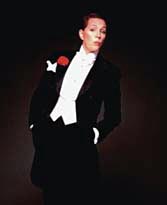
immortal film classic, Miss Dietrich wore black tails and a top-hat which
was a sensation. This androgynous appearance became an important part of
her image. Two decades later, Kenneth Tynan wrote, "She has the
bearing of a man, the characters she plays love power and wear trousers.
Marlene´s masculinity appeals to women and her sexuality to men."
After Morocco and her next film, Dishonored, 1931, in which
she played an Austrian spy during World War I, the "Dietrich
character" was well established: The lonely "femme fatale"
whose past won´t let her be at peace. The women Marlene played were
intelligent and independent (as Marlene was in private).
In her next film, Shanghai Express, 1932, she showed again a
variation of the "Dietrich character": Marlene played a "notorious
coaster" who travels from Peking to Shanghai during the Chinese civil
war. Shanghai Express was the most successful Dietrich/von-Sternberg-film.
Marlene now was Hollywood´s leading empress of desire, an image of style,
mystic, and allure.
Her fourth American film was one of the strangest films Marlene ever made:
Blonde Venus, 1932, in which she wore tails and top-hat (but this
time in white) again. Marlene herself had the idea of the story for this
film. This is Marlene´s only film in which she played a mother (with the
only exception of Lady is Willing ten years later - but there she
adopted a child). Above all, the film became immortal because of the
unique nightclub scenes. In one of them, Marlene slipps off a gorilla
costume and performs "Hot Voodoo".
Song of Songs, 1933, was Miss Dietrich´s first sound film not
directed by Josef von Sternberg: Director of this quite exceptional film
was Rouben Mamoulian. In Germany the film was forbidden because it was
"un-German (!)". But Goebbels wanted Marlene to come back. He
made her several offers during the 1930s to return as "Queen of the
German film" but, of course, Dietrich turned down all Nazi offers.
In 1934, von Sternberg was Marlene´s director again: The Scarlet
Empress is one of the most controversial historical dramas ever made.
Marlene played the German princess Sophie Frederike who became
"Catherine the Great". The last Dietrich/von-Sternberg-film was The
Devil is a Woman, 1935. She played the Spanish dancer Concha Perez,
but this role was not at all in her character. Strangely enough, The
Devil is a Woman became Marlene´s own favourite film.
V. LIFE AFTER VON STERNBERG
After her first seven American movies, which were all dramas,
Marlene was able to show her great sense of humour in an intelligent
comedy directed by Frank Borzage, produced by Ernst Lubitsch: Desire,
1936. In this film Marlene played a glamourous jewel thief who wins the
heart of Gary Cooper. She proofed that she was great even without her
"Svengali" Josef von Sternberg.
The Garden of Allah, 1936, was Marlene´s first colour film,
directed by Richard Boleslawski and produced by David O. Selznick. Marlene
was stunning as usual, but the film was very kitschy. Marlene played a
very sad woman with the terrible name "Domini Enfilden" who goes
into the desert to find happiness again. There she falls in love with
Boris (Charles Boyer) without knowing he is a monk who flew from a
monastery. At this time, MD was the world´s most highly paid actress. Her
next film was made in England: Knight wihout Armour, 1937. Back in
Hollywood, she played one of her best parts in Ernst Lubitsch´s
melancholy film Angel. Marlene played Lady Maria Barker who had a
"one night stand" in Paris. A few days later her "one night
stand lover" comes to her house - as an old friend of Maria´s
husband...
Although her performance was brilliant, Angel was not successful
and in May of 1938 the Hollywood Reporter printed an advertisement
in which some of the greatest Hollywood stars were called "Box-Office
Poison": Joan Crawford, Bette Davis, Greta Garbo, Katherine Hepburn
and - Marlene Dietrich!
But in 1939, Marlene had a sensational Comeback with Destry Rides Again,
directed by George Marshall, produced by Joe Pasternak. It was a great
western and it gave Marlene Dietrich a completely new image: Now she was
no longer the distant, untouchable, cool venus, but the loud bar singer
who shouts "See What the Boys in the Backroom Will Have!". The
audience and the press were amazed. This was a completely unknown facet of
Marlene Dietrich. It was in the same year, that Marlene became an American
citizen. The German press called her "traitor".
At that time, she also made a series of immortal recordings, such as
"You Go to My Head", a very sensual and almost sentimental
performance of "Falling in Love Again", as well as Cole Porter´s
classic song "You Do Something to Me".
Her next film was Seven Sinners, 1940, directed by Tay Garnett. In
this movie, Marlene wore the uniform of the navy, singing "You Can
Bet Your Life the Man´s in the Navy!". After Seven Sinners
she did a series of films that couldn´t compete with the movies she made
in during the 1930s: The Flame of New Orleans, 1941, Manpower,
1941, The Lady is Willing, 1942, The Spoilers, 1942
and Pittsburgh, 1942.
VI. LILI MARLENE - WORLD WAR II
Miss Dietrich felt guilty for what Hitler did to the world -
because she was German. So she decided to help to fight against Hitler.
Her work with the USO brought her to North Africa, Italy and to many other
scenes of this cruel war. She entertained the American troops, stayed with
them at the front and risked her life. She also helped in the hospitals
and made radio broadcasts. At that time she picked up her famous song
"Lili Marleen" that would accompony her for the rest of her
life. For her bravery during her work with the USO, the U.S., the French
and the Israeli governments awarded her medals.
VII. THE POST-WAR YEARS
In 1946, Marlene made her first post-war-film: Martin Roumagnac,
a French Criminal film directed by George Lacombe. Marlene´s Co-Star was
Jean Gabin whom she called "the love of my life". The film
became an absolute flop. Marlene returned to Hollywood. There she played a
gypsey woman in Mitchell Leisen´s film Golden Earrings, 1947.
Although Golden Earrings is no masterpiece, it is very enjoyable
and Marlene obviously had fun playing the role of the tempting gypsey
Lydia.
In 1948, MD performed stunningy again in Billy Wilder´s terrific comedy A
Foreign Affair. Marlene played a Nazi singer "in the Ruins of
Berlin". It was difficult for Wilder to get the convinced Anti-Nazi
Marlene Dietrich for the part of a Nazi woman. She performed three songs
in A Foreign Affair: "Illusions", "The Ruins of
Berlin" and - the greatest of all "Black Market". In the
same year, her daughter Maria made Miss Dietrich "the world´s most
glamourous grandmother", when she gave birth to the first of her four
sons.
The next great Dietrich film was Stage Fright, 1949/50, directed by
Alfred Hitchcock. Marlene played the part of a very suspect theatre
actress in this criminal film. She sang Cole Porter´s "The Laziest
Gal in Town" and Edith Piaf´s "La vie en rose". Hitchcock
called Marlene an "absolute professional". He even allowed her
to give directions on his set - which was more than unusual for Hitchcock.
Dietrich´s next film was No Highway in the Sky, 1951. Stage
Fright and No Highway in the Sky were both made in England.
Marlene returned to America again. In November of 1951, she recorded her
first long-play album for Columbia in New York. The album was called
"Marlene Dietrich Overseas" and contained 12 songs, such as
"Mean to Me", "Annie Doesn´t Live Here Anymore",
"Time On My Hands", and "Miss Otis Regrets", all sung
in her native German. Some critics still call these "Overseas"
recordings Dietrich´s best album.
Dietrich`s next movie, Rancho Notorious, 1952 (directed by Fritz
Lang), was - in her own words - "a very bad film". Marlene´s
time as screen goddess was over. A change was overdue: Marlene Dietrich
decided to go on stage!
VIII. A NEW ADVENTURE
In December of 1953, Marlene Dietrich had her first live appearance
in her new career as diseuse at the "Hotel Sahara" in Las
Vegas. The success was overwhelming. In June of 1954, she appeared at the
legendary "Café de Paris" in London, where she was introduced
by her old friend Sir Noel Coward. Her deep, smoky voice and her
extraordinary gowns made headlines all over the world.
Before she captured the rest of the world with her unique stage shows, she
made a few more movies: In Around the World in 80 Days, 1956, she
made a guest appearance, and in The Monte Carlo Story, 1956/57,
made in Italy, she played the main part, a gambling marquise, opposite
Vittorio de Sica. This film was rather boring. But her next two roles were
fascinating: In Orson Welles` great film noir Touch of Evil,
1957/58, Marlene played a cigar smoking brothel keeper. This became one of
Dietrich`s own favourite film performances. After working with her friend
Welles, another good friend made a film with her: Billy Wilder, whom she
knew since the 1920s and with whom she had made A Foreign Affair
ten years before, directed Marlene as Witness for the Prosecution,
1957/58. Marlene`s performance of Christine Vole in this immortal
courtroom thriller was one of her greatest character roles.
IX. THE SINGING LEGEND
In 1959, Marlene gave a series of concerts in South America. In Rio
de Janeiro, 25000 people were waiting for her when she arrived at the
airport. The enthusiasm of the Cariocas was overwhelming. Marlene recorded
one of her most famous albums there, "Dietrich in Rio". She
repeated her South American trimph in Paris at the "Theatre de l´Etoile".
A reviewer reported, "Marlene has taken Paris!"
In 1960, she even risked returning to Germany for a series of concerts.
There were still many Germans who called her "traitor" and
didn`t want her to sing in "their" country. But finally, Miss
Dietrich - as she usually did - won out and had 62 curtain calls in Munich.
The world loved Marlene`s dusky voice, her incomparable stage shows -
whether she appeared in Jerusalem or in Copenhagen, "standing
ovations" were obligatory. Her stage appearances were wild successes
everywhere.
In 1961, Dietrich played her last great film role as the widow of a German
general in Stanley Kramer`s Judgment at Nuremberg, a
re-construction of the Nuremberg trials. In 1962, she narrated a
documentary called The Black Fox. This film connected Adolf
Hitler`s biography with Goethe`s story of "Reineke Fuchs".
But now, Marlene didn`t make any more films (with the two exceptions of a
rather short guest role in Paris When It Sizzles, 1964, and her
last film Just a Gigolo, 1978). Now, her new career as diseuse
was her main career. And by the early 1960s, her concerts changed a lot:
Eroticism and sex had to take second place because the main part of her
stage shows was very serious now: "Lili Marlene" was hers since
the early 1940s, but now she added new anti-war songs to her repertoire,
for example Bob Dylan`s "Blowin´ in the Wind", Charles
Meerewood`s "White Grass" and - most famous - Pete Seeger`s
"Where Have All the Flowers Gone?". She also sang other very
serious songs like "Marie Marie" by Gilbert Beceaud, or "Shir
Hatan", sung in Hebrew.
X. QUEEN OF THE WORLD
The world was hers now. Until 1975, she toured the whole world.
Some special highlights were her concerts in Warsaw, Moscow and Leningrad
in 1964, her appearances in Jerusalem and Tel Aviv in 1960 and 1966, her
Broadway triumphs in 1967 and 1968, and her tour to Japan in 1974.
In 1972, she made a TV special called Marlene Dietrich: I Wish You Love.
It was recorded in at the New London Theatre. After he had seen this
concert, Cecil Beaton (who was one of her favourite Hollywood
photographers during the 1930s), wrote, "The old trouper never chages
her tricks, because she knows they work, and because she invented them".
But in September of 1975, the "old trouper" broke a leg on stage
in Sydney, Australia. This was the end of her stage career. She lived in
Paris, was rather lonely because many of her friends had died or were soon
to pass away: Ernest Hemingway, Edith Piaf, Erich Maria Remarque, Jean
Cocteau, Noel Coward... - In 1978, she played her last film role opposite
David Bowie in David Hemmings` Just a Gigolo.
XI. PARIS - THE LAST YEARS
After making Just a Gigolo, MD didn`t want to be
photographed anymore. The reason was not that she couldn`t face age, the
reason was that she didn`t want to destroy her myth. In 1982, Maximilian
Schell interviewed Marlene on six afternoons. He used parts of the 18
hours lasting tapes for his celebrated documentary Marlene: A Feature
which became an international success in 1984. Asked why she didn`t want
to be photographed, Dietrich simply replied, "Because I don`t want it!
Tempi passati! - I´ve been photographed to death". This was her
version, but the truth was - of course - that she was photographed to
immortality. Marlene: A Feature shows clips from her movies, her
concerts and newsreels, connected with Marlene`s comments from the tapes,
partially sentimental, partially sarcastic. This collage became a
fascinating account of the Dietrich legend.
On May 6, 1992, Marlene Dietrich died in her flat in Paris. And yet: she
remains immortal! Because "Blue Angels" never die!
Gruppo di teatro, di vita, di passioni
Chiamarlo il "Nobil Giuoco' è poco ma può portare alla pazzia? In questo caso... "Scacco alla Regina"!
La musica che non muore mai
Victor Victoria Cafe, grande comunità virtuale


*J R Web Sites*