| Woodwinds |
| The woodwind family got its name because most of its members require wooden reeds to produce sound. A reed is a small piece of wood that produces sound when the air is split causing the reed to vibrate. The flute and piccolo do not require a reed because the blow hole in these instruments split the air. You could even think of the flute and piccolo as one big reed. |
| FLUTE and PICCOLO |
 |
| Flute |
 |
| Piccolo |
| The flute, along with the piccolo, is the highest of the woodwind instruments. These two instruments do not use a reed to produce sound. Sound is produced by the splitting of the air over the blow hole. |
| CLARINET |
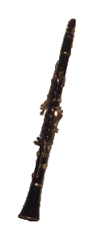 |
| The clarinet is a single reed woodwind instrument. The sound is produced when the reed is placed on the mouthpiece and the air is split. The vibration of the reed, the air, and the instrument produces the unique sound of the clarinet. |
| SAXOPHONE |
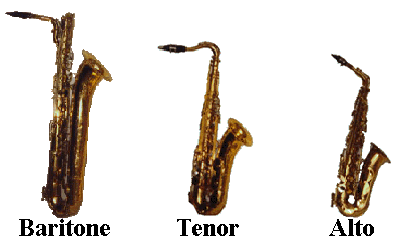 |
| The saxophone, a single reed woodwind instrument, is usually not seen in the orchestra because it was not invented until 1846 by Adolphe Sax. In the 1900s some composers began to write music for this instrument allowing the saxophone to be incorporated into the orchestra. |
| OBOE and ENGLISH HORN |
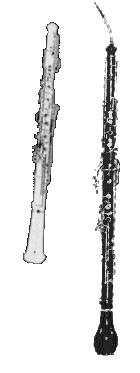 |
| Oboe English Horn |
| The Oboe resembles the clarinet from a far but is bigger. The Oboe is a double reed instrument, meaning that two reeds are used to split the air. The Oboe has a high squeaky sound that requires years of practice to master. |
| The English horn is bigger than the Oboe and has a more muffled sound because of the circular shaped bell. The English Horn is also a double reed instrument and has a lower sound then the oboe. |
| BASSOON |
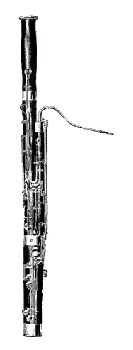 |
| The Bassoon, like the Oboe and English Horn, is a double reed instrument. This instrument also takes years of practice to produce a warm nice tone. Because of its size it is a low sounding instrument but with practice high notes can be accomplished. |