|
|
|
|
|
and the garage doors remained closed for months at a time, John would take me out for a spin in one of his cars. This was a certain guarantee of full time activity in the garage for at least a couple of months. I was also offered the use of his air compressor whenever there was a need to do any spray painting. From his support and encouragement, the car is now on the road when I could have given up years ago.
The top end of the motor was sent to the engineers for reconditioning. Instead of using the original piston design with thick high friction rings, I decided to use Toyota Corona pistons which added an extra 1.5 mm height above the bore for better compression. These pistons weigh a lot less, are certainly far better designed and place less stress on the motor. When it came to the bottom end of the motor, some valued advice from another club member telling me how to get the most out of your original bearings and journals, his advice saved about $2,000 worth of reconditioning. His method included the use of wet and dry sandpaper on a flat plate of glass, shim brass, a broken ring, some blueing oil and patience to grind the bearing caps down to size.
The magneto was re-magnetized by a specialist. The starter motor and dynamo only needed new bearings, brushes, a clean and a coat of paint. I was also able to buy a reproduction Bendix drive for the starter motor normally used in a T Ford that only required a little modification. Once the clutch was reconditioned, I then reassemble the crankcase section of the motor and placed it into the chassis followed by the cylinder block assembly and firewall. Eventually after making the muffler (using the original cast iron ends) and repairing the damaged sump, it was time to get the motor running. I blocked off the lower water pipe and filled the block with water. With the use of jumper leads connected from my other car I then zapped the starter motor into action. After only a few turns I noticed the fan quietly turning without assistance, so in disbelief I pulled on the throttle to hear the motor burst into life for the first time with a healthy plume of smoke.
With the electrical wiring, most of the rubber in the armoured wiring had perished. It was replaced with reproduction armoured wire. Heavier gauged triple core armoured wire was not available so to get around this problem, I decided to make it by spinning the armoured wrapping from the old wire to the new. To do this, I used a hand drill laying on its side in the vice on one side of the shed while a bearing and spring were attached to the other side, the new wires were then strung from the drill chuck to the bearing. When I was installing the wiring, I at first decided to copy the original wiring design by providing an earth return wire, though later the return wire proved to be more useful when I was told that the car required brake lights by law. After some rewiring, the chassis has now been converted to negative earth. Rather than wasting the remaining wires, I use them to install traffic
|
|
|
|
|
|
|
|
|
|
indicators.
The body required quite a lot of attention. Around 60% of the timber frame parts were worn, rotten or severely damaged due to its inflexibility. After dismantling the body, my first job was to rebuild the base of the body. With the little carpentry knowledge I had learnt from secondary school, persistence, and many hours of labour, I gradually carved out most of the complex shapes of the base and rebuilt it on top of the chassis. Most of the difficult cornerings, arches and the drivers side door pillars on the upper frame had to be replaced. These pieces certainly test my patience, especially the top corners of the front seat. The rear wheel arches (and rear hood bow) were steam-bent in Echuca by the same people who restore the steamboats. I soon learnt to appreciate the skilled craftsmanship from the coach builders of the day from my own experience of coach building, even when they didn't get the two sides of the body to be of equal shape.
The Vehicle Restoration course held at G.V. TAFE College in the evening, proved to be extremely useful. I was soon taught the craft of panel beating. My instructor would always say, "anything is possible with sheet metal". So after developing my panel beating technique on some of the easier panels, I was then encouraged to make the missing front mudguard myself. After a period of time and some assistance, I finally fabricated the desired shape. I also decided to replace the two right hand door skins and the right side panel as the original panels were too stretched for my liking from the previous panel repair work. The body was then reassembled at home on top of the chassis.
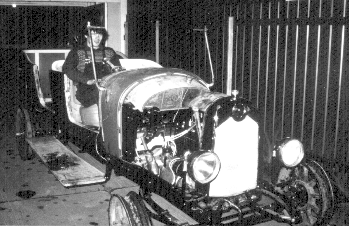
Around this stage, I thought it was time to make the car driveable. The gears in all of the three gearboxes I had were fairly worn and rough, so I chose the least worn gears and hoped for the best. Once the drive train was in place, I then set up a few cushions for a seat and drove the car on the 18" rims up and down the driveway. Within minutes John popped his head over fence thinking that there was a tram in my driveway. With great delight, he then raced around with his camera to take some photos. (Unfortunately all photos previous to the photos taken by John of my car have been lost in my travels.)
With the body rubbed back, I then filled it with lead and fiberglass and finally undercoated the body. The panels were built up with spray putty followed by a guide coat. After much preparation and more undercoats, I then painted the body with 7 to 8 coats of Bergers blue acrylic lacquer, rubbing it down with 1200 paper between every 2 coats. Once the body was reunited to the chassis my enthusiasm soared. Not long after, the doors and bonnet were also fitted to the car
I had some of the nickel plating of the bright ware done by a firm in Melbourne, though much to my annoyance, they had lost my handbrake, I was also not impressed when they later
|
|
|
|
|
|