|
|
|
|
|
Where did this vintage car madness begin one may ask! I still remember the day when my father bought home a 1923 Dodge to what I referred to as "an old bomb". I thought 'why'… (as one kid does!) I was around four years old at the time. It wasn't long after when I was told to hold a spanner to a nut from under the 1923 Dodge and as time went on, I gradually watch it transform into a magnificent car. This car has left me with many cherished memories of nostalgic vintage car motoring; hence "the madness had set in".
At the age of 9, I was very excited when my father decided to give me a 1926 Chrysler Roadster with plans of restoring the car together. These plans never eventuated due my parents who terminated their marriage.
The Crossley on the other hand was purchased in 1965 by my late grandfather at an auction for 14 pounds. This car was then stored in an open shed on his farm for another 10 years. When I was at the age of 13, my grandfather passed away. My grandmother then made the decision to give each family member a vintage car. With the acquisition of the Crossley, a Chrysler and a passion for music and no keyboard instrument to practice on, I had to make a decision on which car to sell. I preferred the English elegance and ornamented craftsmanship of the Crossley, the black iron Chrysler had to go with little regret, (much to my fathers disgust!).
Not a great deal of history is known about this Crossley, The drivers side door pocket reveal a drivers license belonging to David Gilmor from Terang, dated 1936. There is also a strong possibility of the owners having a keen interest in golf, owing to the spiked holes in the floor matting. What I do know is that during the later part of the 1930's, the Crossley was involved in a severe collision in Tocumwal (on the Victorian border) due to the driver's over indulgence of alcohol. At first sight the damage appeared to be reasonably simple with just the front axle torn off, the front right mudguard shaped into a foot long concertina plus a few other bent and broken pieces in need of attention. The body appeared to be fine apart from the tub section that broke away from the rest of the body when it was removed from the chassis. The motor was a little stiff and the car was almost rust free and 95% complete.
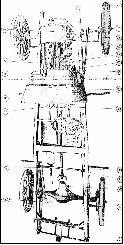
In 1977, I eagerly began the task of dismantling the chassis only to reveal the true extent of the damage. The whole front half of the chassis had been bent 13" across to the right, placing it in line with the centre of the chassis. As the chassis is the base for all other components to be attached, it need prior attention. My mother and I then decided to pay half each as a gift for my 15th birthday to have the chassis corrected in a
|
|
|
|
|
|
|
|
|
|
chassis jig.
I then began stripping down the body only to find out that the timber frame had also been severely damaged. It had become evident that the damage had spread throughout the entire car. Signs of a previous incident were also evident owing to the crude repair work on the right side door skins, side panel and associated coach timbers.
From 1979 to 1984 my family and I were on the move, this caused major disruption (and loss of parts) to the project when the Crossley was moved to five different locations. The car was completely dissembled in boxes and dragged back and forth up to 180 km's in some cases. Not a great deal of restoration work was achieved during this period, though I did manage to hunt around for replacement parts. These parts included a front axle, front springs, headlamp forks, bell housing, steering-box housing and arm etc. The four out of five wheels on the car had been reduced from 23" Beaded edge to 18" Well based which needed to be brought back to correct size for originality. Missing parts included the speedo, 1 front parking lamp and later, a lost horn. My first big find was a Ute load of Crossley parts and a few leads of other Crossley cars from other enthusiasts at the Bendigo Swap meeting. I made several attempts to locate these cars until I had finally located one down in the back blocks of the central Victorian farming district. This car had been exposed to the elements for a considerable time owing to the few remaining rotten body timbers and panels hanging off the chassis, the rest of the car laid around the farm in pieces. The wreck was very useful for my restoration project while the farmer was very pleased to be paid $20.00 to have the car removed.
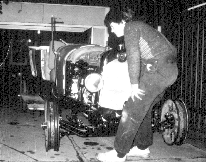
Now with all the broken parts replaced, the springs were then re-tempered; the chassis, axles and other relevant parts were re-bushed and sent to the sandblasters. The brakes were reconditioned, new Kingpins were made and the differential was cleaned, checked and reassembled. The whole lot was then painted with undercoat and reassembled to a rolling chassis. The chassis and other parts were then finally prepared and painted in black enamel. At this stage of the project, I really felt like I had finally achieved something by having a rolling chassis.
Also around this time, I had moved from a flat to the house while the car was moved from my mother's farm. This home was ideal for a car restoration, not only did I have a shed in the backyard, I also had a wonderful neighbour (John) who had an impressive collection of old English sports cars and lots of useful advice. Whenever my enthusiasm had waned
|
|
|
|
|
|