MEDICAL DELAYS |
| Far from providing any medical benefits, animal experiments have actually DELAYED medical progress... |
| ANATOMY Galen (131-201AD) related his experiments on pigs and apes to humans - stating that humans have a five-lobbed liver; a double bile duct; two uterine cavities (the right side for male, the left side for female foetus); an inter- maximillary bone in the skull between the two bones which form the upper jaw. Versalius (151-1564) dissected human cadavers, correcting Galen`s wrong theories. |
| BLOOD CIRCULATION: Galen proposed that blood ebbed and flowed like the tide, and passed thru invisible pores. Leonardo da Vinci (1452-1519) noted, from studies of human cadavers, that valves prevented blood changing course and returning to the heart by the same route. Servetus (in 1545), by studies of human cadavers, contradicted Galen`s theory that blood passed thru invisible pores. Fabricus (in 1579) studied human cadavers and described valves in the circulatory system. |
| CAUSES OF CANCER: Galen believed that an excess of black bile built up in the lips, breasts or tongue, causing cancer. Versalius (in 1540) studied human cadavers and, failing to find black bile, proved Galen was wrong. John Hunter (1728-93), an animal experimenter, thought that cancer tumours grew from coaguated lymph, constantly nourished by the host organism. Johannes Mueller (in 1838), by microscopic studies, established that cancer was not of coagulated lymph but was of cells. Rudolph Virchow (in 1858), an animal experimenter, wrote that cancer came from abnormal changes within cells, the abnormal cells then multiplied through division, so that cancers were the result of disturbances in the cellular division of the body. Theodor Klebs (in 1867) condemned Virchow`s theory, and suggested that most human cancers originate in eptheral tissue. Tumours originating in human epitheral tissue - for example, breasts, lungs, stomach - are known as carcinomas. |
| DIABETES: Galen reasoned that diabetes was a "weakness of the kidney which cannot hold back water". Thomas Cawley (in 1778) showed by autopsy studies that diabetes may result from damage to the pancreas. |
| POLIOMYELITIS: Flexner and Lewis (in 1910) experimented on rhesus monkeys, which led to the belief that blood vessels, lymph channels, and tiny nerves below the surface of the nasal mucosa and close to the brain were incriminated in the cause of polio. Harmon (in 1937) isolated poliovirus from the intestinal washings from five human polio patients. This led to Flexner`s "olfactory portal" tract theory giving way to acceptance of the understanding of "oral-alimentary tract" portal of entry of the poliovirus. |
| ARTERIAL SUTURING: Asman (in 1773) tried suturing experimentally-produced lacerations of small arteries in dogs and failed. Negative results in animal experiments led to abandonment of the arterial suturing for clinical use. Postempski (in 1886) undertook lateral suturing of a human, and described the procedure to the Italian Surgical Society. |
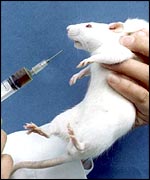
| HUMAN PSYCHOLOGY: B F Skinner (in 1938) developed a perspex box into which a small animal, such as a rat, could be placed and taught to press a lever for a "reward". If the animal failed to response, it did not receive the reward. Later, in a review of a book on the life of Skinner, the author wrote that "By his over-simplification, Skinner held back progress of human psychology for a generation". |
the law |
 |
animals or babies? |
Adverse Drug Reactions |
 |
| click on image for more information |
safety testing? |
alternatives to animal experiments? |
recommended reading and book reviews |
 |
news |
 |
statistics |
 |
recommended websites |
index |
 |
 |
|
 |
 |
 |
 |
 |
 |