. .
�Marine fisheries yield 80 to 90 million tons of fish and shellfish per year, 95 per cent of which is taken from waters under national jurisdiction.� (17.69)
"Problems extend beyond fisheries. Coral reefs and other marine and coastal habitats.........are critical resources for food, energy, tourism and economic development. In many parts of the world, such marine and coastal systems are under stress or are threatened from a variety of sources, both human and natural." (17.73)
�Adequate financial, scientific and technological cooperation should be provided to support action by [developing countries] to implement these objectives.� (17.76)
�States should ensure that marine living resources of the exclusive economic zone and other areas under national jurisdiction are conserved and managed in accordance with the provisions of the United Nations Convention on the Law of the Sea.� (17.77)
��Assess the potential of marine living resources, including underutilized or unutilized stocks and species, by developing inventories, where necessary, for their conservation and sustainable use.� (17.79)
��Enhance the productivity and utilization of their marine living resources for food and income.� (17.79)
��Expand multidisciplinary education, training and research on marine living resources, particularly in the social and economic sciences � (17.93)
��Develop research capacities for assessment of marine living resource populations and monitoring.� (17.94)
�Coastal States should explore the scope for expanding recreational and tourist activities based on marine living resources�� (17.94)
Agenda 21, Chapter 17, Section D
Sustainable Use and Conservation of Marine Living Resources Under National Jurisdiction
The primary concern of this section of Agenda 21 is fisheries as these are the major living resources that are exploited within a country's jurisdiction and Exclusive Economic Zone (EEZ). In some cases, areas of natural beauty under threat such as coral reefs and mangrove swamps are also considered. Particular emphasis is placed upon the protection of habitats in this section, so as to maintain their biodiversity and environmental functions. For example, the protection of mangrove forests from clearance will often lead to financial rewards such as the protection of fish spawning grounds that generally result in increased fish yields. Areas that have well preserved environments are generally major tourist attractions, which can be utilised for capital income and are often the main income of smaller countries' industries.
 They are an important source of food, accounting for approximately 20% of the world's protein intake.
They are of fundamental importance to many fishing communities that survive on the products of capture fisheries on a subsistence level. This is  particularly true of developing countries.
They produce large quantities of revenue on both the domestic and export market.
Global fisheries landings have increased massively in the last 50 years(see figure 1, below), rising from approximately 18 million tonne per annum in the 1950s to over 231 million tonnes per year by 1990. However since 1990 catches have levelled off, suggesting fisheries are being harvested at their maximum capacity.
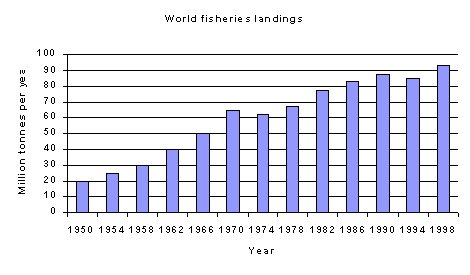
Source (FAO, 2000)
The understanding and management of sustainable levels of catch from traditional and currently unexploited stocks while maintaining a healthy environment is therefore a major concern in this section.
Mariculture: 'the growth of marine organisms normally harvested from the wild under natural conditions' is recommended as a method for the reduction of strain on wild stocks from fishing pressure.
However, the environmental implications of mariculture must be considered at a local level on a case-by-case basis; the release of food, waste products, pesticides and alien species or non local strains into the environment is undesirable and must therefore be considered at the planning stage.
Wastes of potential foodstuffs from the processing of the products from both capture fisheries and mariculture must be reduced. The implementation of this could ease global malnutrition levels and
should therefore be particularly scrutinized by developing nations.
An attempt to reduce fishing fleet capacities to that of approximately 30 years ago.
Calls for the protection of the marine environment as a whole, thus maintaining the presence of ecosystms which though not obviously of primary economic significance (like mangrove forests and sea grass beds) yet have secondary impacts as coastal protection and nursing grounds for fish as well as having intrinsic value.
Encouragement of the use of artisanal fishing methods and knowledge to allow sustainable fishing in traditional fishing grounds.
The promotion of the rights of fishermen who use these methods, particularly the right to subsistence by these means.
The discouragement of destructive fishing methods such as dynamite fishing which cause long-term damage to fishing grounds.
Commitment of Governments to a managerial role within their jurisdiction; applying the stipulations of the United Nations Law Of the Sea (UNCLOS) and the management of highly migratory species,
cetaceans and those fish stocks that straddle international jurisdictions.
Strengthening of legislation and institutional capacity to enforce these commitments.
With a reduction in fishing capacity a greater understanding of the population dynamics and stock management of these fisheries is suggested. Increased international cooperation
and the development of monitoring and analytical tools should be developed. Particular consideration should be paid to stocks that straddle jurisdictional boundaries and highly migratory
species. To this end cross jurisdiction and cross disciplinary education is suggested to maximise the understanding of the issues involved in these management and monitoring methods.
These measures could allow maximum sustainable extraction of resources from the environment with the minimum damage to that environment.