Agenda 21, Chapter 17, Section D
Sustainable Use and Conservation of Marine Living Resources Under National Jurisdiction
Christopher Lowe
Marine protected areas are a potentially strong tool for the protection of living resources, but there are obstacles to their success?
A marine protected are can be considered to be �any area of intertidal or subtidal terrain, together with its overlying water and associated flora, fauna, historical and cultural features, which has been reserved by law or other effective means to protect part or all of the enclosed environment� (IUCN resolution officially adopted at the Fourth World Wilderness Congress, 1987). In the context of Agenda 21 this means that a level of protection is afforded to the biological diversity of communities present within an MPA.
The regulations
In 1992 the signatory parties of the Oslo (dumping) and Paris (land-based pollution) conventions met in Paris to attempt an amalgamation of these two agreements. The outcome of this meeting was the OSPAR convention which though not in force until 1998 in practice replaced its parent agreements upon its signing. With its coming into power in 1998 a further annex was added to the agreement stating that habitats within the OSPAR region should be protected on an ecological basis rather than plainly on physical and chemical properties. As a result of this a goal of the OSPAR convention is to produce a set of interconnected MPAs within the OSPAR region to maintain ecological function.
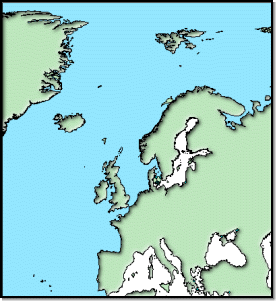
Source (OSPAR, 2001)
In the European Community a similar goal has been set up under the Habitats Directive (92/43/EEC), designating certain habitats under which MPAs should be designated. A mandatory duty of care is placed on the member state in which that habitat is found. Although this directive is somewhat terrestrially orientated, provision for marine habitats is made. Eight categories of habitats are set forward as requiring designation as Special Areas of Conservation (SACs) under the directive. Under the Directive, SACs are defined as �a site of Community importance designated by the Member States through a statutory, administrative and/or contractual act where the necessary conservation measures are applied for the maintenance or restoration, at a favourable conservation status, of the natural habitats and/or the populations of the species for which the site is designated�. At the time of publication of the directive, a number of coastal areas within the UK were designated as falling within these guidelines however no open sea areas were designated.
The habitats
In 1998 a vessel undertaking a survey of the seabed of the North Atlantic frontier for the Southampton Oceanography Centre (SOC) the British Geological Survey (BGS) and the Scottish Association of Marine Science (SAMS) found something surprising in the North of the Rockall trough; a series of deep water coral reefs constructed from the deep water colonial coral Lophelia pertusa. This species was known to be present in small numbers in British waters but the large aggregations with their associated biological communities were unique in this area. Though considered interesting form the point of view of ecologists for the biological diversity these presented, from the point of view of the European Commission they were considered of less import. The area where these were discovered were named the �Darwin Mounds� after the research vessel on which they were discovered. They lie in a region which was under dispute for oil exploration rights between the Faroe Islands the Great Britain and as such was at that time not open to threat from exploration due to the dispute and, if the area was found to be Faroes Island territory, not under the auspices of the EEC anyway.
Disputes
In 1999 the area was determined to be within the UK Economic Exclusive Zone (EEZ). With this designation the UK government began selling licences for the oil exploration of these sites to oil companies (the 19th Round). The government considered the Lophelia reefs to not be covered by the habitats directive which was considered to apply only out to the 12 nautical mile territorial water boundary.

The decision to grant oil exploration licensing within these areas caused uproar within environmental groups who considered that Lophelia reefs applied as habitats which were protected under the Habitats Directive (�Reefs�) and that the habitats directive should be enforced to the 200NM EEZ on the continental shelf and not only within territorial waters.
This cumulated in a court case with the environmental NGO Greenpeace taking on the UK government in court. In a landmark decision the Justice Maurice Kay ruled with Greenpeace, meaning that the UK government would have to protect the reefs from damage. However the licences provided to the oil companies for exploration still stand, thus exploratory drilling around the Darwin mounds is still planned.
So are MPAs a viable option for the protection of marine resources in the North Atlantic?
MPAs have been shown to be an effective method of maintaining and indeed increasing biodiversity and biomass in areas like New Zealand and the Caribbean, however in the North Atlantic with its large fishing and oil industries as well as the number of countries with a claim to areas if the North Atlantic this becomes more problematic. Although the environment movement can claim a victory with the ruling that the habitats directive has authority to the 200nm EEZ there are still major failings with the current system.
 Licensing was allowed to occur prior to the outcome of the dispute of the powers of the directive. This shows distinct lack of the �precautionary principle� much quoted in current environmental legislation.
  Environmental NGOs continue to lobby for the nullifying of the licences granted under the 19th round.
The status of a habitat as an SAC is precarious, provisions are allowed under the directive for the an SAC to be vetoed by member countries within the European community.
Fishing activity in the area around the Darwin mounds have been shown to be causing massive damage to the reefs, currently no regulations exist for their protection.
Marine Protected Areas should not be considered as a stand alone measure, indeed environmental policy continues to evolve; within the European Union a suite of measure exist to regulate mans impact on the North Atlantic, the water framework Directive (2000/60/EEC), the Dangerous Substances Directive (76/464/EEC) and the incoming EU chemicals strategy all serve to reduce the input of hazardous chemicals and nutrients to the environment, MARPOL, the EU Common Fisheries Policy and its upcoming review serve to control impacts from shipping and fishing vessels. Above this organisations like OSPAR, the North Sea conferences and the European Union act as frameworks for the administration of these regulations to a common goal. The designation of MPAs therefore fits into this framework as areas where these measures still apply and take this further to protect and enhance the biodiversity in these areas. Ultimately as policies evolve the goal is to manage the whole environment, but until such time as that is possible, protection for small areas maintains diversity in areas to in lieu of the loss of less protected habitats.
James Highfield
A destructive fishing practice (DFP) can be fined as an activity that results in direct damage to either the fished habitat or the primary structuring organisms in the fished habitat (e.g. scleractinian corals in a coral reef fishery) (Pet-Soede, 1997). These can include; blast-fishing, cyanide fishing, and inshore trawling.
Blast Fishing
Blast-fishing was first introduced by the Japanese during the Second World War and is now so common in some parts of East Asia that it can almost be considered a �traditional� fishing practice. The types of explosives used have progressed from dynamite from WWII munitions to homemade fertiliser and kerosene bombs that are thrown from the boat once a shoal of fish has been located. Once the bomb has exploded, the fishermen move in to collect those fish that have been killed or stunned by the shockwave that is caused. Schooling reef fish and small pelagic species are those which are targeted by these operations. This method of fishing, however, is highly indiscriminate and not only kills non-target species but also has devastating effects upon the coral reef itself. Branching, tabulate, and foliose hard corals are shattered whilst massive or columnar corals are fractured (Pet-Soede, 1997). The resultant coral rubble is less attractive to coral larvae and schooling reef fish and so sustained blast fishing on a particular reef can seriously reduce its fishery and therefore make it less profitable to the fishermen. This method of fishing is prevalent in Indonesia, even though it is illegal, as the financial benefits are very attractive with blast-fishers earning up to $150 a week; an amount greater than many government officials and ten times that of a labourer (Pet-Soede, 1997). These profits combined with the relative low population densities of the area make the fight against blast-fishing a difficult one. An economic analysis shows that not enforcing blast-fishing regulations is costing Indonesia US $200 million per year.
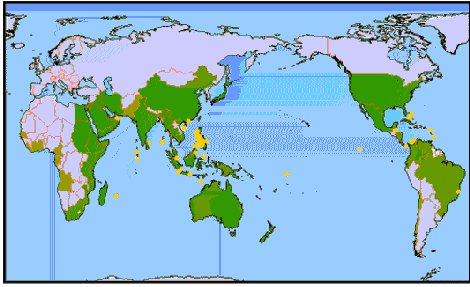
Fig.1 Selected reports of blast fishing. Increasing human densities along fringing reefs and limited reef resources leads to the increasing use of destructive fishing methods.
Cyanide Fishing
In 1995, it was estimated that the annual volume of the live reef food fish trade in Asia was between 20,000 and 25,000 metric tons (mostly groupers and large wrasses) with an estimated annual retail value of approximately $1 billion Cyanide has been used to catch live fish for the aquarium trade since the 1960s and is supported by a rapidly increasing demand in Hong Kong for live reef food fish along with a massive demand for aquarium fish in North America and Europe. This practice has increased dramatically with annual revenues being estimated at over US $1 billion. This method involves a diver, using hookah or free diving, spraying cyanide from a squirt bottle over the target fish consequently stunning them. The fish are then collected from the reef, often resulting in some structural damage to the coral. Many fish are often killed through �overdosing� on the cyanide used. This practice is also indiscriminate and results in the deaths of many non-target organisms including coral polyps. This practice is also very difficult to police due to the isolated nature of the fishing operations (cyanide fishers tend to fish pristine reefs away from centres of population) and the fact that it represents a massive billion-dollar industry. The fish, once caught, are transported to Hong Kong where they are sold but a large percentage often dies in transit, thus exacerbating the impact upon coral reef fisheries.
Overcoming The Problem
A number of measures have been implemented in order to combat the effects of destructive fisheries practices. The Indo-Pacific Destructive Fishing Reform Initiative (DFRI) is a partnership between the International Marinelife Alliance (IMA) and the World Resources Institute (WRI) that was launched in 1998 in order to provide information and assistance to those governments and NGOs that wish for aid in monitoring, managing, and policy-making for their own live reef fish industries. The East Asian Seas ICRI workshop in 1996 identified the main threats facing the south-east Asian coral reefs and recommended several actions to be taken in order to reduce these impacts. These are:
To encourage countries to develop and implement policies for the conservation and sustainable use of their coral reefs.
To promote co-ordination at regional and national levels.
To achieve awareness at all community levels on the issues of coral reef management and associated ecosystems.
Address rational resource use, social equity, access, and use issues in the sustainable use of coral reef ecosystems.
A recent ICRI workshop in May 2000 re-addressed these issues and identified the major actions that have remained unchanged since 1996. There were four outstanding actions identified from the 1996 workshop:
To stop cyanide fishing in the East Asian Seas region.
To implement programs to "Train-the-Trainers" to build capacity throughout the region to address the threats to coral reefs and related ecosystems.
To implement the regional priorities for MPA establishment and management as identified in the "Global Representative System of Marine Protected Areas (MPAs)" Report.
To support the development of a regional node for the Global Coral Reef Monitoring Network.
Future Management Options
In order to reduce the level of destructive fisheries practices in South-East Asia and their impacts upon coral reef ecosystems, a range of actions must be taken:
The demand for live reef fish for the aquarium and restaurant trades must be reduced either by lowering the prices paid for the fish or increasing the prices of the materials needed to catch the fish. By doing this, it will not be economically viable for the level of fishing at present to be sustained.
Education of the fishermen as to the impact their activities are having on the reef systems and the effects this damage will have on their livelihoods in the future through decreases in catches.
Promotion of the sustainable use of reef fisheries in order to allow these often subsistence fishermen to continue earning a living for themselves and their families.
Co-operation and co-ordination between governments to develop and implement effective policies that aim to reduce the use of destructive fishing practices and provide effective enforcement of these policies.
Promotion of marine tenure systems to encourage fisherman to protect their �own� reef systems through changing the view of coral reefs from exploitable resources to ones which need to be �husbanded� in order to promote sustainable use.
It is clear that only through education of the public to promote alternative methods of managing reef fisheries that the struggle to stop destructive fishing practices will be won.