. .
"Problems extend beyond fisheries. Coral reefs and other marine and coastal habitats��. are critical resources for food, energy, tourism and economic development. In many parts of the world, such marine and coastal systems are under stress or are threatened from a variety of sources, both human and natural." (17.72)
"Develop and increase the potential of marine living resources to meet human nutritional needs, as well as social, economic and development goals." (17.74)
Maintain or restore populations of marine species at levels that can produce the maximum sustainable yield as qualified by relevant environmental and economic factors, taking into consideration relationships among species." (17.74)
"Implement strategies for the sustainable use of marine living resources." (17.79)
"Coastal States should explore the scope for expanding recreational and tourist activities based on marine living resources, including those for providing alternative sources of income. Such activities should be compatible with conservation and sustainable development policies and plans." (17.80)
Agenda 21, Chapter 17, Section D
Sustainable Use and Conservation of Marine Living Resources Under National Jurisdiction
 The fight to save fish stocks is far from over; the objectives set out in this section have largely been unfulfilled.
However there is a growing realisation that our fisheries are in danger. In the North Sea around Britain, catches of cod have dropped by almost 75%  since the late 1980s and fishermen are worried as they are now only able to catch approximately 60% of their already reduced cod quota.
As more fish stocks are over exploited and areas are protected from fishing, the number of people who are able to make a living from fishing is likely to decline.
Many people continue working in marine environment through eco-tourism.
Several countries now rely on the money from overseas that is brought by tourists.
Analysis of tracks left behind by trawling activity in the North Sea demonstrated that on average the entire sea floor of the North sea is disturbed by having heavy fishing trawls dragged over it up to seven times each year. However this fishing effort is patchy so many areas may be completely untrawled while others are disturbed several times a year.
In some cases this is thought to maintain the community present which has developed along side this disturbance.
Increased deep water trawling has resulted in the fishing of areas not previously targeted, applying new pressure on the sea bed communities.
Areas which are afforded some or total protection from fishing and other activities are becoming increasingly used as a tool to counter these effects. These Marine Protected Areas (MPAs) (See Case Study) have been called for in Europe under the OSPAR (1992) convention and the European Habitats Directive (92/43/EEC).
MPAs have been employed successfully in New Zealand and Australia to protect and enhance fisheries. In the North sea they are used as a fisheries management tool to increase spawning success. In Island countries MPAs can be set up as methods of protecting areas with potential for exploitation as tourist attractions.
At the time of the Rio summit eco-tourism was still in its infancy and this is reflected in the text of the Agenda 21 document.
Most of the relevant paragraphs refer to encouraging development of this industry with little or no reference to the resulting environmental consequences (see "Agenda 21" box).
However new pressures have emerged as tourism has become more prevalent; ranging from increases in waste loads on the environment from increasing visitor numbers, to the direct damage of the habitats that the tourists have come to visit.
Fisheries management is still the major issue that is associated with the sea�s living resources.
Globally, fisheries supply more revenue than tourism and more people live on this income, or the fish themselves.
The overcapacity of fishing fleets for the stocks they target continues to be the major cause for concern; rapid increase in technological development such as sonar equipment, bathymetry data and Global Positioning Systems (GPS) means that a smaller number of vessels are able to target and extract fish stocks with unprecedented efficiency.
This technology also means that fleets are able to target stocks in areas that were previously closed to them due to constraints on fishing gear.
Management targets have tended to become less idealistic and incorporate more of the perceptions of the fishing community and ecological uncertainties as well as economic principles.
The maximum sustainable yield is no longer considered a realistic goal. This relies on the reduction in the capture rate of fishermen so as to maximise the future capture rate and viability of the stock.
There is considerable resistance from the fishing community to do this, due to uncertainty in the long-term future of the fishing industry and a general lack of faith in the reality of these future increases.
The natural thing to do therefore is maximise the exploitation of stocks in the short term to maximise profits from the stock while it is still possible.
An eco-tourism driven economy dictates that the environment is managed on an ecosystem level as well as sustainable management of specific fish stocks.
With management preserving the ecosystem for the purposes of generating revenue, a less extensive fishing fleet should be sustainable.
The economic dependency of the community would thus be diversified and the economy would therefore become more stable.
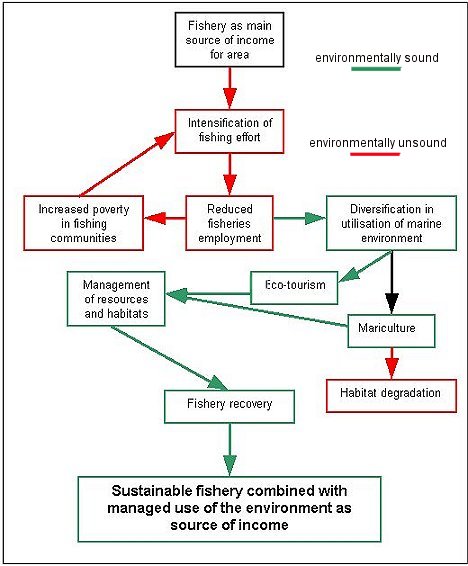
A simple model of how diversifying the exploitation of the marine environment can lead to economic stability.
Although the objectives set out in this section have enjoyed a degree of success, they remain largely unfulfilled. Efforts have been made to promote the recovery of coastal fish stocks through such methods as closed seasons, no-take fishing zones, permits, and so on. While this is in reality a good start, it is clear that the existing management schemes in place to monitor and conserve fisheries still need a degree of modification if they are to allow this dwindling resource to recover in order to provide future generations with food.
Unfortunately, as fish stocks are increasingly over-exploited there will be less people who are able to make a living from them and so the numbers of people working in the fishing industry will continue to decrease until a level of fishing effort is reached that can sustainably fish the stocks while they recover.
From the examples mentioned, the prevailing attitude is that by educating people to the damage they are causing and what they can do to help alleviate this problem, then the fight to conserve fisheries and maintain fishing in society will be easier. These actions combined with the setting up of marine reserves and passing legislation to limit the number of fish caught, will hopefully bring success in the future.
It is through education, for example, that the legislative authorities of the South-East Asian seas are hoping to reduce the use of destructive fisheries practices such as blast fishing and cyanide fishing. By creating regulations banning the use of these practices, they have made a start from which they can continue by educating the native people as to the damage they are causing and the future economic consequences they will face as a result.
As a result of the dwindling fish stocks, many coastal populations are switching to tourism as a means of providing income and, in fact, many places that have traditionally fished as a way of life now earn more income from tourism. This rapid increase in tourism is not without it�s detrimental effects and urban sprawl is now a problem in many coastal regions. This changing attitude of seeing the marine environment as a tourist magnet rather than an exploitable resource is allowing many conservation schemes to be set up in order to help maintain the benefits gained from tourism.
As this attitude becomes increasingly prevalent, it seems that a greater emphasis should be placed upon protecting and preserving whole ecosystems as we are staring to appreciate their value in supporting fish stocks through providing food, nursery and breeding grounds, and shelter. The pressure to allow fish stocks to recover is one that should be maintained in order to allow the tradition of exploiting marine resources to continue.
So, what needs to be done in the future in order to attempt to meet the objectives set out in this section?
Effective management of fish stocks needs to be implemented in order to exploit them sustainably.
Habitats important to the maintenance of fish stocks need to be conserved.
Destructive fisheries practices need to be stopped as they have a devastating effect on many important reef habitats and the knock-on effects of this damage to fish stocks needs to be studied.
The use of selective fishing gear needs to have a greater amount of legislative power behind it in order for it to work effectively but care must be taken to prevent a repeat of the East Tropical Pacific tuna incident.
International co-operation is needed to implement global fisheries conservation schemes to allow for the continuation of the fishing industry as a way of life.
In conclusion, agenda 21 has prompted a number of management schemes and conservation measures to be implemented in the ten years since it was drafted but it is evident that this is just a beginning and a great deal more effort needs to be put in if the objectives set out in the document are to be met.