
Bahrain has been ruled since 1782 by the Al Khalifa dynasty, generally in succession of father to son. From the time of Shaikh Isa bin Ali Al Khalifa, who ruled from 1869 to 1923, the title of 'Ruler' or 'The Shaikh' was generally accorded. The first Ruler to take the title of Amir was Shaikh Isa's great grandson, Isa bin Salman Al Khalifa, the father of His Majesty Shaikh Hamad bin Isa Al Khalifa, the King of Bahrain.
Shaikh Isa became ruler on the death of Shaikh Salman in 1961 and spent the first ten years of his rule preparing Bahrain for indpendent statehood. The historic declaration of independence came on August 14th 1971, with Shaikh Isa taking the title Amir.
The first National Day celebrations were held on December 16, 1971 the date of Amir's accession in 1961.
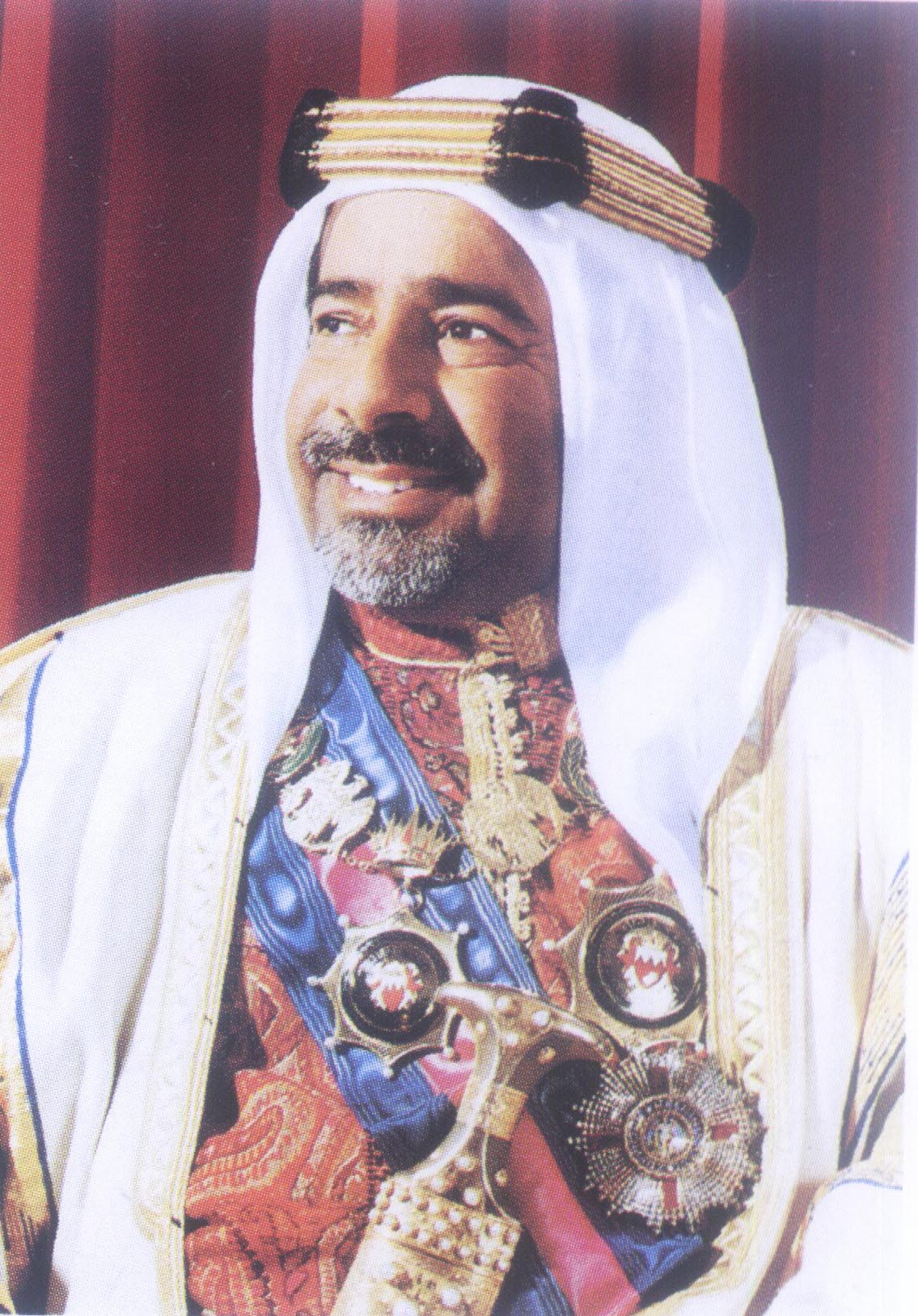
Achievements of Bahrain under the rule of Shaikh Isa:
 The causeway linking Bahrain to Saudi Arabia was opened in 1986.
 Gulf Daily News starts publications on March 21,
1978.
Gulf Daily News starts publications on March 21,
1978.
Al Areen Wildlife Santuary near Zallaq is set to
open in 1979.
The first phase of BDF Hospital is opened in
West Riffa in 1979.
The new National Museum Complex was opened in 1989.
Beit Al Quran - the House of Quran opens in
1990.
The new Manama-Muharraq crossing was opened by
H.H the Amir Shaikh Isa in
1997.
His Majesty Shaikh bin Isa Al Khalifa became the ruler of Bahrain in 1999 after the death of his father, Late Shaikh Isa bin Salman Al Khalifa.
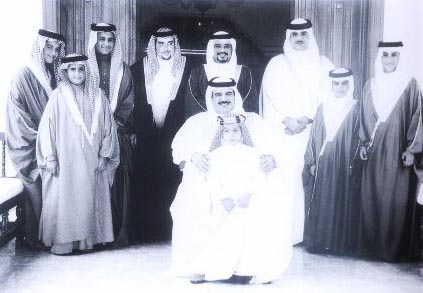
His Majesty the King Shaikh Hamad bin Isa Al Khalifa with his sons and grandsons
The
earliest recorded reference to Bahrain dates back to the third millennium BC,
when it was known as Dilmun.
Recent
excavation have revealed the existence of a very organised lifestyle, with well
ordered roads, proper houses, workshops and a central marketplace.
Equally
significant is the discovery of thousands of burial mounds, each covering a
stone built chamber which formed the grave. It is believed that at one time
there were more than 150,000 burial mounds.
The
era has also been chronicled in the Epic of Gilgamesh, who called Dilmun the
land of immortality when he visited it in his quest for eternal life.
With
its lush vegetation and abundant fresh water springs, not to speak of its ideal
location between Mesopotamia and the Indian subcontinent, Dilmun became a
popular haven on the sea trade route.
The
good times were not to last; between 1800 and 1600 BC, Aryan forces invaded and
destroyed the cities of the Indus Valley civilisation, bringing trade to a halt.
For
a long period thereafter Bahrain remained isolated, forced to depend on its own
resources. It would not be until the early first millennium that Bahrain would
flourish again, as part of the Assyrian Empire. Bahrain became an important
pearling and fishing port, but the high quality and abundance of pearls in its
waters attracted some unwelcome attention.
Tylos:
By 600 BC, Bahrain was drawn into the expanding Babylonian empire. The Greeks,
who called the island Tylos, soon began settling in Bahrain.
Trade
began to play an important part with the fall of Babylonia to the Persians - who
now controlled much of the region between India and the Mediterranean - and by
323 BC, Bahrain regained its independence.
There
followed a period of relative calm, up until the 15th century when the Europeans
began exploring new sea trade routes.
Awal:
Bahrain was also known as Awal during the pre-Islamic era. The name is
associated with a pagan idol worshipped by the Wael tribe who lived in Bahrain
at that time.
Bahrain:
The islands first became known as Bahrain in the early Islamic era, when the
name was used for the entire region stretching from Basra (Iraq) in the north to
Oman in the south. By the early 1500's, the Portuguese saw Bahrain as a key
point to protect their trade routes between India, Africa and Europe.
They
invaded the island and set up military base at the Bahrain Fort. The fort, which
ironically had been used by the people of Bahrain to defend themselves against
the Portuguese, was strengthened and new stone towers erected. Right up until
today, the Bahrain Fort is widely known as the Portuguese Fort.
The
Portuguese were however unable to protect the islands, which fell to the
Persians in 1603. Then came a long period of turmoil, with Bahrain changing
hands between the warring Persians and Arabs until it was finally conquered in
1783 by Shaikh Ahmed bin Mohammed Al Khalifa. known as Al Fateh, the conqueror,
who ushered the new era.
