
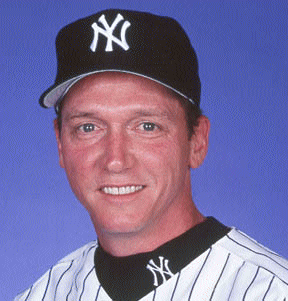
 David
Brian Cone was born on January 2, 1963 in Kansas City, MO.
He is the youngest of Ed and Joan Cone’s four children. Like all great athletes, David submerged himself
into sports at a young age. He played in
Little League where his father was the coach, and even though then David was just a boy of
seven or eight, one could see the passionate fire of the Cone bloodline kindling within
his little heart. This fire dates back at
least two generations if not more, with David’s grandfather Edwin Cone who was in
charge of a chain of hotels in Kansas City, and who apparently had the reputation of
owning the streets as well. The torch was
then passed on to his son, Ed Cone, who also had a street-fighter reputation. So call it genetics or a sort of divine right, but
David was destined to have this same fire, and it wasn’t long before the fire was
ignited…
David
Brian Cone was born on January 2, 1963 in Kansas City, MO.
He is the youngest of Ed and Joan Cone’s four children. Like all great athletes, David submerged himself
into sports at a young age. He played in
Little League where his father was the coach, and even though then David was just a boy of
seven or eight, one could see the passionate fire of the Cone bloodline kindling within
his little heart. This fire dates back at
least two generations if not more, with David’s grandfather Edwin Cone who was in
charge of a chain of hotels in Kansas City, and who apparently had the reputation of
owning the streets as well. The torch was
then passed on to his son, Ed Cone, who also had a street-fighter reputation. So call it genetics or a sort of divine right, but
David was destined to have this same fire, and it wasn’t long before the fire was
ignited…
David attended Rockhurst High
where he played quarterback, and he led his team to the district championships. He was also the main focus of talent on the
basketball team as a point guard with a beautiful, natural shot. During one game he was forced to unleash that
family fire when a guy from the opposing team threw the ball against his chest. David wasn’t about to put up with that, so he
took the ball and threw it right back in the guy’s face! By that time the crowd had gone wild, but David
refused to ever give in, for that fire of his just wouldn’t let him…
 Since his high
school didn’t have a baseball team, David proceeded to play during the summer in the
Ban Johnson League. At the age of 15 he was
already showing signs of an amazing, talented arm, and by the age of 16 he found himself
at open tryouts for the Cardinals and an invitation-only tryout for the Royals. He was making scouts raise their eyebrows at his
phenomenal arm, for only at the age of 17 was he throwing balls at 88 mph! By this time many colleges wanted David for his
football and baseball talents, but he ended up enrolling at Missouri State, enticed by a
letter written to him from Ewing Kauffman. In
June of 1981, at the age of 18, the Royals selected him in the third round of the
free-agent draft. That year he played rookie
ball, then proceeded on to A ball, but in March of 1983 he collided with a runner trying
to score from third at home plate. The
collision resulted in some torn cartilage in his left knee, and he had to give the year up
to surgery and rehab. David also found
himself working at a company that produced conveyor belts in Kansas City in his time off
from baseball. Always a bright-eyed dreamer
who dared not let the fire inside of him falter, he fantasized his return to baseball. For he knew that baseball was his destiny…
Since his high
school didn’t have a baseball team, David proceeded to play during the summer in the
Ban Johnson League. At the age of 15 he was
already showing signs of an amazing, talented arm, and by the age of 16 he found himself
at open tryouts for the Cardinals and an invitation-only tryout for the Royals. He was making scouts raise their eyebrows at his
phenomenal arm, for only at the age of 17 was he throwing balls at 88 mph! By this time many colleges wanted David for his
football and baseball talents, but he ended up enrolling at Missouri State, enticed by a
letter written to him from Ewing Kauffman. In
June of 1981, at the age of 18, the Royals selected him in the third round of the
free-agent draft. That year he played rookie
ball, then proceeded on to A ball, but in March of 1983 he collided with a runner trying
to score from third at home plate. The
collision resulted in some torn cartilage in his left knee, and he had to give the year up
to surgery and rehab. David also found
himself working at a company that produced conveyor belts in Kansas City in his time off
from baseball. Always a bright-eyed dreamer
who dared not let the fire inside of him falter, he fantasized his return to baseball. For he knew that baseball was his destiny…
 Well, in March of
1987 David was shipped off to the New York Mets in a trade for two pitchers and a catcher
named Ed Hearn. Kansas City would later
regret such a trade, for David went 20-3 in 1988 and finished third in the Cy Young Award
voting. Despite the magic he had displayed,
David was at first crushed by this transaction but he soon learned to embrace New York in
all its grandeur. He surrounded himself with
culture as he attended Broadway shows and perused the elegant art galleries. Then in 1988, the boy who enjoyed journalism in
school was even given a column in the New York Daily
News. He resided in an apartment in
Queens, and even though he wasn’t going to live there again, he kept it as sort of a
good luck charm. That was just another
textbook characteristic of the bright-eyed dreamer…
Well, in March of
1987 David was shipped off to the New York Mets in a trade for two pitchers and a catcher
named Ed Hearn. Kansas City would later
regret such a trade, for David went 20-3 in 1988 and finished third in the Cy Young Award
voting. Despite the magic he had displayed,
David was at first crushed by this transaction but he soon learned to embrace New York in
all its grandeur. He surrounded himself with
culture as he attended Broadway shows and perused the elegant art galleries. Then in 1988, the boy who enjoyed journalism in
school was even given a column in the New York Daily
News. He resided in an apartment in
Queens, and even though he wasn’t going to live there again, he kept it as sort of a
good luck charm. That was just another
textbook characteristic of the bright-eyed dreamer…
 Feeling pretty
pressured to pitch well for Toronto, he did just that as he won four games for them and
helped them win the World Series. So
needless to say Toronto and arguably the whole country of Canada loved this “hired
gun.” His tainted past didn’t haunt
his reputation anymore as every ballclub was enticed by what he had to offer
professionally. At the end of the ’92
season he became a free-agent, and he didn’t want to rule out any options…not
even his hometown Royals. For it was the
Royals who won him over with an $18 million 3-year contract, but they also offered
something no other ballclub could offer--the chance to come back home…
Feeling pretty
pressured to pitch well for Toronto, he did just that as he won four games for them and
helped them win the World Series. So
needless to say Toronto and arguably the whole country of Canada loved this “hired
gun.” His tainted past didn’t haunt
his reputation anymore as every ballclub was enticed by what he had to offer
professionally. At the end of the ’92
season he became a free-agent, and he didn’t want to rule out any options…not
even his hometown Royals. For it was the
Royals who won him over with an $18 million 3-year contract, but they also offered
something no other ballclub could offer--the chance to come back home…
So back to Kansas
City David went in 1993, and upon his return he decided to purchase Bret Saberhagen’s
old house. For Bret had won two Cy Young
awards while residing there, so David bought it in the hopes of finding another one
drifting around in it somewhere. As
superstitious and far-fetched as that may sound, his dreaming was not in vain as he
himself picked up the Cy Young award in 1994. Despite
not being a league leader in any category that season, it was still a successful one as he
went 16-5 with a 2.94 ERA. Finally content
again in his hometown, the bright-eyed dreamer had a new goal in mind—to pitch in the
World Series for his hometown team. Unfortunately,
that dream was put to rest in April of 1995 when the Royals decided to trade him again,
this time back to the Blue Jays. Their
purpose in doing such was to trim their payroll, and by unloading David they subtracted $5
million from it. They claimed they were also
uncertain on whether they would be able to re-sign him at the end of the season, and that
his union activities had nothing to do with the trade.
So then the “hired-gun” voyaged back to Toronto where he pitched for only
a little over four months, until he was traded yet again.
However, this trade finally led him to his destiny, for what better choice of a
ballclub does a dedicated bright-eyed dreamer who cherishes baseball history belong other
than that of the New York Yankees…
 Traded to New York
on July 28, 1995, David made his Yankee debut the very next day in Minnesota and won 4-2. He won his next three starts thereafter, making
that his longest winning streak of the season. He
passed more milestones along the way, such as pitching and winning his 50th
complete game and his 40th ten-plus strikeout game. He became a free-agent at the end of the ’95
season and decided to sign a three year contract including two option years with the
Yankees. Also near the end of the year,
David got married to Lynn, his girlfriend of eight years.
Traded to New York
on July 28, 1995, David made his Yankee debut the very next day in Minnesota and won 4-2. He won his next three starts thereafter, making
that his longest winning streak of the season. He
passed more milestones along the way, such as pitching and winning his 50th
complete game and his 40th ten-plus strikeout game. He became a free-agent at the end of the ’95
season and decided to sign a three year contract including two option years with the
Yankees. Also near the end of the year,
David got married to Lynn, his girlfriend of eight years.
Despite all the obstacles
throughout his career, David never allowed his competitive flame to falter. In 1997, he went 12-6 with a 2.82 ERA in 29
starts. He continued to nest his place within
the Yankee lore by ranking third highest ever in strikeouts (222) for a Yankee, and
establishing the Yankees all-time, single-game strikeout record for a right-hander with 16
on June 23 in Detroit, making it the second highest strikeout total in franchise history. He also became the 48th pitcher in Major-League
history to record 2,000 strikeouts on July 28 in Oakland.
However he was placed on the 15 day disabled list on August 19 due to mild
tendinitis in his right shoulder. He returned
on September 20 vs. Toronto and received a no decision, but in his next start against
Cleveland on September 25 he pitched 5 hitless innings also receiving a no decision in a
5-4 Yankees win. He started Game 1 of the Division Series vs. Cleveland, but then did not
pitch for the rest of the post season. Then
on October 17, David underwent successful arthroscopic surgery on his right shoulder,
removing inflamed bursal tissue as well as minimal frayed labral and rotator cuff tissue. Once again the surgery took place at Columbia
Presbyterian Medical Center and was performed by Dr. Stuart Hershon and Dr. Louis
Bigliani. Also in ’97 David became the
first recipient of both the “Team Valor Award” and the “Children’s
Award.” The “Team Valor Award”
is given out by the Mickey Mantle Foundation to athletes who best illustrate Mantle’s
spirit and courage, while the “Children’s Award” is presented by the Marty
Lyon’s Foundation to those whose accomplishments off the field touch the lives of
children.
 Still burning
stronger than ever, David came back in 1998 and experienced one of his best seasons ever
as he went 20-7 with a 3.55 ERA in 31 starts. He
tied his career high in wins with his 20-3 record in 1988 with the Mets, and established
the longest stretch between 20 game wins in the Major Leagues. He struck out ten or more batters nine times,
where three of those were without issuing one walk, and three were straight starts. He was
named the American League's Pitcher of the Month for July, going 4-1 with a 0.69 ERA in 5
games allowing only three earned runs in 39 innings.
On June 3 he missed his start against Tampa Bay after sustaining a dog bite on his
right index finger from his mother's Jack Russell terrier, and it was Orlando Hernandez
who debuted in his place. He pitched 5
innings in game 3 of the World Series against San Diego, and the Yankees came from behind
and won 5-4. The Yankees went on to win the
’98 World Series.
Still burning
stronger than ever, David came back in 1998 and experienced one of his best seasons ever
as he went 20-7 with a 3.55 ERA in 31 starts. He
tied his career high in wins with his 20-3 record in 1988 with the Mets, and established
the longest stretch between 20 game wins in the Major Leagues. He struck out ten or more batters nine times,
where three of those were without issuing one walk, and three were straight starts. He was
named the American League's Pitcher of the Month for July, going 4-1 with a 0.69 ERA in 5
games allowing only three earned runs in 39 innings.
On June 3 he missed his start against Tampa Bay after sustaining a dog bite on his
right index finger from his mother's Jack Russell terrier, and it was Orlando Hernandez
who debuted in his place. He pitched 5
innings in game 3 of the World Series against San Diego, and the Yankees came from behind
and won 5-4. The Yankees went on to win the
’98 World Series.
In 1999, David went 12-9 with a
3.44 ERA, second best in the American League behind Pedro Martinez. Highlights of this year included winning game 2 of
the ALCS against Boston and game 2 of the World Series in Atlanta, along with receiving
the Hutch Award in February for his on-field accomplishments, community service, and
return from adversity. However, the most
memorable and historic event that marked David’s 1999 season happened on July 18 when
he pitched a perfect game against the Montreal Expos in Yankee Stadium. It was the 16th perfect game in all of
Major League history, and the third by a Yankee pitcher.
And not that that in and of itself isn’t something purely timeless and
magical, but he did it on Yogi Berra Day, with Don Larsen throwing out the first pitch to
Berra to start the game. Larsen is the only
pitcher in history to have thrown a perfect game in the World Series, and Berra was his
catcher. Also, July 18 just happens to be Joe
Torre’s birthday, and a baseball manager can’t really ask for more as a gift
than a perfect game from one of his own great pitchers….
 As the season came to a close, David became very emotional as
he wondered if this would be his last year in pinstripes.
He had finally found his home and he surely didn’t want to leave, but his
contract was up and he really wasn’t sure what was going to happen to him upon
entering free-agency all over again. Ideally,
he was seeking a two year contract from the Yankees, but they just were not prepared to
offer that due to his age and the never ending question marks that surround his sacred
arm. So nobody made any moves—not David
because he was looking for his two years, not the Yankees because they just wanted to
contract for one, and while other teams may have been interested, none pursued David
seriously because they all knew he wanted to remain a Yankee. These other teams, rumored to have been the Mets
and the Indians, were not prepared to negotiate with David until he cut off his
negotiations with the Yankees. However that
just was not going to happen and on December 6 they agreed on a one-year $12 million
contract, which made both sides happy. For
the Yankees kept one of their greatest pitchers and spiritual clubhouse leaders, and David
was able to remain where he belongs in New York, as a Yankee.
As the season came to a close, David became very emotional as
he wondered if this would be his last year in pinstripes.
He had finally found his home and he surely didn’t want to leave, but his
contract was up and he really wasn’t sure what was going to happen to him upon
entering free-agency all over again. Ideally,
he was seeking a two year contract from the Yankees, but they just were not prepared to
offer that due to his age and the never ending question marks that surround his sacred
arm. So nobody made any moves—not David
because he was looking for his two years, not the Yankees because they just wanted to
contract for one, and while other teams may have been interested, none pursued David
seriously because they all knew he wanted to remain a Yankee. These other teams, rumored to have been the Mets
and the Indians, were not prepared to negotiate with David until he cut off his
negotiations with the Yankees. However that
just was not going to happen and on December 6 they agreed on a one-year $12 million
contract, which made both sides happy. For
the Yankees kept one of their greatest pitchers and spiritual clubhouse leaders, and David
was able to remain where he belongs in New York, as a Yankee.
Unfortunately, the 2000 season wasn't the kindest to David, as he endured the worst season of his career. He went 4-14 with a 6.91 ERA and broke his old records of career-high losing and winless streaks. His first win of the season came on April 28 against Toronto, then his second win came on August 10 against the Oakland A's while his father was watching him in the stands. David tried everything during his dry spell...he tried a swinging-arm motion before delivery to help his rhythm, he stood on different sides of the rubber, he even wore his socks up to his knees "El-Duque" style for a game...but nothing seemed to help. After his loss against the Minnesota Twins on July 27, the Yankees sent David down to Tampa to work with their pitching expert Billy Connors. The hiatus seemed to help a lot, as David recorded those next 3 wins in August. Things seemed to finally be turning around for him until the Yankees went to Kansas City for a series against the Royals. In his own hometown David didn't have much of a chance to start when he dislocated his left shoulder on September 5 trying to field a popped up ball in the third inning of the game. At St. Luke's hospital the next day, an MRI examinatioin revealed normal bruising consistent with dislocating a shoulder and no abnormalities. Many thought this would be the end of his season, but David missed only one start in his rotation and came back on September 15 against Cleveland. Unfortunately, he wouldn't record another win for the rest of the season, but he still showed just enough of that magical talent that Torre couldn't give up on him. He made his first relief appearance as a Yankee, and for the 30th time in his career, on September 25 against Detroit. Come post-season time David knew his role would be questionable, and he remained with the team as a reliever with no quarrels. A big relief appearance for him was in Game 4 of the World Series against the Mets. In his last performance as a Yankee, he successfully got Mike Piazza to pop out to shallow right center as the Yankees won 3-2 and proceeded on to take the Series.
After the World Series, David had gone free-agent and most of the baseball world was wondering whether he would remain a Yankee. The sentimental words he uttered during the victory parade basically foreshadowed what was to follow. The Yankees were rumored to have made David a somewhat shallow offer with a one-year contract worth $500,000 plus undefined incentives to be the Yankees' possible 5th starter. David was looking for more than a 5th starting position, so on December 7, the night of the arbitration deadline, he and the Yankees mutually agreed to go their seperate ways. Once the rest of Major League Baseball saw that he and the Yankees were no more, other teams emerged with their interests. David was counting on an offer from the Mets who would have been a fine fit for him. After all the Mets was where it all began and he could have stayed right in New York, but the offer never came. So David continued to work out in Tampa, determined to right every wrong that occured last season. Several teams were rumored to be interested: the Red Sox, the Giants, the A's, the Rangers, and the Royals. The Royals were mostly interested in turning David into a closer, an idea that intrigued him but a role he would only play for the Royals. However, David is just 16 wins away from the 200 mark, and in his eyes that is just too close to quit now. So if he had the chance to remain a starter, that would be the road he would choose. The Rangers were very persistent in their courting, their newly-acquired Alex Rodriguez even called a few times to try and convince David to come to Texas, and for awhile it really seemed that would be the direction he would go. So it was quite a shock to arguably just about everybody when it was announced on January 11 that David had signed a contract with the Boston Red Sox. To many the contract seemed shaky, it would be guaranteed only if he were to make the team during Spring Training, and if cut, the Red Sox would only owe him termination pay. However, if he does make the team, which the Red Sox seem quite confident that he will, he could very well be their new #2 starter behind Pedro Martinez and earn a salary between $1-2 million. Though somewhere between all of this new drama, time was still found to award David and his big heart with the Joan Payson award for helping out charities.
 Now the 2001 season awaits David with new challenges in a new home.
His fire is still burning brighter than ever, just daring someone to agitate it. Many
winds and storms have tried to kill his flame throughout the course of time, but the fire
will continue to burn strong. And while that
flame may shiver in the breeze or become dim in the darkness, it will never burn
out…for the flame that lies within David Cone will forever burn eternal.
Now the 2001 season awaits David with new challenges in a new home.
His fire is still burning brighter than ever, just daring someone to agitate it. Many
winds and storms have tried to kill his flame throughout the course of time, but the fire
will continue to burn strong. And while that
flame may shiver in the breeze or become dim in the darkness, it will never burn
out…for the flame that lies within David Cone will forever burn eternal.
--Written by KC the Webmaster
All information was gathered from the article written by
John Ed Bradley in the April 5, 1993 edition of Sports Illustrated, and Yankees.com.
Home Biography Pictures Career Stats Charities The Perfect Game
Various Articles Other Links Coney's Court Contributors E-mail the Webmaster