| | Index 9 | | DEWs | | Space | | Lasers | | Scalar | | Microwaves | | Antennas | | Verse | | PDFs | | EMF | | Exit |

 |
.: SPACE WARFARE :. Space warfare is a combat that takes place in outer space. The scope of space warfaretherefore includes ground-to-space warfare, such as attacking satellites from theearth, as well as space-to-space warfare, such as satellites attacking satellites. In the early 1960s the US military produced a film called Space and NationalSecurity which depicted space warfare. |
|
From 1985 to 2002 there was a United States Space Command, which in 2002merged with the United States Strategic Command, leaving Air Force Space Com-mand as the primary American military space force. The Russian Space Force,established on August 10, 1992, which became an independent section of theRussian military on June 1, 2001, was replaced by the Russian Aerospace DefenseForces starting December 1, 2011, but was reestablished as a component of theRussian Aerospace Forces on August 1, 2015. Only a few incidents of space warfare have occurred in world history, and all involved training missions, as opposed to actions against real opposing forces. In1985 a USAF pilot in an F-15 (see Fig. 1.19) successfully shot down the P78-1, anAmerican research satellite, in a 345-mile (555 km) orbit. In 2007 China used a missile system to destroy one of its obsolete satellites (see2007 Chinese anti-satellite missile test), and in 2008 the United States similarlydestroyed its malfunctioning satellite USA-193. As of 2018 there have been nohuman casualties resulting from conflict in space.International treaties are in place that regulate conflicts in space and limit theinstallation of space weapon systems, especially nuclear weapons. Space-Based Laser (SBL)
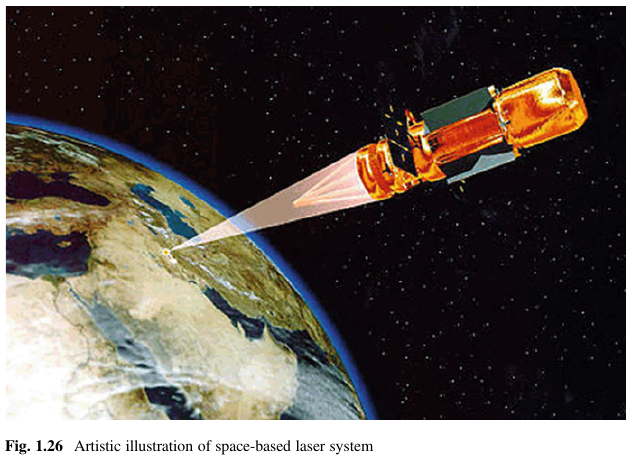
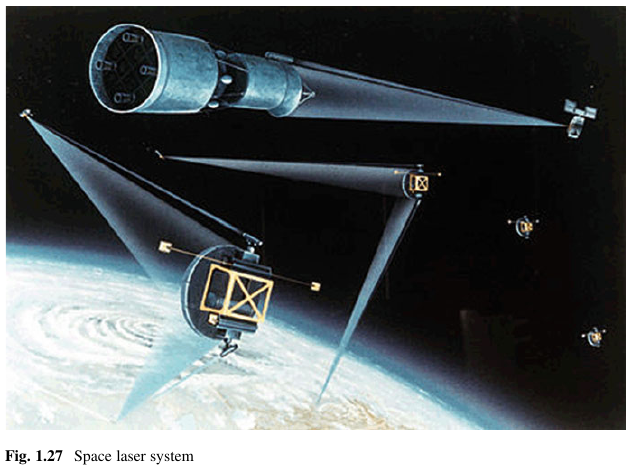
Figure 1.26 is an artistic illustration of light amplification by the stimulated emissionof radiation (LASER) pump energy into molecules, creating an electronic state thatreleases energy in the form of photons. The photons pass by other molecules,spreading energy, making more photons. To make an actual laser, a beam has topass through mass quantities of laser medium by bouncing back and forth betweenmirrors placed at opposing ends. Then the light beam exits through one of themirrors which is more transparent than the other. Making a functional laser requiresthe electrons to not only reach their excited state but also be reliant on the time ittakes for them to get excited, and also the time for the energy created to reach newelectrons. The efficiency of the laser relies on the amount of heat that exits. In termsof lasers, the power of the laser far outweighs the chemical efficiency. Of course, the trajectory of the laser matters as well as its ability to hit the target it is aimed at, but when lasers are placed in space diffraction can cause interference [14]. “Waiting until an adversary is in midcourse [phase of flight] is giving theadversary a free pass to launch,” Michael Griffin, the undersecretary of defense forresearch and engineering, told reporters during a media roundtable at the Space andMissile Defense Symposium. ................... Aug 14, 2018—Space-based laser weapons could ultimately take out missilethreats in boost phase. Congress says that Pentagon must come up with boost-phasemissile defense plan next year. DoD Presses On In Pursuit of Laser Weapons.Coming in 2021: A laser weapon for fighter jets. Lethality of Space Lasers As illustrated in Fig. 1.27 an artistic of space lasers requires mirrors in the system todirect their beams to achieve impact, but if not done correctly major damage canaffect the skin. However, if the laser or lasers do make impact, “a 10 m mirror with a HF laser beam would yield a 0.32 micro-radian divergence angle andcreate a laser spot 1.3 m in diameter at a range of 4000 m. The distribution of the 20 MWover the laser spot would create an energy flux of 1.5 kilowatts per square centimeter(kW/cm 2). The laser spot would need to dwell on the target for 6.6 s to create the nominallethal fluence of 10 kilojoules per square centimeter (kJ/cm2)” meaning that the laser would essentially blow holes into missiles they are aimedat, as long as the laser mirrors are aimed correctly, and the heated molecules exit thebeam quickly. Other factors of impact would be the type of laser itself, the amount ofexposure, what the laser is attempting to hit (the target), environmental factors, andthe ability of the target to either absorb or reflect the laser beam itself [15]. So whathappens when a target is hit? Since this is a topic of space-based lasers it's safe toassume that the target is in the atmosphere so “a beam with an intensity of around 10 million watts per square centimeter would cause theair immediately in front of the target to ionize, which would create a layer of plasma as thebeam hits the surface. The plasma would absorb the energy of the laser beam and growextremely hot (around 6000 C). The plasma would distribute this energy in two ways, byemitting ultraviolet radiation and by expanding explosively. These mechanisms couldincrease the extent of the beam energy attached to the target to approximately 30% andreduce the amount of energy the laser would have to produce.” When a laser is placed on the ground there are many more chances for obscurityin terms of a laser beam having to travel through the atmosphere as well as a muchfarther length of travel for the beam to hit the target. Other issues that can cause thelaser beam to not be efficient is a state called thermal blooming when the laser heatsup the air around it which can cause diffusion because of the heat and sparking, andsimply decreasing the beam size by increasing the mirror size could fight againstthermal blooming. The atmosphere can also cause absorption, scattering, turbulence,and sparking to the beam, even simply bending the beam so the target isn’taccurate [16]. Characteristics of Space-Based Laser Directed energy weapons might be put on satellites in earth orbit, but the altitude ofthe satellite would depend on what the laser is supposed to be targeting and where.The height of the satellite, the capacity of the laser, and the hardness of the missilesdetermine the optimum placement so that the positioning of the satellite allows fortargeting the furthest boosting missile but is not far enough out that the beam missesany of its targets. “When the Soviet Union was considered to be the main threat,polar orbits were chosen since they provided good coverage of the northern lati-tudes,” even though there were no ballistic missiles deployed there. Equipment in thesatellite improves the performance of surveillance, acquisition, and tracking, as wellas damage assessment, and management functions. A ballistic missile booster maybe required as well to be able to locate the missiles [17]. Electronic Warfare With the end of the Cold War and continued development of satellite andelectronics technology, attention was focused on space as a supporting theater forconventional warfare. Currently, military operations in space primarily concerneither the vast tactical advantages of satellite-based surveillance, communications,and positioning systems or mechanisms used to deprive an opponent of said tacticaladvantages.
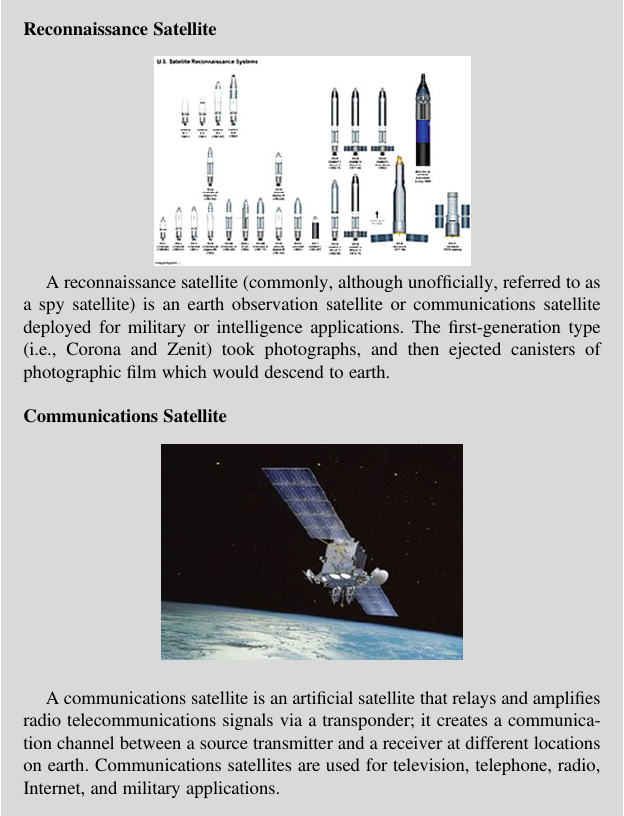
Accordingly, most spaceborne proposals which would traditionally be considered“weapons” (a communications or reconnaissance satellite may be useful in warfare butisn’t generally classified as a weapon) are designed to jam, sabotage, and outrightdestroy enemy satellites, and conversely to protect friendly satellites against suchattacks. To this end, the United States (and presumably other countries) is researchinggroups of small, highly mobile satellites called “microsats” (about the size of arefrigerator) and “picosats” (approximately 1 cubic foot ( ̃27 L) in volume) nimbleenough to maneuver around and interact with other orbiting objects to repair, sabotage,hijack, or simply collide with them.
Space Debris Anti-satellite attacks, especially ones involving kinetic kill vehicles, can contributeto the formation of space debris which can remain in orbit for many years and couldinterfere with future space activity or in a worst case trigger a Kessler syndrome[19]. In January 2007 China demonstrated a satellite knockout whose detonationalone caused more than 40,000 new chunks of debris with a diameter larger than151 cm and a sudden increase in the total amount of debris in orbit. The PRC isreported to be developing “soft-kill” techniques such as jamming, and vision killsthat do not generate much debris [20]. Possible Warfare Over Space Most of the world’s communications systems rely heavily on the presence ofsatellites in orbit around earth. Protecting these assets might seriously motivatenations dependent upon them to consider deploying more space-based weaponry,especially in conflicts involving advanced countries with access to space. Since 2017, the US Air Force has run an annual military exercise called “SpaceFlag” at Peterson Air Force Base, which involves a red team simulating attacks onUS satellites [21].
|