| | Index 9 | | DEWs | | Space | | Lasers | | Scalar | | Microwaves | | Antennas | | Verse | | PDFs | | EMF | | Exit |

 |
.: LASER BEAM ENERGY AS WEAPON :. Laser technology is only 30 years old, but it is much diversified. There are alreadyvarieties of military applications, although there are many limitations restricting theuse of lasers. Today, the armed forces in most countries routinely use a wide range oflaser devices such as laser range finders and designators. In some countries, work isproceeding on more imaginative laser weapon concepts that will eventually fulfillrealistic, yet very precise, military requirements. The design of a specific laserweapon is heavily influenced by the characteristics of the intended target. |
|
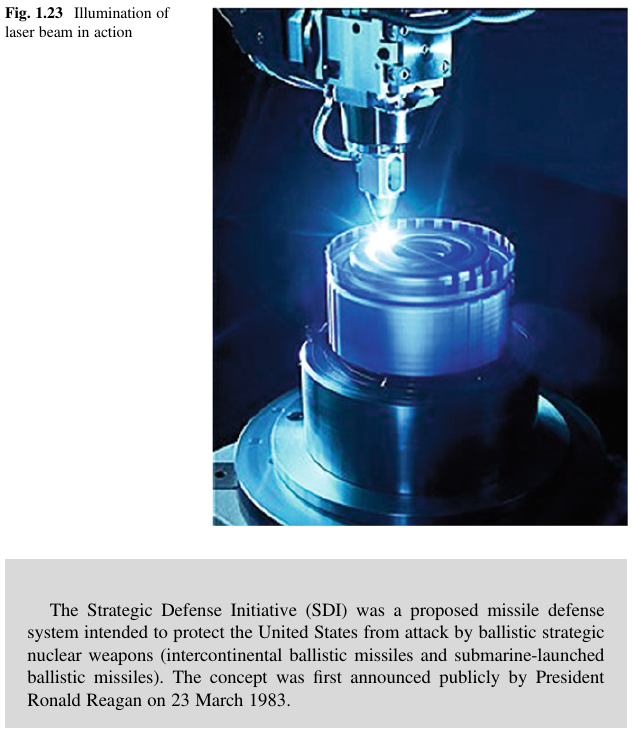
If thedesired effect of the weapon is to neutralize aircraft, helicopters, or missiles byburning holes through them or tanks by putting many miniature cracks (crazing) inthe glass vision blocks to make them appear to be frosted, a very-high-energy laserhas to be used with a power output on the order of several megawatts (MW). Such alaser would be a true anti-material weapon. However, if the target is a sensitiveelectro-optical system or some other type of sensor system, which has to be jammedor destroyed by a laser operating in a countermeasure mode, the choice will be alow-energy laser operating within the frequency bandwidth of the target sensor. Thisuse of a laser can also be considered anti-material. If the target is a soldier, there isone part of his body that is extremely sensitive to laser radiation—his eyes. It issufficient to use a low-energy laser operating in the visible or near-infrared (near-IR)part of the spectrum to damage the soldier’s eyes and, in effect, cause blindness. Ifthe laser is to cause burn injuries to the soldier’s skin or to set fire to his uniform, ahigh-energy laser is required. In either case, if the purpose of the laser is to blind orburn the soldier, it will obviously be antipersonnel. Introduction Even before the laser was invented, science fiction writers told of incredible weaponsand machines that emitted a bright saber of light, a death ray that disintegratedeverything in its path. Even today, science fiction movies and books place high emphasis on weapons that use light instead of bullets. The laser beam is popularlythought of as a very powerful death ray which can be fired from a handheld laser gunto vaporize soldiers, demolish building, and burn through target armors. In reality,the laser is a suitable tool for many military applications and can be turned into adeadly weapon but there are definitely limitations to what a laser can do. The laserreally is a ray weapon, and its light rays can damage some targets in a way thatappeals to the most vivid imagination. It is important to take these somewhatspeculative factors into consideration when studying the psychological effects ofthe use of laser weapons on the battlefield. Otherwise, it will not be possible to get acomplete and realistic picture of what using a laser really means to the combatants. High-Energy Lasers (HEL) as Weapons
An air defense HEL weapon designed to shoot down airplanes, helicopters, andmissiles successfully must have the ability to keep a very powerful beam at one pointon the target for a long enough time to deliver at least 5000 joules per squarecentimeter. This requires a laser in the megawatt range. If the shot is to be successful,it must be directed to a certain part of the target that is limited in size and verysensitive and then kept there until the desired effect is reached. Thus, the laser beammust track and follow a target if any great length of time is needed to achieve thedesired effect. Many parts of an aircraft or helicopter are highly resistant to a HEL weapon, but there are still enough thin-skin parts and sensitive areas to produce a devastatingeffect or destruction if hit precisely. On the other hand, it is obvious that at battlefieldranges even an extremely high-energy laser weapon cannot penetrate the heavy armor on a tank or other armored vehicles and thus a HEL weapon is of no use fordestroying resistant ground targets in the battlefield. However, sensors, optics,and related devices are still valid targets wherever they appear on the battlefield,even in a tank. Airborne Laser (YAL-1A)
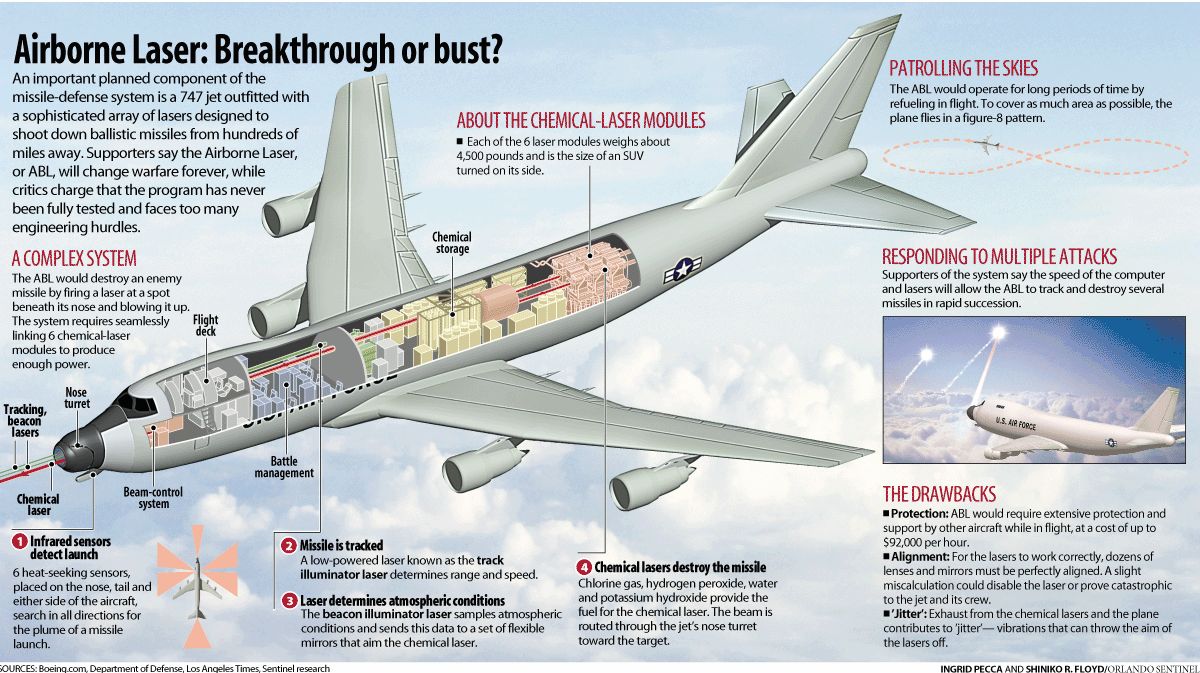
Destroying ballistic missiles is a complicated process, one that is confounded evenmore by the revolutionary use of a directed energy device as a weapon rather than asa targeting or range-finding apparatus. To be successful, ABL must: - Be housed aboard a stable platform that can stay aloft for hours on end aboveweather systems whose clouds could refract its laser beams and nullify itseffectiveness - Be equipped with sensors able to locate a ballistic missile shortly after launch andhold the track long enough for other system elements to swing into operation -Be implemented with a sophisticated computer system capable of keeping trackof dozens of missiles and prioritizing them so that the most threatening is targetedfirst - Have a highly developed optical system capable of measuring the amount ofthermal disturbance between the aircraft and the target, and then be capable ofdirecting a beam of energy that self-compensates for the clear-air obstacles - Possess the ability to focus the killer beam on a rapidly rising target, which maybe traveling at a speed of Mach 6 or more, and then keep the shaft of energy inplace long enough to burn a hole in the missile’s metal skin - And lastly be provided with a laser powerful enough to prove lethal at a distanceof hundreds of kilometers Some of those requirements have already been tested: - The first ABL aircraft—YAL-1A—made its virgin flight over western Kansas onJuly 18, 2002, staying aloft for 1 h and 22 min before returning to the Boeingmodification facility in Wichita. Between then and the time it transitioned to itsnew temporary home at Edwards Air Force Base, California., in December,YAL-1A made an additional 13 flights logging more than 60 flight hours. - As part of a Missile Defense Agency test over the Pacific Ocean in December2002, ABL’s infrared trackers successfully detected a Minuteman booster rocketas soon as it broke the clouds, holding a lock until the rocket’s engines burned out500 km downrange. - Its battle management (computer) system was flight tested in late summer andearly fall of 2002 to verify internal crew communications and the V/UHF radios,plus the data acquisition system and high-definition VHS. - The six infrared search and track sensors were successfully flight tested. - The first COIL module was installed on YAL-1A tested at 118% of anticipatedpower during a shakedown run at TRW’s facility in San Juan Capistrano, Calif.,in January 2002. Shortly afterwards, it was disassembled and shipped to EdwardsAir Force Base. Small-Scale Weapons Using Lab-Type Lasers So far part of this report has covered high-energy weapons, designed to countermajor military conflicts and attack. Laser guns in the movies are often handhelddevices, or at most small enough to prop on a vehicle. Lasers powerful enough toinflict damage, but small enough to be carried, have developed, but they are not usedin any current military application. It’s relatively easy, for example, to build ahandheld ruby laser that puts out bursts of large amounts of light energy. Whenfocused to a point, the light from a ruby laser can cut through paper, cloth, skin, oreven thin metal. Ruby crystals are poor conductors of heat, so ruby lasers emit only short pulses oflight to allow the crystal to cool between firings. Nd:YAG lasers operate in a similarfashion as ruby lasers, but they can produce a continuous beam. Making a handheldNd:YAG laser is no easy feat, however. The Nd:YAG crystal must be opticallypumped by another high-powered laser or by an extremely bright-flash lamp or lightsource. Though the power output of an Nd:YAG laser is extremely high, consideringthe current state of the art, a handheld model is impractical. However, such a weaponcould be built as a “laser canon,” transported on an armored vehicle or on a towedtrailer [3]. CO2 lasers are often used in industry as cutting tools. This type of laser is knownfor its efficiency—30% or more compared to the 1–2% of most gas and crystallasers. A pistol-sized CO2 laser would probably be difficult to design and manufac-ture because the CO2 gas mixture (which includes helium and nitrogen) must beconstantly circulated through the tube. What’s more, the laser requires a heftyelectrical power supply. Still, such apron could be built in an enclosure about thesame size as a personal rocket launcher. These are designed to be slung over ashoulder and fired when standing in an upright position [3]. The Major Laser Weapon Concepts
There is generally more than one laser weapon alternative for each proposed laserweapon mission on the battlefield. It is quite possible to vary the laser properties andenergy level, the tracking system, and the fire control equipment according to themilitary requirements for each specific mission. Environmental influences will alsohave a very strong impact on the final choice of laser weapon applications. Forexample, hydrogen fluoride (HF) laser is not the best choice for long-range usewithin the atmosphere, because its wavelength is strongly absorbed by the atmo-sphere. Every laser weapon that is designed to operate within the atmosphere overany great range, whether ground-based laser (GBL), sea-based laser (SBL), or airborne-based laser (ABL), must use wavelengths at which the atmosphere absorp-tion and scattering are as small as possible [1]. To be effective, the wavelength of a laser weapon must be short, at least in thevisible band, but preferably in the ultraviolet or X-ray band. The greatest difficulty indesigning short-wavelength lasers is power—the shorter the wavelength, the moreenergy that is required. Optical (visible or ultraviolet) lasers work by heating the skinof the target. The beam must remain at the same spot for several seconds until theskin is hot enough to do internal damage to the target. This is tough because thetypical ballistic missile travels in excess of 6 miles per second. Imagine focusing onthe same 20 or 30 spot over a distance of 50,000 ft and you have an idea how accuratesuch a laser weapon must be. In addition to the problems of accuracy, laser weapons of any power tend to bemonstrous and there are many technical obstacles that the designer should overcome.The SBL is using relay mirrors to direct the beam to the target. ABL lasers are usingturbine-powered chemical jets and they are placed aboard aircraft, but the wave-length of the light is long—6–10 μm—far in the infrared region. This makes laserrelatively inefficient at destroying their targets unless certain atmospheric andenvironmental conditions are met for target engagements. X-ray lasers, still wrapped in secrecy, emit an extremely high-powered beam thatcan literally destroy a missile in mid-flight. X-rays can’t be deflected by mirrors,however, which means that the weapon must be easily aimed and in a direct line ofsight to the target. Fortunately, X-ray lasers can be built small, expert say, makingthem suitable for space-based operation. The biggest disadvantage to X-ray lasers isthat they use an internal nuclear explosion to work, so they are essentially one shortdevice. A relative newcomer to this laser weapon scene is the free-electron laser, which isbeing developed at the several national laboratories and universities. The free-electron laser (FEL) uses a stream of electrons that is made to emit photons oflight after being oscillated by giant electromagnetic. Free-electron lasers (FELs)have been built and they do work. However, if put into production, an actualantiballistic missile FEL would take up a huge field such as football field or more.Obviously, such a device would be useful only as a stationary ground-based laser(GBL) weapon with its present technology [2]. Laser weapons may be used within an army’s air defense against aircraft,helicopters, and missiles. The desired effect on the target may be either to burnholes or destroy key structures, to blind or trick the sensors, or blind the crewstemporally or permanently. The high-energy air defense laser may use all threeeffects at the same time if the target is within the reach of the main effects of thelaser. At longer distances, only the anti-sensor and anti-eye capability will bepossible. The low-energy air defense laser will use enough energy to be effectiveagainst sensors and eyes. It is also possible to field a laser with the main purpose ofblinding or flash blinding the crews. Flash blinding will be most effective in the darkwhen the eye is dark adapted and much more sensitive to overload by brightflashes [1].
|