Switch
A switch is a device for changing the
course (or flow) of a circuit. The prototypical model is a mechanical device
(for example a railroad switch) which can be disconnected from one course
and connected to another. The term "switch" typically refers to electrical
power or electronic telecommunication circuits. In applications where
multiple switching options are required (e.g., a telephone service),
mechanical switches have long been replaced by electronic variants which can
be intelligently controlled and automated.
The switch is referred to as a "gate" when abstracted to mathematical form.
In the philosophy of logic, operational arguments are represented as logic
gates. The use of electronic gates to function as a system of logical gates
is the fundamental basis for the computer—i.e. a computer is a system of
electronic switches which function as logical gates.
A simple electrical switch
A simple semiconductor switch
is a transistor.
Contacts
A toggle switch in the "on" position.
In the simplest case, a switch has two pieces of metal called
contacts that touch to make a circuit, and separate to break the
circuit. The contact material is chosen for its resistance to
corrosion, because most metals form insulating oxides that would
prevent the switch from working. Contact materials are also
chosen on the basis of electrical conductivity, hardness
(resistance to abrasive wear), mechanical strength, low cost and
low toxicity[1].
Sometimes the contacts are plated with noble metals. They may be
designed to wipe against each other to clean off any
contamination. Nonmetallic conductors, such as conductive
plastic, are sometimes used.
Actuator
The moving part that applies the operating force to the contacts
is called the actuator, and may be a toggle or dolly, a rocker,
a push-button or any type of mechanical linkage (see photo).
Power sources
Biased switches
A biased switch is one containing a spring that returns the
actuator to a certain position. The "on-off" notation can be
modified by placing parentheses around all positions other than
the resting position. For example, an (on)-off-(on) switch can
be switched on by moving the actuator in either direction away
from the centre, but returns to the central off position when
the actuator is released.
The momentary push-button switch is a type of biased switch. The
most common type is a push-to-make switch, which makes contact
when the button is pressed and breaks when the button is
released. A push-to-break switch, on the other hand, breaks
contact when the button is pressed and makes contact when it is
released. An example of a push-to-break switch is a button used
to release a door held open by an electromagnet. Changeover push
button switches do exist but are even less common.
Special types
Switches can be designed to respond to any type of mechanical
stimulus: for example, vibration (the trembler switch), tilt,
air pressure, fluid level (the float switch), the turning of a
key (key switch), linear or rotary movement (the limit switch or
microswitch), or presence of a magnetic field (the reed switch).
The mercury switch consists of a drop of mercury inside a glass
bulb. The two contacts pass through the glass, and are
mechanically joined when the bulb is tilted to make the mercury
roll on to them. The advantage of this type of switch is that
the liquid metal flows around particles of dirt and debris that
might otherwise prevent the contacts of a conventional switch
from closing.
Other types of switch include:
Centrifugal switch
DIP switch
Hall-effect switch
Inertial switch
Membrane switch
Toggle switch
Transfer switch
Mindy switch
Intermediate switch
A DPDT switch has six connections, but since polarity reversal
is a very common usage of DPDT switches, some variations of the
DPDT switch are internally wired specifically for polarity
reversal. They only have four terminals rather than six. Two of
the terminals are inputs and two are outputs. When connected to
a battery or other DC source, the 4-way switch selects from
either normal or reversed polarity. Intermediate switches are
also an important part of multiway switching systems with more
than two switches (see next section).
Multiway switching
Multiway switching is a method of connecting switches in groups
so that any switch can be used to connect or disconnect the
load. This is most commonly done with lighting.
Two locations
1. First method
2. Second method
3. Labelling of switch terminals
Switching a load on or off from two locations (for instance,
turning a light on or off from either end of a flight of stairs)
requires two SPDT switches. There are two basic methods of
wiring to achieve this, and other not recommended.
In the first method, mains is fed into the common terminal of
one of the switches; the switches are then connected through the
L1 and L2 terminals (swapping the L1 and L2 terminals will just
make the switches work the other way round), and finally a feed
to the light is taken from the common of the second switch. A
connects to B or C, D connects to B or C; the light is on if A
connects to D, i.e. if A and D both connect to B or both connect
to C.
The second method is to join the three terminals of one switch
to the corresponding terminals on the other switch and take the
incoming supply and the wire out to the light to the L1 and L2
terminals. Through one switch A connects to B or C, through the
other also to B or C; the light is on if B connects to C, i.e.
if A connects to B with one switch and to C with the other.
Wiring needed in addition to the mains network (not including
protective earths):
First method:
double wire between both switches
single wire from one switch to the mains
single wire from the other switch to the load
single wire from the load to the mains
Second method:
triple wire between both switches
single wire from any position between the two switches, to the
mains
single wire from any position between the two switches, to the
load
single wire from the load to the mains
If the mains and the load are connected to the system of
switches at one of them, then in both methods we need three
wires between the two switches. In the first method one of the
three wires just has to pass through the switch, which tends to
be less convenient than being connected. When multiple wires
come to a terminal they can often all be put directly in the
terminal. When wires need to be joined without going to a
terminal a crimped joint, piece of terminal block, wirenut or
similar device must be used and the bulk of this may require use
of a deeper backbox.
Using the first method, there are four possible combinations of
switch positions: two with the light on and two with the light
off.
Off On
An unrecommended method
The unrecommended way using the hot and neutral directly
If there is a hot (a unique phase) and a neutral wire in both
switches and just one wire between them where the light is
connected (as in the picture), you can then solve the two way
switch problem easily: just plug the hot in the top from switch,
the neutral in the bottom from switch and the wire that goes to
the light in the middle from the switch. This in both switches.
Now you have a fully functional two way switch.
This works like the first method above: there are four
possibilities and just in two of them there is a hot and a
neutral connected in the poles of the light. In the other ones,
both poles are neutral or hot and then no current flows because
the potential difference is zero.
The advantage of this method is that it uses just one wire to
the light, having a hot and neutral in both switches. The reason
why this is not recommended is because in both switches there
will be hot and neutral wires near to each other, which can lead
to a short circuit more easily than in the other methods.
Another problem with this method is the poles of the light may
still be hot even with the light off, this poses a (potentially
great) risk when changing a bulb.
More than two locations
Three-way switching.
1. First method
2. Second method
3. Labelling of switch terminals
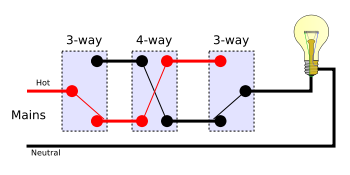
For more than two locations, the two cores connecting the L1 and
L2 of the switches must be passed through an intermediate switch
(as explained above) wired to swap them over. Any number of
intermediate switches can be inserted, allowing for any number
of locations.
Wiring needed in addition to the mains network (not including
protective earths):
First method:
double wire along the sequence of switches
single wire from the first switch to mains
single wire from the last switch to the load
single wire (neutral) from load to mains
Second method:
double wire along the sequence of switches
single wire from first switch to last switch
single wire from anywhere between two of the switches to the
mains
single wire from anywhere between the same two switches to the
load
single wire (neutral) from load to mains
Using the first method, there are eight possible combinations of
switch positions: four with the light on and four with the light
off.
Off On
As mentioned above, the above circuit can be extended by using
multiple 4-way switches between the 3-way switches to extend
switching ability to any number of locations.
Power switching
When a switch is designed to switch significant power, the
transitional state of the switch as well as the ability to stand
continuous operating currents must be considered. When a switch
is on its resistance is near zero and very little power is
dropped in the contacts; when a switch is in the off state its
resistance is extremely high and even less power is dropped in
the contacts. However when the switch is flicked the resistance
must pass through a state where briefly a quarter (or worse if
the load is not purely resistive) of the load's rated power is
dropped in the switch.
For this reason, most power switches (most light switches and
almost all larger switches) have spring mechanisms in them to
make sure the transition between on and off is as short as
possible regardless of the speed at which the user moves the
rocker.
Power switches usually come in two types. A momentary on-off
switch (such as on a laser pointer) usually takes the form of a
button and only closes the circuit when the button is depressed.
A regular on-off switch (such as on a flashlight) has a constant
on-off feature. Dual-action switches incorporate both of these
features.
Contact bounce
Contact bounce (also called chatter) is a common problem with
mechanical switches and relays. Switch and relay contacts are
usually made of springy metals that are forced into contact by
an actuator. When the contacts strike together, their momentum
and elasticity act together to cause bounce. The result is a
rapidly pulsed electrical current instead of a clean transition
from zero to full current. The waveform is then further modified
by the parasitic inductances and capacitances in the switch and
wiring, resulting in a series of damped sinusoidal oscillations.
This effect is usually unnoticeable in AC mains circuits, where
the bounce happens too quickly to affect most equipment, but
causes problems in some analogue and logic circuits that are not
designed to cope with oscillating voltages.
Sequential digital logic circuits are particularly vulnerable to
contact bounce. The voltage waveform produced by switch bounce
usually violates the amplitude and timing specifications of the
logic circuit. The result is that the circuit may fail, due to
problems such as metastability, race conditions, runt pulses and
glitches.
There are a number of techniques for debouncing (mitigating the
effects of switch bounce). They can be split into timing based
techniques and Hysteresis based techniques.
Timing based
Timing based techniques rely on adding sufficient delays that
the extra transitions introduced by bounce are ignored. Their
big advantage is they do not require any special design on the
switch side and so are generally cheaper. However for good
performance they must be designed to suit the switch (too much
delay and the response will be needlessly sluggish, too little
and bounce will not be eliminated).
Resistor/Capacitor

If an on/off switch is used with a pull up (or pull down)
resistor and a single capacitor is placed over the switch (or
across the resistor, but this can cause nasty spikes of current
on the power supply lines) then when the switch is closed
(generally pressed) the capacitor will almost instantly
discharge through the switch. But when the switch is opened
(generally released) the capacitor takes some time to recharge.
Therefore contact bounce will have negligible effect on the
output. The slow edges can be cleaned up with a Schmitt trigger
if necessary. This method has the advantage of fast response to
the initial press but the current surges through the switch may
be undesirable. Other RC based systems are also possible with
various responses and such systems are probably the easiest
method when constructing with simple logic gates and discrete
components.
State machines and software
A finite state machine or software running on a CPU can be
designed to wait a fixed number of clock cycles after any
transition before registering another one. This provides a cheap
option for debouncing when a microprocessor, microcontroller or
gate array is already in use but is unlikely to be worthwhile if
constructing with single logic gates.
Hysteresis
Alternatively, it is possible to build in hysteresis by making
the position where a press is detected separate from that where
a release is detected. As long as the bounces are small enough
not to take the switch between these positions, bounce problems
will be eliminated. Hysteresis can be mechanical or electronic
(e.g. a Schmitt trigger).
Changeover switch
A changeover switch provides two distinct events, the making of
one contact and the breaking of the other. These can be used to
feed the inputs of a flip-flop. This way the press will only be
detected when the pressed contact is made and the release will
only be detected when the released contact is made. When the
switch is bouncing around in the middle no change is detected.
To get a single logic signal from such a setup a simple SR latch
can be used.
Variable resistance
Normal switches are designed to give a hard on-off but it is
also possible to design one that varies more gradually between
the hard-on and hard-off states. This keeps the output changes
caused by bouncing small. Then by feeding the output to a
schmitt trigger the effect of those bounce based changes can be
eliminated.