Inductor
An inductor is a passive electrical device
employed in electrical circuits for its property of inductance. An inductor
can take many forms.
Physics
Overview
Inductance (measured in henries, H) is an effect which results from the
magnetic field that forms around a current-carrying conductor. Electrical
current through the conductor creates a magnetic flux proportional to the
current. A change in this current creates a change in magnetic flux that, in
turn, generates an electromotive force (emf) that acts to oppose this change
in current. Inductance is a measure of the generated emf for a unit change
in current. For example, an inductor with an inductance of 1 henry produces
an emf of 1 V when the current through the inductor changes at the rate of 1
ampere per second. The number of turns, the area of each loop/turn, and what
it is wrapped around all affect the inductance. For example, the magnetic
flux linking these turns can be increased by coiling the conductor around a
material with a high permeability.
Stored energy
The energy (measured in joules, in SI) stored by an inductor is equal to the
amount of work required to establish the current through the inductor, and
therefore the magnetic field. This is given by: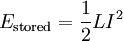
where L is inductance and I is the current flowing through the inductor.
Hydraulic model
Electrical current can be modeled by the hydraulic analogy. The inductor can
be modeled by the flywheel effect of a turbine rotated by the flow. As can
be demonstrated intuitively and mathematically, this mimics the behavior of
an electrical inductor; voltage is proportional to the derivative of current
with respect to time. Thus a rapid change in current will cause a big
voltage spike. Likewise, in cases of a sudden interruption of water flow the
turbine will generate a high pressure across the blockage, etc. Magnetic
interactions such as in transformers are not usefully modeled hydraulically.
Inductor construction
Inductors. Major scale in centimetres.
An inductor is usually constructed as a coil of conducting material,
typically copper wire, wrapped around a core either of air or of
ferromagnetic material. Core materials with a higher permeability than air
confine the magnetic field closely to the inductor, thereby increasing the
inductance. Inductors come in many shapes. Most are constructed as enamel
coated wire wrapped around a ferrite bobbin with wire exposed on the
outside, while some enclose the wire completely in ferrite and are called
"shielded". Some inductors have an adjustable core, which enables changing
of the inductance. Inductors used to block very high frequencies are
sometimes made with a wire passing through a ferrite cylinder or bead.
Small inductors can be etched directly onto a printed circuit board by
laying out the trace in a spiral pattern. Small value inductors can also be
built on integrated circuits using the same processes that are used to make
transistors. In these cases, aluminium interconnect is typically used as the
conducting material. However, practical constraints make it far more common
to use a circuit called a "gyrator" which uses a capacitor and active
components to behave similarly to an inductor.
Q factor
An ideal inductor will be lossless
irrespective of the amount of current flowing through the winding. However,
typically inductors have winding resistance from the metal wire forming the
coils. Since the winding resistance appears as a resistance in series with
the inductor, it is often called the series resistance. The inductor's
series resistance converts electrical current flowing through the coils into
heat, thus causing a loss of inductive quality. The quality factor (or Q) of
an inductor is the ratio of its inductive reactance to its resistance at a
given frequency, and is a measure of its efficiency. The higher the Q factor
of the inductor, the closer it approaches the behavior of an ideal,
lossless, inductor.
The Q factor of an inductor can be
found through the following formula, where R is its internal electrical
resistance:

By using a ferromagnetic core the
inductance is increased for the same amount of copper, raising the Q. Cores
however also introduce losses that increase with frequency. A grade of core
material is chosen for best results for the frequency band. At VHF or
highter frequencies an air core is likely to be used. Inductors wound around
a ferromagnetic core may saturate at high currents, causing a dramatic
decrease in inductance (and Q). This phenomenon can be avoided by using a
(physically larger) air core inductor. A well designed air core inductor may
have a Q of several hundred.
An almost ideal inductor (Q approaching infinity) can be created by
immersing a coil made from a superconducting alloy in liquid helium or
liquid nitrogen. This supercools the wire, causing its winding resistance to
disappear. Because a superconducting inductor is virtually lossless, it can
store a large amount of electrical energy within the surrounding magnetic
field (see superconducting magnetic energy storage).
1. Basic inductance formula for a
cylindrical coil: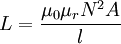
L = Inductance in henries (H)
μ0 = permeability of free space = 4π × 10-7 H/m
μr = relative permeability of core material
N = number of turns
A = area of cross-section of the coil in square metres (m2)
l = length of coil in metres (m)
Applications
Inductors are used extensively
in analog circuits and signal processing. Inductors in
conjunction with capacitors and other components form tuned
circuits which can emphasize or filter out specific signal
frequencies. This can range from the use of large inductors as
chokes in power supplies, which in conjunction with filter
capacitors remove residual hum or other fluctuations from the
direct current output, to such small inductances as generated by
a ferrite bead or torus around a cable to prevent radio
frequency interference from being transmitted down the wire.
Smaller inductor/capacitor combinations provide tuned circuits
used in radio reception and broadcasting, for instance.
Two (or more) inductors which have coupled magnetic flux form a
transformer, which is a fundamental component of every electric
utility power grid. The efficiency of a transformer decreases as
the frequency increases but size can be decreased as well; for
this reason, aircraft used 400 hertz alternating current rather
than the usual 50 or 60 hertz, allowing a great savings in
weight from the use of smaller transformers.
An inductor is used as the energy storage device in some
switchmode power supplies. The inductor is energized for a
specific fraction of the regulator's switching frequency, and
de-energized for the remainder of the cycle. This energy
transfer ratio determines the input-voltage to output-voltage
ratio. This XL is used in complement with an active
semiconductor device to maintain very accurate voltage control.
Inductors are also employed in electrical transmission systems,
where they are used to intentionally depress system voltages or
limit fault current. In this field, they are more commonly
referred to as reactors.
As inductors tend to be larger and heavier than other
components, their use has been reduced in modern equipment;
solid state switching power supplies eliminate large
transformers, for instance, and circuits are designed to use
only small inductors, if any; larger values are simulated by use
of gyrator circuits.