<< Previous Page - Next Page >>

Section (9/21)

  1. Importance of E-Polarized Wave Scattering from from Infinitely Thin and Finitely Width Strip Systems.
  2. What will be represented in E-Polarized Wave Scattering from from Infinitely Thin and Finitely Width Strip Systems?
  3. What is Analytical Regularization?
  4. Geometry and Formulation of Problem.
  5. Dirichlet Boundary Problem and Integral Representation of Scattered Field.
  6. Sommerfeld Radiation Conditions.
  7. Fundemental Solution for Helmholtz. Equation, Third Kind of Green Formula for Free Space.
  8. Analytic Continuity of homogeneous Helmholtz Equation: Sobolev Theory.
  9. Dirichlet Boundary Problem and Integral Representation of Scattered Field.
  10. Solution of Integral Equation.
  11. Local Singular Expantion.
  12. Integral Equation Identities due to Strip System.
  13. Reduction of Integral Equation to the Numerical System.
  14. Fourier-Chebyshev Expansions of Equation Terms.
  15. Reducing Integral Equation to the Infinite Linear Algebra System.
  16. Analytical Regularization Method for Infinite Linear Algebra System.
  17. Solution of Problem in Numerically.
  18. Finding Fourier-Chebshev for Matrix.
  19. Solution of Regularized Equation System.
  20. Solution of Regularized Equation System For Multi Strips.
  21. Scattered Field for Arbitrary Point in Space.


.: Gebze Institute of Technology Electronics Engineering Department

Mr.Deniz ELMASLI Master's Thesis

.: E-Polarized Wave Scattering from from Infinitely Thin and Finitely Width Strip Systems

Dirichlet Boundary Problem and Integral Representation of Scattered Field

• In formulations derived till now no Dirichlet Boundary Condition was applied. This is only valid for when equations are equal to null:

• Naturally in physical meaning this condition means that there is no obstacle for scatter. If there is no obstacle, no scattering occures. This is valid for generalized Sobolev's theorems for open space where ;

satisfies Homogeneous Helmholtz Equation and Sommerfeld Radiation Condition.

• By the reason of that in dirichlet boundary problem, scattering field is exposed as;

• Scattered field cannot be zero;
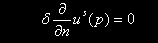
due to necessity of obstacle. Because it means no scattering. If we use Dirichlet Boundary condition to rearrange the right side of formula;

• As unknown function of J D (p) can be written as;

• By substituting it to the right place in formula;

• But it has to known that J D (p) must be continious function.


Web site contents © Copyright Deniz ELMASLI 2006, All rights reserved.

Website templates


Hosted by www.Geocities.ws

1