Mr.Deniz ELMASLI
Master's Thesis
|
.:
E-Polarized Wave Scattering from from Infinitely Thin and Finitely Width Strip Systems
Analytic Continuity of homogeneous Helmholtz Equation: Sobolev Theory

Has an integral representation of the kind :
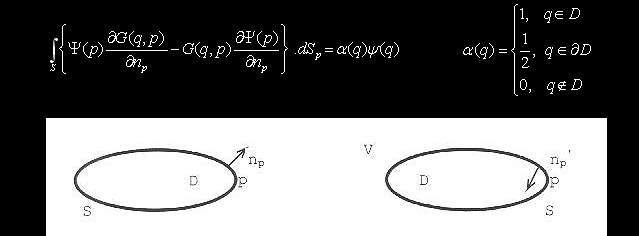
• If we change the direction of outward normal

• Formula will be:

• Now we will consider a very important consequence of the integral representations, which is known as the Sobolev's theorem. Let D1 and D2 are some two bounded domain in R2 space with boundary contours S1 and S2 correspondently. This contour have a common part L that:
13;

• Let function Ψ1(p) and Ψ2(p) are solutions of homogeneous Helmholtz equation in correspondently D1 and D2.
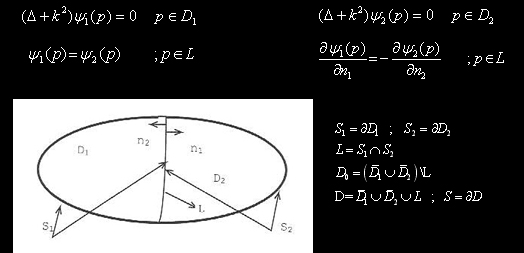
• When n1=-n2 that function Ψ1(p) and Ψ2(p) have the same normal derivatives on L relatively tp the one fixed direction of the normal to the contour L;
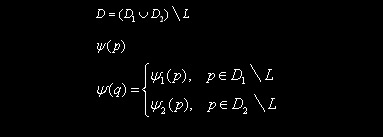
• Let us now define now domain

• Now function :
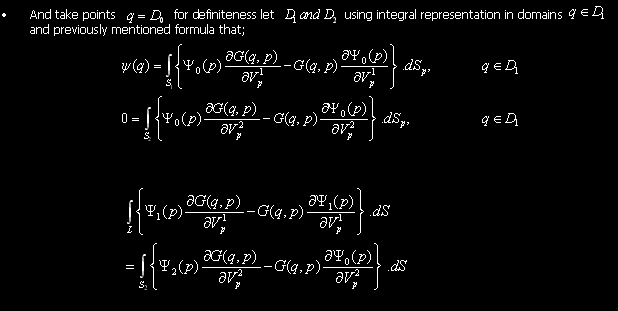

• Where contour S0 is;
13;

• Where domain D equal to;

• According to all these we can describe Sobolev Theory as;
13;
– For two closed domain which have joint border, two scaler functions defined as fundemental solutions of Helmholtz Equation in their domains. If the function values in joint border is negative signed of each one, in total field, a function that is fundemental solution of homogeneous Helmholtz Equation can be found. This function is known as Sobolev's theorem about continuation of the solutions of the homogeneous Helmholtz equation.
Web site contents © Copyright Deniz ELMASLI 2006, All rights reserved.
Website templates
|