|
CIT Home
Why come to Pakistan? Trekking Mountaineering Other interests How to get here? Airlines Tour operators Embassies Travel Requirements Visa Health Embassies Security Concerns Advisories Accomodation/Travel Within Pakistan Hotels/Hostels Transport-Buses Air travel within Pakistan Facilities Banks Internet Cafes Foriegn Embassies Hospitals General Information News Photogalleries Shopping Food Travel Books Who are we? About Us The Clubhouse! |
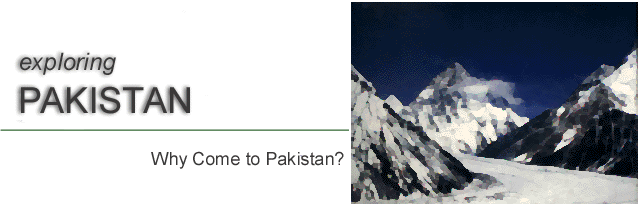
Mighty mountains… Massive glaciers… Thundering, foaming rivers… Lush, emerald valleys… Archaeological ruins guarding secrets of age-old civilizations… Sleepy-eyed camels offering you a ride across the sandy beaches of the Arabian Sea and golden deserts… The apex of three mammoth mountain ranges… One of the oldest trade routes known to mankind… We have it all in Pakistan, and want you to explore it and experience the magic! TrekkingThree of the world's mightiest mountain ranges converge in the northern areas of Pakistan: the Karakoram, Himalayas, and the Hindukush. These mountain ranges also cradle several of the world's largest glaciers, luring trekkers from all over the world. Trekking in this region is also quite unlike anything in Americas, Europe or even elsewhere is Asia. Apart from well known areas around K2 and Nanga Parbat, it is possible to walk for days along glaciers and over passes without meeting anyone, let alone a Westerner. The combination of hospitable people, isolation and magnificent mountain scenery makes it a perfect place to trek provided you have a thrust for adventure, love of nature and strength to enjoy a challenging walk. Trekking possibilities are defined in several popular trekking guides on this region. Once you have chosen your treks you can either have one of the tour operators organize the entire itinerary for you or arrange it yourself in Gilgit or Skardu. Best time to trek in this area is from April to September. The government has dfined three trekking zones: Open, Restricted and Closed. Make sure you understand the difference and regulations for these zones before planning your treks. Pakistan boasts five of the world's fourteen highest peaks, including the ominous K2. In these mountain ranges rise numerous peaks above 6000 and 7000 meters, and five above 8000 meters, including the second highest peak in the world - the K2. These mountains offer some of the toughest challenge to mountaineers. Mountaineering is defined as peaks over 6000m and require a mountaineering permitfrom government of Pakistan prior to arrival in Pakistan. All mountaineering expeditions must be organized through an approved tour operator . Jeep SafarisRemote and unspoiled valleys in the northern areas of Pakistan provide the most amusing and interesting destinations for jeep safaris. On small winding dirt roads cut from steep mountains, you can experience the culture of these lovely lush valleys, unharmed by modern civilization. Tour operators that organize jeep safaris: Mountain BikingScenic biking expeditions along Karakoram Highway and the Hindukush let the biker soak up the awesome beauty and the strikingly fresh atmosphere of the majestic mountain ranges. Tour operators that organize biking expeditions: The Silk Route & KarakoramsInitially a military project intended to safeguard the borders of the Chinese Empire against invaders from the west centuries ago, the Silk route is one of the oldest trade routes known to mankind. The Silk Roads now offer a panoramic route across the Karakorams and the neighboring mountain ranges, passing through lush green valleys and steppes, high snowy passes, lustrous sapphire lakes and rugged mountain landscape. Tour operators that organize trips across the Silk Route/Karakorams: Cultural Tours & Archaeological RuinsExplore the rich, diverse culture of Pakistan; the dazzling costumes, magnificent monuments, grand architecture and rich history. Visit the remote northern areas untouched by modern civilization where the dwellers are engagingly hospitable and enchanting. Cross the golden Cholistan desert on camel back. Taxila and Swat valley contain remains from one of the biggest Buddhist civilizations whereas Mohenjodaro and Harrapa are sites of remains of the Indus Valley Civilization that developed around 3000 BC. Tour operators that organize cultural tours:
A Few Amusing Treats!Camel Safari - An enchanting camel safari across the Cholistan desert arranged by:
Boat Safari - A magical boat safari along the sensuous Indus arranged by:
Shandur Polo Festival - A spectacular Polo Festival played on the Shandur Pass. The trips are arranged by:
Steam Train Safari - A wondrous train journey across the Khyber Pass, organized by:
Air Safari - A spectacular aerial view of the Himalayas and Karakorams, arranged by:
Wild Boar Hunting - Hunts arranged by:
Trout Fishing - Trips organized by:
Permit for ClimbingA permit for climbing in Pakistan is required from the Pakistan Ministry of Tourism. Permits require a minimum of 4 persons, who all must be registered at time of applying for the permit, though these names can be changed later (with difficulty). 1992 Permit cost for 6000 meter peaks: $1000. Application for a specific peak must be received no later than October 31 of the preceding year. Changes to the permit must be finalized 4 months prior to arrival in Pakistan. The application needs to include such particulars like specific dates of arrival and departure, members (including specified leader and reserve members), general size (amount of gear), particulars of travel to and from the peak, information on the peak desired (with second, third, fourth choices), and specifics (including passport info of the leader and expedition members). A visa is also required. Obtain the visa after permit application is approved.
Area of Pakistan close to its international border and Line of Control between India is defined as either Restricted or Closed for foreigners. Foreigners can enter Restricted Zone by obtaining permission from Ministry of Tourism in Islamabad. You should be able to obtain this permission the same day you apply but must be prepared to spend an extra day because of backlog. At the end of trek, there is debriefing session in Islamabad. Though you can arrange treks in restricted zone by yourself, it is advisable to contact an approved tour operator to arrange such treks. Foreigners cannot go into Closed Zone. All other areas are defined as Open Zone and does not require any permission from any government authority. The text below is reporduced from "Trekking Rules and Regulations" issued by the Ministry of Tourism in 1994. 1. Trekking means the act of travelling on foot to a maximum height of six thousand meters (6000 m) with the purpose of sight-seeing and recreation at various natural and cultural sites in places where means of modern transportation either not available or are purposely not used. 2. Issue of permits to trekking parties shall be regulated as follows :- (a) Treks situated in the Open Areas : Foreigners are allowed to trek in the "Open Zone" without permit and guide etc. List of treks in open zone is at Annex "G" (b) Specified treks in the Restricted Areas:
(c) Unspecified treks in "Restricted Areas"
|
|
|
| CIT Home |
| Why come to Pakistan? | | How to get here? | | Travel Requirements | | Accomodation/Travel | | Facilities | | General Information | | Who are we? | |