
| HOME | PREVIOUS | NEXT | LINK | CONTACT US |
|---|
“I'm trying to understand,” Caruso speculates, “On a village level in the self-sufficiency idea, if I am a rice farmer I should only sell my rice on a national level to other Thai people. But what if the guy in the next country offers me more money? If I make more money, then I can go buy the bowls that you make...or should I not buy your bowls because I think it’s better to keep my rice in my village and won’t be able to afford them?” The simplistic nature of comparative advantage makes it seem all too easy to succeed: jump on the bandwagon to free trade and your economy will magically thrive.
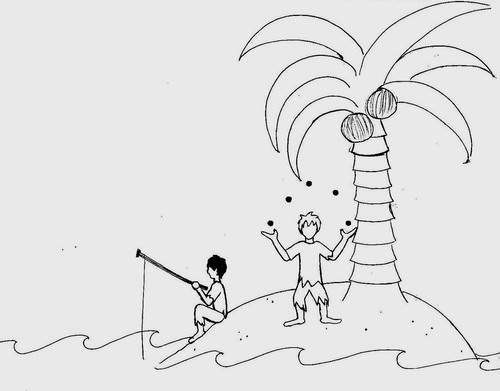
However, one need not go to Thailand to figure out that using comparative advantage to develop a country is as nonsensical as being dropped off on a deserted island. My realization of the downfalls of free trades came to me close to home. Minnesota is the largest producer of beet sugar in the nation. On June 30 of last year, the Central American Free Trade |
Agreement (CAFTA)—an agreement that liberalized trade between the U.S., Central America and the Dominican Republic—was passed by only two votes in the House of Representatives. With this FTA, the $2 billion dollar sugar industry will not be able to compete when an influx of cheaper subsidized sugar comes in from Central America. Likewise, dairy and corn farmers in Central America will be pushed off their land.
Minnesota Senator Norm Coleman voted a bold “yes” in support of the Bush Administration’s proposed CAFTA, against the interests of 20,000 constituents. He stated, “I hope in the end, within the next year or two that folks in western Minnesota say I did the right thing for them.” Daniel Roche, president of a farmers’ cooperative, countered, “I was offended that he feels that he knows what is best for the industry better than we do. I live and breathe the sugar industry 24 hours a day. CAFTA is not what's best.” Back in the comfort of the U.S. Embassy, Caruso reflects, “A weak point of democracy is it requires a certain amount of commitment on the part of the voters to understand complex issues.” What Caruso cannot see from the insular walls of the Embassy nor Coleman from his guarded office at the capital, is that for small-scale farmers, farming is not about mastering the business world to propagate a comparative advantage; it is a way of life. People like Samwang Srimantha and Daniel Roche don’t care about having the purchasing power to buy the right bowl or being able to grab a Snickers bar upon a craving. But then again, they aren’t the ones making the decisions. In their “we-know-best” quest to expand, politicians lose sight of the fact that there is a lot more than just fish and berries in the real world. While the villagers of Kutchum gradually work to enhance their capacities as a community, the drive to liberalize undermines a “slower” lifestyle, and business interests come first. Yet, if people like Samwang are forced to struggle to keep up with the global economy, who will focus on strengthening things on the home front? After falling victim to Washington-backed trade policies for years, Latin American leaders are starting |