Production By the Masses
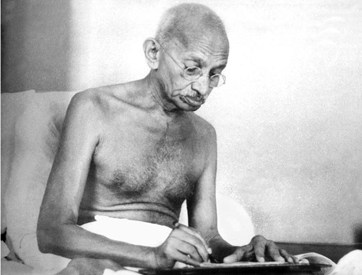
When Britain left India and Pakistan as independent countries in 1947, it was largely due to Mohandas Gandhi’s principles of swaraj (self-rule) and swadeshi (home economy). Gandhi described swadeshi as “a call to the consumer to be aware of the violence he is causing by supporting those industries that result in poverty, harm to workers and to humans and other creatures.”
Instead of the British ideas of centralized, industrialized, and mechanized production, Gandhi envisioned production that would be decentralized, homegrown, and hand-crafted. He advocated “not mass production, but production by the masses,” which cares about the producers and the process.
In response, hundreds of thousands of Indians boycotted British-made goods and institutions. They began to spin their own yarn and weave their own cloth. Through this, Indians could revive traditional techniques, show support for independence, and return to the meditative and self-fulfilling aspects of work that is done by hand.
Swadeshi spoke to the need for long-term survival as a people. Gandhi emphasized that “the true India is to be found not in its few cities, but in its seven hundred thousand villages. If the villages perish, India will perish too.” His vision for a free India was not as a nation-state. He saw instead a confederation of self-governing and self-reliant people living in village communities who would derive their livelihood from the products of their homesteads.
The aims of swadeshi still apply today. Local-based economics avoid dependence on external market forces and reduce unhealthy, wasteful, and environmentally destructive transportation. Real peace in the world is impossible if we only see each other’s countries as sources for raw materials or as markets for industrial goods. In Gandhi’s words, “There is enough for everybody’s need, but not enough for anybody’s greed.”
By Katherine Ciecko