| HOME | PREVIOUS | NEXT | LINK | CONTACT US |
|---|
| Next>> | 2 | 3 |
|---|
How To End Poverty: Making Poverty History and the History of Poverty |
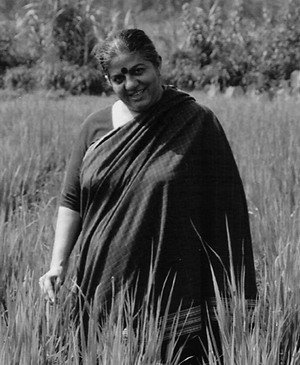
Dr. Vandana Shiva is a physicist, ecologist, activist, editor, and author. She received the Right Livelihood Award (also known as the Alternative Nobel Prize) in 1993 and currently directs the Research for Science, Technology and Natural Resource Policy Foundation in New Delhi, India. She has also established Navdanya, a movement for biodiversity conservation and farmers’ rights. Her most recent books are Biopiracy: The Plunder of Nature and Knowledge and Stolen Harvest: The Hijacking of the Global Food Supply. Dr. Shiva is a leader of the International Forum on Globalization and is a prominent figure in the de-globalization movement. For more information about Dr. Vandana Shiva’s work, please visit or www.navdanya.org. The cover story of the TIME Magazine of March 14, 2005 was dedicated to the theme, “How to End Poverty.” It was based on an essay by Jeffrey Sachs, “The End of Poverty,” from his book with the same title. The photos accompanying the essay are homeless children, scavengers in garbage dumps, and heroin addicts. These are images of disposable people, people whose lives, resources, and livelihoods have been snatched from them by a brutal, unjust, and excluding process which generates poverty for the majority and prosperity for a few. Garbage is the waste of a throwaway society— ecological societies have never had garbage. Homeless children are the consequences of impoverishment of communities and families who have lost their resources and livelihoods. These are images of the perversion and externalities of a non-sustainable, unjust, and inequitable economic growth model. In “Staying Alive,” I referred to a book, entitled Poverty: the Wealth of the People, in which an African writer draws a distinction between poverty as subsistence, and misery as deprivation. It is useful to separate a cultural conception of simple, sustainable living as poverty from the material experience of poverty that is a result of dispossession and deprivation. Culturally perceived poverty need not be real material poverty: sustenance economies, which satisfy basic needs through self-provisioning, are not poor in the sense of being deprived. Yet the ideology of development declares them so because they do not participate overwhelmingly in the market economy, and do not consume commodities produced for and distributed through the market even though they might be satisfying those needs through self-provisioning mechanisms. People are perceived as poor if they eat millets (grown by women) rather than commercially produced and distributed processed junk foods sold by global agri-business. They are seen as poor if they live in self-built housing made from ecologically adapted natural material like bamboo and mud, rather than in cement houses. They are seen as poor if they wear handmade garments of natural fibre rather than synthetics. Sustenance, as culturally perceived poverty, does not necessarily imply a low physical quality of life. On the contrary, because sustenance economies contribute to the growth of nature’s economy and the social economy, they ensure a high quality of life measured in terms of the rights to food and water, sustainability of livelihoods, and robust social and cultural identity and meaning. On the other hand, the poverty of the 1 billion hungry and the 1 billion malnutritioned people who are victims of obesity suffer from both cultural and material poverty. A system that creates denial and disease, while accumulating trillions of dollars of super-profits for agribusiness, is a system for creating poverty for people. Poverty is a final state, not an initial state of an economic paradigm, which destroys ecological and social systems for maintaining life, health and sustenance of the planet and people. And economic poverty is only one form of poverty. Cultural poverty, social poverty, ethical poverty, ecological poverty, and spiritual poverty are other forms of poverty more prevalent in the so-called rich North than in the so called poor South. And those other poverties cannot be overcome by dollars. They need compassion and justice, caring and sharing. Ending poverty requires knowing how poverty is created. However, Jeffrey Sachs views poverty as the original sin. As he declares:
|