| Time |
Dynasty |
Notable Events |
| 2205-1766 B.C. |
 XIA XIA |
Xia dynasty introduced tithe system with annual
distribution of fields. |
| 1766-1027 B.C. |
 SHANG SHANG |
Earliest Form of Chinese writing founded. Beginning of Persian Empire (1750 - 550) Destruction
of Troy during Trojan War (1193) Thutmose I of Egypt builds
first tomb in Valley of Kings. |
| 1027-771 B.C. |
  WESTERN ZHOU WESTERN ZHOU |
Rational philosophy of Zhou dynasty gains over
mysticism of earlier Shang dynasty. King David (1000-960) is
succeeded by his son, Solomon (960-925). Samaria (formerly
Sichem) rebuilt as capital and religious center of Israel (879). Age of Hebrew prophets (875-520). "Iliad"
and "Odyssey", the Greek epics traditionally ascribed to Homer. Temple of Hera, oldest remaining temple in Olympia, Greece. First Recorded Olympic Games (776). |
| 770-221 B.C. |
 EASTERN ZHOU EASTERN ZHOU |
| � 770-476 B.C.  Spring and Autumn Period Spring and Autumn Period
� |
Iron casting invention.
Multiplication table invented. Philosophers: Lao-tse
(604-531), Confucius (551-479), and Mencius (373-288). Feudalism begins to decline.
Construction of Han Gou Canal (486). Founder of Mohism, Mo-tse
(479-438). Building of first wall in China (356). Death of Xun-tse
(233) marked the end of classical philosophy. Founding of Rome (753).
First prediction of solar eclipse by Thales of Miletus. Siddhartha (Buddha), founder of Buddhism (550-480). Indian surgeon Susrata performed cataract operations (500). Sophocles (496-406), tragic dramatist, wrote "Antigone" in 443.
Persian Wars (490-449), the Persian burned Athen (480), destoryed
Acropolis (480) and Babylon (479). The Greek Herodotus
"Father of History" (485-424). Socrates, Athenian
philosopher (470-399). Hippocrates, Greek physician,
"Father of Medicine" (birth 460). Beginning of
Indian empire: Magadha "Cradle of Buddhism". Consecration
of completed Parthenon (438). Plato (427-347), author of
"The Republic". Aristotle, Greek philosopher
(384-322), founded music theory (340). Alexander the Great
(356-323), he founded the Port of Alexandria (332). The Roman
Censor Appius Claudius Caecus completed construction of Appian aqueduct and begun Appian
Way (312). Completion of the Colossus of Rhodes and
lighthouse at Pharos, Alexandria (275). Hannibal,
Carthaginian general (246-182). |
475-221 B.C.  The Warring Period The Warring Period |
| 221-207 B.C. |
 QIN QIN |
The unification of China (221) under emperor
Qinshihuang (246-209). Unification of all Chinese measures and weights (221). Began
building of Great Wall of China (1400 miles long) (215). Hannibal
crossed the Alps (218). "Hannibal ante portas!" The
Carthaginians before Rome (211).�� |
| 206 B.C. - A.D. 9 |
 WESTERN HAN WESTERN HAN |
Hu Shin produced Chinese dictionary of 10,000
characters (149). Silk Road opened (139). Confucianism made official state ideology (100).
Book of Ritual (Li) (100). First Chinese ship reached the east coast of India (100). Inscription engraved on Rosetta Stone (200). Hannibal
commits suicide in exile to avoid extradition by Rome (182). Hipparchus
of Nicaea, who made important astronomical discoveries and invented trigonometry (160).
Birth of Gaius Julius Caesar (100). Florence
founded (62). Caesar: "De bello Gallico," account
of Gallic War (51). Reign of Cleopatra VII (47 - 31), last
queen of Egypt. Adoption of Julian calendar of 365.25 days;
leap year introduced (46). Caesar murdered by Brutus and
Cassius (44). Herod, at Rome, appointed king of Judaea (40).
Octavian retitled Augustus (63 B.C. - A.D.14) became Roman emperor
(30 B.C. - A.D.14). Building of Pantheon begun (30 B.C.) and
completed in (A.D. 124). Birth of Jesus Christ (4 B.C.) Death of Herod (A.D. 6). |
| A.D. 9 -25 |
 XIN XIN |
Wang Mang, a reformer, interrupted the Han
dynasty. |
| A.D. 25-220 |
EASTERN HAN |
Invention of Paper (100). Ming-Ti, emperor of
China introduced Buddhism (58). Chinese conquered Mongolia (121). Great Wall Completed
(214). Probable Date of crucifixion of Jesus (30). Roman emperor Claudius poisoned by his wife Agrippina (54), succeeded by
her son Nero. Nero killed his mother (59) and later on
commited suicide (68). Revolt of the Jews against Rome:
Jerusalem captured and destroyed (70). Trajan emperor
(98-116); under him the Roman Empire reached its greatest geographical extent. Earliest known Sanskrit inscriptions in India (150). Oldest Maya monuments (164). The great plague in the Roman Empire (164 -
180). Period of Neo-Platonism, last of Greek philosophies
(200). |
| A.D. 220-280 |
 THREE KINGDOMS
��������������
THREE KINGDOMS
�������������� |
A.D. 220-265  Wei� Wei�
|
Invention of Compass in China(271) The Sassanids in Persia (Ctesiphon) (226). Persecution
of Christians increases; martyrs are being revered as saints (250). Diophantus of Alexandria produced the first book on algebra (250). |
A.D.221-263  Shu Shu |
A.D. 229-280  Wu Wu |
| A.D. 265-316 |
 WESTERN JIN WESTERN JIN |
Growing Buddhist influence in China (300). Partition of the Roman Empire into western and eastern empires (285).
The last persecution of Christians in Rome (303-311). Edict of Milan: Constantine establishes toleration of Christianity (313). |
| A.D. 317-420 |
EASTERN JIN |
Lo-Tsun, a Chinese monk, founded the Caves of
Thousand Buddhas in Kansu (360). Constantinople became capital of
Roman Empire (330). Emperor Theodosius forbidded the Olympic
Games. Emperor Magnus Maximus crossed Channel and conquered
Gaul and Spain (383). |
| A.D. 420-588 |
   SOUTHERN AND NORTHERN DYNASTIES
 |
| A.D. 386-588 |
NORTHERN DYNASTIES |
| A.D. 386-533 Northern Wei |
Competing dynasties vie for controls (220-589).
Cave temples at Yun-Kang, northern China, with figures of Buddha (476). Emperor Wu-Ti
became Buddhist, and introduces the new religion to central China (517). The Chinese monk
Chi-Kai (531-597) interpreted Buddhism as symbolic mysticism for the initiates (570). Accession (392) of Theodosius the Great as Emperor of East and West (395),
the last ruler of the united Roman Empire. Founding of
Burgundian kingdom of Worms (406). The Visigoths conquer
Vandal kingdom in Spain (416). |
| A.D. 534-549 Eastern Wei |
| A.D. 535-557 Western Wei |
A.D. 550-577  Northern Qi Northern Qi |
| A.D. 557-588 Northern Zhou |
| A.D. 420-588 |
� SOUTHERN DYNASTIES |
A.D. 420-478  Song
Song |
Nanking became once more the capital of northern
China (420). Tamo brought tea from India to China (500). Justinian sent missionaries to
China and Ceylon to smuggle out silkworms; beginning of European silk industries (552). Venice founded by refugees from Attila's Huns (452). Flowering of Maya city civilization in southern Mexico (470). End of the Western Roman Empire (476). Mississippi
valley culture in N. America. Pre-Inca culture in Tiahuanco,
Peru. War broke out between Persia and Byzantine empire
(539-562) and again (572-591). The plague in Constantinople,
imported by rats from Egypt and Syria, spreaded all over Europe, it halved the population
of Europe (542-594). Mohammed, founder of Islam (570-632). |
| A.D. 479-501 Qi |
A.D. 502-556  Liang
Liang |
A.D. 557-588  Chen
Chen |
| A.D. 581-617 |
 SUI SUI |
Accession of Yan Chien to the throne of China
and foundation of the Sui dynasty (581). The dynasty reunited the Chinese empire (589).
Book printing in China (600). Tea first cultivated (600). From India smallpox spreaded via
China and Asia Minor to southern Europe (600). Examinations demanded for applicants to
public offices in China (606). The first Japanese ambassadors in China (607). Leovigild conquered the entire Spain (585). The
plague in Rome (590). Chosroes II ascended the throne of
Persia and renewed the war with the Byzantine empire (590-628). Flowering of architecture and sculpture in northern and southern India
(600). Founding of the last empire in northern India through
a native ruler, Harsha of Thanesar (606-647). |
| A.D. 618-907 |
 TANG TANG |
Construction of Grand Canal under Emperor Yang
Di (605-618). The "Suan-Ching" ("10 classics"): scientific textbooks
used for Chinese examinations (619). Ching Hao, great landscape painter (855-915).
Production of porcelain in China (620). Activity of Yen Li-Pen, the greatest artists of
the Tang dynasty (645-673). Wang Wei, painter and poet (698-759). Li-Po, poet (701-762).
Tu-Fu, poet and friend of Li-Po (712-770). Prime of Chinese paintings at court of emperor
Ming Huang (713-756). The capital Chang-an is the largest city in the world;
Constantinople, second largest (725). Flowering of Buddhist culture in China (725). The
first printed newspaper appeared in Peking (748). Han Yu, Confucian poet who actively
fought Buddhism (786-824). Paper money lead to inflation and state bankruptcy (845).
Buddhist persecution in China (845). Rise of Arab Empire (635-715).
Founding of Turkish Empire by a Tartar tribe in Armenila (760).
Beginning of Viking era in Britain (792). Charlemagne crowned first Holy Roman Emperor (800). Groups of Jews settled in Germany and began to develop their own language:
Yiddish (850). Iceland discovered by the Northmen (861). Napal gained independence from Tibet (879). Earliest
Hebrew manuscipt of the Old Testament (895). Vikings
discovered Greenland (900). Beginning of Samanid rule in
Persia (901). |
| A.D. 907-960 |
 FIVE
DYNASTIES FIVE
DYNASTIES |
A.D. 907-923  Later Liang Later Liang |
Dissolution of empire following fall
of Tang (907). Wang Chien established central monarchy in China (935). Khitans left the
Old Chinese capital on the Liaotung peninsula and establish new capital of Yenching, later
called Peking (938). Li Yu, emperor of Nanking, founded Academy of Painting (961). Chinese
encyclopedia of 1000 volumes begun in 978, completed in 984. Europe
in the Dark Ages (950). New Maya empire (964-1191). The earliest authenticated earthquake in Britain (974). The present arithmetical notation brought into Europe by the Arabs (975).
Hisham, Caliph of Cordoba: prime of Arab science, art, and
philosophy (976). |
| A.D. 923-936 Later Tang |
| A.D. 936-946 Later Jin |
| A.D. 947-950 Later Han |
| A.D. 951-960 Later Zhou |
| A.D. 907-979 |
 TEN KINGDOMS
 |
| A.D. 960-1279 |
SONG |
| A.D. 960-1127 Northern Song |
Gunpowder invented (1000). "Bridge of Ten
Thousand Ages," Foochow (1000). "Ying Tsao Ea Shuh" (method of architecture
published in China (1103). Climax of Mayan civilization in Yucatan
peninsula (1000). Beginning of decline of Byzantine power
(1025). First crusade began (1096). Sinchi Roca civilization in Peru (1100). Probable
colonization of Polynesia from S. America (1100). Full
development of Scholastic philosophy (1120). |
| A.D. 1127-1279 Southern Song |
Great age of figure and landscape painting
during Southern Song dynasty. Zhu Xi, neo-Confucian
philosopher (1130-1200). Kublai Khan became Governor of China, and in 1259 Mongol ruler
(1251). Chao Meng-fu, Chinese painter of the transitional era between the Song and the
Yuan dynasties (1254-1322). Maro Polo's journeys to China (1271-1292). Second Crusade proclaimed by Pope Eugene (1145). Crusaders perisded in Asia Minor: failure of Second Crusade (1147).
Genghis Khan (born in 1156), Founder of Mongol empire (1206).
Magna Carta (1215). The Inquisition
began (1233). Marco Polo, Venetian travler (1254-1324).
"Hundred Years War" between Venice and Genoa (1256).
The Aztecs arrived in Mexico (1267). |
| A.D. 916-1125 |
 LIAO LIAO |
See Above For the Events |
| A.D. 1038-1227 |
WESTERN XIA |
See Above For the Events |
| A.D. 1115-1234 |
 JIN JIN |
Nanking renamed Chung-tu (Central Capital) under
Jin dynasty (1153). Imperial Palaces built at Chung-tu at site of Forbidden City (1179).
Genghis Khan captured Chung-tu (1215). Kublai Khan moved Mongol capital to Chung-tu;
construction begun on new site, renamed Ta-Tu (1264). |
| A.D. 1279-1368 |
 YUAN YUAN |
Kublai Khan founded Yuan dynasty (1279-1368). Spectacles invented (1290). End of Crusades;
Knights of St. John of Jerusalem settle in Cyprus (1291). Dante
Alighieri (1265-1321) composed "Divina Commedia" (1307). The Aztecs found their capital, Mexico-Tenochtitlan, which would became
Mexico City (1325). Bubonic plague originates in India
(1332). Black Death devastated Europe (1347), it killed a
third of popluation of England (1349). Persecution of the
Jews in Germany (1349). Black Death reappeared in England
(1361).�� |
| A.D. 1368-1644 |
 MING MING |
Compilation of "Yung Lo Ta Tien,"
Chinese encyclopedia in 22,937 vols (only three copies made) (1403). Ta-tu renamed peking
under Ming dynasty (1404). Construction of Forbidden City begun (1406). Erection of the
Great Temple of the Dragon, Peking (1420). Ming capital moved to Peking, establishment of
Forbidden City as new capital (1421). Reign of Nurhaci, unifier of Manchu tribes
(1584-1626). Nurhaci began construction of Shenyang Palace (1625). Geoffrey
Chaucer (1340-1400) wrote "The Book of the Duchesse" (1369) and "Canterbury
Tales (1387). Joan of Arc (1412-1431). Turks captured Constantinople, end of east
Roman (or Byzantine) empire (1453). Wars of the Roses
(1455-1485). Columbus (1451-1506) discovered New World
(1492). Leonardo da Vinci painted Mona Lisa (1503). Reformation inaugurated by Martin Luther (1517). |
| A.D. 1644-1911 |
 QING QING |
Manchus conquered Beijing and establish Qing
dynasty (1644). Lord Macartney lead first British Embassy to China (1763). Britain
defeated China in Opium War (1842). Taiping Rebellion; Hung Hiu-tsuen proclaimed himself
emperor (1850-1855). Chiang kai-shek, Chinese general and statesman (1887-1975). Boxer
Rebellion; allied armies occupy Beijing; court flees (1900).� Sun Yat-Sen founded a
union of secret societies to expel the Manchus (Qing dynasty) from China (1905). Two year
old Puyi named emperor (1908).� Reign of Catherine the Great
(1762 - 1796). United States Declaration of Independence
(1776). French Revolution (1789). English defeated Napoleon at Waterloo (1815). Reign
of Queen Victoria (1837-1901). Marx wrote Communist Manifesto
(1848). Abraham Lincoln, U.S. 16th president from 1861 -1865.
American Civil War (1861-1865).
Mark Twain "Huckleberry Finn" (1884). First Modern
Olympics held in Athens (1896). J.J Thomson discovered
electron (1897). Sigmund Freud: "The Interpretation of
Dreams" (1900). Albert Einstein formulated Special
Theory of Relativity (1905). |
| A.D. 1911-1949 |
 REPUBLIC OF CHINA REPUBLIC OF CHINA |
Chinese Revolution: fall of Chinese Emperors,
Dr. Sun Yat-sen proclaims Chinese Republic (1911). Chiang Kai-shek elected president of
China (1928). Chiang Kai-shek declared war on Japan (1936). Nanking massacre by Japan
(1937). Tientsin fell to the Communists; Chiang Kai-shek resigned as President of China
(1949). Woodrow Wilson won U.S. Presidential election (1911).
World War I (1914-1918). Einstein
postulated his General theory of Relativity (1915). Ku Klux
Klan activities became violent throughout southern U.S., destroying property and branding
and whipping blacks (1921). The First Winter Olympics held at
Chamonix (1924). Hitler granted dictatorial powers (1933). The first concentration camps erected by the Nazis in Germany; by 1945, 8
to 10 million prisoners have been interned and at least half of them killed (1933).
Stalin's close collaborator, Serge Kirov, assassinated in Leningrad;
purge of Communist Party began (1934). Mussolini and Hitler
proclaimed Rome - Berlin Axis (1936). World War II (1939 -
Aug14, 1945). U.S. droped atomic bombs on Hiroshima Aug6 and
Nagaski Aug9 (1945). Gandhi (borned 1869) assassinated
(1948). President Harry S. Truman inaugurated as U.S.
president (1949). |
| A.D. 1949- |
REPUBLIC OF CHINA (in Taiwan) |
Chiang Kai-shek moved forces from China to
Taiwan (1949). |
| A.D. 1949- |
PEOPLE'S REPUBLIC OF CHINA (Communist Regime in mainland
China) |
Communist People's Republic proclaimed under Mao
Tse-tung, with Chou En-lai as Premier (1949). |



 E-mail Me:

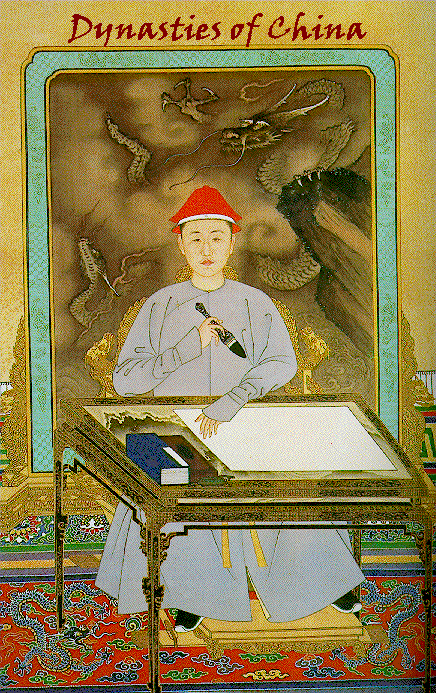 Emperor Kangxi of Qing
Dynasty (1662-1722): Kangxi was the second emperor of the Qing Dynasty. He
ascended to the throne at the age of seven, and ruled for sixty years. The portrait shows
the young emperor Kangxi, sitting at his writing table and holding a thick writing brush.
On the marble top of the table there are paper, ink, brush and inkstone, the "Four
Treasures of the Study"; they are the tools of the scholars.
Emperor Kangxi of Qing
Dynasty (1662-1722): Kangxi was the second emperor of the Qing Dynasty. He
ascended to the throne at the age of seven, and ruled for sixty years. The portrait shows
the young emperor Kangxi, sitting at his writing table and holding a thick writing brush.
On the marble top of the table there are paper, ink, brush and inkstone, the "Four
Treasures of the Study"; they are the tools of the scholars.

 � Chinese Dynasties