
|
|
|
� �
and instantly be in touch with me if I am online! � � the author is a member of
� |
Arts and Paintings
History of Chinese Paintings Sculpture is represented by the life-size terra-cotta soldiers and horses in the tomb of Qin Shi Huang, the first emperor of the Qin Dynasty, and the stone figures lining the approach to the tomb of General Huo Qubing. Both sets of sculptures are extremely lifelike, and each figure is a distinct creation. Religious art thrived as never before during the Wei, Jin and Northern and Southern Dynasties, from 220 to 581. The spread of Buddhism in this period led to the practice of filing cliff grottoes with sculptures and murals of Buddhist images. The most famous of these, known the world over, are the Kizil Grottoes in Xinjiang, the Mogao Grottoes at Dunhuang, Gansu, the Yungang Grottoes at Datong, Shanxi, and the Longmen Grottoes at Luoyang, Henan. Construction of the grottoes at Dunhuang began in 366 and continued for more than a thousand years. Today 492 caves are still in a fairly good state of preservation and contain 2,500 painted clay sculptures and 45,000 square metres of murals. The most famous of the many noted painters at that time was Gu Kaizhi (c.345-406). Chinese art reached a new height during the period covered by the Sui and Tang
dynasties, the Five Dynasties and the Song Dynasty (581-1279), when the main schools that
still dominate traditional Chinese painting were formed. China's earliest - known
landscape scroll, The Spring Outing by Zhan Ziqian, dates from the Sui Dynasty. Many
famous painters emerged during the Tang Dynasty, such as Yan Liben, Yuchi Yizeng, Li
Sixun, Wu Daozi and Wang Wei. Grotto sculpture continued to flourish, developing a distinctively Chinese style as it
matured. Important examples of funerary statuary are the stone figures leading up to the
Qianling (the tomb of the Tang Emperor Gaozong and Empress Wu in Qianxian, Shaanxi), the
six horses in bold relief in the Zhaoling, the tomb of the Tang Emperor Taizong (in
Liquan, Shaanxi), and the stone sculptures at the seven imperial tombs of the Northern
Song Dynasty at Gongxian County, Henan. Woodblock printing, first used for printing Buddhist scriptures in the Sui and Tang dynasties, flourished as an art form in the Ming and Qing dynasties. Illustrations for novels, opera scripts and tales of the marvelous, New Year pictures by folk artists and albums by professional artists were all printed from skillfully carved woodblocks. A further and distinctly Chinese development was ink-wash wood-block printing in several colours. Among the most famous early examples of illustrations made by this method is the Ming Notepaper from the Ten Bamboo Studio and the Qing Mustard Seed Garden Album.
Five Dynasties (910-980A.D.) : ��� 1) Night Party by Gu HongZhong Song and South Song Dynasties : ��� 1) Painting of A Scholar ��� 2) by Liang Kai Yuan Dynasty : ��� 1) Poetry Contest Ming Dynasty (1368-1644A.D.) : ��� 1) Plants: 1by ChenChun, 2by Wen Zhengming, ��� 2) Landscapes: 1by ChouYing, 2by Tung Chi-Chang, 3by TangYin ��� 3) People: 1by TangYin, 2byWang Cheng-Ming ��� 4)Animals: 1byHanKan Ching Dynasty : ��� 1) Landscape: 1, ��� 2) Collections by Pa-ta Shan-jen: Scatch from Life, Landscape-Ink, Flower, Rock, and Two Fish. ��� 3) Collections by PuRu 20th Century : ��� 1) Collections by Chang Dai-Chien ��� 2) Collections by Qi BaiShi ��� 3) Collections by Xu Beihong
2) Terra Cot 3) Imperial Tombs of China
It features 250 magnificent artifacts which
Links to Museums and Galleries |
) E-mail Me:
E-mail Me: 
)
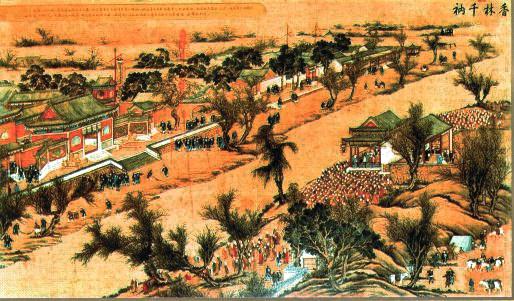

 Paintings by dynasties� (collected from other
sites)
Paintings by dynasties� (collected from other
sites) Pictures Album (collected from other sites)


