
|
|
|
and instantly be in touch with me if I am online!
the author is a member of
|
Xia was the first pre-historic dynasty that at first it was thought as myth. Xia
descended from a wide-spread Yellow River Valley. In 1928 scientific excavations were made
at early bronze-age sites at Anyang, Henan Province. Especially in 1960's and 1970's,
archeologists had uncovered urban sites, bronze implements, and tombs that pointed to the
existence of Xia civilization in the same locations cited in ancient Chinese historical
texts. Longshan culture, a late Neolithic culture, was famous for their
black-lacquered pottery. There were no know example of Xia-era writing, but they most
certainly had a writing system that was a precursor of the Shang dynasty's "oracle
bones". Xia period marked the end of the late Neolithic and the beginning of the
typical Chinese civilization of Shang Dynasty. The Shang dynasty flourished on the banks of Yellow River around 1700 B.C. and ended around 1027 B.C. Thousands of archeological records were found in Huang He, Henan Valley. The Shang civilization was based on agriculture and augmented by hunting and animal husbandry. Shang was the most advance bronze working civilization in the world. There were a number of ceremonial bronze vessels with inscription dated from the Shang period. The dynasty had the earliest and the most complete form of Chinese writing, as revealed in archaic inscriptions found on tortoise shells and flat cattle bones (commonly called oracle bones). The people believed in human sacrifice. Along with valuable articles that were found in royal tombs, the archeologists also found hundreds of slave bodies who were believed to be buried alive with the royal corpses. Human were also scarified during other religious and ceremonial rituals. Shang troops fought frequent wars with neighboring settlements and normandic tribes. The capitals, one of which was in the modern days of Anyang, were the centers of glittering life. Court rituals to propitiate spirits and to honor sacred ancestors were highly developed. In addition to the secular position, the king was also the head of the ancestor spirit-worship cult. A line of hereditary Shang kings ruled over much of northern China. Instead of a patrilineal succession system where the king's power was passed from the father to the son, the Shang kingship was passed from the older brother to the younger brother. If there were no brothers left, the kingship was then passed to the oldest maternal nephew.
The Spring and Autumn Period, though marked with disunity and civil strife, witnessed an unprecedented era of cultural prosperity -- the golden age of China. The atmosphere of reforming and new ideas were attributed to the struggle for survival among warring regional lords who completed for strong and loyal armies and increasing economic production to ensure a richer bases for tax collection. To affect these economic, cultural, and military developments, the regional lords started to recruit elite, skilled, literate officials base on merits. Also during this time, commerce was stimulated through the introduction of coinage and technological improvements. Iron came into general use, making possible of weapon production and agricultural tool production. Public works were started on a grand scale -- such as flood control, irrigation projects and canal digging. Enormous wall were built around cities and along the broad stretches of the northern frontier. Many philosophies were developed during the late Spring Autumn period and the early Warring state period that it is known as Hundred Schools of Thoughts. Author of the Tao Te Ching and founder of Taoism. The focus of Taoism was the individual in nature rather than the individual in society. Literally translated "the way", Taoism was full of seemingly cryptic and paradoxical meanings. It hold that the goal of life was to find your own rhythmic pattern to fit into the nature's way. A classic Taoism story: a man fell asleep and dreamt that he was a butterfly. He woke up afterwards and wondering whether he was a man or actually a butterfly dreaming to be a man. In many ways Taoism opposed the rigid Confucius moralism, but it served many of its adherents as a complement to people's daily order of life. This movement had laid the foundation of which Buddhism and Confucianism built on. Author of The Analects. He taught the importance of centralized authority and filial piety. Like Aristotle, he believed that the state was a natural institution. The functions of government and social stratification were facts of life to be sustained by ethical culture. Moral men made good leader, and one of the most important characteristics of officials was to have virtue. Such virtue can be obtained by following a proper way of behaving. Confucius also codified the status of the ruler in Chinese political thought -- the emperor was the son of heaven and he had the divine right (or mandate) to rule. Strong regional states had grown into major territorial powers. The goal among the rulers was to acquiring military powers and wealth. War was perpetuated because each ruler wanted to be the great leader behind the unification of states. Despite the turmoil of the period, it was the time when ideas were able to exchange via accessible roads. Large areas were newly brought under cultivation with the development of water control and irrigation projects. "The Hundred Schools of Thoughts" continued to flourish. Notable inventions at the time were iron casting and multiplication tables. The school of ying-yang and five elements were developed during this period. It attempted to explain the universe in basic forces of nature, the complements of ying (dark, cold, female, negative) and yang (light, hot, make, positive) and the five elements (water, fire, wood, metal, and earth). In later periods these theories continued to play important role in philosophy and popular belief. Founder of Mohism, a philosopher, he believed that all men were created equal before God and that mankind should follow heaven by practicing universal love. Advocating that all actions must be utilitarian, Mo-Tse condemned the Confucius emphasis on ritual and music. Warfare was regarded as wasteful and pacifism was advocated. He also believed that unity of thoughts and actions were necessary to achieve goals. People should obey their leaders and the leaders should follow the will of the heaven. Although Mohism failed to establish itself as major school of thought, its views were said to be strongly echoed in Legalist thoughts. He was a Confucian disciple who made major contributions to the humanism of Confucius thought. Like Confucius, he declared that all men were by nature, good. He expostulated the idea that a ruler could not govern without people's consent and that the penalty for unpopular, despotic rule was the loss of the "mandate of heaven". The effect of the combined works of Confucius who was the codifer and interpreter of a system of relationships based on ethical behavior, and Mencius who was the synthesizer and developer of applied Confucian thought, was to provide traditional Chinese society with a comprehensive framework on which to order virtually every aspect of life. Founder of Legalism, he was Confucius's disciples. He believed that man was innately selfish and evil, and that goodness was attainable only through education and conduct befitting one's status (this is more than 2000 years before Adam Smith argued that self-interest is what makes market work and therefore is good). He argued that the best government was one based on authoritarian control, not ethical or moral persuasion. Legalism advocated techniques such as maintaining an active secret police, encourage neighbor to inform on each other, and the creation of a general atmosphere of fear. Later rulers such as Hitler, Stalin, and Mao all employed such tactics. Xun-tse's unsentimental and authoritarian inclinations were developed into the doctrine embodied in the School of Law (or fa) or Legalism. The doctrine was formulated by Hen Fei Zi and Li Si. , who maintained that human nature was incorrigibly selfish and therefore the only way to pressure social order was by imposing disciplines from above and to enforce law very strictly.
The collapsed of the Han dynasty was followed by nearly four centuries of rule by warlords. The age of civil wars and disunity began with the era of the Three Kingdoms (Wei, Shu and Wu which had overlapping reigns during the period A.D. 220-280). Unity was restored briefly in the early years of the Jin dynasty (A.D. 265-420), but Jin could not contain the invasions of the nomadic peoples. In A.D. 317, the Jin court was forced to flee from Luoyang and re-established itself at Nanking to the south. The transfer of the capital coincided with China's political fragmentation into a succession of dynasties that was to last from A.D. 304-589. During this period the process of sinicization accelerated among the non-Chinese arrivals in the north and among the aboriginal tribesmen in the south. This process was also accompanied by the increasing popularity of Buddhism (introduced into China in the first century A.D.) which started in India around 6th century B.C., in both north and south China. For various political and social reasons, Buddhism emerged to be a major cultural force in China. Despite the political disunity of the times, there were notable technological advances. The inventions of gunpowder (at that time for use only in fireworks) and the wheelbarrow were believed to date from the sixth or seventh century. Advances in medicine, astronomy, and cartography were also noted by historians. China was reunified in A.D. 581 by the short-lived Sui dynasty, which had often been compared to the earlier Qin dynasty in tenure and the ruthlessness of its accomplishments. The Sui dynasty's early demise was attributed to the government's tyrannical demands on the people, who bore the crushing burden of taxes and compulsory labor. These resources were overstrained in the completion of the Grand Canal -- a monumental engineering feat -- and in the undertaking of other construction projects, including the reconstruction of the Great Wall. Weakened by costly and disastrous military campaigns against Korea in the early seventh century, the dynasty disintegrated through a combination of popular revolts, disloyalty, and assassination.
Song Neo-Confucian philosophers who found a certain purity in the originality of the ancient classical texts, wrote commentaries on them. The most influential of these philosophers was Zhu Xi, whose synthesis of Confucian thought and Buddhist, Taoist, and other ideas became the official imperial ideology from late Song times to the late nineteenth century. As incorporated into the examination system, Zhu Xi's philosophy evolved into a rigid official creed, which stressed the one-sided obligations of obedience and compliance of subject to ruler, child to father, wife to husband, and younger brother to elder brother. The effect was to inhibit the societal development of pre-modern China, resulting both in many generations of political, social, and spiritual stability and in a slowness of cultural and institutional chang up to the19th century. By the mid-thirteenth century, the Mongols had subjugated north China, Korea, and the Muslim kingdoms of Central Asia and had twice penetrated Europe. With the resources of his vast empire, Kublai Khan, a grandson of Genghis Khan and the supreme leader of all Mongol tribes began his drive against the Southern Song. Even before the extinction of the Song dynasty, Kublai Khan had established the first alien dynasty to rule all China -- the Yuan. While the Mongols did use the existing governmental structures for the duration, the language they used was Mongolian, and many of the officials they used were non-Chinese. Mongols, Uighurs from central Asia, some Arabs and even an Italian named Marco Polo all served as officials for the Mongol government. The Chinese were discriminated against both socially and politically. They were more often employed in non-Chinese regions of the empire. A rich cultural diversity developed during the Yuan dynasty. The major cultural achievements were the development of drama and novel, and the increased use of the written vernacular. The Mongols' extensive West Asian and European contacts produced a fair amount of cultural exchange. Western musical instruments were introduced to enrich the Chinese performing arts. Beijing Opera was invented during this time. From this period dated the conversion to Islam, by Muslims of Central Asia (growing numbers of Chinese in the northwest and southwest). Nestorianism and Roman Catholicism also enjoyed a period of toleration. Lamaism (Tibetan Buddhism) flourished, although native Taoism endured Mongol persecutions. Confucian governmental practices and examinations based on the Classics, which had fallen into disuse in north China during the period of disunity, were reinstated by the Mongols in the hope of maintaining order over the Chinese society. Advances were realized in the fields of travel literature, cartography and geography, and scientific education. Certain key Chinese innovations, such as printing techniques, porcelain production, playing cards, and medical literature, were introduced in Europe, while the production of thin glass and cloisonn� became popular in China. The first records of travel by Westerners date from this time. The most famous traveler of the period was the Venetian Marco Polo, whose account of his trip to "Cambaluc," the Great Khan's capital (now Beijing), and of life there astounded the people of Europe. The Mongols undertook extensive public works. Roads and water communications were re-organized and improved. To provide against possible famines, granaries were ordered built throughout the empire. The city of Beijing was rebuilt with new palace grounds that included artificial lakes, hills, and mountains, and parks. During the Yuan period, Beijing became the terminus of the Grand Canal, which was completely renovated. These commercially oriented improvements encouraged overland as well as maritime commerce throughout Asia and facilitated the first direct assistance in such areas as hydraulic engineering, while bringing back to the Middle Kingdom new scientific discoveries and architectural innovations. Contacts with the West also brought the introduction to China of a major new food crop -- sorghum -- along with other foreign food products and methods of preparation.
During the 18th century, the market in Europe and America for tea, expanded greatly. Additionally, there was a continuing demand for Chinese silk and porcelain. But China wanted little that the West had to offer, causing the Westerners, mostly British, to incur an unfavorable balance of trade. To remedy the situation, the foreigners developed a third-party trade, exchanging their merchandise in India and Southeast Asia for raw materials and semiprocessed goods, which found a ready market in Guangzhou. By the early 19th century, raw cotton and opium from India had become the staple British imports into China, in spite of the fact that opium was prohibited entry by imperial decree. The opium traffic was made possible through the connivance of profit-seeking merchants and a corrupt bureaucracy. In 1839, the Qing government, after a decade of unsuccessful anti-opium campaigns, adopted drastic prohibitory laws against the opium trade. The emperor dispatched a commissioner, Lin Zexu to Guangzhou to suppress illicit opium traffic. Lin seized illegal stocks of opium owned by Chinese dealers and then detained the entire foreign community and confiscated and destroyed some 20,000 chests of illicit British opium. The British retaliated with a punitive expedition, thus initiating the first Anglo-Chinese war, better known as the Opium War. Unprepared for war and grossly underestimating the capabilities of the enemy, the Chinese were disastrously defeated. The Treaty of Nanking, signed on board a British warship by two Manchu imperial commissioners and the British plenipotentiary, was the first of a series of agreements with Western trading nations later called by the Chinese the "Unequal Treaties". Under the treaty, China ceded Hong Kong to the British; abolished the licensed monopoly system of trade; opened 5 ports to British nationals extraterritoriality, and paid a large indemnity. Britain was to have most-favored-nation treatment -- it would receive whatever trading concessions the Chinese granted other powers then or later. The treaty set the scope and character of an unequal relationship for the ensuing century of what the Chinese called "national humiliations". The treaty was followed by other incursions, wars, and treaties that granted new concessions and added new privileges for the foreigners. A.D. 1851-1864 Taiping Rebellion During the mid 19th century, China's problems were compounded by natural calamities of unprecedented proportions, including droughts, famines, and floods. Government neglect of public works was in part responsible for this and other disasters. The Qing administration, however, did little to relieve the widespread misery caused by them. Economic tensions, military defeats at Western hands, and anti-Manchu sentiments all combined to produce widespread unrest, especially in the south. South China had been the last area to yield to the Qing conquerors and the first to be exposed to Western influence. It provided a likely setting for the largest uprising in modern Chinese history -- the Taiping Rebellion. The rebels were led by Hong Xiuquan, a village teacher and unsuccessful imperial examination candidate. Hong formulated an eclectic ideology combining the ideals of pre-Confucian utopianism with Protestant beliefs. He soon had a following in the thousands who were heavily anti-manchu and anti-establishment. Hong's followers formed a military organization to protect against bandits and recruited troops not only among believers but also from among other armed peasant groups and secret societies. In 1851 Hong Xiuquan and others launched an uprising in Guizhou Province. Hong proclaimed the Heavenly Kingdom of Great Peace (or Paiping Tianguo) with himself as king. The new order was to reconstitute a legendary ancient state in which the peasantry owned and tilled the land in common; slavery, concubinage, arranged marriage, opium smoking, footbinding, judicial torture, and the worship of idols were all to be eliminated. The Taiping tolerance of the esoteric rituals and quasi-religious societies of south China -- themselves a threat to Qing stability -- and their relentless attacks on Confucianism -- still widely accepted as the moral foundation of Chinese behavior -- contributed to the ultimate defeat of the rebellion. Its advocacy of radical social reforms alienated the Chinese scholar-gentry class. The Taiping army, although it had captured Nanking and driven as far north as Tianjin, failed to establish stable base areas. The movement's leaders found themselves in a net of internal feuds, defections, and corruption. Additionally, British and French forces, being more willing to deal with the weak Qing administration than contend with the uncertainties of a taiping regime, came to the assistance of the imperial army. Before the Chinese army succeeded in crushing the revolt, however, 14 years had passed and well over 30 million people were reported killed. To defeat the rebellion, the Qing court needed, besides Western help, an army stronger and more popular than the demoralized imperial forces. In 1860, scholar-official Zeng Guofan from Hunan Province, was appointed imperial commissioner and governor-general of the Taiping - controlled territories and placed in command of the war against the rebels. Zeng's Hunan army, created and paid for by local taxes, became a powerful new fighting force under the command of eminent scholar-generals. Zeng's success gave new power to an emerging Chinese elite and eroded Qing authority. Simultaneous uprisings in north China (the Nian Rebellion) and southwest China (the Muslim Rebellion) further demonstrated Qing weakness. World War I broke out soon after the fall of Qing empire. In the early 1920's Dr. Sun Yatsen, as the leader of the Nationalist Party, accepted Soviet aid. With the Communist help, Sun Yatsen was able to forge an alliance with the fledgling Chinese Communist party (CCP), and started the task of re-unifying a China beset with warlords. Chiang Kaishek took over the party when Sun died of cancer in 1925. After Chiang took over the KMT, he launched his famous "Northern Expedition" -- all the way from Guangzhou to Shanghai. This unified Southern China and allowed the Nationalist control the Lower Yangzi. Once they got to Shanghai, Chiang, who had never liked the Communists to beginning with, launched a massacre of CCP members. Among those who managed to escape the carnage was a young communist named Mao Zedong. The Communists were forced to abandon their urban bases and fled to the countryside. While in Yan'an, on the periphery of Nationalist power, Mao consolidated his position as the sole leader of the Revolution. On the other side of the country, the Japanese were busy occupying Manchuria. This proved helpful for the Communists -- the troops sent by Jiang to the North to contain and eventually eliminate the CCP much preferred to spend their time fighting the Japanese. In late 1936, Jiang's own generals kidnapped him and held him captive until he agreed to fight the Japanese before fighting the Communists. In 1937, the Japanese invaded China proper from their bases in Manchuria. By the end of the Japanese invasion in 1945, 20 million Chinese had died at the hands of the Japanese. The Nationalist Government fled up the Yangzi to Chongqing from Nanking. In 1939, World War II started. This initially had little effect on the situation in China. However, after the attack on Pearl Harbor in 1941, the main thrust of the Japanese war effort turned away from fighting the Chinese and towards fighting the Americans. After the U.S. entered the war, the Communists started to consolidate their control over North China in preparation for the resumption of the civil war that would occur after the Japanese had been defeated. The nationalists, in contrast to the Communists, were disorganized, corrupt, problems that would only intensify after the war. Moreover, their attempts to fight the Japanese were ineffective. At the end of World War II, the war between the Nationalists and the Communists started up again. The Communists were hampered by the fact that the Japanese were under orders to surrender only to the nationalists, not the Communists. By early 1949, the Nationalists were hamstrung by intractable corruption and huge debts; they paid off their debts by printing more money, which only lead to hyper - inflation. By October of 1949, Mao Zedong proclaimed the creation of the People's Republic of China (communist regime), and Chiang Kaishek and other Nationalists fled to Taiwan to establish the Republic of China.
|







 E-mail Me:

 History of China

 Shang Dynasty
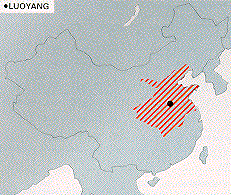 The last Shang ruler, Chou Hsin was overthrown by Wu-Wang, a chieftain of a
frontier tribe called Zhou. The Zhou dynasty settled in the Wei Valley in modern
Shuanxi Province. It had its capital at Hao, near the city of Xi'an or Chang'an as it was
known in its heyday in the imperial period. Sharing the language and cultures of Shang
dynasty, the Zhou rulers through conquest and colonization gradually extended Shang
culture through much of China Proper North of the Chang Jiang (or Yangtze River). The Zhou
dynasty lasted longer than any other, from 1027 to 221 B.C. The Zhou did not actually rule
all of China. China was made up of a number of quasi-independent tribes. Zhou was the most
powerful tribes of all and it played the role of hegemon in the area. Zhou was located in
the middle of the tribes, giving rise to what the Chinese called their country - Middle
Kingdom. Later, numerous Chinese philosophers had attributed Middle Kingdom as the ideal
state between Heaven and Underworld. The early Zhou system was proto-feudal, in which the
effective control depends more on familial ties than on feudal legal bonds. The Zhou
amalgam of city-states became progressively centralized and established increasingly
impersonal political and economic institutions. These developments, which probably
occurred in the latter Zhou period, were manifested in greater central control over local
governments and a more routinized agricultural taxation. In 771 B.C., the Zhou faced
difficulty when its leader King Yu, alienated the noble class who refused to answer his
call when the barbarian attacked. The king was killed and the noble install a new king.
The capital was moved eastward to Luoyang in present day Henan province. The Zhou era was
hence divided into Western Zhou (1027-771 B.C.) and Eastern Zhou (770-221 B.C.) With royal
line broken, the power of Zhou diminished. Eastern Zhou divided into 2 sub-periods -- the
Spring and Autumn Period (770-476) and the Warring States period (476-221).
The last Shang ruler, Chou Hsin was overthrown by Wu-Wang, a chieftain of a
frontier tribe called Zhou. The Zhou dynasty settled in the Wei Valley in modern
Shuanxi Province. It had its capital at Hao, near the city of Xi'an or Chang'an as it was
known in its heyday in the imperial period. Sharing the language and cultures of Shang
dynasty, the Zhou rulers through conquest and colonization gradually extended Shang
culture through much of China Proper North of the Chang Jiang (or Yangtze River). The Zhou
dynasty lasted longer than any other, from 1027 to 221 B.C. The Zhou did not actually rule
all of China. China was made up of a number of quasi-independent tribes. Zhou was the most
powerful tribes of all and it played the role of hegemon in the area. Zhou was located in
the middle of the tribes, giving rise to what the Chinese called their country - Middle
Kingdom. Later, numerous Chinese philosophers had attributed Middle Kingdom as the ideal
state between Heaven and Underworld. The early Zhou system was proto-feudal, in which the
effective control depends more on familial ties than on feudal legal bonds. The Zhou
amalgam of city-states became progressively centralized and established increasingly
impersonal political and economic institutions. These developments, which probably
occurred in the latter Zhou period, were manifested in greater central control over local
governments and a more routinized agricultural taxation. In 771 B.C., the Zhou faced
difficulty when its leader King Yu, alienated the noble class who refused to answer his
call when the barbarian attacked. The king was killed and the noble install a new king.
The capital was moved eastward to Luoyang in present day Henan province. The Zhou era was
hence divided into Western Zhou (1027-771 B.C.) and Eastern Zhou (770-221 B.C.) With royal
line broken, the power of Zhou diminished. Eastern Zhou divided into 2 sub-periods -- the
Spring and Autumn Period (770-476) and the Warring States period (476-221). 


 Qin Dynasty
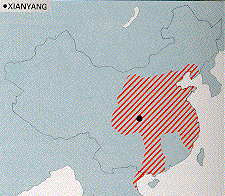 Much
of what came to constitute China proper was unified for the first time in 221 B.C. In that
year the western frontier state of Qin, the most aggressive of the Warring States,
subjugated the last of its rival states. There were 2 major reasons for its victories over
other states. He took the theory of Legalism and put it to practice: persecution of
Confucius scholars to silence criticism of imperial rule, confiscation and incineration of
all their scholarly books, and ruthless treatments to his generals (executed generals for
showing up late for maneuvers -- as it turned out later, this was the downfall of the
emperor). Another reason was that the state of Qin had a great resource of iron. This
proved to be a military advantage because Qin was able to have many more iron weapons than
the other states. Qin aggrandizement was aided by frequent military expeditions pushing
forward the frontiers in the north and south. Once the king of Qin consolidated his power,
he took the title ShiHuangdi (First emperor) a formulation previously reserved for deities
and the mythological sage-emperors, and imposed Qin's centralized, non hereditary
bureaucratic system on his new empire. Centralization, achieved by ruthless methods, was
focused on standardizing legal codes and bureaucratic procedures, the forms of writing and
coinage, and the pattern of thoughts and scholarship. To fend off barbarian intrusion, the
fortification walls built by the various warring states were connected to make a
5000-kilometer long Great Wall. What is commonly referred to as the Great Wall was
actually four great walls rebuilt or extended during the Western Han, Sui, Jin, and Ming
periods, rather than a single, continuous wall. At its extremities, the Great Wall reached
from northeastern Hei long jang Province to northwestern Gansu. A number of public works
projects such as building of grand palaces, roads, waterways were also undertaken to
consolidate and strengthen imperial rule. Enormous levies of man - power and resources
with repressive measures and controls were required to complete those projects. Revolts
broke out as soon as the first Qin emperor died in 210B.C. It was helped in part by a
revolution started by a general who, when faced with execution because he was going to be
late delivering a group of new draftees (it had been very rainy and the roads had turned
to mud), convinced his conscripts to rebel with him (they faced execution as well). And
while they eventually were caught and duly executed, the revolution they started ended up
destroying the old dynasty and set the stage for Han. The Qin dynasty was extinguished
less than 20 years after its triumph. The imperial system initiated during the Qin
dynasty, however, set a pattern that was developed over the next 2 millennia.
Much
of what came to constitute China proper was unified for the first time in 221 B.C. In that
year the western frontier state of Qin, the most aggressive of the Warring States,
subjugated the last of its rival states. There were 2 major reasons for its victories over
other states. He took the theory of Legalism and put it to practice: persecution of
Confucius scholars to silence criticism of imperial rule, confiscation and incineration of
all their scholarly books, and ruthless treatments to his generals (executed generals for
showing up late for maneuvers -- as it turned out later, this was the downfall of the
emperor). Another reason was that the state of Qin had a great resource of iron. This
proved to be a military advantage because Qin was able to have many more iron weapons than
the other states. Qin aggrandizement was aided by frequent military expeditions pushing
forward the frontiers in the north and south. Once the king of Qin consolidated his power,
he took the title ShiHuangdi (First emperor) a formulation previously reserved for deities
and the mythological sage-emperors, and imposed Qin's centralized, non hereditary
bureaucratic system on his new empire. Centralization, achieved by ruthless methods, was
focused on standardizing legal codes and bureaucratic procedures, the forms of writing and
coinage, and the pattern of thoughts and scholarship. To fend off barbarian intrusion, the
fortification walls built by the various warring states were connected to make a
5000-kilometer long Great Wall. What is commonly referred to as the Great Wall was
actually four great walls rebuilt or extended during the Western Han, Sui, Jin, and Ming
periods, rather than a single, continuous wall. At its extremities, the Great Wall reached
from northeastern Hei long jang Province to northwestern Gansu. A number of public works
projects such as building of grand palaces, roads, waterways were also undertaken to
consolidate and strengthen imperial rule. Enormous levies of man - power and resources
with repressive measures and controls were required to complete those projects. Revolts
broke out as soon as the first Qin emperor died in 210B.C. It was helped in part by a
revolution started by a general who, when faced with execution because he was going to be
late delivering a group of new draftees (it had been very rainy and the roads had turned
to mud), convinced his conscripts to rebel with him (they faced execution as well). And
while they eventually were caught and duly executed, the revolution they started ended up
destroying the old dynasty and set the stage for Han. The Qin dynasty was extinguished
less than 20 years after its triumph. The imperial system initiated during the Qin
dynasty, however, set a pattern that was developed over the next 2 millennia. 
 Western Han Dynasty
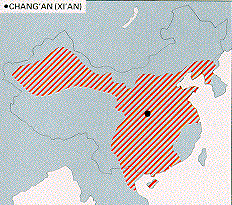 The
Han dynasty, named after the members of the ethnic majority in China. The "people of
Han" was notable also for its military prowess. The empire expanded westward as far
as the rim of the Tarim Basin (in modern Xinjiang-Uyghur Autonomous Region). A relatively
secure caravan traffic was hence possible across Central Asia to Antioch, Baghdad, and
Alexandria. The paths of caravan traffic were often called the "silk route"
because the route was used to export Chinese silk to the Roman Empire. Chinese armies also
invaded and annexed parts of northern Vietnam and northern Korea toward the end of the
second century B.C. Han control of peripheral regions was generally insecure, however. To
ensure peace with non-Chinese local powers, the Han court developed a mutually beneficial
"tributary system". Non-Chinese states were allowed to remain autonomous in
exchange for symbolic acceptance of Han overloardship. Tributary ties were confirmed and
strengthened through both intermarriages at the ruling level and periodic exchanges of
gifts and goods. The Han bureatcratic system was based on Confucian Classics. Confucianism
was reinterpreted and adopted as the official state ideology. The dynasty established a
national university for the training of Confucian officials. Science and technology
flourished during Han era. Paper, compass, and seismograph were invented during this time.
The
Han dynasty, named after the members of the ethnic majority in China. The "people of
Han" was notable also for its military prowess. The empire expanded westward as far
as the rim of the Tarim Basin (in modern Xinjiang-Uyghur Autonomous Region). A relatively
secure caravan traffic was hence possible across Central Asia to Antioch, Baghdad, and
Alexandria. The paths of caravan traffic were often called the "silk route"
because the route was used to export Chinese silk to the Roman Empire. Chinese armies also
invaded and annexed parts of northern Vietnam and northern Korea toward the end of the
second century B.C. Han control of peripheral regions was generally insecure, however. To
ensure peace with non-Chinese local powers, the Han court developed a mutually beneficial
"tributary system". Non-Chinese states were allowed to remain autonomous in
exchange for symbolic acceptance of Han overloardship. Tributary ties were confirmed and
strengthened through both intermarriages at the ruling level and periodic exchanges of
gifts and goods. The Han bureatcratic system was based on Confucian Classics. Confucianism
was reinterpreted and adopted as the official state ideology. The dynasty established a
national university for the training of Confucian officials. Science and technology
flourished during Han era. Paper, compass, and seismograph were invented during this time. Xin Dynasty
 Three Kingdoms
 Sui Dynasty
 Tang Dynasty
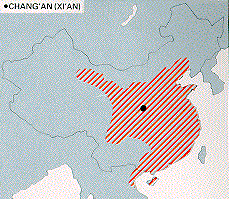 The dynasty with its capital at Chang'an, was regarded by historians as a
high point in Chinese civilization. Its territory, acquired through the military exploits
of its early rulers, was greater than that of the Han. They extended the boundaries of
China through Siberia in the North, Korea in the east, and were in what is now Vietnam in
the South. They even extended a corridor of control along the Silk Road well into
modern-day Afghanistan. Stimulated by contact with India and the Middle East, the empire
saw a flowering of creativity in many fields. Buddhism, originating in India around the
time of Confucius, flourished during the Tang period, becoming thoroughly sinicized and a
permanent part of Chinese traditional culture. Block printing was invented, making the
written words available to vastly greater audiences. The Tang period was the golden age of
literature and art. A government system supported by a large class of Confucian literati
selected through civil service examinations was perfected under Tang rule. This
competitive procedure was designed to draw the best talents into government. By the middle
of the eighth century A.D., Tang power had ebbed. Domestic economic instability and
military defeat in 751 by Arabs at Talas, in Central Asia, marked the beginning of five
centuries of steady military decline for the Chinese empire. The An Lushan Rebellion
marked the beginning of the end for the Tang. It had its roots in the behavior of one of
the great emperors of Chinese history, Xuanzong. Until he fell in love with a young
concubine named Yang Buifei, he had been a great ruler, and had brought the Tang to its
height of prosperity and grandeur. He was so infatuated with Yang that the administration
of the government soon fell into decay, which was not made any better by the fact that
Yang took advantage of her power to stuff high administrative positions with her corrupt
people. She also took under her wing a general named An Lushan, who quickly accumulated
power. He launched the rebellion from A.D. 755-763. During which time, the emperor was
forced to flee the capital, and on the way, the palace guard, blaming Yang Guifei for all
the problems that had beset the dynasty, strangled her and threw her corpse in a ditch.
Misrule, court intrigues, economic exploitation, and popular rebellions weakened the
empire, making it possible for northern invaders to terminate the dynasty in 907. The next
half-century saw the fragmentation of China into five northern dynasties and ten southern
kingdoms.
The dynasty with its capital at Chang'an, was regarded by historians as a
high point in Chinese civilization. Its territory, acquired through the military exploits
of its early rulers, was greater than that of the Han. They extended the boundaries of
China through Siberia in the North, Korea in the east, and were in what is now Vietnam in
the South. They even extended a corridor of control along the Silk Road well into
modern-day Afghanistan. Stimulated by contact with India and the Middle East, the empire
saw a flowering of creativity in many fields. Buddhism, originating in India around the
time of Confucius, flourished during the Tang period, becoming thoroughly sinicized and a
permanent part of Chinese traditional culture. Block printing was invented, making the
written words available to vastly greater audiences. The Tang period was the golden age of
literature and art. A government system supported by a large class of Confucian literati
selected through civil service examinations was perfected under Tang rule. This
competitive procedure was designed to draw the best talents into government. By the middle
of the eighth century A.D., Tang power had ebbed. Domestic economic instability and
military defeat in 751 by Arabs at Talas, in Central Asia, marked the beginning of five
centuries of steady military decline for the Chinese empire. The An Lushan Rebellion
marked the beginning of the end for the Tang. It had its roots in the behavior of one of
the great emperors of Chinese history, Xuanzong. Until he fell in love with a young
concubine named Yang Buifei, he had been a great ruler, and had brought the Tang to its
height of prosperity and grandeur. He was so infatuated with Yang that the administration
of the government soon fell into decay, which was not made any better by the fact that
Yang took advantage of her power to stuff high administrative positions with her corrupt
people. She also took under her wing a general named An Lushan, who quickly accumulated
power. He launched the rebellion from A.D. 755-763. During which time, the emperor was
forced to flee the capital, and on the way, the palace guard, blaming Yang Guifei for all
the problems that had beset the dynasty, strangled her and threw her corpse in a ditch.
Misrule, court intrigues, economic exploitation, and popular rebellions weakened the
empire, making it possible for northern invaders to terminate the dynasty in 907. The next
half-century saw the fragmentation of China into five northern dynasties and ten southern
kingdoms. Song Dynasty
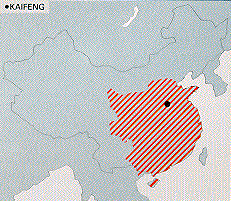 Fifty years after the official end of Tang, an imperial army re-unified China
and established the Song dynasty. The Song period divided into two phases: Northern Song
and Southern Song. The division was caused by the forced abandonment of north China in
1127 by the Song court, which could not push back the nomadic invaders. The founders of
the Song dynasty built an effective centralized bureaucracy staffed with civilian
scholar-officials. Regional military governors and their supporters were replaced by
centrally appointed officials. This system of civilian rule led to a greater concentration
of power in the emperor and his palace bureaucracy than had been achieved in the previous
dynasties. The Song dynasty was notable for the development of cities not only for
administrative purposes but also as centers of trade, industry, and maritime commerce. The
landed scholar-officials, sometimes collectively referred to as gentry, lived in the
provincial centers alongside the shopkeepers, artisans, and merchants. A new group of
wealthy commoners -- the mercantile class -- arose as printing and education spread,
private trade grew, and a market economy began to link the coastal provinces and the
interior. Landholding and government employment were no longer the only means of gaining
wealth and prestige. Agricultural technology advances, aided by the importation of a
fast-growing Vietnamese strain of rice and the invention of the printing press, developed
to the point where the food-supply system became self-sustaining. The efficiency of the
system not only made it economically self-sustaining, but also re-enforced the existing
social structure. Consequently, society and economics were largely static from the Song
until the collapse of the dynastic system in the twentieth century. Culturally, the Song
refined many of the developments of the previous centuries. Included in these refinements
were not only the Tang ideal of the universal man, who combined the qualities of scholar,
poet, painter, and statesman, but also historical writings, painting, calligraphy, and
hard-glazed porcelain. Song intellectuals sought answers to all philosophical and
political questions in the Confucian Classics. This renewed interest in the Confucian
ideals and society of ancient times coincided with the decline of Buddhism, which the
Chinese regarded as foreign and offering few practical guidelines for the solution of
political and other mundane problems.
Fifty years after the official end of Tang, an imperial army re-unified China
and established the Song dynasty. The Song period divided into two phases: Northern Song
and Southern Song. The division was caused by the forced abandonment of north China in
1127 by the Song court, which could not push back the nomadic invaders. The founders of
the Song dynasty built an effective centralized bureaucracy staffed with civilian
scholar-officials. Regional military governors and their supporters were replaced by
centrally appointed officials. This system of civilian rule led to a greater concentration
of power in the emperor and his palace bureaucracy than had been achieved in the previous
dynasties. The Song dynasty was notable for the development of cities not only for
administrative purposes but also as centers of trade, industry, and maritime commerce. The
landed scholar-officials, sometimes collectively referred to as gentry, lived in the
provincial centers alongside the shopkeepers, artisans, and merchants. A new group of
wealthy commoners -- the mercantile class -- arose as printing and education spread,
private trade grew, and a market economy began to link the coastal provinces and the
interior. Landholding and government employment were no longer the only means of gaining
wealth and prestige. Agricultural technology advances, aided by the importation of a
fast-growing Vietnamese strain of rice and the invention of the printing press, developed
to the point where the food-supply system became self-sustaining. The efficiency of the
system not only made it economically self-sustaining, but also re-enforced the existing
social structure. Consequently, society and economics were largely static from the Song
until the collapse of the dynastic system in the twentieth century. Culturally, the Song
refined many of the developments of the previous centuries. Included in these refinements
were not only the Tang ideal of the universal man, who combined the qualities of scholar,
poet, painter, and statesman, but also historical writings, painting, calligraphy, and
hard-glazed porcelain. Song intellectuals sought answers to all philosophical and
political questions in the Confucian Classics. This renewed interest in the Confucian
ideals and society of ancient times coincided with the decline of Buddhism, which the
Chinese regarded as foreign and offering few practical guidelines for the solution of
political and other mundane problems. 
 Ming Dynasty
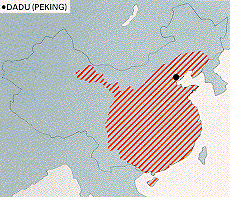 Rivalry among the Mongol imperial heirs, natural disasters, and numerous
peasant uprisings led to the collapse of the Yuan dynasty. The Ming dynasty was founded by
a Han Chinese peasant and former Buddhist monk turned rebel army leader. Having its
capital first at Nanking and later at Beijing, the Ming reached the zenith of power during
the first quarter of the fifteenth century. The Chinese armies reconquered Annam, as
northern Vietnam was then known, in Southeast Asia and kept back the Mongols, while the
Chinese fleet sailed the China seas and the Indian Ocean, cruising as far as the east
coast of Africa. The maritime Asian nations sent envoys with tribute for the Chinese
emperor. Internally, the Grand Canal was expanded to its farthest limits and proved to be
a stimulus to domestic trade. The Ming maritime expeditions stopped rather suddenly after
1433, the date of the last voyage (great expenses, opposition at court were just some of
the many factors). Pressure from the powerful Neo-Confucian bureaucracy led to a revival
of strict agrarian-centered society. The stability of the Ming dynasty, which was without
major disruptions of the population (then around 100 million), economy, arts, society, or
politics, promoted a belief among the Chinese that they had achieved the most satisfactory
civilization on earth and that nothing foreign was needed or welcome. Long wars with the
Mongols, incursions by the Japanese into Korea, and harassment of Chinese coastal cities
by the Japanese in the sixteenth century weakened Ming rule. In 1644 the Manchus took
Beijing from the north and became masters of north China, establishing the last imperial
dynasty, the Qing (1644-1911).
Rivalry among the Mongol imperial heirs, natural disasters, and numerous
peasant uprisings led to the collapse of the Yuan dynasty. The Ming dynasty was founded by
a Han Chinese peasant and former Buddhist monk turned rebel army leader. Having its
capital first at Nanking and later at Beijing, the Ming reached the zenith of power during
the first quarter of the fifteenth century. The Chinese armies reconquered Annam, as
northern Vietnam was then known, in Southeast Asia and kept back the Mongols, while the
Chinese fleet sailed the China seas and the Indian Ocean, cruising as far as the east
coast of Africa. The maritime Asian nations sent envoys with tribute for the Chinese
emperor. Internally, the Grand Canal was expanded to its farthest limits and proved to be
a stimulus to domestic trade. The Ming maritime expeditions stopped rather suddenly after
1433, the date of the last voyage (great expenses, opposition at court were just some of
the many factors). Pressure from the powerful Neo-Confucian bureaucracy led to a revival
of strict agrarian-centered society. The stability of the Ming dynasty, which was without
major disruptions of the population (then around 100 million), economy, arts, society, or
politics, promoted a belief among the Chinese that they had achieved the most satisfactory
civilization on earth and that nothing foreign was needed or welcome. Long wars with the
Mongols, incursions by the Japanese into Korea, and harassment of Chinese coastal cities
by the Japanese in the sixteenth century weakened Ming rule. In 1644 the Manchus took
Beijing from the north and became masters of north China, establishing the last imperial
dynasty, the Qing (1644-1911). Qing Dynasty
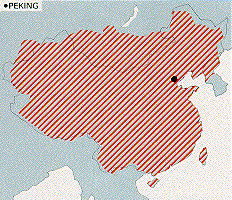 Although the Manchus were not Chinese and were strongly resisted especially
in the south, they had assimilated a great deal of Chinese culture before conquering
China. The Manchus retained many institutions of Ming and earlier Chinese derivation. They
continued the Confucian court practices and temple rituals, over which the emperors had
traditionally presided. Although Chinese were barred from the highest offices, Chinese
officials predominated over Manchu officeholders outside the capital, except in military
positions. The Neo-Confucian philosophy, emphasizing the obedience of subject to ruler,
was enforced as the state creed. The Manchu emperors also supported Chinese literary and
historical projects of enormous scope; the survival of much of China's ancient literature
was attributed to these projects. Ever suspicious of Chinese, the Qing rulers put into
effect measures aimed at preventing the absorption of the manchus into the dominant
Chinese population. In many government positions a system of dual appointments was used --
the Chinese appointee was required to do the substantive work and the Manchu to ensure
Chinese loyalty to Qing rule. The Qing regime was determined to protect itself not only
from internal rebellion but also from foreign invasion. The Qing was the first dynasty to
eliminate successfully all danger to China from across its land borders. Under Manchu rule
the empire grew to include a larger area than before or since. The success of the Qing
dynasty in maintaining the old order proved a liability when the empire was confronted
with growing challenges from seafaring Western powers. The centuries of peace and
self-satisfaction dating back to Ming times had encouraged little change in the attitudes
of the ruling elite. The imperial Neo-Confucian scholars accepted as asiomatic the
cultural superiority of Chinese civilization and the position of the empire at the hub of
their perceived world. To question this assumption, to suggest innovation, or to promote
the adoption of foreign ideas was viewed as tantamount to heresy. Imperial purges dealt
severely with those who deviated from orthodoxy. By the nineteenth century, China was
experiencing growing internal pressures of economic origin. There were over 300 million
Chinese -- a surplus of labor and the scarcity of land. They led to widespread rural
discontent and a breakdown in law and order. Localized revolts erupted in various parts of
the empire in the early 19th century. Secret societies, such as the White Lotus sect in
the north and the Triad Society in the south, gained ground, combining anti-Manchu
subversion with banditry. The weakening through corruption of the bureaucratic and
military systems and mounting urban pauperism also contributed to these disturbances. The
Qing empire, the last of Chinese empire, finally collapsed in 1911 and the entire China
was in chaos once again.
Although the Manchus were not Chinese and were strongly resisted especially
in the south, they had assimilated a great deal of Chinese culture before conquering
China. The Manchus retained many institutions of Ming and earlier Chinese derivation. They
continued the Confucian court practices and temple rituals, over which the emperors had
traditionally presided. Although Chinese were barred from the highest offices, Chinese
officials predominated over Manchu officeholders outside the capital, except in military
positions. The Neo-Confucian philosophy, emphasizing the obedience of subject to ruler,
was enforced as the state creed. The Manchu emperors also supported Chinese literary and
historical projects of enormous scope; the survival of much of China's ancient literature
was attributed to these projects. Ever suspicious of Chinese, the Qing rulers put into
effect measures aimed at preventing the absorption of the manchus into the dominant
Chinese population. In many government positions a system of dual appointments was used --
the Chinese appointee was required to do the substantive work and the Manchu to ensure
Chinese loyalty to Qing rule. The Qing regime was determined to protect itself not only
from internal rebellion but also from foreign invasion. The Qing was the first dynasty to
eliminate successfully all danger to China from across its land borders. Under Manchu rule
the empire grew to include a larger area than before or since. The success of the Qing
dynasty in maintaining the old order proved a liability when the empire was confronted
with growing challenges from seafaring Western powers. The centuries of peace and
self-satisfaction dating back to Ming times had encouraged little change in the attitudes
of the ruling elite. The imperial Neo-Confucian scholars accepted as asiomatic the
cultural superiority of Chinese civilization and the position of the empire at the hub of
their perceived world. To question this assumption, to suggest innovation, or to promote
the adoption of foreign ideas was viewed as tantamount to heresy. Imperial purges dealt
severely with those who deviated from orthodoxy. By the nineteenth century, China was
experiencing growing internal pressures of economic origin. There were over 300 million
Chinese -- a surplus of labor and the scarcity of land. They led to widespread rural
discontent and a breakdown in law and order. Localized revolts erupted in various parts of
the empire in the early 19th century. Secret societies, such as the White Lotus sect in
the north and the Triad Society in the south, gained ground, combining anti-Manchu
subversion with banditry. The weakening through corruption of the bureaucratic and
military systems and mounting urban pauperism also contributed to these disturbances. The
Qing empire, the last of Chinese empire, finally collapsed in 1911 and the entire China
was in chaos once again.  Republic of China