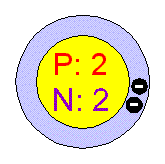
Janssen was the first to see Helium in 1868 when he saw a new line in the solar spectrum. Lockyer and Frankland thought it would be nice to name the new element helium. In 1895 Sir William Ramsay in Scotland discovered helium in clevit.
The cost of helium fell from $2500/ft^3 in 1915 to 1.5cents/ft^3 in 1940. The United States Bureau of Mines have set the price of grade A helium at $37.50/1000ft^3.
Helium has the lowest melting point of any element and is vital to the study of superconductivity. Helium is the olny liquid that can not be solidified by lowering the temperature. It remains a liquid down to absolute zero at ordinary pressures but it can be solidified by increasing the pressure. Helium forms no compounds. Helium is a colorless, odorless gas that is totally inreactive. It is extracted from natural gas wells, some of which contain gas that is 7% helium. It is used in deep sea diving for balloons and, as liquid helium, for low temperature research. The earth's atmosphere contains 5 parts per million by volume, totalling 400 million tonnes, but it is not worth extracting it from this source at present. |