 |
| Basic Information: Symbol: Ar Atomic Number: 18 Atomic Mass: 39.948 Melting Point: -189.3 degrees Celcius Boiling Point: -186 degrees Celcius Number of Protons or Electrons: 18 Number of Nuetrons: 22 Classification: Noble Gas Crystal Structure: Cubic Density @ 293 K: 1.784g/cm cubed Color: colorless |
|
|
|
|
 |
|
|
|
|
| Isotope |
| Half Life |
| AR-37 |
| AR-36 |
| AR-38 |
| AR-39 |
| AR-40 |
| AR-41 |
|
| Stable |
| Stable |
| Stable |
| 35 days |
| 269 years |
| 1.8 hours |
| Facts: Date of Discovery: 1894 Discoverer: Sir William Ramsey Name Origin: From the Greek Word argon Uses: Lighting Obtained From: air |
| Recent News: On August 23, 2000 at 2:27 p.m. EDT scientists finally caoxed Argon into joining with other atoms to form a compound. This leaves only two of the six that are still not compounds. The reason noble gases are so hard to make compunds is because the outer shell of electrons surrounding their nuclei is arranged in a highly stable form. The argon compound can only exist at low temperatures. To create the compound they sprayed argon mixed with a small amount of hydrogen onto a supercooled surface. Then they put ultraviolet light onto the mixture. This broke the bond between the two atoms causing them to attach to each other. |
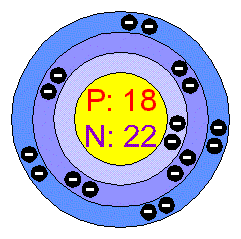 |
| The argon atom has three energy levels. The first has two electrons, the second has eight electrons, and the third also has eight electrons. |
| Argon is the third most abundant gas making up one percent of the atmosphere. The quantity has increased since the Earth was formed because radioactive potassium turns into argon as it decays. Argon is a colorless, odorless gas that is totally inert to other substances, and for this reason it is ideal in tube lights. Argon is two and a half times as soluable in water as nitrogen, having about the same solubility as oxygen. Argon is used in electric light bulbs and in flourescent tubes at a pressure of about 400 pa. and in filling photo tubes. Argon is also used as an inert gas shield for arc welding and cutting, as blanket for the production of titanium and other reactive elements, and as a protective atmosphere for growing silicon and germanium crystals. |
 |
 |
|
|
|
|
|
 |