Global Warming
Last Update: 12/02/2001

Global Warming
|
|
|
GREENHOUSE
GASES
Since
the beginning of the industrial revolution, atmospheric concentrations of carbon
dioxide have increased nearly 40%, methane concentrations have more than
doubled, and nitrous oxide concentrations have risen about 15%.4
These increases have enhanced the heat-trapping capability of the
earth’s atmosphere causing the greenhouse effect. Scientists
generally believe that the combustion of fossil fuels and other human activities
such as deforestation are the primary reason for the increased concentration of
carbon dioxide in the atmosphere. Since
fossil fuels provide most of the energy used by humans, everything from our
factories to our cars to our refrigerators directly cause the release of some
carbon dioxide. From this
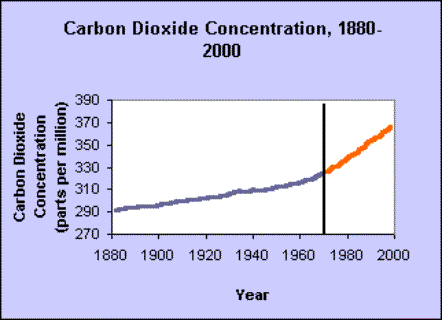
graph2, one can see that the concentration of carbon dioxide has
increased greatly after the industrial revolution.
Living
forests and soil, absorb and store large amounts of carbon dioxide.
Deforestation alters the carbon cycle be eliminating trees and disturbing
soil. This carbon cycle involves
not only forests and soil, but also oceans and the atmosphere.
They act as either sinks or sources for carbon.
A sink absorbs more carbon than it gives off while a source emits more
carbon than it absorbs. Before the
industrial revolution the amount of carbon moving around was relatively in
balance. However, in the present
day, with the burning of fossil fuels, at least six billion tons of carbon is
introduced to the carbon cycle every year.
Some good examples of this are the Canadian forests, which until the
1980s use to act as a sink for the carbon cycle.
Now, however, through fires, insect infestation and harvesting, they have
become a net source. Modern farming
practices also disrupt the carbon cycle. Soils,
which contain about 75% of carbon found on land are excellent sinks.
Unfortunately, once cultivated the organic matter that soil contains
drops by 20-50%.5 Another
important greenhouse gas which we are adding to in the atmosphere is methane.
Naturally occurring methane emissions come from wetlands where anaerobic
decay of material results in the production and release of methane.
Other natural methane sources include fires and animals.
Human industrialization is responsible for 50% of the methane in our
atmosphere. Methane’s overall contribution to global warming is
significant because it is estimated to be 21 times more effective at trapping
heat in the atmosphere than carbon dioxide.4
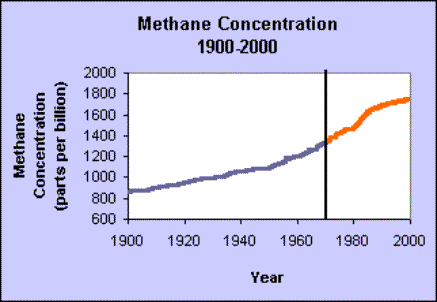
The graph2 shows us the increase in methane concentration over
the past 100 years and it has doubled.
Anthropogenic
sources of methane, which means man-made sources, include rice cultivation,
landfills and the mining, processing and distribution of fossil fuels.6 Nitrous
oxide emissions are primarily due to microbial action in the soils.
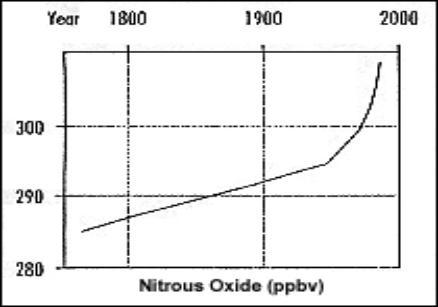
However, as one can see from the graph7, anthropogenic
activities have contributed to a 15% growth in nitrous oxide concentrations in
the atmosphere over the last 200 years.
While
nitrous oxide emissions are much lower than carbon dioxide emissions, nitrous
oxide is approximately 310 times more powerful than carbon dioxide at trapping
heat in the atmosphere.4 Anthropogenic
sources include land clearing, fossil fuel consumption, and fertilizer.6 Man-made gases, such as hydrofluorocarbon, perfluorocarbon and sulphur hexafluoride, each contribute to global warming. The first two were developed as an alternative to CFC’c which were blacklisted internationally in 1987. The hydrofluorocarbon gas has a global warming potential of up to 10 000 times that of carbon dioxide, and its main uses are in refrigeration, cleaning agents and in semi-conductor manufacturing. The perfluorocarbon gas has the same global warming potential, and it is used as a purging agent for semi-conductor manufacture and small amounts are produced during the uranium enrichment processes. Sulphur hexafluoride has a global warming potential of 25 000 times that of carbon dioxide, and it is used as an insulating material for high voltage equipment and also in water leak detection.4
|